
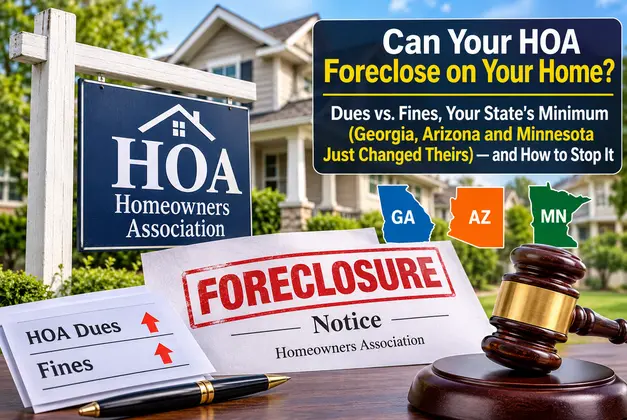
YES: For unpaid dues and assessments — even if your mortgage is current.
OFTEN NOT: For fines alone — California, Texas and (from 2027) Georgia exclude them, and other states limit them.
WATCH OUT: Attorney and collection fees can quickly grow bigger than what you originally owed.
See where you stand in your state →
State laws verified . Georgia and Minnesota changes take effect January 1, 2027.
HOA Foreclosure Risk Checker
This checker compares what you owe with the state rules we verified, flags fines-only and heavy-fee balances, and lists next steps for your stage, so you can see what to ask about before you pay, dispute or call an attorney.
Step 1 of 3: Your state
Step 2 of 3: What you owe
Use your latest statement. Leave a box empty if it is zero.
Step 3 of 3: Where you are
Your result
It appears here. Nothing you enter is saved or sent.
Need to respond now? Copy the payment-plan request letter →
How an HOA Gets a Lien — and Why It Can Foreclose
If your HOA holds a lien for unpaid assessments, created by your community’s governing documents, state law or both, it can generally foreclose that lien and force a sale of your home, even while every mortgage payment you owe your lender is current.
Where the lien comes from
Governing documents. The CC&Rs (declaration) usually make assessments a charge against each home.
State law. Many states also create the lien by statute and set conditions for enforcing it.
A recorded notice may follow, but in some states the lien exists as soon as an assessment is due.
Judicial vs. nonjudicial
Judicial: the HOA sues, and a court orders the sale. You must answer by the deadline.
Nonjudicial: a sale follows required notices, largely outside court. Your state and documents decide.
A typical timeline (it varies)
- 1. Late notice and late charges
- 2. Demand letter, often from a law firm
- 3. Lien recorded
- 4. Lawsuit, or notice of default or sale
- 5. Foreclosure sale
- 6. Surplus claim and any redemption period
Community associations house more than 1 in 3 Americans, over 78 million people (NCSL, July 2026, citing HOA Resources).
An HOA may sue for the money instead. See how small claims court works.
Dues vs. Fines vs. Fees: The Line That Matters
Unpaid dues and special assessments are what usually put a home at risk, while fines are barred or limited as grounds for foreclosure in several states, and attorney and collection fees follow their own rules, so separate every charge on your ledger before judging your risk.
CAN LEAD TO FORECLOSURE Unpaid assessments over your state’s minimum.
USUALLY CAN’T Fines alone, where the law excludes them.
WATCH THE FEES Attorney and collection costs.
| Type | Example | Can it lead to foreclosure? | Where it can’t, or is limited |
|---|---|---|---|
| Regular dues | Monthly or yearly operating charge | Yes, generally, once any state minimum is met | Below a state’s amount or age test (CA, AZ; GA from 2027; MN from 2027) |
| Special assessment | One-time charge for a roof or major repair | Often, like dues | AZ: one of $10,000 or more uses only the 18-month test |
| Fines | Paint color, parking or rental violation | Depends on the state | TX: not if the debt is only fines. CA: no nonjudicial sale for disciplinary fines. GA from 2027: don’t count toward the minimum |
| Late fees, interest, attorney and collection fees | Late charge, demand-letter fee, lien filing cost | May be added to what you owe | CA and GA (from 2027) leave fees out of the minimum. TX: not fees tied only to fines |
California: Civil Code § 5725(b)
A disciplinary fine can’t be treated as a lien enforceable by a nonjudicial foreclosure sale.
Different rule: a charge to repair common-area damage may be lienable if the documents say so (§ 5725(a)).
Texas: Property Code § 209.009
No foreclosure if the debt is solely fines, or attorney fees tied only to fines.
The same bar covers certain records and election-recount charges. Condos fall under a different chapter.
Georgia: from January 1, 2027
Changed in 2026
Fines, fees and specific assessments won’t count toward the new foreclosure minimum under the Property Owners’ Association Act.
Can a fine still become a lien? Sometimes. A lien and the right to foreclose it are separate questions.
How Much You Must Owe in Your State
There is no national minimum: some states require a dollar amount or months of delinquency before an HOA can foreclose, others exclude certain charges, and the table below covers only the rules we verified, so check your own statute if your state is missing.
| State | Minimum before foreclosure | Fines alone? | Source | Effective |
|---|---|---|---|---|
| CaliforniaCiv. Code §§ 5720, 5725. In effect. | $1,800 in assessments (not counting late charges, fees, interest or collection costs), or assessments more than 12 months delinquent | No nonjudicial sale for disciplinary fines | Civ. Code §§ 5720, 5725 | In effect |
| Arizona: planned communityA.R.S. § 33-1807. Since 2025; amended Sept. 12, 2026. | 18 months delinquent or $10,000, whichever comes first. Special assessment of $10,000+: 18 months only | Test is measured in assessments | A.R.S. § 33-1807; Laws 2025, Ch. 71; SB 1246 | Since 2025; special-assessment rule Sept. 12, 2026 |
| Arizona: condoA.R.S. § 33-1256, SB 1246. Sept. 12, 2026. | 18 months delinquent or $10,000, whichever comes first. Special assessment of $10,000+: 18 months only | Test is measured in assessments | A.R.S. § 33-1256; SB 1246 | Sept. 12, 2026 |
| Georgia (from 2027)SB 406; § 44-3-232(c). Jan. 1, 2027. | Lesser of $4,000 or 12 months of regular assessments, but not less than $2,000. Until then: lien of at least $2,000 | From 2027, fines and fees don’t count | SB 406; O.C.G.A. § 44-3-232(c) | Jan. 1, 2027 |
| TexasProp. Code §§ 209.009, 209.0092. In effect. | No dollar minimum listed here. Court order generally required | No, if the debt is solely fines | Prop. Code §§ 209.009, 209.0092 | In effect |
| Minnesota (from 2027)2026 Ch. 82; § 515B.3-116. Jan. 1, 2027. | Assessments and qualifying fines must be more than 3 months overdue | Only qualifying fines are included; fine cap applies | Laws 2026, Ch. 82; § 515B.3-116 | Jan. 1, 2027 |
| Nevada (super-priority example)SFR v. U.S. Bank. Decided 2014; statute later amended. | No minimum listed here. Part of the HOA lien can outrank the first mortgage | Not covered here | SFR v. U.S. Bank, 334 P.3d 408; NRS 116.3116 | Decided 2014; statute amended 2015 |
Your state isn’t listed? Check your state’s HOA or condo statute and your CC&Rs. No listing doesn’t mean no risk.
Meeting a minimum doesn’t make a foreclosure proper. Notices, votes and other steps may also be required.
What Changed in 2026
Georgia passed new fee, payment and foreclosure rules, Arizona raised the condominium foreclosure threshold to match planned communities, and Minnesota capped many fines and tightened foreclosure timing, but these changes start on different dates, and several do not apply until January 1, 2027.
Georgia: SB 406, signed May 12, 2026
Changed in 2026
In force since July 1, 2026 (actions filed on or after that date):
- Before collecting or being awarded attorney fees, written notice by certified mail or statutory overnight delivery identifying what’s owed
- 30 days from receipt to pay
- Itemized attorney fees
- In bench trials, the judge reviews the fees for reasonableness
- Exception for emergencies involving public safety or preserving property
Takes effect January 1, 2027:
- Minimum: lesser of $4,000 or 12 months of regular assessments, never below $2,000
- Fines, fees and specific assessments don’t count toward it
- 60 days (up from 30) to pay after the foreclosure notice
- Payment order: regular dues, special assessments, specific assessments, then other fees and fines
- No refusing a payment of any amount toward an assessment
- Registration with the Secretary of State required to collect fines or fees, record liens or foreclose
- Lien lapses after six years (up from four)
The minimum and lien changes amend the Property Owners’ Association Act. Condo owners: ask which statute applies.
Arizona: SB 1246, effective September 12, 2026
Changed in 2026
Condos: the test rose from one year or $1,200 to 18 months or $10,000, whichever comes first.
Planned communities already had 18 months or $10,000 (Laws 2025, Ch. 71).
Both: a special assessment starting at $10,000 or more uses only the 18-month test.
Minnesota: 2026 Chapter 82, from January 1, 2027
Changed in 2026
Fine cap: $100 for a single violation unless owners holding a majority of votes approve more at a board meeting.
Exceptions: repeat conduct, serious health or safety impact, certain property damage, or financial gain (such as rentals).
Timing: assessments and qualifying fines must be more than three months overdue before foreclosure.
Foreclosures follow Minnesota chapters 580 or 581. The timing rule applies to cases started on or after January 1, 2027.
The Attorney-Fee Trap
Once a delinquent account goes to a collection firm, late charges, attorney fees and filing costs can pile up faster than the dues themselves, turning a few hundred dollars into thousands, so request an itemized ledger early and check how each payment you made was applied.
Worked example (illustrative numbers only)
Dues are $150 a month. The owner pays nothing for six months. Real fees vary.
- Month 1:
Dues owed $150
Fees added $25 (late fee)
Total $175 - Month 2:
Dues owed $300
Fees added $25
Total $350 - Month 3:
Dues owed $450
Fees added $275 (late fee + demand letter)
Total $775 - Month 4:
Dues owed $600
Fees added $375 (late fee + lien filing)
Total $1,300 - Month 5:
Dues owed $750
Fees added $25
Total $1,475 - Month 6:
Dues owed $900
Fees added $925 (late fee + attorney work)
Total $2,550
| Month | Dues owed | Fees added that month | Total |
|---|---|---|---|
| 1 | $150 | $25 (late fee) | $175 |
| 2 | $300 | $25 | $350 |
| 3 | $450 | $275 (late fee + demand letter) | $775 |
| 4 | $600 | $375 (late fee + lien filing) | $1,300 |
| 5 | $750 | $25 | $1,475 |
| 6 | $900 | $925 (late fee + attorney work) | $2,550 |
Result: $900 in dues, $1,650 in fees. Fees are about 65% of the bill.
In California, this example’s $900 and six months would not meet the § 5720 test, despite the $2,550 total.
Payment application order decides what stays unpaid
If a payment goes to fees first, dues stay delinquent. Ask for the order in writing.
California: payments go to assessments first (Civ. Code § 5655).
Arizona planned communities: unpaid assessments first, unless you direct otherwise (§ 33-1807).
Georgia, from January 1, 2027: regular dues first.
Georgia’s fee rules, in force since July 1, 2026
Notice, a 30-day chance to pay and itemized fees come before the association collects or is awarded attorney fees.
See the full Georgia list. Mark the date you receive any certified letter.
Your Mortgage, Your Equity, and the Sale
In most states an HOA foreclosure sale does not wipe out your first mortgage, so the buyer takes the home subject to it, while any money left after the HOA’s debt, costs and junior liens generally belongs to you but usually must be claimed.
Your mortgage servicer
Your servicer may pay late HOA dues to protect its lien, then bill you or add the amount to escrow.
Check your mortgage terms. See why a mortgage payment goes up.
A lender’s foreclosure follows a different clock. Compare how many mortgage payments you can miss.
Super-priority liens
Roughly 20 uniform-act-style states let part of an HOA lien, often 6 or 9 months of dues, outrank the first mortgage.
Nevada: SFR Investments Pool 1 v. U.S. Bank, (2014): properly foreclosing that part extinguishes the first deed of trust.
In 2018 that court held a lender’s proper payment offer preserves the deed of trust. Nevada amended its law in 2015.
Don’t assume your loan debt vanishes if a lien on the house does.
Florida is not a super-lien state. § 720.3085 limits what a foreclosing first mortgagee owes the HOA.
When its conditions are met: the lesser of 12 months of unpaid assessments or 1% of the original mortgage debt.
Surplus funds: your equity
Sale money generally pays the HOA’s debt and costs, then junior liens. Any surplus generally goes to the owner.
A home can sell far below market value, so lost equity may never show up as surplus.
The claim process and deadline depend on your state. Ask the court, trustee or officer who held the sale.
How to Stop an HOA Foreclosure
Act before the sale: get an itemized ledger, dispute wrong charges in writing, propose a payment plan you can keep, use any dispute process your state or documents provide, and speak with a foreclosure or bankruptcy attorney quickly, especially after a lawsuit or sale notice arrives.
1. Check the ledger and dispute in writing
Match each charge to your records and the CC&Rs. Name the charge you dispute and why.
Keep paying current dues. Don’t withhold them as protest; use the ledger, the documents and the law.
2. Use any required dispute process
Your state or documents may offer mediation, a board hearing or internal dispute resolution. Ask in writing, with dates.
Arizona planned communities: before filing, the board must try to reach you and offer a payment plan.
3. Ask for a payment plan
Offer an amount you can sustain on top of current dues. Get the terms in writing.
Payment-Plan & Ledger Request Letter
Copy it, fill in the brackets, and send it in a way you can prove. Keep a copy.
[Date]

To: [HOA name]
Re: Account for [Lot/unit]

I am writing about the balance claimed on this account. Please send me, in writing:

1. An itemized ledger that separates regular dues, special assessments, fines, late fees, interest, and attorney and collection fees.
2. A record of how each of my past payments was applied.
3. A copy of the current collection policy.

I propose a payment plan of [Amount you can pay monthly] per month toward any past-due balance, in addition to current dues. Please confirm in writing that you accept it, and that collection activity will pause while the plan is current.

This letter is not an agreement that every charge is correct. I reserve my right to dispute any charge.

Please reply in writing within 14 days.

Sincerely,
[Signature]
4. Bankruptcy
Filing triggers an automatic stay (11 U.S.C. § 362). Timing matters, and repeat filers can get less protection.
Chapter 13 can spread HOA arrears over a repayment plan, while you keep up new dues.
Chapter 7: dues that come due after filing aren’t discharged while you own the home (§ 523(a)(16)).
Talk to a bankruptcy attorney. Start with hiring a bankruptcy lawyer and the Chapter 7 income limit.
If the Sale Already Happened
A completed sale may not be the end: you may be able to claim surplus money, and some states give a limited period to buy the home back, so find the exact sale and notice dates today and ask an attorney which deadlines are already running.
Redemption periods we verified
California: 90 days after a nonjudicial HOA foreclosure sale (Civ. Code § 5715(b)).
Texas: 180 days after the association mails written notice of the sale (§ 209.011).
Redeeming means paying required amounts in full and on time. Other states: check the statute.
Texas homestead: it didn’t block assessment foreclosure in Inwood North v. Harris (Tex. 1987).
| Question | General rule | Where it differs |
|---|---|---|
| First mortgage | Usually survives an HOA sale | Super-priority states, such as Nevada |
| Surplus | Generally goes to the owner after the HOA, costs and junior liens; usually must be claimed | Process and deadline vary by state |
| Redemption | Exists only where law provides it | CA: 90 days after nonjudicial sale. TX: 180 days after notice of sale is mailed |
| Credit impact | Collections, judgments or a related mortgage default can hurt your ability to borrow | Reporting varies; check all three credit reports |
Be wary of anyone offering to recover surplus for a large cut before you’ve checked the official process.
Don’t move out or sign anything over without advice. Occupancy rules differ from squatters’ rights.
Selling or Refinancing With an HOA Lien
You can often sell a home with an HOA lien if the balance is paid at closing from your proceeds, but a refinance may require clearing it first, and either way you should request a written payoff statement early and check every charge before the closing date.
Payoff at closing: the title or closing agent typically collects the balance and arranges a lien release.
Estoppel letter or resale certificate: the HOA’s written statement of what’s owed. Names, fees and timing vary.
Dispute errors before closing. If the balance exceeds your equity, talk to an attorney first.
A planned sale doesn’t automatically pause foreclosure. Get any pause in writing.
Before You Pay Anything
Before sending a large payment or signing a plan, get the itemized ledger, separate dues from fines and fees, check your state’s minimum, read the community’s documents and collection policy, and keep proof of everything, while watching every deadline printed on the notices you receive.
FAQ
These short answers cover the questions homeowners ask most after a late notice or demand letter, including mortgages, fines, partial payments, redemption and bankruptcy, but they are general information, and your governing documents, state statute and notice dates can change the answer for you.
Can an HOA foreclose if my mortgage is current?
Generally yes, if it has a lien for unpaid assessments and meets state and document requirements.
Can an HOA foreclose on a paid-off house?
Yes, it generally can. With no mortgage, more of your equity is exposed.
How much do I have to owe before they can foreclose?
It depends on your state. See the state table; some have no minimum listed there.
Can an HOA foreclose for fines?
Sometimes. Texas says no for fines alone. California bars nonjudicial sale for them. Georgia changes in 2027.
Can an HOA foreclose for attorney fees alone?
It depends. Texas bars fees tied only to fines. California and Georgia (from 2027) leave fees out of the minimum.
What changed in Georgia in 2026?
Fee rules began July 1, 2026. A new minimum, 60-day notice and payment rules begin January 1, 2027.
What changed in Arizona in 2026?
Condo foreclosure now requires 18 months or $10,000 delinquent. A $10,000+ special assessment uses only the time test.
What changed in Minnesota?
From 2027: a $100 cap on many fines, with exceptions, and a more-than-three-months-overdue rule before foreclosure.
Can an HOA refuse a partial payment?
It depends. A California appeals court required acceptance. Georgia bars refusal from 2027 for assessments.
Will my mortgage company pay my HOA dues?
It may, to protect its lien, then charge you. It isn’t guaranteed, and it isn’t free.
What happens to my mortgage if the HOA forecloses?
The first mortgage usually survives, and you may still owe the loan. Super-priority states can differ.
What is an HOA super lien?
A limited part of the HOA lien that state law ranks ahead of the first mortgage.
What happens to my equity?
Any surplus after debts, costs and junior liens generally goes to you, usually only if claimed.
Can I buy my house back after an HOA sale?
Only where law allows. California: 90 days after nonjudicial sale. Texas: 180 days after notice is mailed.
Does Chapter 13 stop an HOA foreclosure?
Filing generally triggers an automatic stay, and a plan can spread arrears. Get legal advice before the sale.
How long does an HOA lien last?
It varies. Georgia’s Property Owners’ Association Act uses four years now and six from 2027. Check your statute.
Can I sell my house with an HOA lien?
Often yes, by paying it at closing. Request a written payoff early.
Can my HOA cut off my water or pool access?
Water depends on who supplies it and your state. Amenities may be suspended where documents and state law allow.
Sources
- California Civil Code § 5715, § 5720, § 5725
- Georgia SB 406 (2026), as passed
- Arizona SB 1246 Senate fact sheet; A.R.S. § 33-1807
- Minnesota Laws 2026, Ch. 82; House Research summary
- Texas Property Code ch. 209; Tex. R. Civ. P. 736
- SFR Investments Pool 1 v. U.S. Bank (Nev. 2014)
- Florida Statutes § 720.3085
- 11 U.S.C. § 362 and § 523(a)(16)
- NCSL, “Lawmakers Tackle Range of Issues in New HOA Legislation” (July 2026)
- Nolo, HOA lien and foreclosure guidance
Last updated:
General information, not legal advice. Rights depend on your documents and state law. Some 2026 laws start later. Verified November 26, 2026.

Daniel Hayes is the founder and sole researcher at AdvoraHQ. He covers U.S. personal finance, insurance, and consumer law — working directly from IRS publications, federal and state statutes, court opinions, and SEC filings rather than secondary summaries. His focus is the gap between what readers think they know and what the source documents actually say. Daniel is not a licensed attorney, CPA, or financial advisor; his articles are educational and not personalized advice. Reach him at Daniel.Hayes@advorahq.com.
