
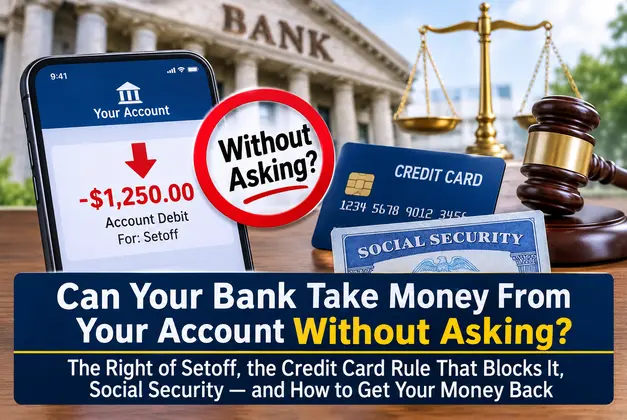
When it’s legal, when it isn’t, and what to do in the next 48 hours.
USUALLY ALLOWED: Past-due loans at the same bank, if your agreement allows. Usually no court or warning.
BLOCKED BY FEDERAL LAW: Consumer card debt, unless you set up autopay or knowingly pledged the account.
DEPENDS: Benefits (Social Security, SSI, VA) · joint accounts · credit unions · state rules.
Owe a different company? That isn’t setoff. A private creditor generally needs a court order.
If it already happened
- Ask the bank, in writing, which debt it took the money for and under what clause.
- If any of it was Social Security, VA, SSI, unemployment or wages, tell them now.
- Send the dispute letter, then file with the right regulator.
California: got a setoff notice with a response form? You have 20 days. See why it matters.
Check your situation in 30 seconds →
Sources checked November 26, 2026. State rules vary — check yours.
Setoff Check
Answer what you can. Nothing you choose is saved or sent. No names or account numbers.
What the Right of Setoff Is (and Why You Agreed to It)
The right of setoff, also called right of offset, lets a bank or credit union take money from your deposit account to pay a separate overdue debt you owe that same institution, usually under terms in your account or loan agreement and without first going to court.
Your deposit makes the bank owe you money. Your overdue loan makes you owe the bank. Setoff nets one against the other.
A federal bank regulator, the OCC, says banks generally may do this if you’re behind and contracts allow it.
- Find the clause. Look for “setoff,” “offset” or “security interest” in your deposit agreement and loan papers.
- Same institution only. A lender can’t set off against money you keep at a different bank. That takes a creditor’s legal process, usually a lawsuit and garnishment.
- Which accounts. Checking, savings and CDs can all be named in the clause.
- Warning. There’s generally no federal advance notice rule for loan setoffs. Some states, including New York and California, require notice.
Setoff needs no court order; garnishment generally does.
Can They Take It? Debt by Debt
Whether a bank can take your money depends mostly on the debt: overdue loans at the same institution are usually fair game, consumer credit card balances are usually protected by federal law, and debts owed to other companies can’t be collected by setoff at all.
| Debt | Tier | The rule | Exceptions and limits |
|---|---|---|---|
| Consumer credit card | BLOCKED BY FEDERAL LAW | The card issuer can’t offset the balance against your deposits. | Written automatic-payment plan; qualifying consensual security interest; court process open to creditors generally. |
| Business credit card | DEPENDS | The federal card protection covers consumer credit only. | Your agreement and state law decide. California’s consumer limits didn’t apply in Martin. |
| Car loan | USUALLY ALLOWED | Past due, same institution, and your contract allows it. | State limits (CA, NY, MD); benefit deposits may be protected. |
| Personal loan | USUALLY ALLOWED | Same as a car loan. | State limits; benefit deposits may be protected. |
| Mortgage or HELOC | USUALLY ALLOWED | The general loan rule; check both agreements. | States may add rules for loans secured by a home. If a credit card draws on the line, raise the card rule. |
| Overdraft or fees on the same account | USUALLY ALLOWED | The bank recovers it from later deposits to that account. | Benefit rules vary. An overdraft credit line tied to a card plan can fall under the card rule. |
| Debt at another company | BLOCKED: NEEDS A COURT | Not a setoff. A private creditor generally must sue, then garnish. | Government debts, such as federal taxes or child support, can follow levy rules without a new lawsuit. |
Behind on a car loan? It’s a common setoff trigger. See what happens if the car is repossessed.
Credit Cards: The Federal Rule That Stops Most Setoffs
Federal law generally bars a card issuer from taking money from your deposit account to pay consumer credit card debt, even if the account is at the same bank, unless you authorized automatic payments in writing or knowingly granted a qualifying security interest in your deposits.
BLOCKED BY FEDERAL LAW
The sources are 15 U.S.C. § 1666h and Regulation Z, 12 CFR 1026.12(d)(1). They apply to every card issuer.
- Closed cards too. The ban continues after card privileges end, for debt run up before then.
- Holds count. The official interpretation treats freezing your deposit as the same as taking it, with limited exceptions.
- Courts still work. An issuer can use a court order or levy if creditors generally could.
Exception 1: written automatic payments
You can authorize the issuer, in writing, to deduct card payments from your account on a schedule (§ 1026.12(d)(3)).
The authorization must be signed or initialed and describe the terms. Compare what was taken with what you agreed to.
Disputing a charge? Send a billing-error notice quickly. § 1026.13(d)(1) limits automatic deduction of disputed amounts.
Exception 2: a security interest you knowingly gave
The issuer may enforce a consensual security interest in your deposits (§ 1026.12(d)(2)). The bar is high.
- You must affirmatively agree to it.
- It must be disclosed in the account-opening disclosures.
- It can’t just be an offset right under another name.
Routine contract language giving a security interest in any deposit account is not enough (comment 12(d)(2)-1).
Signs of real intent include a separate signature or initials, a separate page, or a specific amount or account number.
Business cards and your bank’s wording
The federal rule covers consumer credit only.
In Martin v. Wells Fargo (2001), a business card fell outside California’s limits.
Banks change their agreements. Read the version that applies to you today, and keep a dated copy.
Credit card debt usually can’t be taken this way — federal law.
Struggling with card payments? Ask about a credit card hardship program.
Credit Unions: Same Card Rule, Different Paperwork
Credit unions have no blanket right to take your deposits for consumer credit card debt: they follow the same federal rule as banks, so they need your written automatic-payment authorization or a qualifying security interest that you knowingly agreed to when the account was opened.
DEPENDS on the debt and what you signed. For card debt, the federal block applies first.
Some card applications ask for a pledge of your shares (deposits). Look for a separate signature, initials or a pledge page.
A credit union case: Gardner
In Gardner v. Montgomery County Teachers Federal Credit Union (D. Md. June 4, 2012), members sued.
They challenged card payments taken from their deposits.
The court denied the credit union summary judgment on the federal claim and rejected its security-interest argument.
That was a pretrial ruling on those facts, not a final verdict after trial.
Other loans and cross-collateral clauses
For other loans, credit unions can generally use deposits if law and contracts allow.
Federal credit unions also have a statutory lien on shares.
A cross-collateral clause can make your car secure your card debt too. That’s a lien on the car, not a deposit setoff.
Check each loan agreement for it before you pay off or sell the collateral.
The NCUA oversees federal credit unions.
State-chartered ones also answer to a state regulator.
Social Security, SSI, VA and Other Benefits
No single, settled federal rule stops a bank from setting off Social Security deposits: courts disagree, New York bans it for certain direct-deposit accounts, California protects some benefits, and your most urgent step anywhere is telling the bank in writing where the money came from.
DEPENDS
What the federal statutes say
42 U.S.C. § 407 shields Social Security from “execution, levy, attachment, garnishment, or other legal process.”
SSI borrows that protection.
38 U.S.C. § 5301 gives VA benefits a similar shield against creditors, before and after receipt.
The fight: is a bank’s contract-based setoff “legal process”? Courts have answered differently.
Why courts disagree
- Tom v. First American Credit Union (10th Cir. 1998): a credit union couldn’t apply Social Security deposits to a separate loan, despite a pledge and authorization. The 10th Circuit covers CO, KS, NM, OK, UT and WY.
- Lopez v. Washington Mutual (9th Cir. 2002): a bank could recover overdrafts and overdraft fees from benefit deposits, because customers had consented. It distinguished Tom‘s separate loan.
- Frazier v. Marine Midland Bank (W.D.N.Y. 1988): a trial court allowed a setoff, reasoning it wasn’t legal process. The account was mostly cash deposits, and the depositor’s basic needs weren’t affected.
We haven’t confirmed a court ruling on VA money and bank setoff. Raise the VA shield, and get legal help.
State protections for benefits
New York bars setoff against certain accounts (Banking Law § 9-g).
They receive direct-deposited Social Security or SSI under a bank agreement.
California: Kruger v. Wells Fargo (1974) barred setoff for a card debt.
The deposits came from unemployment and disability benefits.
That doesn’t stop overdraft recovery on the same account (Miller v. Bank of America, 2009).
The two-month rule is for garnishment
31 CFR Part 212 protects up to two months of directly deposited federal benefits when a garnishment order arrives.
A bank’s own setoff isn’t a garnishment order. Don’t rely on that rule here.
What to do today
- Tell the bank in writing which money was benefits. The OCC advises this too.
- Attach award letters and statements showing each deposit.
- Contact legal aid or a consumer attorney.
- Ask your benefit agency how to send future payments to an account where you owe nothing.
Tell the bank if the money is Social Security or VA.
Joint Accounts: When Someone Else’s Debt Hits Your Money
A bank may be able to take money from a joint account for one owner’s debt, but the answer turns on your account agreement, how the account is owned, who deposited the funds and your state’s law, so the other owner should object in writing quickly.
DEPENDS
Some agreements say the bank may set off any owner’s debt against the whole account. State law may limit that.
- Nebraska: Blanchette v. Keith County Bank & Trust Co. (1989) said a bank may not use funds it knows, or should know, belong to someone else.
- Colorado: an older law review survey reported banks could take the whole joint account, while most states stopped at the debtor’s share.
- California: Martin involved a joint account, but turned on the card being a business card.
These examples are dated. Have a lawyer check current law in your state.
If you’re the co-owner who doesn’t owe, send records showing which deposits were yours.
Before sharing an account, read the risks of adding someone to your bank account.
Your State’s Protections
State law can add protections beyond the federal card rule: California keeps a $1,000 floor for many consumer debts, New York shields certain benefit accounts and requires notice, and Maryland restricts some consumer-debt offsets, while other states have their own rules that you should check.
California
$1,000 floor: applies to a bank’s consumer-debt setoff.
It can’t leave your checking accounts there below $1,000 combined.
Notice: for a checking setoff, due by the next day, in person or by first-class mail.
20 days: sign and return the response form.
Use it to dispute the debt or claim exempt money, such as paid wages.
The statute then calls for reversal. The bank can sue.
Not covered: overdrafts and bank fees.
Excepted: agreed automatic debits and some pledged savings.
Cite: Fin. Code § 1411 (formerly § 864). Savings associations: § 6660. Also Kruger and Miller.
New York
Benefits: no setoff against direct-deposit benefit accounts.
That means Social Security or SSI deposited under a bank agreement.
Certain other protected payments are covered too.
Notice: for other accounts, mailed with reasons before or on the same business day.
Catch: missing notice doesn’t by itself undo the setoff.
Covers: credit unions and savings and loans too.
Cite: Banking Law § 9-g.
Maryland
Rule: no offset for a delinquent consumer debt unless you authorized it in writing or a court orders it.
Check: your signed agreement may be that authorization.
“Consumer debt” has a legal definition tied to consumer goods.
Cite: Com. Law § 15-702.
Every other state
We haven’t listed your state’s rules. That doesn’t mean it has none. Ask your state regulator or legal aid.
| State | Rule | Source | What to cite |
|---|---|---|---|
| California | $1,000 floor across checking accounts for consumer debts; notice by the next day; return the response form within 20 days to dispute or claim exempt money, and the statute calls for reversal (the bank can sue). Overdrafts and fees aren’t covered; some written-agreement exceptions apply. | Fin. Code § 1411 (formerly § 864); § 6660; Kruger; Miller | § 1411 for the floor and claim form; Kruger for unemployment or disability benefits. |
| New York | No setoff against accounts receiving direct-deposited Social Security or SSI under an agreement; other setoffs need notice mailed by the same business day. Missing notice doesn’t void the setoff. Covers credit unions. | Banking Law § 9-g | § 9-g |
| Maryland | No offset for a delinquent consumer debt without your written authorization or a court order. Check the definition and what you signed. | Com. Law § 15-702 | § 15-702 |
| Other states | Not listed here. Check yours. | State regulator or legal aid | Ask before citing. |
Federally chartered institutions may argue that federal rules override a state limit. Ask legal aid if yours does.
Setoff vs. Garnishment vs. Bank Levy
Setoff is your own bank collecting a debt you owe it, usually without a court, while garnishment and levy involve someone else reaching your money through legal process, which brings different notices, deadlines, exemptions and automatic protections for certain federal benefits that you can use.
| Type | Who acts | Court order needed? | Which accounts | Benefit protections |
|---|---|---|---|---|
| Setoff | Your bank or credit union, as your lender | Usually no | Accounts at that same institution | Contested under federal law; state rules such as NY § 9-g may help |
| Garnishment | A creditor or agency serving an order on your bank | Private creditors generally yes; some agencies no | Accounts at the bank that gets the order | 31 CFR 212 looks back two months and protects directly deposited federal benefits, with exceptions |
| Bank levy | The IRS, a state agency, or a judgment creditor | IRS: no. Private creditor: generally yes | Accounts at the bank that gets the levy | Depends on the type of levy and debt |
“Levy” and “garnishment” overlap in some states. See how much of your paycheck can be garnished.
It Already Happened: How to Get Your Money Back
To try to recover money after a setoff, call the bank, follow up the same day with a written dispute naming the protection that applies, meet any state claim-form deadline, complain to the right regulator if needed, and contact legal aid when benefits or essential funds are involved.
1. Call
Ask which debt, how much, what date and which clause. Ask who can reverse it. Note the name and time.
Can’t cover rent or food? Say so, and ask for a full or partial reversal and a payment plan.
California: return the signed response form within 20 days.
Count from when the notice was mailed or handed to you.
Read it first; you sign under penalty of perjury.
2. Write
Copyable dispute letter
Keep only the paragraphs that fit. Delete any statement that isn’t true for you. Remove the bracketed labels.
The 10-business-day reply window is our suggestion, not a legal deadline.
[Date]

[Bank name]

Re: Setoff from account ending in [____]

On [Date of setoff], [Amount] was taken from my account and applied to [Debt they applied it to]. I am disputing this and asking you to review it.

[REQUEST: keep for everyone]
Please send me in writing: the date and amount of the setoff; the debt it was applied to; the clause of the deposit or loan agreement you relied on, with a copy of that agreement; my balances before and after; and any fees that resulted.

[CREDIT CARD: keep only for consumer card debt, and only if both statements are true]
15 U.S.C. § 1666h and 12 CFR 1026.12(d) generally prohibit a card issuer from offsetting consumer credit card debt against funds on deposit. I did not authorize in writing an automatic payment plan covering this deduction, and I did not separately agree to give a security interest in this account. If you disagree, send me the signed document you rely on. Please return [Amount] and reverse related fees.

[BENEFITS]
The funds taken include [Social Security / VA / SSI / unemployment] benefits, directly deposited on [Dates]. Please return these funds and do not set off against my future benefit deposits.

[CALIFORNIA: consumer debt at a bank]
California Financial Code § 1411 (formerly § 864) says a setoff for a consumer debt may not leave less than $1,000 across a customer's demand deposit accounts with the bank. My combined balance after this setoff was [Balance]. Please restore the amount required.

[NEW YORK: keep the sentences that apply]
N.Y. Banking Law § 9-g bars setoff against an account into which Social Security or SSI is directly deposited under an agreement with the bank. My account receives these deposits. Please return the funds.
For other accounts, § 9-g requires notice and reasons to be mailed no later than the same business day. Please tell me when and where you mailed it.

[JOINT ACCOUNT]
My co-owner on this account is not liable for this debt, and [Amount belonging to co-owner] of the funds taken was the co-owner's money. Records are enclosed. Please return it.

[CLOSING]
Please reply in writing within 10 business days. If this is not resolved, I plan to file a complaint with [Regulator].

Sincerely,
[Signature]
Save: the setoff notice, statements, both agreements, benefit letters, your letter, proof of delivery, fee records and call notes.
3. File a complaint
| Your institution | Regulator | How |
|---|---|---|
| National bank or federal savings association | OCC | HelpWithMyBank.gov |
| Federal credit union | NCUA | MyCreditUnion.gov |
| State-chartered bank or credit union | Your state financial regulator | Its website’s complaint page |
| Bank, credit union or financial app | CFPB (may refer it elsewhere) | CFPB complaint portal |
4. Get legal help
Contact legal aid or a consumer attorney if benefits were taken, or you can’t absorb the loss. Don’t wait for a complaint to finish.
What Happens Next: Overdrafts, Closure, ChexSystems
After a setoff, pending payments may bounce, fees may pile up, the account could be frozen or closed, and an unpaid negative balance can be charged off and reported to a checking-account screening company, so check upcoming debits immediately and ask about fee reversals.
- List automatic payments due in the next two weeks. Pay them another way if needed.
- Ask the bank to waive fees the setoff caused.
- Ask for your updated loan balance. One setoff may not bring the loan current.
- Account locked or shut? See Bank Froze or Closed Your Account.
- Turned down for a new account? See ChexSystems and Early Warning.
A setoff that overdraws your account can lead to fees and a ChexSystems report.
How to Protect Yourself Before It Happens
The best protection comes before a setoff: read your agreements, call about a payment plan before the lender acts, and consider moving future paychecks or benefit deposits to a bank where you owe nothing, which is lawful when done before any court order.
“Before It Happens” checklist
[ ] 1. Read the setoff section of my deposit agreement.
[ ] 2. If behind on a loan, call before the bank acts and ask for a hardship or payment plan.
[ ] 3. Move future direct deposits of wages or benefits to a bank where I owe nothing (lawful when done before any court order).
[ ] 4. Turn off autopay from this account to a card at the same bank only if I understand the late-payment consequences.
[ ] 5. Avoid mixing benefit money with other money; mixing makes the source harder to prove.
[ ] 6. Watch for an overdraft after any setoff; it can trigger fees and a ChexSystems report.
Help with steps 2 and 6: card hardship programs and ChexSystems reports.
These steps don’t cancel the debt.
Garnishment or levy already served? Get legal advice. Don’t withdraw money to avoid it.
FAQ
These short answers cover the questions people ask most about bank setoff, including loans, credit cards, credit unions, benefits, joint accounts and complaints; each one is general information, so confirm the details against your own agreements and the law in your state.
Can a bank take money from my account without permission?
Often, yes, for an overdue debt you owe that bank.
Your “permission” is usually in your agreement. Card debt differs.
Can a bank take money from my savings to pay a car loan?
Usually, if the loan is past due, it’s the same institution and your contract allows it. State limits and protected money can change that.
Can my bank take money from checking to pay my credit card?
Generally not for a consumer card.
Exceptions: written autopay, or a qualifying security interest.
Can Chase or Wells Fargo take money from my account for a credit card?
The same federal rule applies to every card issuer, with the same two exceptions. Check what you signed.
Can a credit union take money from my account to pay a credit card?
Only within the federal rule’s exceptions, or through court process. Credit unions get no blanket right for consumer card debt.
Does a bank have to warn me before a setoff?
Usually not in advance.
New York requires mailing notice by the same business day.
California requires notice by the next day for covered checking setoffs.
Can a bank take my Social Security for a loan?
It depends on where you are.
New York bars it for qualifying direct-deposit accounts.
The 10th Circuit ruled against it in Tom. Elsewhere it may be contested.
Is VA disability protected from setoff?
Federal law shields VA benefits from creditors.
Don’t assume that stops a bank. Tell it, and get legal help.
Can a bank take money from a joint account for one person’s debt?
Sometimes. It depends on the agreement, ownership, whose money it was and state law.
Can a bank take money from my IRA or 401(k)?
Generally no. A 401(k) is held by a plan.
Pledge IRA money for a loan and tax law treats it as paid out (26 U.S.C. § 408(e)(4)).
This isn’t absolute. Money already moved into checking may be treated differently.
Can a bank take money for a debt owed to another bank?
Not by setoff. A private creditor generally needs a court order to garnish your account.
Can a bank take overdraft fees out of my Social Security deposit?
Lopez (9th Circuit) allowed overdraft recovery.
So did Miller under California law.
Elsewhere, including New York, ask legal aid.
How much can a bank take? Is there a minimum it must leave?
There’s no general federal minimum for loan setoffs.
California has a $1,000 floor for covered consumer debts.
Is setoff the same as garnishment?
No. Setoff is your bank collecting its own debt.
Garnishment is a legal order making your bank hold money for someone else’s claim.
Can I stop a setoff before it happens?
You can lower the risk with a payment plan.
Before any court order, you can move future deposits to another bank.
How do I get my money back after a wrongful setoff?
Dispute it in writing and meet any claim deadline.
Then file a complaint and get legal help. Recovery isn’t guaranteed.
Where do I complain about my bank?
National banks: OCC. Federal credit unions: NCUA.
State charters: your state regulator. The CFPB also takes complaints.
See the complaint table.
Will a setoff hurt my credit score?
The setoff itself typically isn’t a credit report entry. The late loan payments, and any later charge-off or collection, can be.
Disclaimer: This is general information, not legal advice. Your rights depend on your account agreement, the type of institution, the type of debt and your state's law. It is based on sources checked on November 26, 2026. For benefit-funded accounts or large amounts, contact a consumer attorney or legal aid. Last updated .

Daniel Hayes is the founder and sole researcher at AdvoraHQ. He covers U.S. personal finance, insurance, and consumer law — working directly from IRS publications, federal and state statutes, court opinions, and SEC filings rather than secondary summaries. His focus is the gap between what readers think they know and what the source documents actually say. Daniel is not a licensed attorney, CPA, or financial advisor; his articles are educational and not personalized advice. Reach him at Daniel.Hayes@advorahq.com.
