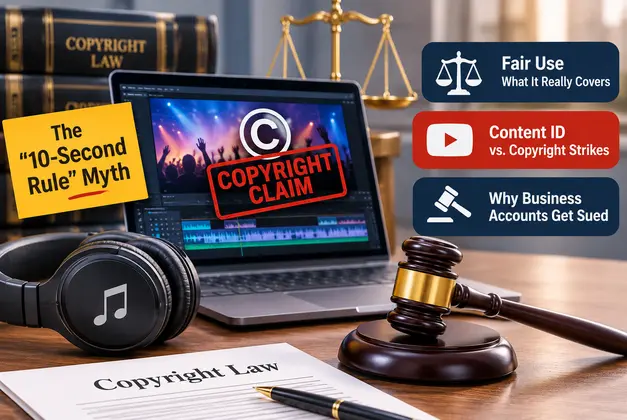
Quick verdict: There’s no “10-second rule.” No number of seconds makes a use legal by itself. Giving credit doesn’t, and neither does not monetizing.
Fair use can apply, for example when you’re commenting on the song itself. But courts decide it case by case, and platforms’ automated systems don’t decide it at all.
The two copyrights: Most songs carry two copyrights: one for the composition and one for the recording. A video usually needs permission for both.
The business line: Business accounts are held to a different standard. Brands like Bang Energy, Marriott, and Crumbl have been sued by record labels over social media videos.
What happened to you?
- Got a Content ID claim
- Got a copyright strike
- Audio was muted
- Got a letter or CCB notice
- I run a business account
- Want free music legally
Laws and platform rules checked . Not legal advice.
The Myths Everyone Repeats
None of these myths holds up: no rule turns a few seconds, a credit line, or an unmonetized post into permission.
MYTH “Under 10 seconds (or 15, or 30) is always fine.”
Truth: No time-based safe harbor exists. Length is only part of factor three, amount and substantiality. A short, recognizable hook can still weigh against fair use.
WHAT THE LAW SAYS §107 lists four factors and no time limit. The Copyright Office says there are “no legal rules permitting the use of a specific number of words,” and the same for notes.
MYTH “I gave credit, so it’s fine.”
Truth: Credit is not permission. It isn’t one of the four fair use factors, and it doesn’t turn an unlicensed use into a licensed one.
WHAT THE LAW SAYS YouTube’s dispute page lists giving credit among reasons that don’t justify disputing a Content ID claim.
MYTH “No copyright infringement intended.”
Truth: A disclaimer isn’t a license. Infringement doesn’t depend on intent. Intent mostly matters later, when damages are set.
WHAT THE LAW SAYS In the Bang Energy case, the court treated the company’s belief that TikTok licensed the music as a damages issue, not a liability one.
MYTH “I’m not monetizing, so it’s fine.”
Truth: Non-commercial purpose is only part of factor one. An unmonetized video can still infringe.
WHAT THE LAW SAYS §107 treats commercial versus nonprofit purpose as one consideration. YouTube’s dispute page lists not monetizing as an invalid reason by itself.
MYTH “I bought the song, so I can use it.”
Truth: A purchase on iTunes or a CD gives you the right to listen. It doesn’t give you video rights.
WHAT THE LAW SAYS Putting a recording in a video typically needs a sync license (composition) and a master use license (recording).
MYTH “It’s on TikTok, so it’s fine everywhere.”
Truth: Platform licenses don’t travel. A TikTok sound isn’t cleared for YouTube or Instagram, and in-app libraries are built for personal, non-commercial posts on that platform.
WHAT THE LAW SAYS TikTok and Meta both limit what business accounts can use. See the business section below.
MYTH “Sped up or pitch-shifted is okay.”
Truth: Changing the sound doesn’t change the analysis. The result is still built from the original composition and recording. We don’t recommend edits meant to dodge matching systems.
WHAT THE LAW SAYS Altering a copyrighted work doesn’t remove the original owner’s rights. It can add a derivative-work problem.
| Myth | Truth | Source |
|---|---|---|
| “Under 10, 15, or 30 seconds is always fine.” | No time-based safe harbor. Length is part of factor three only; a short hook can still weigh against fair use. | 17 U.S.C. §107; Copyright Office fair use FAQ |
| “I gave credit.” | Credit is not permission and is not a fair use factor. | 17 U.S.C. §107; YouTube Help, Dispute a Content ID claim |
| “No copyright infringement intended.” | A disclaimer isn’t a license. Intent matters mostly for damages. | 17 U.S.C. §504(c); UMG v. Vital Pharmaceuticals (S.D. Fla. 2022) |
| “I’m not monetizing.” | Non-commercial purpose is one piece of factor one, not a shield. | 17 U.S.C. §107(1); YouTube Help |
| “I bought the song.” | A purchase is for listening. Video use typically needs sync and master licenses. | 17 U.S.C. §106 |
| “It’s on TikTok, so it’s fine everywhere.” | Platform licenses don’t travel and are aimed at personal, non-commercial use. | TikTok and Meta help pages |
| “Sped up or pitch-shifted is okay.” | Altering audio doesn’t remove either copyright and doesn’t change the analysis. | 17 U.S.C. §106(2) |
No number of seconds makes a use legal by itself.
Every Song Has Two Copyrights
Most songs carry a copyright in the composition and a separate one in the sound recording, so a video using a recording typically needs both permissions.
The composition is the melody and lyrics. The recording is one specific performance captured on audio. Different people usually own each.
| Right | Who usually owns it | License needed for video | Covers | Public domain rule (U.S.) |
|---|---|---|---|---|
| Musical composition (melody, lyrics) | Songwriters and music publishers | Sync license | A cover still uses the composition, so video use needs composition permission | Published 1929-1977: 95 years after publication. Published 1978 or later: author’s life plus 70 years |
| Sound recording (the recorded performance) | Usually the label | Master use license | A cover you perform yourself is a new recording, so no master license, unless you use the original recording, a sample, or someone else’s backing track | Before 1923: public domain. 1923-1946: 100 years. 1947-1956: 110 years. Through Feb. 14, 1972: until Feb. 15, 2067 |
Sync license vs. master use license
A sync license covers the composition when it’s paired with moving images. A master use license covers the specific recording.
Using a label’s recording usually means getting both. Using your own recording of someone else’s song usually means getting only the sync license.
Covers
Singing or playing a song yourself doesn’t make it yours. The composition still belongs to the songwriter and publisher.
On YouTube, covers often draw claims from publishers. YouTube’s help page says “monetize” is the most common policy on music claims.
A claim that monetizes your video is not a license you hold.
Remixes and sped-up versions
A remix, mashup, or sped-up track is built from the original composition and the original recording. Both copyrights are still in play, plus any sample issues.
AI covers and soundalikes
An AI-generated version of an existing song still raises composition questions. It can raise more if it imitates a specific recording.
Who owns the AI output is a separate question; see You Don’t Own the AI Content You Created.
If you need the basics of copyright versus trademark and patent, start with Trademark vs Copyright vs Patent.
Buying a song doesn’t let you put it in your videos.
What Fair Use Really Covers
Fair use is a defense that a court decides by weighing four factors; it isn’t a platform setting, a checkbox, or a rule about length.
It comes from 17 U.S.C. §107, which lists commentary, criticism, news reporting, teaching, scholarship, and research as examples.
Being on that list does not guarantee the result.
DEPENDS 1. Purpose and character
Is the use commercial or nonprofit educational? Does it add something new or serve the same purpose as the original?
DEPENDS 2. Nature of the work
Creative works like songs generally get stronger protection than factual ones.
DEPENDS 3. Amount used
How much, and how important is the part? Length is only one piece. A short but recognizable hook can matter a lot.
DEPENDS 4. Effect on the market
Would your use substitute for a license the owner normally sells? Songs are routinely licensed for videos and ads.
Andy Warhol Foundation v. Goldsmith (2023)
Andy Warhol Foundation for the Visual Arts, Inc. v. Goldsmith, 598 U.S. 508 (2023), narrowed how “transformative” is weighed under factor one.
The Court held that when a new use and the original “share the same or highly similar purposes” and the new use is commercial, factor one likely weighs against fair use. That holds unless there is some other justification for copying.
The Court looked only at factor one.
For music, that makes background-music uses in commercial videos hard to defend. Licensing songs for videos and ads is a normal market.
A court would still weigh all four factors.
What tends to help and what tends to hurt
DEPENDS Tends to help:
- Critique or commentary about the song itself, using only what you need to make the point.
- Teaching or analysis that discusses specific passages.
- Parody that targets the song being copied.
DEPENDS Tends to hurt:
- Using a hit as background music for unrelated content.
- Using the catchiest part because it draws viewers.
- Using the full track, or using it in promotion or ads.
- Using music in place of a license the owner would normally sell.
Who decides
A court decides, case by case. Content ID is an automated match and doesn’t weigh the four factors. A platform can act on a claim even when a court might later find fair use.
For more, see the Copyright Office’s Fair Use Index.
Music Use Risk Check
Answer the questions to get a general risk checklist for your exact video. Nothing you enter is saved or sent anywhere.
Your checklist
The $150,000-Per-Song Risk: Why Business Accounts Are Different
Platform music libraries are licensed for personal, non-commercial posts, so branded videos generally fall outside them, and labels have sued over that.
Platform licenses vs. commercial use
TikTok’s help page says a business account sees only the Commercial Music Library when adding sound.
TikTok’s business pages warn that promoting a business from a personal account with the general library risks infringement.
Instagram’s help page says certain business accounts and post types can’t use the licensed library, to keep it from commercial use.
Meta’s Sound Collection is the alternative. Meta says it can be used for commercial purposes like ads.
Meta’s music guidelines also prohibit commercial or non-personal use unless you have the proper licenses.
The test is what the post does, not what the account is called.
A TikTok sound isn’t licensed for YouTube or Instagram.
The lawsuits
The $150,000 figure is the statutory ceiling per work for willful infringement.
With 931 alleged infringements in Sony’s Marriott complaint, press reports put that ceiling above $139 million. That was a theoretical maximum, not a result. The case ended in a dismissal.
| Plaintiff | Defendant | Year | Platforms | Works at issue | Status |
|---|---|---|---|---|---|
| UMG, Sony, Warner | Bang Energy (Vital Pharmaceuticals) and its CEO | UMG: April 2021. Sony: August 2021. Warner: September 2022 | TikTok; Warner also alleged Instagram | Sony: 211 recordings. UMG: about 140 videos, per press reports | UMG and Sony won partial summary judgment on direct infringement over Bang’s own videos in 2022. The labels did not win summary judgment on the influencer videos. Cases were paused after Bang’s bankruptcy filing. |
| Sony | Marriott International | 2024 (D. Del., No. 1:24-cv-00598) | Instagram, TikTok, Facebook | 931 alleged infringements of sound recordings | Sony voluntarily dismissed with prejudice in October 2024. Trade press reported it appeared to be a settlement. Terms are not public. |
| Warner | Crumbl | Filed April 2025 | TikTok, Instagram | At least 159 recordings and compositions; up to about $24 million sought | Settled. An agreement in principle was reported in May 2026 and a settlement in June 2026. Terms not disclosed. |
| UMG and Concord (with Capitol) | Quince (Last Brand, Inc.) | Filed April 2026 | TikTok, Instagram | Recordings and compositions by multiple artists | No resolution found as of November 4, 2026. Check the docket. |
Other brands have been targeted too. Sony settled with Gymshark in 2022 and the University of Southern California in March 2026, and Warner sued Luxottica in October 2026.
Those are allegations or settlements, not findings.
Influencer and sponsored posts
If a brand pays a creator who uses a trending sound, the post is promotional. The Marriott, Crumbl, and Quince complaints all describe influencer posts alongside the brand’s own.
In the Bang case, the court did not hold the brand liable for influencer videos at summary judgment. Those facts won’t fit every sponsorship, so don’t treat it as a rule.
Put music terms in the contract: which audio source is allowed, who is responsible, and a duty to take posts down on request.
Why your audio got muted
A business account is one reason for muted audio, not the only one. Other common reasons:
- The post counts as commercial, so the personal library doesn’t apply.
- The platform lost or changed a label deal. When UMG and TikTok’s license lapsed in February 2024, UMG songs were pulled and existing clips were muted.
- The track isn’t licensed in your country or region.
- On YouTube, a Content ID claim blocked the audio or the video.
- The owner sent a takedown request.
What a business account should do now
- Audit past posts for unlicensed music.
- Stop using popular in-app tracks on brand content.
- Use the platform’s commercial library or music licensed in writing.
- Put music rules into influencer contracts.
Some errors and omissions (media liability) policies can respond to claims over content. Terms and exclusions vary, so read yours. See Errors and Omissions Insurance.
YouTube: Content ID Claims vs. Copyright Strikes
A Content ID claim is an automated match that affects one video, while a copyright strike follows a legal removal request and counts against your channel.
A Content ID claim isn’t a strike, but three strikes in 90 days can end a channel.
Content ID claim
- What triggers it
- An automated match against files owners register with YouTube.
- Effect on the video
- The owner can monetize, track, or block it, worldwide or in certain countries.
- Effect on the channel
- Usually none. A claim is not a strike.
- How to respond
- Wait, remove or replace the claimed audio, or dispute if you have the rights or a genuine basis. The claimant has 30 days to answer a dispute and 7 days to answer an appeal.
- How long it lasts
- Until it’s released or resolved. If a claimant doesn’t answer a dispute in 30 days, the claim expires.
Copyright strike
- What triggers it
- A complete legal copyright removal request from the owner.
- Effect on the video
- It’s removed from YouTube.
- Effect on the channel
- It counts against the channel. Three active strikes make the account and its channels subject to termination.
- How to respond
- Complete Copyright School and wait, ask for a retraction, or file a counter-notification.
- How long it lasts
- 90 days, if Copyright School is done and the channel has fewer than three strikes. Deleting the video generally does not remove it.
| Content ID claim | Copyright strike | |
|---|---|---|
| What triggers it | An automated match against files owners register with YouTube. | A complete legal copyright removal request from the owner. |
| Effect on the video | The owner can monetize, track, or block it, worldwide or in certain countries. | The video is removed from YouTube. |
| Effect on the channel | Usually none. A claim is not a strike. | Counts against the channel. Three active strikes make the account and its channels subject to termination. |
| How to respond | Wait, remove or replace the claimed audio, or dispute if you have the rights or a genuine basis. The claimant has 30 days to answer a dispute and 7 days to answer an appeal. | Complete Copyright School and wait, ask for a retraction, or file a counter-notification. |
| How long it lasts | Until it’s released or resolved. If a claimant doesn’t answer a dispute in 30 days, the claim expires. | 90 days, if Copyright School is done and the channel has fewer than three strikes. Deleting the video generally does not remove it. |
Disputing a claim
YouTube’s dispute page says valid reasons include having all the necessary rights.
It lists giving credit, not monetizing, and owning a copy as reasons that don’t count by themselves.
If the claimant rejects your dispute, you may be able to appeal. If the claimant still believes the claim is valid, it can send a removal request, and a valid request means a strike.
Removing or replacing the claimed song is a normal way to resolve a claim. Altering audio to slip past matching is not a fix and doesn’t change the legal analysis.
Resolving a strike
YouTube describes three ways: complete Copyright School and wait 90 days, ask the person who submitted the request to retract it, or submit a counter-notification.
A counter-notification is a legal statement under the DMCA, 17 U.S.C. §512(g).
You state under penalty of perjury that the removal was a mistake, and you consent to U.S. federal court jurisdiction.
The claimant then generally has 10 to 14 business days to show it has filed suit, or the content can be restored. Talk to a lawyer before you file one.
Shorts
YouTube’s help page says Shorts of 1 to 3 minutes with an active Content ID claim are blocked, whatever the claimant’s policy, and that no strike results from that.
What It Can Cost
Statutory damages run $750 to $30,000 per work, up to $150,000 if willful, and a voluntary small-claims route caps at $30,000.
Statutory damages (17 U.S.C. §504(c))
- An owner can elect statutory damages instead of actual damages and profits: $750 to $30,000 per work infringed.
- For willful infringement, a court can award up to $150,000 per work.
- For innocent infringement, a court can reduce the award to as little as $200 per work.
The count is per work, not per post. A song’s composition and its recording are separate works, often with different owners, so one song can involve two.
Registration (17 U.S.C. §412)
Statutory damages and attorney’s fees generally require timely registration of the work. For a well-known catalog song, don’t assume this protects you; the labels in the cases above sought statutory damages.
If you write songs yourself, see How to Copyright Your Work.
The Copyright Claims Board
The CASE Act created the Copyright Claims Board (CCB), a voluntary small-claims tribunal in the Copyright Office. It has taken claims since June 2022.
- Total damages are capped at $30,000 per proceeding.
- Statutory damages are capped at $15,000 per work if the work was timely registered, and $7,500 if not.
- A “smaller claims” track is capped at $5,000.
- You can opt out within 60 days of being served (17 U.S.C. §1506(i)).
If you opt out, the claim is dismissed without prejudice. The owner can still go to federal court, where the larger damages ranges above apply.
If you don’t opt out, the proceeding goes forward and you are bound by the result.
So the 60 days is a decision, not a deadline to ignore. Because it is voluntary for respondents, the CCB is not a way to force an individual into a proceeding.
Consider a lawyer; see the Intellectual Property Lawyer Guide.
If you get a demand letter
- Check who sent it and whether they own or represent the rights.
- Check the registration they claim in the Copyright Office’s public records.
- Don’t ignore it, and don’t pay before checking.
- Keep copies of the post, your music source, and any license.
For a similar letter over a photo, see Got a Copyright Letter Over a Photo? For how a response letter is structured, see the Trademark Cease-and-Desist Letter guide.
Legal Ways to Use Music
Use music cleared for your exact use: a commercial library, a written license, music you own, Creative Commons on its terms, or the public domain.
Platform commercial libraries
TikTok’s Commercial Music Library and Meta’s Sound Collection are built for business use on their own platforms.
Read each one’s terms. They don’t carry over to other platforms.
Licenses with written terms
Whether it comes from a library, a direct deal, or a composer you hire, get the terms in writing. Check:
- Which platforms are covered, and whether your own website is.
- Whether paid ads and boosted posts are covered.
- The term: how long you can keep the video up.
- The territory: which countries.
- Whether it covers client work, and how many videos or projects.
- What happens if an automated claim hits a licensed video.
Original music
You own what you wrote and recorded yourself. Collaborators, samples, loops, and leased beats can change that, so keep the agreements.
Creative Commons
Every Creative Commons license has its own terms. Most require attribution, and attribution is a license condition, not a substitute for one.
A NonCommercial license doesn’t fit brand content.
Creative Commons’ own legal code treats syncing music to moving images as adapting it, so NoDerivatives licenses generally don’t fit video.
Check the license version, and confirm the uploader actually holds the rights.
AI-generated music
The tool’s terms decide your commercial rights, and ownership of AI output is unsettled. See Can You Copyright AI-Generated Work?
The public domain
Some songs can be used freely, but there are two clocks, one per copyright. The next section shows what enters on January 1, 2027, and the tool checks any year.
What Enters the Public Domain on January 1, 2027
Compositions published in 1931 and sound recordings published in 1926 enter the U.S. public domain on January 1, 2027.
CBS News, citing Duke’s Center for the Study of the Public Domain, says the 1931 class includes Herman Hupfeld’s “As Time Goes By.”
Duke’s official 2027 list isn’t out yet. Its 2026 list came out in December 2025, and we’ll update this page when the 2027 list appears.
That’s the composition only. A recording has its own clock.
Example: for a 1942 recording of a 1931 song, the composition enters the public domain on January 1, 2027 and the recording on January 1, 2043.
A new recording of a public domain song is still protected.
| Type | Rule | What enters January 1, 2027 |
|---|---|---|
| Compositions published before 1929 | Public domain | Already public domain |
| Compositions published 1929-1977 | 95 years after publication; public domain on January 1 of publication year plus 96 | Works published in 1931 |
| Compositions published 1978 or later, or never published | Author’s life plus 70 years; public domain on January 1 of death year plus 71 | Unpublished works by authors who died in 1956 (rarely relevant to released songs) |
| Sound recordings published before 1923 | Public domain | Already public domain since January 1, 2022 |
| Sound recordings published 1923-1946 | 100 years after publication; January 1 of publication year plus 101 | Recordings published in 1926 |
| Sound recordings published 1947-1956 | 110 years after publication; January 1 of publication year plus 111 | None. The first, 1947 recordings, enter in 2058 |
| Sound recordings fixed from 1957 through February 14, 1972 | Protected until February 15, 2067 | None |
Is This Song in the U.S. Public Domain?
This tool reports U.S. term status only, for the composition and the recording separately. Nothing you enter is saved or sent anywhere.
For songs before 1978, publication usually means sheet music, not the record release.
Term status
Got a Claim, Strike, or Letter?
Start here, then copy the checklist to keep with your records. This is general information, not legal advice.
- Identify what it is: a Content ID claim, a copyright strike, a platform mute, an email or letter, a CCB notice, or a court complaint. A court complaint has a short deadline, so call a lawyer right away.
- Content ID: check the claimant's policy in YouTube Studio. Trim or replace the audio, or dispute only if you have a license or a genuine fair use basis. The claimant generally has 30 days to respond.
- Strike: don't delete the video, since that generally won't remove the strike. Complete Copyright School, request a retraction, or consult a lawyer before any counter-notification (it's a legal statement).
- A demand letter: verify the sender and the claimed registration. Don't ignore it, and don't pay before checking. See Got a Copyright Letter Over a Photo?
- A CCB notice: note the 60-day opt-out window and decide deliberately.
- Business accounts: audit past posts for unlicensed music and stop using in-app popular tracks for brand content.
When a claim becomes a legal dispute, a lawyer is worth it. See the Intellectual Property Lawyer Guide.
FAQ
Short answers to the questions people search most.
Can I use 10 seconds of a copyrighted song?
There is no 10-second rule. Permission or fair use decides, not length, and a short, recognizable hook can still weigh against fair use.
Is there any safe length of music to use?
No length is automatically safe or unsafe. Length is part of factor three only, and context decides the rest.
Can I use copyrighted music if I give credit?
No. Credit isn't permission and isn't a fair use factor. YouTube's dispute page lists it as a reason that doesn't count by itself.
Does "no copyright infringement intended" protect me?
No. A disclaimer isn't a license. Intent mostly matters when damages are set, not whether infringement happened.
Can I use copyrighted music if I don't monetize?
Not by itself. Non-commercial purpose is one part of factor one. Unmonetized videos can still draw claims, strikes, or letters.
Can I use a song I bought on iTunes?
A purchase is for listening. Putting the recording in a video typically needs a sync license and a master use license.
Is using a song in a review fair use?
It can be, when you're critiquing the song itself and use only what you need. Courts decide, and Content ID doesn't weigh the factors. Try the risk check.
Can I post a cover song on YouTube?
A cover still uses the composition, so video use needs composition permission. Covers often draw publisher claims on YouTube. A claim isn't a license.
Why did TikTok or Instagram mute my video?
Common reasons include a commercial account or post, a change in the platform's label deals, regional availability, or an owner's request. See why your audio got muted.
Why can't my business account use popular songs?
Platform deals cover personal, non-commercial use. TikTok business accounts see only the Commercial Music Library, and Instagram steers certain business accounts to Meta's Sound Collection.
Can I use TikTok sounds on YouTube?
No. Platform licenses don't travel. A TikTok sound isn't cleared for YouTube or Instagram.
What's the difference between a Content ID claim and a copyright strike?
A claim is an automated match that affects one video. A strike follows a legal removal request, removes the video, and counts against your channel.
How do I remove a copyright strike?
YouTube describes three ways: complete Copyright School and wait 90 days, get a retraction, or file a counter-notification. Deleting the video generally doesn't resolve it.
What happens after three strikes?
The account and its associated channels become subject to termination, uploaded content becomes inaccessible, and you can't create new channels.
Can I be sued for using music in a video?
Yes. Owners can sue in federal court, where statutory damages can reach $150,000 per work if willful, or use the Copyright Claims Board. If you received a letter, use the checklist.
What is the Copyright Claims Board?
It's a voluntary small-claims tribunal in the Copyright Office. Total damages are capped at $30,000 per proceeding, and you can opt out within 60 days of service.
What music enters the public domain in 2027?
Compositions published in 1931 and sound recordings published in 1926 enter on January 1, 2027. Check any year with the public domain tool.
Is a public domain song safe to use if someone else recorded it?
Not automatically. The song may be public domain, but a recording has its own copyright. Use your own recording or a recording whose term has ended.
Sources
All sources accessed November 4, 2026. Platform rules change, so check each page before you rely on it.
- U.S. Code: 17 U.S.C. §107, §412, §504, §512, §1401, §1506, §302, §303, §304
- U.S. Copyright Office: Fair use FAQ; Fair Use Index; Copyright Claims Board
- Andy Warhol Foundation for the Visual Arts, Inc. v. Goldsmith, 598 U.S. 508 (2023)
- YouTube Help: Copyright strike basics; Content ID claims; Dispute a Content ID claim; Appeal a Content ID claim
- TikTok: How to use the Commercial Music Library (last updated July 2026 per the page)
- Meta: Instagram Help, music and Meta's Sound Collection; Music Guidelines
- Duke Center for the Study of the Public Domain: Public Domain Day 2026; CBS News: notable works entering the public domain
- Lawsuits: Loeb & Loeb on UMG v. Vital Pharmaceuticals; Bloomberg Law on the Bang cases; Digital Music News on the Marriott dismissal; Music Business Worldwide on Marriott; Digital Music News on Crumbl; Music Business Worldwide on Quince; Music Business Worldwide on Luxottica. Check the court dockets for current status.
- Copyright Claims Board overview: Haynes Boone
Last updated:
This article is general information, not legal advice. Fair use is decided case by case, and platform policies change. Laws and platform rules were checked on November 4, 2026. Consult a copyright attorney about your situation.

Daniel Hayes is the founder and sole researcher at AdvoraHQ. He covers U.S. personal finance, insurance, and consumer law — working directly from IRS publications, federal and state statutes, court opinions, and SEC filings rather than secondary summaries. His focus is the gap between what readers think they know and what the source documents actually say. Daniel is not a licensed attorney, CPA, or financial advisor; his articles are educational and not personalized advice. Reach him at Daniel.Hayes@advorahq.com.