
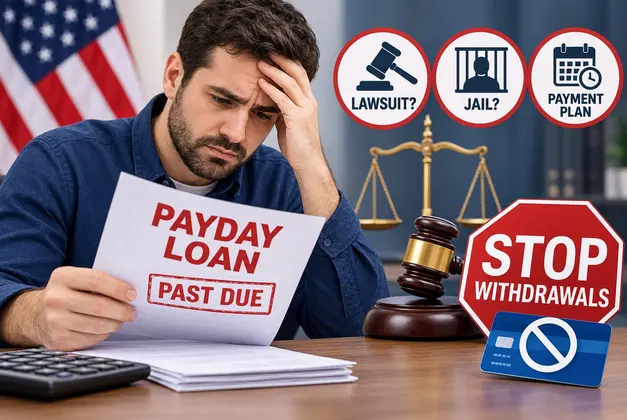
Payment Due This Week? Do These Three Things
- Ask the lender for an extended payment plan before the due date. Some states require lenders to offer a no-cost one. Check yours below.
Stop the automatic withdrawal if you can’t cover it.
Revoke authorization in writing with the lender, and give your bank a stop payment order at least 3 business days ahead.
Your bank may charge a fee, and you still owe the loan.
- Don’t take a new payday loan to pay this one.
You can’t be jailed for the debt itself. But if you’re ever served court papers, respond — ignoring a court order is what creates real legal trouble.
See your state’s rules and what each option costs →
- What happens next
- Jail & threats
- Stop withdrawals
- Payment plans
- Online lenders
- If you’re sued
- Your options
- Letters
State rules verified . The CFPB’s two-attempt rule is in effect but lightly enforced; see below.
Payday Loan Exit Planner
Pick your state to see its rules, your payment-plan right, and what rollovers cost next to a plan. Nothing you type leaves this page.
Use the fee on your loan agreement. It fills in with your state’s cap where one exists.
What Happens If You Don’t Pay: Step by Step
The lender usually tries to collect first, fees add up next, and a lawsuit comes later, if it comes at all.
Timing varies by lender and by state. This is the usual order, not a schedule.
How to read the labels: YOUR RIGHT is a federal or state protection. DEPENDS ON YOUR STATE means the rule changes where you live.
WHAT LENDERS MAY SAY marks pressure tactics, with the reality beside them.
Due date
What happens: The lender collects the way you authorized, by automatic withdrawal or postdated check, or expects you to pay.
What you can do: Decide before the date. Ask for a payment plan, and stop the withdrawal if you can’t cover it.
Withdrawal attempts and NSF fees
What happens: If the money isn't there, your bank may charge a fee and the lender may try again.
What you can do: Ask your bank to stop further attempts. Bank fees can sometimes be refunded: overdraft fee refunds.
Rollover offers
What happens: The lender may offer to extend the loan for another fee. What you borrowed doesn't go down.
What you can do: Ask about a payment plan first. See the rollover section.
Late fees
What happens: Fees and interest after the due date depend on your contract and your state's law.
What you can do: Ask for an itemized statement in writing, and check the charges against your state’s rules.
Collections
What happens: The lender may sell the loan or hand it to a collector. Calls and letters follow.
What you can do: Ask for validation: Debt Validation Letter. Use the collector checklist below.
Credit report
What happens: Payday lenders often don't report.
A collection account can appear and stay up to seven years from the first missed payment (Fair Credit Reporting Act).
What you can do: Check your free credit reports and dispute errors.
Lawsuit
What happens: The lender or collector may sue. You get a summons with a deadline.
What you can do: Respond by the deadline. See Broke and Sued for Debt.
Judgment
What happens: If you don't respond, or you lose, the court may enter a judgment for the debt and allowed costs.
What you can do: Call legal aid quickly. Some judgments can be challenged, and deadlines are short.
Garnishment or bank levy
What happens: With a judgment, the creditor may ask to take wages or bank funds, subject to state exemptions and federal protections.
What you can do: Know your limits: paycheck garnishment. Federal benefits are protected.
| Stage | What happens | What you can do |
|---|---|---|
| Due date | The lender collects the way you authorized, by automatic withdrawal or postdated check, or expects you to pay. | Decide before the date. Ask for a payment plan, and stop the withdrawal if you can’t cover it. |
| Withdrawal attempts and NSF fees | If the money isn't there, your bank may charge a fee and the lender may try again. | Ask your bank to stop further attempts. Bank fees can sometimes be refunded: overdraft fee refunds. |
| Rollover offers | The lender may offer to extend the loan for another fee. What you borrowed doesn't go down. | Ask about a payment plan first. See the rollover section. |
| Late fees | Fees and interest after the due date depend on your contract and your state's law. | Ask for an itemized statement in writing, and check the charges against your state’s rules. |
| Collections | The lender may sell the loan or hand it to a collector. Calls and letters follow. | Ask for validation: Debt Validation Letter. Use the collector checklist below. |
| Credit report | Payday lenders often don't report. A collection account can appear and stay up to seven years from the first missed payment (Fair Credit Reporting Act). | Check your free credit reports and dispute errors. |
| Lawsuit | The lender or collector may sue. You get a summons with a deadline. | Respond by the deadline. See Broke and Sued for Debt. |
| Judgment | If you don't respond, or you lose, the court may enter a judgment for the debt and allowed costs. | Call legal aid quickly. Some judgments can be challenged, and deadlines are short. |
| Garnishment or bank levy | With a judgment, the creditor may ask to take wages or bank funds, subject to state exemptions and federal protections. | Know your limits: paycheck garnishment. Federal benefits are protected. |
Can You Go to Jail? What Lenders Can and Can’t Threaten
You can’t be jailed for the debt itself, but you can be arrested if you ignore a court order in a lawsuit over it.
Owing a payday loan is a civil matter. The CFPB says a judge may issue an arrest warrant if you are sued and ignore a court order to appear.
Never ignore court papers.
A debt collector can’t threaten to have you arrested, or have you arrested, over an unpaid debt.
The CFPB calls that harassment under the Fair Debt Collection Practices Act (FDCPA).
Many state payday laws limit criminal action over a payday check. Rules on bounced checks differ, so ask your state regulator about yours.
“You’ll be arrested,” “this is check fraud,” or “a warrant is coming.”
Treat any of these as a reason to write down the call and report it, not as a reason to pay on the spot.
The FDCPA covers third-party debt collectors. A lender collecting its own loan is usually not a “debt collector” under that law.
State law and the federal ban on unfair, deceptive or abusive practices (UDAAP) can still apply to false threats.
The CFPB says to report an arrest threat to your state attorney general, your state regulator, and the CFPB at (855) 411-2372.
More on your rights: Debt Collector Rights.
| What you may hear | What the law says |
|---|---|
| “You’ll be arrested.” | A collector can’t threaten arrest for an unpaid debt. Arrest becomes possible only if you ignore a court order in a lawsuit. |
| “We’ll file check-fraud charges.” | A bounced postdated check is usually handled as a civil debt, and some state payday laws bar criminal charges over it. Rules vary, so ask your state regulator. |
| “We’ll call your employer.” | Collectors generally can’t tell your employer or family about the debt. They may contact others only to find you, without revealing it (FDCPA, 15 U.S.C. 1692c(b)). |
| “We’ll take your Social Security.” | A creditor generally needs a court judgment first, and banks must protect up to two months of directly deposited federal benefits from garnishment orders (31 CFR Part 212). Exceptions exist. |
| “We can keep withdrawing.” | You can revoke authorization and give your bank a stop payment order. A CFPB rule limits repeat attempts after two failures, but enforcement is light. |
| “You can’t stop the debit.” | You can. Tell the lender in writing, and give your bank a stop payment order at least 3 business days ahead (Regulation E, 12 CFR 1005.10(c)). A fee may apply, and the loan remains. |
How to Stop the Automatic Withdrawals
Revoke your authorization with the lender, and give your bank a stop payment order at least 3 business days ahead.
- Revoke authorization with the lender. Call, then put it in writing. Use Letter 1 below and keep proof you sent it.
Give your bank a stop payment order. Do it at least 3 business days before the scheduled payment, in person, by phone, or in writing.
Use Letter 2 below.
Send written confirmation if the bank asks.
If you gave the order by phone, the bank can ask for it in writing, and you have 14 days from the oral order to provide it.
- Expect a fee. Banks commonly charge a stop payment fee. Ask what yours is before you pay it.
Watch your statements. If a transfer comes out that you did not authorize, or that you had revoked, tell your bank.
Under Regulation E (12 CFR 1005.11), you generally have 60 days from the statement that first shows it.
You can revoke authorization, give a stop payment order, and dispute unauthorized transfers.
Postdated checks work differently, so ask your bank how to stop a check.
“The authorization can’t be cancelled.” It can. Cancelling it ends the withdrawals, not the debt.
Stopping a withdrawal doesn’t cancel what you owe
The loan, and any fees allowed by your state, stay on the books. Stopping the payment buys you time to set up a plan.
It does not settle anything.
The two-attempt rule exists — but don’t count on lenders following it
A CFPB rule says a covered lender can’t try again after two consecutive failed withdrawals without your new authorization.
Don’t wait for the second failure. Use the stop payment route yourself.
| What it requires | Status | What to do anyway |
|---|---|---|
| After two consecutive failed attempts, a covered lender can’t try again without your specific new authorization. | Took effect March 30, 2025. | Revoke and stop payment before a second failure. |
| Advance notice before the first withdrawal, and a notice after two failures. | In effect. On March 28, 2025 the CFPB said it would not prioritize enforcement or supervision regarding penalties or fines under these provisions. | Keep every notice. Report problems to the CFPB and your state regulator. |
| Ability-to-repay underwriting. | Rescinded in 2020. | Don’t assume the lender checked what you can afford. |
| Possible changes. | The CFPB’s 2026 regulatory agenda plans a proposal to reconsider the rule’s remaining provisions. | Re-check the rule’s status before relying on it. |
Closing your bank account is not a first step.
It doesn’t cancel the loan, it can make other payments fail, and the lender can still pursue you.
Talk to a nonprofit credit counselor before you consider it.
Bank fees from a bounced payment can sometimes be refunded. See How to Get Overdraft Fees Refunded.
The No-Cost Extended Payment Plan Your State May Require
Some states require payday lenders to let you split what you owe into installments with no added fee, but the rules differ a lot from state to state.
A plan usually covers what you borrowed plus the fee already charged. It can cost far less than rolling the loan over again and again.
The CFPB’s April 2022 snapshot found 16 of 26 payday-authorizing states have payment plan laws.
It lists 14 that require lenders to offer one and 2 (California and Mississippi) that leave it to the lender.
Only 7 of the 16 required lenders to disclose the plan before the loan. Usage ranged from under 1% in Florida to 13.4% in Washington.
Eligibility varies. Florida requires credit counseling first.
Louisiana requires the request before the due date and allows one plan per 12 months.
Michigan allows a fee and only after eight loans in 12 months. Several states allow a plan only once every 12 months.
Often nothing. The CFPB found that rollover and default rates consistently exceed plan usage, so don’t wait for the lender to mention it.
Ask.
The state list below comes from the CFPB’s 2022 report. Laws change, so confirm with your state regulator before you rely on it.
State by state: the 16 states in the CFPB’s 2022 review
Alabama: required, with conditions
Four monthly installments over about four months, no added fee. Available after one rollover.
Citation: Ala. Code 5-18A-1 et seq. (payment plan: 5-18A-12(c))
Alaska: required, with conditions
No added fee. You must repay at least 5% of the outstanding balance when you sign the plan.
Citation: Alaska Stat. 06.50.010 et seq. (payment plan: 06.50.550)
California: up to the lender
California leaves payment plans to the lender's discretion.
Citation: Cal. Civ. Code 1789.30 et seq.; Cal. Fin. Code 23000 et seq. (payment plan: 23036(b))
Delaware: required, with conditions
A plan of at least 60 days with no added fee. Available after a loan or rollover threshold; the number was not stated in the CFPB summary.
Citation: 5 Del. C. 2227 et seq. (payment plan: 2227(8), 2235A(a)(2))
Florida: required, with conditions
A plan of at least 60 days with no added fee.
Counseling: You must first enroll in credit counseling. The lender pays half the counseling cost if you complete the plan.
Citation: Fla. Stat. 560.402 et seq. (payment plan: 560.404(21)-(22))
Idaho: required
Four or more installments over at least 60 days, no fee.
How often: Once per 12-month period.
Citation: Idaho Code 28-46-401 et seq. (payment plan: 28-46-414)
Indiana: required, with conditions
Four or more installments over at least 60 days, no fee.
Available after a loan or rollover threshold; the number was not stated in the CFPB summary.
Citation: Ind. Code 24-4.5-7-101 et seq. (payment plan: 24-4.5-7-401)
Louisiana: required
Four or more installments, no fee.
How often: One plan per 12-month period.
When to ask: Request it before the due date.
Citation: La. R.S. 9:3578.1 et seq. (payment plan: 9:3578.4.1)
Michigan: required, with conditions
Three or more installments timed to your pay schedule.
A fee is allowed: $18.69 through 2025, adjusted every five years, so ask for the current amount.
Available only after eight loans with the same lender in 12 months.
Citation: Mich. Comp. Laws 487.2121 et seq. (payment plan: 487.2155)
Mississippi: up to the lender
Mississippi has no specific plan requirements; plans are at the lender's discretion.
Citation: Miss. Code 75-67-501 et seq. (payment plan: Miss. Admin. Code Title 5, Part 3, Ch. 3, Rule 3.3(8))
Nevada: required
Four or more installments over at least 60 days, no fee.
How often: Once per 12-month period.
Citation: Nev. Rev. Stat. 604A.010 et seq. (payment plan: 604A.5026 to 604A.5027)
South Carolina: required
Four or more installments timed to your pay schedule, no fee.
How often: Once per 12-month period.
Citation: S.C. Code 34-39-110 et seq. (payment plan: 34-39-280)
Utah: required, with conditions
Four or more installments over at least 60 days, no fee. Available after a loan or rollover threshold.
A lender may require a 20% initial payment for a plan entered after default.
How often: Once per 12-month period.
Citation: Utah Code 7-23-101 et seq. (payment plan: 7-23-403(7))
Washington: required
Three or more installments over at least 90 days, no fee.
How often: No limit on the number of plans.
When to ask: Any time after you tell the lender you can't repay.
Citation: Wash. Rev. Code 31.45.010 et seq. (payment plan: 31.45.084)
Wisconsin: required
Four or more installments timed to your pay schedule, no fee.
How often: Once per 12-month period.
Citation: Wis. Stat. 138.14 (payment plan: 138.14(11g))
Wyoming: required
Four or more installments over at least 60 days, no fee.
How often: Once per 12-month period.
Citation: Wyo. Stat. 40-14-362 et seq. (payment plan: 40-14-366)
How to ask
- Ask before the due date. Some states set a deadline, and asking late can cost you the right.
- Ask in writing. Use Letter 3 below. The planner fills in your state’s statute if your state has a plan law.
- Ask for the schedule in writing. Get the installment dates and amounts before you rely on them.
- Ask that no withdrawals happen outside the plan. Keep your stop payment order ready as a backup.
- If a required plan is refused, tell your state regulator and the CFPB.
Can a lender refuse? Where your state requires a plan and you qualify, the lender should not.
Where the law leaves it to the lender, or there’s no law, the lender can say no. Ask anyway.
What Rollovers Really Cost
A rollover pays another fee to push the due date back, and it doesn’t reduce what you borrowed.
Take a $400 loan with a $15 per $100 fee for 14 days. The fee is $60 each time, which works out to about 391% APR.
Roll it over twice and you pay three fees, $180, and still owe the $400. The total is $580.
Through a no-cost plan at the first due date, you’d pay $460. The difference is $120.
The planner above runs the same math with your numbers. This is an example, not a typical loan, and your contract controls.
Some states ban rollovers, some limit them, and some count renewals toward a cap on total fees.
The planner shows the rollover rule on file for your state, or says none is confirmed.
“Just pay the fee and we’ll extend it.” That keeps the loan alive and the fees coming. Ask about a payment plan first.
Online and Unlicensed Payday Lenders
Lenders generally need a license in your state, and an unlicensed loan may be limited or void there, so check before you stop paying.
- Find your state’s regulator. The planner names it for your state.
- Search the lender’s license. Use the regulator’s license lookup, or NMLS Consumer Access where your state uses it.
- Write down what you find, with the date, and save your loan agreement and every message.
- Ask the regulator in writing whether the loan is valid, and what it advises.
What an unlicensed or over-cap loan is worth depends on state law.
For example, NCSL’s summary says loans that break the 36% cap are void in Nebraska and South Dakota.
Your bank account is yours wherever the lender is. You can revoke authorization and give a stop payment order for any loan, licensed or not.
“Tribal law applies, so your state’s rules don’t.” Courts and regulators have disputed that claim, and results differ.
Treat it as a reason to call legal aid, not as the final word.
Why not simply stop paying? If the lender is licensed and the loan is valid, you’d be defaulting.
If it isn’t, the lender may still sell the debt or sue. Check first, keep records, and get advice.
If You’re Sued: Garnishment, Bank Levies, and Protected Benefits
A lender or collector generally needs a court judgment before it can garnish wages or levy your bank account.
Never ignore court papers
If you don’t respond, the court can enter a judgment against you by default. Ignoring a court order to appear can lead to an arrest warrant.
Read the summons the day it arrives and note the deadline printed on it.
- Respond by the deadline. The deadline is on the papers and can be short. Call legal aid or a lawyer if you can.
- Ask for proof. You can ask the plaintiff to show it owns the debt and that the amount is right.
- Raise the statute of limitations if it applies. Payday loan time limits vary by state. See Statute of Limitations on Debt.
- Know your exemptions. Federal law caps wage garnishment, and many states protect more. See How Much of My Paycheck Can Be Garnished.
Banks must protect up to two months of directly deposited federal benefits, such as Social Security, from garnishment orders (31 CFR Part 212).
Exceptions exist, such as some government and family-support orders.
Garnishment limits and exemptions differ. The CFPB notes that a few states don’t allow wage garnishment for payday loan debt.
“We’ll garnish your wages tomorrow.” The CFPB warns that some lenders threaten garnishment without a court order or judgment.
Ask for the case number.
If your income and assets are very low, a judgment may be hard to collect. See Broke and Sued for Debt.
Settling a Payday Loan
Settling means paying less than the full balance, and it is worth trying after you’ve asked about a no-cost payment plan.
- Get the settlement in writing before you send money.
Ask that the account be marked “paid in full” or “settled” and which one it will be.
Many payday lenders don’t report to the credit bureaus, so ask the lender.
- Forgiven debt can be taxable. If a creditor cancels $600 or more, it may send a Form 1099-C. See Is Forgiven Debt Taxable.
- For how settlement offers work, see How Much Will a Credit Card Company Settle For.
Every Way Out, Ranked by Cost
The cheapest way out is usually a no-cost payment plan, and the costliest is borrowing again to pay this loan.
| Option | What it costs | Best when |
|---|---|---|
| Extended payment plan | No added fee in most plan states. Michigan allows one. | Your state requires it, or the lender agrees. |
| Credit union Payday Alternative Loan (PAL I or II) | Interest up to 28% APR plus an application fee of no more than $20. PAL I is $200 to $1,000 over 1 to 6 months. PAL II is up to $2,000 over 1 to 12 months. | You can join a federal credit union that offers PALs. |
| Employer or community emergency funds | Often free or low cost. Terms vary. | You need a short bridge. Ask HR, a local charity or a community group. |
| Nonprofit credit counseling or a debt management plan | Counseling is often free. A plan may carry a small monthly fee. | You have several debts. See Is a Debt Management Plan Worth It. |
| Settlement | Part of the balance, possibly taxable if forgiven. | You can pay a lump sum and the lender agrees in writing. |
| Bankruptcy | Court and attorney costs. Cash advances over $1,250 within 70 days before filing are presumed nondischargeable, a rebuttable presumption, not automatic fraud. | Your debts are beyond a plan. See Chapter 7 Income Limit. |
| Military Lending Act (service members) | Covered loans are capped at a 36% military APR. | You or a dependent are covered, and the loan was made while on active duty. |
Service members and dependents have extra protection under the Military Lending Act: a 36% MAPR cap on many covered loans.
Ask your installation’s legal assistance office whether yours is covered.
Beware Payday Loan “Relief” Companies
A company that asks for fees before it has settled or reduced any of your debt is a warning sign.
Beware “payday loan relief” companies that charge upfront
The FTC’s Telemarketing Sales Rule generally bars phone-sold debt relief from charging fees before settling at least one debt.
Be wary of anyone who promises to erase your loan, or who tells you to stop paying and send money to them.
Legitimate help is usually free or low cost and up front about price.
Start with a nonprofit credit counselor, your state regulator, or legal aid.
Copy-Ready Letters
Three letters cover the first moves: revoke authorization, give your bank a stop payment order, and request a payment plan.
Each letter uses placeholders in brackets. Fill them in after you copy.
Never put your full account number in a letter; use the last four digits only. Keep a copy and proof of when and how you sent it.
Letter 1: Revoke authorization (to the lender)
Send it now, and call too. Ask for written confirmation.
[Date]

[Lender name]
[Lender mailing address or email]

Re: Revocation of authorization, loan [loan number]
Borrower: [Your name]

I revoke authorization for electronic withdrawals from my bank account for the loan above, effective immediately. This covers any recurring or one-time electronic payment and any remotely created check drawn on my account.

Please stop all attempts to withdraw money from my account for this loan.

I am not refusing to deal with this loan. I would like to discuss a payment plan. Please reply in writing at [your mailing address or email].

Please confirm in writing that you received this letter and cancelled the authorization.

[Your name]
Letter 2: Stop payment order (to your bank)
Send it at least 3 business days before the payment date.
If you gave the order by phone, the bank can ask for written confirmation within 14 days.
[Date]

[Bank name]
[Bank address, or send through your bank's secure message center]

Re: Stop payment order for electronic withdrawals
Account ending in: [last four digits only]

Please stop all payments from [lender name] to my account ending in [last four digits], starting with the payment scheduled for [date of the next scheduled payment]. This confirms my [phone / in-person] stop payment order made on [date you called or visited].

If any payment has already been processed, please treat this as notice of a revoked or unauthorized transfer and tell me what else you need from me.

Please confirm in writing and tell me the fee for this order.

[Your name]
[Your phone number]
Letter 3: Extended payment plan request (to the lender)
Send it before the due date. If you pick your state in the planner above, the statute fills in here when your state has a payment plan law.
If your state has no such law, delete the “under” phrase and ask under the lender’s policy.
[Date]

[Lender name]
[Lender mailing address or email]

Re: Request for extended payment plan, loan [loan number]
Borrower: [Your name]

I cannot repay this loan in one payment on [due date]. I am requesting a no-cost extended payment plan under [STATE STATUTE].

I ask for [number] equal installments timed to my pay dates, with no added fees or interest, starting on [date].

Please send me the payment schedule in writing before the due date. Please also confirm that no payment will be taken from my account while you review this request, and that no withdrawals will be attempted outside the plan.

[Your name]
These letters are general templates, not legal advice.
For other wording, see the CFPB’s sample letters for stopping payday loan withdrawals.
If a Collector Calls
Stay calm, ask who is calling, and agree to nothing on the phone.
- Ask who they are, who they collect for, and the amount. Ask for it in writing.
- Request validation if it’s a third-party collector. See Debt Validation Letter.
- Don’t agree to a payment on the call. Get any deal in writing first.
Don’t confirm the debt if it may be past your state’s statute of limitations. A payment can restart the clock in some states.
- Write down threats word for word, with the date and time.
- Report to your state regulator, your attorney general, or the CFPB.
Collectors have limits on when and how they can contact you. See Debt Collector Rights.
Frequently Asked Questions
These are short answers. Your state’s law and your loan contract control the details.
What happens if you don’t pay a payday loan?
The lender usually tries to collect, bank and lender fees can add up, and the loan may go to a collector. A lawsuit is possible later.
See the step-by-step timeline above.
Can you go to jail for not paying a payday loan?
You can’t be jailed for the debt itself. You can be arrested if you are sued and ignore a court order. Never ignore court papers.
Can a payday lender sue you?
Yes.
A payday lender or collector can generally sue to collect, and a judgment can lead to garnishment or a bank levy under your state’s rules.
What happens if I ignore a court summons?
The court can enter a default judgment, and ignoring a court order to appear can lead to a warrant. Respond by the deadline on the papers.
How do I stop a payday lender from taking money from my account?
Revoke authorization with the lender in writing, and give your bank a stop payment order at least 3 business days before the payment.
Use Letters 1 and 2.
Will a stop payment order work?
It stops the scheduled payment if your bank gets it in time. Your bank may charge a fee, and the loan stays.
Ask your bank how to stop a postdated check.
Does stopping the payment cancel the loan?
No. You still owe the balance. Stopping the payment buys time to arrange a plan.
Can a payday lender keep trying to withdraw money?
A CFPB rule bars a covered lender from trying again after two consecutive failures without your new authorization.
The rule is in effect but lightly enforced, so revoke and stop payment yourself.
What is an extended payment plan, and does my state require one?
It splits what you owe into installments, usually with no added fee. The CFPB’s 2022 review found 16 states with plan laws.
Use the planner above and confirm with your regulator.
Can a lender refuse a payment plan?
Where your state requires one and you qualify, it shouldn’t. Where the law leaves it to the lender, or there’s no law, it can.
Ask anyway, in writing.
Do payday loans show up on my credit report?
Payday lenders often don’t report to the credit bureaus.
A collection account can appear, and under the Fair Credit Reporting Act it can stay for up to seven years.
Can payday loans garnish my wages?
Only after a court judgment, and within federal and state limits. The CFPB notes a few states don’t permit wage garnishment for payday debt.
Can they take my Social Security?
Banks must protect up to two months of directly deposited federal benefits from garnishment orders (31 CFR Part 212).
Exceptions exist, so get help if an order arrives.
Do I have to repay an unlicensed online payday loan?
It depends on your state. Some states void or limit unlicensed or over-cap loans.
Check the license and ask the regulator before you stop paying.
Is there a statute of limitations on payday loans?
Yes, and it varies by state. An expired limit usually works as a defense you must raise in court. See Statute of Limitations on Debt.
Can I settle a payday loan for less?
Sometimes. Get the deal in writing before paying, and know that forgiven debt of $600 or more can be reported on a Form 1099-C.
Can bankruptcy wipe out payday loans?
Often, but cash advances over $1,250 within 70 days before filing are presumed nondischargeable. The presumption can be rebutted.
Talk to a bankruptcy attorney or legal aid.
What should I say if a collector threatens arrest?
Stay calm and write down the exact words, date and time. A debt collector can’t threaten arrest for an unpaid debt.
Report it to your state attorney general, your state regulator and the CFPB.
This article is general information, not legal or financial advice. Payday loan laws vary by state, and your loan contract controls. Rules verified . For your situation, contact legal aid, your state regulator, or a nonprofit credit counselor. Last updated: .

Daniel Hayes is the founder and sole researcher at AdvoraHQ. He covers U.S. personal finance, insurance, and consumer law — working directly from IRS publications, federal and state statutes, court opinions, and SEC filings rather than secondary summaries. His focus is the gap between what readers think they know and what the source documents actually say. Daniel is not a licensed attorney, CPA, or financial advisor; his articles are educational and not personalized advice. Reach him at Daniel.Hayes@advorahq.com.
