
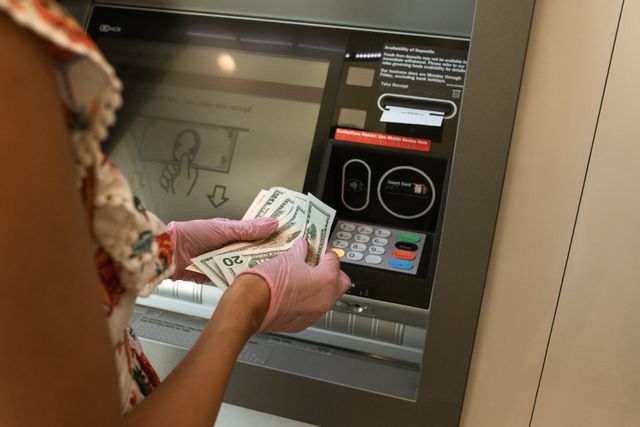
What actually triggers a report when you deposit cash — and the one mistake that turns a completely legal deposit into a federal case.
How Much Cash Can You Deposit Before the Bank Reports It? (2026 CTR, SAR & Form 8300 Rules)
Deposits over $10,000 trigger an automatic, routine report. But a bank can report anything smaller if it looks unusual — and trying to stay under either threshold on purpose is a separate federal crime, even if every dollar is completely legal.
- The $10,000 report is automatic and administrative. It is not an accusation, and it doesn’t mean you did anything wrong.
- A bank can report a deposit as small as $5,000 — or any amount — if it looks suspicious, and it is legally forbidden from telling you.
- Splitting cash into smaller deposits to dodge a report is its own crime, even when the money itself is 100% legitimate.
- Businesses have a separate rule with a 15-day deadline and real penalties for missing it.
Jump to the tool to see which rule applies to your situation.
And here’s the part almost nobody explains: the rule that can flag you has nothing to do with $10,000 at all.
Which rule applies to you?
Answer these about a transaction you’ve already decided to make. This tool identifies which report or rule potentially applies — it doesn’t tell you whether you’ll be reported, and it never suggests an amount to deposit.
If nothing appears above, your browser has JavaScript off. Tables 1 and 2 further down this page cover the same information without the tool.
1. The automatic rule: how the $10,000 CTR actually works
- Automatic
CTR
Filed by the bank on every currency transaction over $10,000. Routine, mechanical, no judgment involved.
- Discretionary
SAR
Filed at the bank’s discretion, starting as low as $5,000. Silent — the bank can’t tell you.
- Prohibited
Structuring
Splitting cash to dodge either report above. A federal crime, regardless of the money’s origin.
The $10,000 figure is real, but it’s not a per-deposit rule the way most people describe it. Banks have to aggregate: if you make more than one cash transaction at the same bank on the same business day, and they add up to more than $10,000, the bank treats them as a single transaction and reports it. That’s true even if you visit two different branches, and it applies to withdrawals and exchanges of currency too, not just deposits. Cash handled at night or over a weekend counts as if it happened the next business day.
When a CTR is required, the bank verifies your identity and taxpayer ID number as part of filing it electronically with FinCEN. You won’t get a formal notice that a CTR was filed on your transaction, but a CTR itself isn’t confidential the way the next layer is — it’s simply routine paperwork, filed and forgotten unless something else about the transaction draws attention on its own.
2. The rule nobody tells you about: Suspicious Activity Reports
This is the layer that surprises people. A Suspicious Activity Report, or SAR, can be filed by a bank on a transaction involving as little as $5,000 — for a money services business like a check casher or money transmitter, the bar is $2,000. And those are just the mandatory floors. A bank has the discretion to file a SAR on a transaction of any size, including well under those thresholds, if it knows, suspects, or has reason to suspect something is off.
A SAR being filed doesn’t automatically mean an investigation has started. It’s information sent to FinCEN and made available to law enforcement, who may or may not ever act on it. Most SARs don’t lead anywhere. If your bank asks where a large cash deposit came from, that’s normal due diligence, not a sign you’ve done something wrong — answer plainly, and keep a note of what you said in case it comes up again later.
3. The federal trap: structuring
The law is 31 U.S.C. §5324. It makes it a crime to break up cash transactions for the purpose of evading a CTR or Form 8300 filing requirement. The key word is purpose: the government has to show intent to evade the reporting requirement. It doesn’t have to show the money was illegal, because that isn’t the point of the statute — the point is that reporting requirements only work if people can’t opt out of them by breaking a transaction into pieces.
The plainest version of this, and the one worth remembering: repeatedly depositing amounts just under $10,000 is itself the crime. Not a warning sign of some other crime — the crime itself, on its own, regardless of where the cash came from.
Penalties are serious. A conviction can bring a fine and up to five years in prison. If the structuring happens alongside another federal crime, or as part of a pattern of illegal activity involving more than $100,000 in a 12-month period, the exposure roughly doubles — up to ten years and double the fine. Separately, the government can pursue forfeiture of the structured funds themselves, even without a related criminal conviction. That’s why this article never frames the thresholds above as something to plan around: the thresholds are facts about how reporting works, not a target to land under.
| Layer | Who files it | Threshold | Does the customer know? |
|---|---|---|---|
| CTR (FinCEN Form 112) | The bank, automatically | Over $10,000, aggregated per person per business day | No formal notice, but not confidential |
| SAR (FinCEN Form 111) | The bank, at its discretion | $5,000 for banks, $2,000 for money services businesses — or any amount if suspicious | No — banks are legally barred from disclosing it |
| Structuring (a prohibition, not a report) | Nobody files this — it’s the crime of trying to avoid the filings above | Any pattern designed to evade a CTR or Form 8300 filing | N/A — this is what triggers prosecution, not a report |
4. If you run a business: Form 8300
Everything above covers banks. If you run a business and accept cash directly from customers, there’s a separate, mandatory rule: any trade or business that receives more than $10,000 in cash in a single transaction, or in two or more related transactions, has to report it to the IRS and FinCEN on Form 8300 within 15 days of receiving the payment that pushes the total over $10,000. “Related transactions” matters here — payments from the same customer tied to one deal or purchase are added together over a 12-month window, even if no single payment tops $10,000 on its own.
Businesses also have to send the customer named on the form a written notice by January 31 of the following year. Unlike the SAR confidentiality rule, this notice requirement is not a secret — the customer is supposed to know a Form 8300 was filed about them.
Penalties for getting this wrong are not small, and they rise with inflation every year, so the year matters. For 2026, per Revenue Procedure 2025-32, a general (non-intentional) failure to file or furnish a correct Form 8300 carries a penalty of $340 per return, capped annually at $4,191,500 for larger filers and $1,397,000 for filers with average annual gross receipts of $5 million or less. If the failure is intentional disregard rather than an honest mistake, the penalty jumps to the greater of $34,930 or the amount of cash actually received, up to $139,500 per violation. Willful failure to file can also be prosecuted criminally — a felony carrying a fine and up to five years in prison, because Form 8300 violations are specifically carved out of the usual one-year misdemeanor treatment for failing to file other tax paperwork.
| Failure type | Per-return penalty | Annual cap — large filer | Annual cap — ≤$5M filer |
|---|---|---|---|
| General, non-intentional failure to file or furnish | $340 | $4,191,500 | $1,397,000 |
| Intentional disregard | Greater of $34,930 or cash received, up to $139,500 | Assessed per violation, not an annual aggregate | Assessed per violation, not an annual aggregate |
Starts the 15-day clock
- Receiving more than $10,000 in actual currency in one transaction
- Related cash payments from the same customer or deal that push a 12-month total over $10,000
- The day you physically receive the cash — not the day you get around to counting or depositing it
Doesn’t start the clock
- Personal checks, wire transfers, or ordinary bank-to-bank payments
- A single sale under $10,000 with no related payments expected later
- Non-cash trade or barter with no currency changing hands
If a structuring question or a missed Form 8300 deadline turns into something more serious, that’s exactly the kind of situation where it’s worth talking to a professional early. See When You Need a Tax Attorney (and Costs) for what that process and its costs typically look like.
5. A 2026 update: the border reporting order
FinCEN reissued a Geographic Targeting Order on September 2, 2026, aimed at cash movement tied to cartel activity along the southwest border. It’s effective for 180 days from its publication in the Federal Register, putting the expiration in early March 2027 barring a further reissuance.
This order lowers the reporting bar dramatically, but only in a narrow slice of the country. It requires certain money services businesses — the kind that cash checks or transmit money, not banks generally — located in specific ZIP codes within Bernalillo, Doña Ana, and San Juan counties in New Mexico, and Cameron, El Paso, Hidalgo, Maverick, and Webb counties in Texas, to report cash transactions between $1,000 and $10,000.
If you don’t live or bank in one of those counties, or you’re dealing with a bank rather than a money services business, this update doesn’t change anything for you. It’s included here for accuracy and currency, not because it’s likely to apply to most readers.
6. Proving where the cash came from (audit defense)
Separate from all of the reporting rules above, there’s a tool the IRS uses during an audit called the bank deposits method. If your bank deposits during a period exceed what your reported income would explain, the IRS can treat the unexplained portion as taxable income — the deposits themselves count as evidence, and the burden shifts to you to show a nontaxable source. This principle traces back to Tokarski v. Commissioner, 87 T.C. 74 (1986), and shows up regularly in later cases. In Berry v. Commissioner, T.C. Memo. 2021-42, a construction company deposited a large payment into its account without reporting it as income; because the deposit itself was enough to support the IRS’s determination, the burden fell on the business to prove otherwise.
The fix is documentation, gathered before you need it rather than after. A signed bill of sale supports a deposit from selling something. A gift letter supports money from a relative. A written loan agreement supports a loan. Records of a prior withdrawal support a simple redeposit of your own money.
| Source of funds | Acceptable documentation | What examiners look for |
|---|---|---|
| Sale of an asset (car, property, valuables) | Signed bill of sale with buyer’s name, date, and price | Whether the sale date and amount line up with the deposit |
| Gift | A written gift letter from the giver | Whether the giver’s own funds could plausibly cover it |
| Loan | A written loan agreement with terms | Whether there’s any actual repayment activity |
| Redeposit of a prior withdrawal | Bank records of the earlier withdrawal | Whether the amounts and dates reasonably match |
If unreported deposits found in an audit turn out to be self-employment income, that can retroactively expose you to underpaid quarterly taxes — see Quarterly Estimated Taxes: How Much to Set Aside & Avoid Penalty. And if an audit finding leaves you owing more than you can pay right away, IRS Hardship Program Guide: How to Apply for Fresh Start & CNC Status covers the options for that next step.
7. What this isn’t
This guide covers physical cash — bills and coins moving through a bank or a business. It doesn’t cover digital payment apps like Venmo or Cash App, which run on an entirely different reporting rule; see 1099-K Threshold 2026: Does Venmo Report to the IRS? for that.
It also doesn’t cover the FinCEN Residential Real Estate Rule, a separate reporting regime for certain real estate closings that a federal court vacated nationwide in March 2026 and that FinCEN is currently appealing — that’s a different, unsettled area of law with its own timeline. Beneficial-ownership reporting under the Corporate Transparency Act and international cash reporting under FBAR rules are likewise outside the scope of this guide.
8. Frequently asked questions
- Does the bank report cash deposits under $10,000?
- Not automatically. The mandatory CTR only kicks in above $10,000, aggregated per business day. But a bank can still file a SAR on a smaller deposit — as low as $5,000, or any amount — if something about it looks unusual.
- Can I deposit $9,000 without it being reported?
- A single $9,000 cash deposit doesn’t trigger the automatic CTR. But depositing $9,000 specifically to stay under the $10,000 threshold, especially as a pattern, is structuring — a separate federal crime under 31 U.S.C. §5324, regardless of the intent behind the money itself.
- Is splitting deposits illegal?
- Yes, when it’s done for the purpose of evading a CTR or Form 8300 filing. The money’s legality doesn’t matter; the intent to dodge the reporting requirement is what makes it a crime.
- What is a CTR?
- A Currency Transaction Report, FinCEN Form 112. Banks file it automatically for currency transactions over $10,000 in a single business day. It’s routine paperwork, not an accusation.
- What is a SAR, and will I know if one is filed?
- A Suspicious Activity Report, filed at a bank’s discretion starting around $5,000. No — banks are legally prohibited from telling you a SAR was filed or even that one exists.
- How much cash can a business accept before it has to report it?
- More than $10,000 in a single transaction, or in related transactions within a 12-month period, triggers a mandatory Form 8300 filing within 15 days.
- What happens if a business misses the 15-day Form 8300 deadline?
- Civil penalties apply, currently up to $340 per return for an honest mistake, or far more for intentional disregard — see the penalty table above for current 2026 figures. Willful failure can also be prosecuted as a felony.
- Is a cash gift taxable?
- Generally, no — gifts aren’t income to the person who receives them. Keep a written gift letter in case the deposit is ever questioned later.
- How does the IRS prove unreported income from bank deposits?
- Through the bank deposits method: unexplained deposits are treated as evidence of income, and the taxpayer has to show a nontaxable source like a gift, loan, sale, or redeposit.
- What’s the difference between a CTR and a SAR?
- A CTR is mechanical and mandatory above $10,000. A SAR is discretionary, can apply to much smaller amounts, and is legally confidential from the customer.
- What’s the difference between Form 8300 and a CTR?
- A CTR is filed by a bank on currency moving through an account. Form 8300 is filed by a business on cash it receives directly from a customer in a trade or business.
- Is a cash deposit the same as income?
- No, not automatically. But if the IRS can’t otherwise explain a deposit, it can treat it as if it were income unless you provide documentation showing a nontaxable source.
- Does my bank tell me if it reports my cash deposit?
- For a CTR, there’s no formal notice, though it isn’t treated as secret. For a SAR, the bank is legally barred from telling you, full stop.
- What if my bank asks where a large cash deposit came from?
- That’s routine due diligence, not a sign of a problem. Answer plainly and keep a record of what you said.
- Do all businesses have to worry about the Form 8300 rule, or just certain ones?
- Any trade or business that receives more than $10,000 in cash — car dealers, real estate agents, contractors, jewelers, attorneys, and plenty of others — is covered, not just businesses that primarily deal in cash.

Daniel Hayes is the founder and sole researcher at AdvoraHQ. He covers U.S. personal finance, insurance, and consumer law — working directly from IRS publications, federal and state statutes, court opinions, and SEC filings rather than secondary summaries. His focus is the gap between what readers think they know and what the source documents actually say. Daniel is not a licensed attorney, CPA, or financial advisor; his articles are educational and not personalized advice. Reach him at Daniel.Hayes@advorahq.com.