
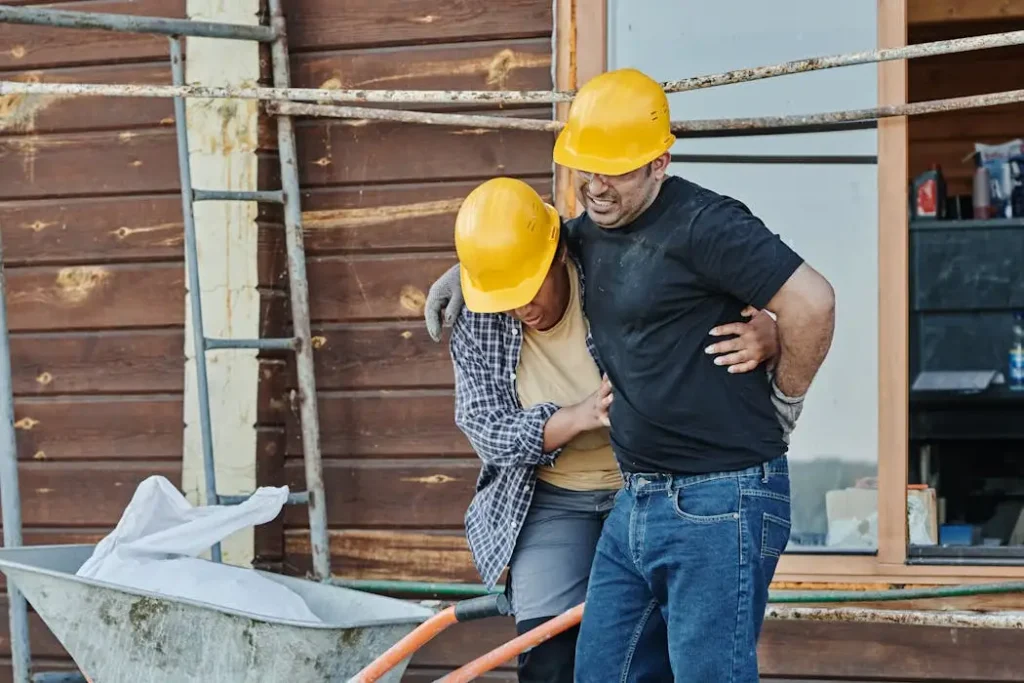
A construction accident lawyer represents injured workers in two parallel cases: a workers’ compensation claim against the employer, and a third-party lawsuit against any other party whose negligence contributed to the injury. The third-party case is usually where significant damages are recovered. Workers’ comp pays medical bills and a fraction of lost wages no matter who was at fault, but it does not pay for pain and suffering, full lost earnings, or diminished future earning capacity. A third-party suit can.
Most construction sites involve multiple companies — property owner, general contractor, several subcontractors, equipment lessors, materials manufacturers. Each one is a potential defendant if its conduct caused the injury. Construction remains one of the deadliest industries in the country: 1,032 construction and extraction workers died on the job in 2024, roughly one in five private-sector workplace deaths. The non-fatal injury count runs into the hundreds of thousands.
If you were seriously hurt — surgery, more than a few weeks off work, permanent restrictions, or any catastrophic injury — and anyone other than your direct employer may have contributed, you likely have a third-party case worth investigating. The consultation is free in nearly every U.S. jurisdiction. The hard work this article does is explain what comes after the consultation: who pays, how much actually reaches the worker, and the financial mechanics most lead-generation pages obscure.
When You Actually Need a Construction Accident Lawyer
Not every construction injury justifies hiring a lawyer. A laceration that heals in two weeks, a sprained ankle that costs you four lost shifts — workers’ compensation alone usually handles those cleanly. The system works as designed for short-duration, low-severity claims.
You need a lawyer when one or more of the following is true:
- The injury required surgery, hospitalization, or has any chance of leaving permanent restrictions
- You will miss more than a few weeks of work, or your wages exceed the workers’ comp weekly cap
- The accident involved a fall from height, a falling object, electrocution, an equipment failure, a trench collapse, or a vehicle on site
- Multiple companies were working on the site (almost always the case)
- The workers’ comp insurer is denying treatment, disputing causation, or pushing you to return to work prematurely
- You were paid on a 1099 and were told you have no claim — that is often wrong
- A family member died on the job
The decision is rarely about whether you can handle workers’ comp paperwork yourself. It is about whether someone other than your employer is also legally responsible — and whether anyone is investigating that question on your behalf. The workers’ comp adjuster will not. That adjuster’s mandate is to pay statutory benefits and close the file.
Workers’ Comp vs. Third-Party Claims: The Two-Track System
This is the most important concept in construction injury law, and most online guides treat it as a footnote. Get this right and the rest of the field becomes navigable.
The Workers’ Compensation Track
Workers’ compensation is a no-fault insurance system. If you are injured in the course of employment, you receive benefits regardless of who caused the accident — even if the accident was entirely your fault. In exchange, you give up the right to sue your employer for negligence. This trade-off is called the exclusive remedy rule, and it appears in every state’s workers’ comp statute.
Workers’ comp benefits typically cover:
- All reasonable and necessary medical treatment, with no copays or deductibles
- Temporary disability payments, usually around two-thirds of average weekly wage, subject to a state cap
- Permanent disability awards based on a statutory schedule or impairment rating
- Vocational rehabilitation in many states
- Death benefits to surviving dependents
What workers’ comp does not cover is the most expensive part of any serious injury: pain and suffering, the wages above the statutory cap, loss of future earning capacity beyond the rated impairment, and loss of consortium for the injured worker’s spouse. For a tradesperson earning $90,000 a year with a permanent shoulder injury, the gap between what workers’ comp pays and what the injury actually costs over a working lifetime can run into seven figures.
Independent Contractor or Employee? Why Misclassification Matters
Workers’ compensation only protects employees. Independent contractors, in most states, are excluded — which is exactly why misclassification is rampant on construction sites. A subcontractor who pays you on a 1099 to avoid carrying workers’ comp coverage is not the final word on your legal status.
Courts and state labor boards apply a multi-factor test, regardless of what your paycheck stub says. Some states use the IRS common-law control test; others have adopted the stricter ABC test, under which a worker is presumed an employee unless the hiring party proves all three of: the worker is free from control, performs work outside the usual course of business, and is engaged in an independent trade. The factors that actually move the needle:
- Who controls the work — the schedule, the methods, the supervision
- Who supplies the tools, materials, and safety equipment
- Whether the worker holds out as a separate business with multiple clients
- Whether the relationship is project-based or open-ended
- How the worker is paid — hourly versus by the job
Two practical consequences when reclassification is granted. First, the worker becomes eligible for workers’ comp benefits retroactively, often with penalties payable by the employer. Second, the exclusive remedy rule does not apply to an employer who failed to carry required coverage — meaning the worker can sue the “employer” directly in tort, with no cap on damages. The third-party case proceeds in parallel either way. If you were told you have no claim because you were 1099, get a second opinion.
The Third-Party Track
The exclusive remedy rule blocks lawsuits against the employer. It does not block lawsuits against anyone else. A “third party” is any person or entity that contributed to the injury and is not your employer or a co-worker. On a construction site, third parties are everywhere:
- The property owner who hired the general contractor
- The general contractor, if you work for a subcontractor
- Other subcontractors whose trade created or ignored a hazard
- Manufacturers of defective scaffolding, hoists, ladders, power tools, or PPE
- Architects or engineers if a design defect caused the harm
- Drivers or owners of vehicles that struck workers on or near the site
- Equipment rental companies that failed to maintain or inspect machinery
A third-party lawsuit recovers the full range of personal injury damages — economic and non-economic. The worker must prove the third party was negligent, but on a construction site that proof is often built into the OSHA-regulated environment. OSHA’s Construction Focus Four hazards account for roughly 60% of construction fatalities. Each carries detailed federal safety standards. A standard violation, while not automatic proof of civil liability, is powerful evidence of negligence.
How the Two Tracks Interact: The Lien
You can pursue both claims at the same time. Filing a third-party suit does not reduce or terminate your workers’ comp benefits, and your employer cannot retaliate for filing one. There is one practical complication: the workers’ comp insurer typically has a statutory lien on the third-party recovery, equal to the benefits it has paid. Courts call this subrogation — the principle that a single injury should not be compensated twice for the same loss.
If workers’ comp paid $80,000 in medical bills and lost wages, and you settle a third-party case for $1,200,000, the comp insurer is entitled to be reimbursed from the settlement before you take your share. An experienced lawyer negotiates the lien down. Most state statutes require the lienholder to absorb a proportionate share of attorney’s fees and costs, and many liens are routinely reduced by 25–40% in settlement. The net effect is meaningful: a well-handled lien negotiation can put six figures more in the worker’s pocket. The math at the end of the damages section makes this concrete.
| Feature | Workers’ Compensation | Third-Party Lawsuit |
|---|---|---|
| Defendant | Employer’s insurer | Owner, GC, other subs, manufacturer |
| Fault required? | No | Yes (negligence or strict liability) |
| Pain and suffering | Not covered | Recoverable |
| Lost wages | ~66% up to weekly cap | Full past and future |
| Spouse’s loss of consortium | Not covered | Recoverable |
| Typical timeline | Benefits begin within weeks | 18 months to 4 years to resolve |
| Jury trial available? | No (administrative hearing) | Yes |
Common Types of Construction Accidents
OSHA tracks four hazard categories — falls, struck-by, electrocution, and caught-in/between — that together cause roughly 60% of construction fatalities. The agency calls them the Focus Four, and they map closely to the most common third-party claim theories. Each category has its own technical proof requirements and its own typical defendants.
Falls from Heights
Falls are the leading cause of construction death by a wide margin, accounting for roughly 33.5% of fatalities. OSHA requires fall protection at any work surface six feet or higher. Where guardrails, safety nets, or personal fall arrest systems are missing, undersized, or improperly anchored, the standard violation typically falls on the controlling employer — the general contractor or property owner. In New York, fall cases are filed under Labor Law § 240 and tried under absolute liability. In other states, they are negligence claims with comparative fault available as a defense. Falls from ladders and from elevations between six and thirty feet make up the bulk of fatal incidents — a reminder that catastrophic injury does not require dramatic height.
Struck-By Incidents
Approximately 11.4% of construction deaths involve workers struck by a moving vehicle, falling tool, swinging load, or flying debris. Common defendants include the equipment operator’s employer, the lifting subcontractor, the crane or hoist owner, and — when a tool falls from above — the trade working overhead. Crane and rigging cases often involve federal regulations under 29 CFR 1926 Subpart CC, which set detailed inspection, certification, and operator-qualification standards. A documented violation is highly persuasive on liability.
Electrocutions
Roughly 8.4% of construction fatalities are electrical. The two recurring fact patterns: contact with overhead power lines by cranes, ladders, or scaffolding, and contact with energized circuits during work that should have been locked out. Electrical contractors carry a heightened duty under both OSHA and the National Electrical Code. Survivors of electrical injuries often have neurological and cardiac sequelae that emerge over months — a reason to delay settlement until the medical picture stabilizes.
Caught-In/Between
About 5.4% of construction deaths involve workers crushed by equipment, pinned between objects, or buried in trench collapses. Trench fatalities specifically have dropped sharply since OSHA’s 2022 zero-tolerance enforcement initiative — from 39 deaths in 2022 to 12 by November 2024 — but excavation work remains acutely dangerous. Trench cases turn on whether protective systems (sloping, shoring, shielding) were used as required by 29 CFR 1926 Subpart P at depths of five feet or more.
Other Categories
Beyond the Fatal Four, construction injury claims regularly arise from vehicle and equipment rollovers, fires and explosions, exposure to silica or asbestos, repetitive trauma (rotator cuff and lumbar disc injuries are the most common), and heat illness. Toxic exposure claims have a unique limitations rule in most states: the clock runs from discovery rather than from first exposure, because the disease often manifests years after the harm.
Who Can Be Held Liable on a Construction Site
Liability on a multi-employer worksite follows control. The general principle: a party is responsible for the safety of the area or activity it controls. OSHA enforces this through its Multi-Employer Citation Policy, which classifies parties as creating, exposing, correcting, or controlling employers. Civil courts apply analogous logic in negligence and premises liability claims.
General Contractors
The general contractor coordinates the entire site and typically holds the broadest safety duty. If the GC’s site safety plan was inadequate, if it failed to enforce fall protection, or if it allowed multiple trades to work in unsafe sequence, the GC is exposed even when the injured worker was employed by a subcontractor. In several states, including New York, the GC’s duty is non-delegable for certain elevation-related hazards.
Property Owners
Owners who actively direct construction methods or retain control over safety are liable under premises liability and, in some states, statutory provisions. Passive owners who simply hire a competent contractor and step away are generally protected — except in jurisdictions like New York that impose strict statutory duties regardless of supervision.
Other Subcontractors
If a different trade left an unguarded floor opening, energized a circuit you were working on, or struck you with a forklift, that subcontractor is a third party. Cross-trade negligence is among the most common third-party theories on multi-employer sites.
Equipment Manufacturers
A defective product claim against a manufacturer does not require proof of negligence — only that the product was defective and caused the injury. Common targets: scaffolding, aerial lifts, ladders, harnesses, power tools, and electrical equipment. Recalls, prior incident reports, and engineering records become discoverable.
Architects and Engineers
Design professionals can be liable when a design defect — an unsafe sequence, an inadequate shoring plan, a structural miscalculation — causes the injury. These claims are technical and require expert testimony, but they can be high-value when the design failure was systemic.
New York’s Scaffold Law and Other State-Specific Statutes
Construction injury law is largely state law, and the variation is substantial. New York’s regime is the most worker-protective in the country and deserves separate attention because it changes the analysis of any case with New York venue.
Labor Law § 240 — The Scaffold Law
New York Labor Law § 240(1), enacted in its modern form in 1921 and amended repeatedly since, imposes absolute liability on property owners and general contractors for elevation-related injuries when proper safety devices are not provided. Absolute liability means once a worker establishes that inadequate fall protection caused a gravity-related accident, fault is assigned by operation of law — comparative negligence does not apply. New York is the only state in the country with this standard still on its books for construction injuries.
Covered events include falls from scaffolds, ladders, roofs, and elevated platforms, as well as injuries from falling objects when the failure of a hoist, sling, or similar device contributed. The statute lists covered activities: erection, demolition, repairing, altering, painting, cleaning, or pointing of a building or structure. Routine maintenance is generally excluded. Owners of one- and two-family homes who do not direct the work are also exempt.
Labor Law § 241(6) — Industrial Code Violations
Section 241(6) requires owners and contractors to comply with specific provisions of the New York Industrial Code. Liability under this section requires proof that a concrete code provision was violated and the violation contributed to the injury. The code addresses trenching, shoring, scaffolding, lighting, walking surfaces, and dozens of other site conditions. A § 241(6) claim does not impose absolute liability the way § 240 does, but a documented code violation is powerful evidence and removes the defense that the owner or GC lacked notice of the hazard.
Labor Law § 200 — Codified Common-Law Negligence
Section 200 codifies the general duty to provide a safe workplace. It functions as a negligence statute and requires proof that the defendant exercised supervisory control over the work, or had actual or constructive notice of a dangerous condition. It is the broadest of the three sections but the hardest to prove.
Most New York construction cases plead all three sections together. They operate as overlapping shields: if § 240 absolute liability is unavailable because the injury was not gravity-related, a § 241(6) code violation may still apply, and § 200 covers the residual.
Other State Frameworks
Outside New York, most states apply ordinary negligence principles to construction injury cases, modified by state-specific premises liability doctrines and contractor licensing rules. California, Illinois, Texas, and Florida all have substantial construction injury caselaw — but none impose absolute liability for elevation hazards. Illinois repealed its Structural Work Act in 1995, leaving New York alone in this regard.
What You Can Actually Recover (and Take Home)
Damages in a construction injury case fall into three categories: economic, non-economic, and, in narrow circumstances, punitive. The category that matters most for serious injuries — and the one that workers’ comp will not pay — is non-economic.
Economic damages include past and future medical expenses, past lost wages, and loss of future earning capacity. Future earning capacity is the largest economic component for younger workers with permanent restrictions. A 35-year-old electrician who can no longer climb is not just losing wages — that worker is losing the wage premium that came with the trade. Vocational and economic experts calculate this number.
Non-economic damages compensate pain and suffering, loss of enjoyment of life, scarring, and emotional distress. There is no formula. Juries set the figure based on severity, duration, age, and the credibility of the testimony. A spouse’s loss of consortium claim is a separate non-economic recovery in most states.
Punitive damages are rare in construction cases but available when the defendant’s conduct was reckless rather than merely negligent — for example, knowingly removing fall protection to speed up a job, or concealing a known equipment defect.
Illustrative Settlement Ranges
The figures below are composite ranges based on published verdicts and settlements in similar cases over the past five years. Individual case values turn on jurisdiction, liability strength, the specific medical picture, and the worker’s earning history. They should be read as orders of magnitude, not predictions.
- Fall from a residential ladder, lumbar disc herniation with single-level fusion, full return to work after twelve months. Negligence-based jurisdiction, comparative fault disputed. Settlement range: $400,000 to $850,000.
- Scaffold collapse, comminuted tibial plateau fracture and traumatic brain injury with permanent cognitive deficits, age 38, union ironworker. New York Labor Law § 240 case, absolute liability. Settlement range: $4.5 million to $9 million.
- Electrocution survivor, contact with overhead line, third-degree burns and lasting peripheral neuropathy, age 45. Multi-defendant case (utility, GC, crane operator). Settlement range: $3 million to $7 million.
- Wrongful death, trench collapse, married father of two, age 32, no protective system in place. OSHA willful violation. Settlement range: $2.5 million to $6 million, varying widely by state caps and venue.
Net Recovery: Where the Money Actually Goes
A $1 million settlement is not $1 million in the worker’s bank account. The math that follows is the single most useful exercise an injured worker can do, and it is the math most law firm marketing pages avoid.
Consider a $1,000,000 third-party settlement in a typical state with a 33⅓% contingency fee, $80,000 in case expenses, and $150,000 in workers’ comp benefits paid before settlement:
| Item | Amount |
|---|---|
| Gross settlement | $1,000,000 |
| Attorney’s fee (33⅓%) | ($333,333) |
| Case expenses reimbursed | ($80,000) |
| Workers’ comp lien (gross $150,000) | — |
| Lien reduction for fees and costs (~33%) | +$50,000 |
| Net lien repayment | ($100,000) |
| Net to worker | $486,667 |
Two variables in that table do most of the work. First, whether the contingency fee is calculated before or after case expenses are deducted — a roughly $26,000 swing on a million-dollar case. Second, how aggressively the workers’ comp lien is negotiated. A skilled lawyer treats both as live issues. A poorly run case treats them as fixed costs.
For workers approaching Medicare eligibility, a third variable enters: a Medicare Set-Aside, which sets aside a portion of the settlement to cover future injury-related medical care that would otherwise fall on Medicare. MSAs typically run from 5% to 25% of the settlement and reduce the immediately-payable amount accordingly.
Critical Deadlines
Construction injury cases die more often from missed deadlines than from weak liability. There are three distinct clocks running, and they do not match.
Workers’ compensation notice is the shortest. Most states require written notice to the employer within 30 days, sometimes within days. Late notice can void the claim entirely. Tell your supervisor in writing the day of the accident and keep a copy.
Workers’ compensation claim filing is a separate deadline, usually one to two years from the date of injury or last benefit payment, depending on the state.
The third-party statute of limitations is typically two to three years from the date of injury, but several states use shorter or longer periods, and the clock can be tolled for minors or workers under legal disability. Product liability claims may run from the date of discovery rather than the date of injury.
Government-owned project claims have a separate, much shorter notice rule. In New York, a notice of claim against a municipality must be served within 90 days. Federal projects fall under the Federal Tort Claims Act, which has its own administrative claim process. Miss the notice and the case is gone, regardless of the underlying statute of limitations.
Wrongful death actions add another deadline overlay. Some states run the limitations period from the date of death rather than the date of the underlying injury, and the personal representative — not the family — must bring the claim.
How Construction Accident Lawyer Fees Work
Almost all construction injury attorneys work on a contingency fee. You pay nothing up front. The lawyer advances case expenses (expert fees, deposition costs, investigation costs) and recovers them from the settlement, plus a percentage fee, only if the case wins.
Standard contingency rates for the third-party portion of the case:
- 33⅓% if the case settles before trial in most jurisdictions
- 40% if the case is tried or appealed, depending on the retainer agreement
- State-specific sliding scales in some jurisdictions (New York uses a sliding scale for medical malpractice but not for general personal injury)
The workers’ compensation portion is regulated separately. Most states cap workers’ comp attorney fees at 15–25% of the disputed benefit, payable only out of disputed amounts and often subject to judge approval. A worker generally does not pay a separate fee for the workers’ comp track when both cases are handled together — the comp portion is folded into the overall representation.
Read the retainer carefully. The fee should be calculated on the recovery net of case expenses in some states and gross in others. The difference matters: on a $1 million settlement with $80,000 in expenses, the difference between net-fee and gross-fee structures is roughly $26,000.
What to Do in the First 72 Hours
The first three days set the evidentiary foundation for everything that follows.
- Get medical care immediately. Tell the treating provider exactly how the injury happened. The medical record is the single most-cited document in any later litigation.
- Report the injury to your supervisor in writing. Email is ideal. Keep a copy. Many states require written notice within days.
- Photograph everything. The accident scene, the equipment involved, your injuries, the surrounding site conditions. Take more photos than you think you need.
- Identify witnesses. Names and phone numbers, written down the same day. Construction sites turn over fast — a witness available today may be on a job in another state next week.
- Preserve the equipment. If a tool, harness, ladder, or piece of machinery failed, ask in writing that it be preserved. A spoliation letter from your lawyer follows. Defendants who destroy or “misplace” failed equipment after notice face evidentiary sanctions.
- Do not give a recorded statement to any insurer. Not your employer’s, not the GC’s, not anyone’s. Polite refusal is your right.
- Consult a construction accident lawyer before signing anything. Releases, settlement offers, and “informal” paperwork from carriers in the first weeks often waive rights you do not yet know you have.
How to Choose the Right Lawyer
Construction injury law is a specialty within personal injury. The general personal injury attorney who handles your neighbor’s car accident is usually not the right choice for a serious construction case. Ask specific questions.
Experience Questions
What percentage of the firm’s docket is construction cases? How many have they tried to verdict in the past five years? Who are the engineering and medical experts they typically use? What was their largest construction recovery, and what was the median? Specifics, not slogans.
Resource Questions
Construction cases are expensive to develop. Site reconstructions, biomechanical experts, OSHA experts, vocational and economic experts, life-care planners — a serious case can cost $100,000 or more in expenses before trial. Ask whether the firm has the resources to fund the case and how it handles expense advances if the case is lost.
Communication Questions
Who will be your point of contact — the named partner you met or a paralegal you have not? How often will you receive case updates? What is the firm’s policy on returning calls? These are not soft questions. The two most common complaints in attorney-client grievances involve communication and unauthorized settlements.
Conflict Questions
Has the firm ever represented the property owner, the general contractor, or any subcontractor on the project? A conflict check is not optional. Insist on it in writing.
Frequently Asked Questions
- Can I be fired for filing a workers’ comp claim or third-party lawsuit?
- No. Every state prohibits retaliation for filing a workers’ comp claim, and federal civil rights and OSHA whistleblower statutes provide additional protection. Retaliation gives rise to a separate cause of action with its own damages.
- Do I have a case if I am an undocumented worker?
- Yes. Workers’ compensation and personal injury rights generally do not depend on immigration status. New York’s Labor Law § 240 explicitly applies regardless of immigration or union status, and most other states reach the same result. Lost-wage damages may be calculated differently in some jurisdictions.
- I was paid on a 1099. Do I really have no claim?
- That is a frequent and often wrong assumption. Your tax form does not determine your legal status. If the company controlled your work, supplied your tools, or you worked exclusively for them, you may be a misclassified employee — eligible for workers’ comp and, where coverage was illegally absent, a direct negligence suit against the employer. Get a second opinion before accepting that you have no claim.
- What if I was partly at fault for the accident?
- It depends on the state and the legal theory. Workers’ comp pays regardless of fault. Most states apply comparative negligence to third-party claims, reducing recovery proportionally. New York’s Labor Law § 240 is a notable exception — comparative negligence does not apply to elevation-related claims under that statute.
- How long does a construction accident case take?
- Workers’ comp benefits typically begin within weeks of filing. A third-party lawsuit takes 18 months to 4 years from filing to resolution, depending on liability complexity, the extent of medical treatment, and court backlog. Cases with disputed liability and serious injuries take longer because the medical picture must stabilize before settlement.
- What if my employer did not carry workers’ comp insurance?
- The exclusive remedy rule generally evaporates when the employer fails to carry required coverage. Most states allow the worker to sue the employer directly for negligence and recover statutory penalties, while also accessing an uninsured employer fund for benefits. The third-party case proceeds as usual.
- What if a family member was killed on the job?
- Surviving dependents typically receive workers’ comp death benefits and may also bring a wrongful death action against any negligent third party. Wrongful death damages include funeral expenses, lost financial support, and, in many states, loss of companionship. The personal representative of the estate brings the claim, not the family directly.
- Should I sign the settlement offer the insurance company gave me in the first week?
- No. Early settlement offers are nearly always below case value because the full medical picture has not yet emerged. A signed release extinguishes the claim. Have a lawyer review any offer before signing.

Daniel Hayes is the founder and sole researcher at AdvoraHQ. He covers U.S. personal finance, insurance, and consumer law — working directly from IRS publications, federal and state statutes, court opinions, and SEC filings rather than secondary summaries. His focus is the gap between what readers think they know and what the source documents actually say. Daniel is not a licensed attorney, CPA, or financial advisor; his articles are educational and not personalized advice. Reach him at Daniel.Hayes@advorahq.com.