
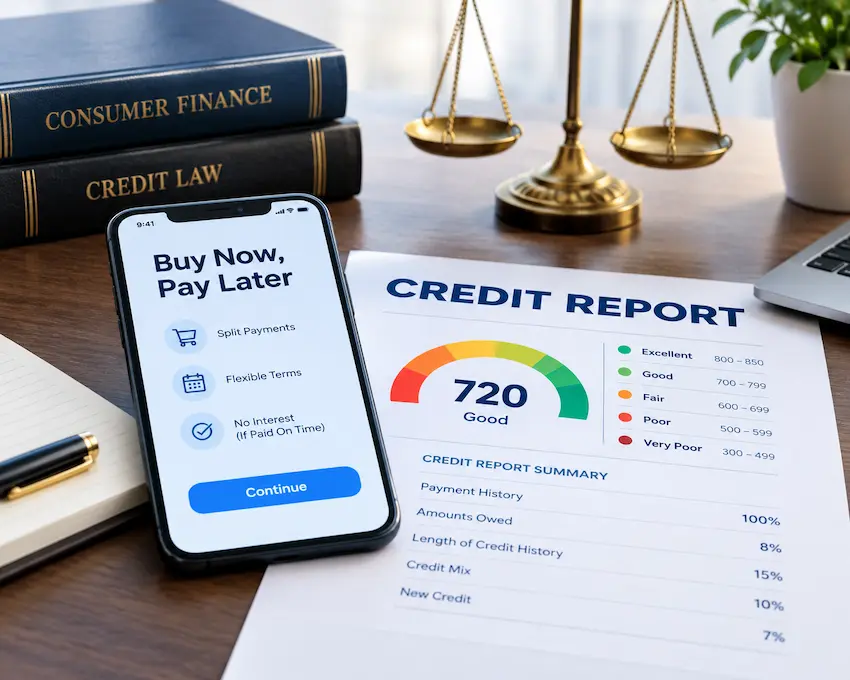
Three different questions get mixed together whenever this comes up, and most articles answer only one of them.
One: does the loan appear on your credit report? For some providers and some products, yes.
Two: does it change your FICO Score? According to myFICO, none of the three major credit bureaus currently feed reported BNPL account data into a FICO Score calculation — so for now, for most people, it doesn’t.
Three: will that last? No. New scoring models already exist, and bureau reporting is expanding provider by provider.
The honest risk line: what can hurt your credit today is the same thing that always could — an unpaid balance that gets sent to collections.
The Three-Layer Answer, at a Glance
- On your report?
- Depends on the provider and the product.
- In your FICO Score?
- Not yet, per myFICO — no bureau currently feeds it into the calculation.
- Used by your lender?
- A BNPL-aware FICO model exists, but adoption by lenders is separate and gradual.
- Affirm
- Reports to Experian and TransUnion, including Pay in 4. Not Equifax.
- Klarna
- Pay in 4 and Pay in 30 not routinely reported. Longer financing is reported.
- Afterpay
- Does not report to any of the three bureaus in the US.
- PayPal Pay Later
- Policy not officially published; on-time activity generally not reported.
Verified October 13, 2026. See the full, sourced table below.
Check your own situation: jump to the reporting checker below.
Verified October 13, 2026. Provider policies change often — check the links before you rely on this.
Will My BNPL Loan Show Up? Check Your Situation
Answer five quick questions about your plan and we’ll walk through what’s likely, based on each provider’s own published policy.
Three Questions People Mix Together
Most of the confusion about BNPL and credit comes from treating one question as if it answers all three.
This is about furnishing: does the provider send your account data to a credit bureau at all? Affirm does, for nearly everything. Klarna and Afterpay mostly don’t, for their short-term plans. This is a provider-by-provider, product-by-product fact, not a yes/no for the whole industry.
Even when an account is sitting in your file at a bureau, that’s not the same as it being used in the math behind your FICO Score. Per myFICO’s own FAQ, none of the three major bureaus currently feed BNPL account information into a FICO Score calculation. An account can be fully visible on your report and still have zero effect on the three-digit number.
The gap above is about routine, on-time use. It doesn’t cover what happens when a payment goes unpaid long enough to land with a debt collector, or when a longer-term loan involves a hard inquiry, or when a mortgage underwriter looks at your bank statements rather than your score. Those risks exist regardless of what the scoring math currently ignores.
| Question | Current answer | Source and date |
|---|---|---|
| Is it on your credit report? | Depends on the provider and product — see the provider table below. | Provider help centers, verified Oct. 13, 2026 |
| Is it in your FICO Score? | Not currently, per the three major bureaus’ own feeds to FICO. | myFICO FAQ, verified Oct. 13, 2026 |
| Is it used by your specific lender? | Only if that lender has chosen a BNPL-aware score, which is a separate, lender-by-lender decision. | FICO Score 10 BNPL announcement, June 23, 2025; reporting on adoption, Sept. 2026 |
Who Reports, and to Which Bureau
Reporting varies by company and, within a company, by which product you used.
- Products
- All pay-over-time products, including Pay in 4 and monthly installments
- Bureaus
- Experian (from April 1, 2025) and TransUnion (from May 1, 2025). Not Equifax.
- Verified on
- October 13, 2026
- Source
- Affirm/TransUnion press release
- Products
- Pay in 4 and Pay in 30 (not routinely reported); longer financing (reported)
- Bureaus
- Longer financing: TransUnion and Experian. Short-term plans: not routinely furnished in the US.
- Verified on
- October 13, 2026
- Source
- Klarna US product terms — confirm current wording for your specific plan
- Products
- All current US products
- Bureaus
- None. Afterpay states it does not currently report to credit bureaus in the United States.
- Verified on
- October 13, 2026
- Source
- Afterpay US help center
- Products
- Pay in 4 and Pay Monthly
- Bureaus
- Not officially published by PayPal. Independent reporting suggests routine on-time payments generally aren’t furnished; defaults may be.
- Verified on
- October 13, 2026 — flagged as unconfirmed at the source
- Source
- PayPal Pay Later — no bureau-reporting statement found on PayPal’s own pages as of this date
| Provider | Product | Bureaus | Verified on | Source |
|---|---|---|---|---|
| Affirm | Pay in 4 and monthly installments | Experian, TransUnion (not Equifax) | Oct. 13, 2026 | Press release |
| Klarna | Pay in 4 / Pay in 30 | Not routinely reported in the US | Oct. 13, 2026 | Klarna US terms |
| Klarna | Longer financing | TransUnion, Experian | Oct. 13, 2026 | Klarna US terms |
| Afterpay | All current US products | None reported currently | Oct. 13, 2026 | Afterpay help center |
| PayPal Pay Later | Pay in 4 and Pay Monthly | Not officially published by PayPal | Oct. 13, 2026 | PayPal Pay Later |
A note on Equifax specifically: Affirm’s expansion announcement covered Experian and TransUnion. That is not the same as Equifax, and nothing in Affirm’s own disclosures says Equifax is included. If a lender pulls only your Equifax file, Affirm activity currently won’t be the reason anything looks different there.
Why It Probably Isn’t Moving Your Score Today
Even where a provider reports faithfully, the bureau side of the pipe is the part most articles skip.
myFICO, in its own FAQ on this exact question, states: in order for BNPL account information to affect a FICO Score, that information has to be in the consumer’s file at a bureau and be fed into a FICO Score calculation by that bureau. Its understanding at this time is that none of the three major bureaus currently feed reported BNPL account information into the calculation of a FICO Score. For as long as that is the case, the information will not impact your FICO Score.
Source: myFICO FAQ, “How will a Buy Now Pay Later (BNPL) account impact my FICO Scores?” Verified October 13, 2026.
Affirm’s own announcement of its TransUnion reporting said the same thing from the provider’s side: transactions would be visible on the TransUnion file, but would not be factored into traditional credit scores, nor visible to lenders, in the near term. TransUnion has said the same — BNPL data is tagged and segmented into its own section of the file, deliberately kept out of standard scores and attributes for now.
Put together: an Affirm Pay in 4 purchase made today can be sitting on your Experian and TransUnion files and still not move a single point on the FICO Score a lender pulls. That’s not a loophole or a guess — it’s the stated position of the company that builds the score and the bureau carrying the data.
Appearing on your report and changing your score are two different things.
FICO Score 10 BNPL: What It Is and Who Uses It
FICO announced two new score versions built specifically to include BNPL data, on June 23, 2025: FICO Score 10 BNPL and FICO Score 10 T BNPL (the trended-data version). Both became available to lenders starting in fall 2025, alongside the regular, non-BNPL versions of the score.
FICO’s own study, run jointly with Affirm’s data, found that adding BNPL loans shifted scores by roughly 10 points for the large majority of the customers it examined — a modest move, not the dramatic swing that some alarmist coverage implies.
Source: coverage of FICO’s Score 10 BNPL announcement and study, June 2025; verified October 13, 2026.
A new scoring model existing is not the same as your lender using it.
That’s the part worth sitting with. A lender has to actively choose to pull the BNPL-aware version instead of the standard one. As of this writing, industry reporting describes adoption as gradual — some analysts expect it could take years before use of the new models is widespread, partly because many BNPL lenders aren’t obligated to furnish data to bureaus in the first place, and several have said they don’t plan to report Pay in 4 activity at all. Until a specific lender tells you otherwise, assume the score it’s pulling is the ordinary one.
Soft Checks, Hard Checks
The credit check at checkout and the ongoing reporting of your account are two separate things, and they follow different rules.
Pay-in-4-style plans typically run on a soft credit check to approve you. A soft check doesn’t appear to other lenders and doesn’t move your score — this applies across Affirm, Klarna, Afterpay, and PayPal’s short-term plans.
Longer-term financing is where that changes. Multi-month plans — Affirm’s monthly installments, Klarna’s financing option, Afterpay’s longer Pay Monthly product — more often involve a hard inquiry at final approval. A hard inquiry can cause a small, temporary dip on its own, separate from anything about the account itself being reported.
Policies vary by provider and even by purchase size, so check the specific plan’s terms before you confirm it if a looming mortgage or auto application makes a stray inquiry something you’d rather avoid.
What Actually Can Hurt You
None of the reassurance above means BNPL is risk-free. It means the risk sits in a different place than most headlines put it.
Collections. The CFPB’s own guidance confirms that while most pay-in-four lenders don’t report on-time payments, a BNPL loan turned over to a debt collector can be reported and can hurt your credit scores. A collections account is the clearest, most consistent way routine BNPL use turns into a real credit problem, regardless of whether the original provider itself reports.
Stacking several plans. Multiple small installment obligations across different apps can be invisible to your credit report and still show up in a lender’s manual review of your bank statements or in a debt-to-income calculation. If you’re juggling several plans at once, our guide on how to pay off credit card debt fast covers how to prioritize them.
Mortgage and other big-loan underwriting. Underwriters for a mortgage or auto loan often look well past the score — at monthly obligations and bank statement activity. Several open BNPL plans can read as a cash-flow concern even when your score hasn’t moved.
Hard inquiries on longer financing. Covered above, but worth repeating here: a flurry of financing applications close together can add up.
The collections path is the real risk.
Does It Build Credit?
Mostly, no — and that follows from everything above. If a short-term plan with a given provider isn’t reported, on-time payments can’t build a payment history that doesn’t exist at the bureau. Afterpay says plainly that its payments don’t affect your credit either way. Klarna’s short-term plans work the same way for most users.
Affirm is the partial exception: because it reports broadly to Experian and TransUnion, consistent on-time payments there can appear as positive history on those two files — though, per the layers above, that history still isn’t factored into your FICO Score today. If building credit is the actual goal, a product designed and reported specifically for that purpose — a secured card, a credit-builder loan — is a more direct and more reliably reported path than any BNPL plan.
How to Check All Three Reports
The only way to know what’s actually on your file is to look at your file, not a general article.
- Go to AnnualCreditReport.com — the free, federally authorized source — and pull all three reports, not just one.
- In each report, look in the installment or “other accounts” section for a lender name you don’t immediately recognize. BNPL tradelines often show under the provider’s own name or a processing name tied to it.
- Note the account’s opening date and current balance, and compare it against your own purchase records.
- Check all three bureaus separately. One showing nothing proves nothing about the other two — reporting relationships differ bureau by bureau, as the provider table above shows.
Check all three reports — one bureau’s silence proves nothing about the others.
If the Entry Is Wrong
If a BNPL tradeline shows an incorrect balance, a late mark you don’t believe is accurate, or an account you don’t recognize at all, this is a credit-report error, not a billing dispute with the merchant.
- Gather your order confirmations, payment records, and any correspondence with the provider.
- File a dispute directly with the bureau showing the error, and separately notify the furnisher — the BNPL provider itself — since both have obligations under credit-reporting law.
- Keep copies of everything you send, with dates.
This is a different process from disputing a billing charge with your card issuer. See our guide on how to dispute a credit card charge for that separate scenario, and our piece on what to do if someone opened a card in your name if the account isn’t yours at all.
What’s Likely to Change Next
This is the one part of the page built to go stale fastest, so treat it as a snapshot rather than a prediction.
More furnishing looks likely: the trend across 2025 and 2026 has been toward more providers reporting more products, not fewer. TransUnion has said it expects BNPL data to eventually move into standard credit scores once scoring models are adjusted to treat these short, frequent loans as their own category rather than as ordinary installment debt. The CFPB has separately pushed bureaus to bring BNPL data into core credit files on a consistent, uniform basis.
On the adoption side, FICO Score 10 BNPL exists but — per industry reporting as of September 2026 — meaningful lender adoption is still described as gradual, with some BNPL providers stating outright that they don’t plan to furnish Pay in 4 data at all. None of this is guaranteed to move on any particular timeline, which is exactly why this page carries a dated status table instead of a one-time verdict.
Checklists
- Pull all three reports free at AnnualCreditReport.com
- Look for small installment tradelines with a lender name you don’t immediately recognize
- Note the opening date and balance on each one
- Remember one bureau’s file may differ from another’s
- Gather your order confirmations and payment records
- Dispute with the bureau showing it and notify the furnisher
- Keep copies and dates of everything you send
- Contact the provider before it goes to collections
- Ask what the reporting consequence is, in writing
- Treat a collections account as the realistic credit risk here
- Remember underwriters look at monthly obligations and bank statements, not only your score
- Clear short-term plans before applying, if you can
- These plans generally aren’t the tool for that right now
- Ask any provider directly what actually gets reported before relying on it
FAQ
Does BNPL show up on my credit report?
Sometimes — it depends on the provider and the specific product. Affirm reports broadly; Klarna and Afterpay mostly don’t for short-term plans. Check the provider table above.
Does it affect my FICO Score?
Not currently, per myFICO: none of the three major bureaus feed reported BNPL data into a FICO Score calculation right now.
Does Affirm report to the bureaus?
Yes, for nearly all of its products, including Pay in 4.
Which bureaus does Affirm report to?
Experian (since April 1, 2025) and TransUnion (since May 1, 2025). Not Equifax, as of this writing.
Does Klarna report Pay in 4?
Generally no, in the US. Klarna’s longer financing product is reported; Pay in 4 and Pay in 30 are not routinely furnished.
Does Afterpay report to US bureaus?
No. Afterpay states directly that it does not currently report to credit bureaus in the United States.
Does paying on time build my credit?
Only if the provider reports that activity in the first place. For most short-term plans, it currently doesn’t.
What is FICO Score 10 BNPL?
A version of FICO’s scoring model, announced June 23, 2025, built to incorporate BNPL loan data alongside the standard score.
Do lenders use it yet?
Some can, but adoption has been described as gradual industry-wide — a model existing isn’t the same as your specific lender using it.
Does applying trigger a hard inquiry?
Usually not for Pay in 4 — that’s typically a soft check. Longer-term financing plans more often involve a hard inquiry.
What happens if I miss a payment?
It depends on the provider, but a late payment can be reported by providers that do furnish data, and can trigger fees or account restrictions even with providers that don’t.
Can it go to collections?
Yes. The CFPB found that every major BNPL provider it reviewed has sent some customers to collections, and a collections account can appear on your credit report.
Do several plans at once hurt me?
Not necessarily through your score directly, but a lender manually reviewing your bank statements, or a mortgage underwriter, may see stacked plans as a cash-flow concern.
Will it affect a mortgage application?
It can, indirectly — through bank-statement review and debt-to-income assessment, even if the BNPL accounts themselves aren’t on your credit report.
Is BNPL counted in credit utilization?
No — BNPL installment loans aren’t revolving credit, so they don’t factor into your utilization ratio the way credit cards do. See our credit utilization ratio guide for how that figure actually works.
How do I see my BNPL accounts?
Pull all three credit reports free at AnnualCreditReport.com and look for installment accounts under a provider’s name.
How do I dispute a wrong entry?
File with the bureau showing the error and separately notify the provider that furnished it. See the dispute section above.
Why do articles disagree about this?
Mostly because they blur the three layers above — reporting, scoring, and lender adoption — into one yes/no answer, and because provider policies change often enough that older articles go stale quickly.
This is general information, not financial advice. Provider policies, bureau practices, and scoring models in this area change frequently — every claim on this page was checked against the linked sources on the date below.
Last updated: . Provider rows and the myFICO position should be re-verified quarterly.

Daniel Hayes is the founder and sole researcher at AdvoraHQ. He covers U.S. personal finance, insurance, and consumer law — working directly from IRS publications, federal and state statutes, court opinions, and SEC filings rather than secondary summaries. His focus is the gap between what readers think they know and what the source documents actually say. Daniel is not a licensed attorney, CPA, or financial advisor; his articles are educational and not personalized advice. Reach him at Daniel.Hayes@advorahq.com.
