
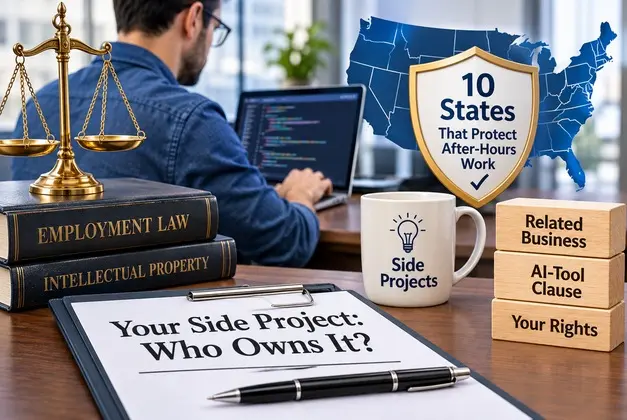
Your time? Not even "a little" during work hours.
Your stuff? Laptop, cloud account, AI subscription, code, data.
Unrelated? Unrelated to the employer's current business and its anticipated R&D.
Fail one, and the protection can be lost.
New risk: building your project with an AI tool your employer pays for. No court has decided whether that counts as company equipment.
Don't be the test case.
Check your own project in 60 seconds →
Statutes verified November 23, 2026. Not legal advice. Your contract and your state's law decide your situation.
This guide is for employees building something on the side: an app, a product, a channel, a brand.
It explains which rules decide ownership, where the law leans your way, and where it does not.
Patents, copyrights, and trademarks work differently, so see trademark vs copyright vs patent for the basics. Still choosing what to build?
Start with side hustles that pay $1K+.
Side Project Risk Check
Answer eight questions. You get an issue checklist, not a verdict.
Nothing is stored or sent anywhere, and there are no fields for names, employers, or project titles.
The Three Tests That Decide Most Cases
Most side-project disputes turn on three questions: did you build it on your own time, without your employer's resources, and is it unrelated to your employer's business?
Ten state statutes use these tests, and contracts elsewhere often borrow them.
1. Your own time
The statutes say entirely on your own time. Work-hours effort, even occasional, can undercut the test.
Remote work and on-call duties blur the line, so decide where it falls and stick to it.
2. Your own resources
The tests name equipment, supplies, facilities, and trade secret information.
Think laptop, phone, VPN, cloud and code accounts, software licenses, AI subscriptions, data, and documents. New Jersey's version says "information," which is wider.
3. Unrelated to the business
Your project fails this test if it relates to the employer's business or its actual or demonstrably anticipated research and development.
It also fails if it results from work you did for the employer. See the "related" catch.
One failed test can be enough to lose the protection. The tests are cumulative.
Miss one and the clause may apply to your project as written, which then depends on your contract.
A statute does not make you the owner.
It limits what a contract can demand, and it only helps if all three tests are met.
The three tiers used in this guide
- PROTECTED BY LAW A state statute applies and all three tests are met.
- DEPENDS ON YOUR CONTRACT No statute applies, or an exception may apply. Your signed agreement decides.
- UNSETTLED AI tools, whether statutes reach code, and how "anticipated R&D" applies to a giant company.
Your State's Rule: The 10 Statutes
Ten states limit invention assignment clauses by statute: California, Delaware, Illinois, Kansas, Minnesota, New Jersey, New York, North Carolina, Utah, and Washington.
Nevada points the opposite way, and every other state leaves the question to your contract and common law.
Tap your state to read the rule.
California: Cal. Lab. Code § 2870
PROTECTED BY LAW The model statute.
A clause cannot reach an invention built entirely on your own time without employer equipment, supplies, facilities, or trade secrets.
Exceptions: it relates to the business or its anticipated R&D, or results from your work.
The employer must give written notice (§ 2872), and the employee carries the burden of proof.
Statute: Cal. Lab. Code § 2870 (see also §§ 2871–2872)
Delaware: 19 Del. C. § 805
PROTECTED BY LAW Same structure as California: own time, no employer resources, and the two exceptions.
Read § 805 itself for its notice and proof wording.
Statute: 19 Del. C. § 805
Illinois: 765 ILCS 1060/2
PROTECTED BY LAW Same core test.
Written notice is required for agreements made after January 1, 1984, and the employee must prove the invention qualifies.
An employer cannot require the void clause as a condition of employment. Shop rights stay available against employees with no signed agreement.
Statute: 765 ILCS 1060/2 (Employee Patent Act)
Kansas: K.S.A. 44-130
PROTECTED BY LAW Same core test, plus written notice when the agreement is made.
Even a protected employee must disclose inventions being developed (subsection (d)). The business-link wording differs between subsections, so read the text.
Statute: K.S.A. 44-130
Minnesota: Minn. Stat. § 181.78
PROTECTED BY LAW The business link must be “directly” related (the anticipated R&D link has no “directly”).
Written notice is required for agreements made after August 1, 1977, and an employer cannot require the void clause as a condition of employment.
Statute: Minn. Stat. § 181.78
New Jersey: N.J.S.A. 34:1B-265
PROTECTED BY LAW Applies to contracts entered on or after April 1, 2018.
The resources test covers employer “information,” including trade secrets, which is wider than trade secrets alone.
An employer may still require confidential disclosure of your inventions.
Statute: N.J.S.A. 34:1B-265
New York: N.Y. Labor Law § 203-f
PROTECTED BY LAW Signed and effective September 15, 2023. Same core test; the business link is measured at conception or reduction to practice.
The section creates no private right of action, so a claim cannot stand on it alone.
Statute: N.Y. Labor Law § 203-f
North Carolina: N.C. Gen. Stat. § 66-57.1
PROTECTED BY LAW Same core test. The employee bears the burden of proof.
A companion provision lets employers require reporting of your inventions, so read it.
Statute: N.C. Gen. Stat. § 66-57.1
Utah: Utah Code § 34-39-3
PROTECTED BY LAW Works differently. Utah’s Employment Inventions Act defines an “employment invention” broadly, including inventions related to the employer’s industry or trade.
It bars requiring you to assign or license any other invention you create entirely on your own time. Amended in 2025.
Statute: Utah Code § 34-39-3
Washington: RCW 49.44.140
PROTECTED BY LAW Same core test, with “directly” in the business link. Written notice is required when the agreement is made.
A separate section (RCW 49.44.150) requires you to disclose inventions you are developing.
Statute: RCW 49.44.140
Nevada: NRS 600.500
DEPENDS ON YOUR CONTRACT The opposite default.
Unless an express written agreement says otherwise, the employer is the sole owner of a patentable invention or trade secret.
This covers what you develop in the course and scope of employment that relates directly to your work.
Statute: NRS 600.500
All other states: no statute
DEPENDS ON YOUR CONTRACT No statute. Your signed agreement and common law control, and broad clauses are generally enforceable.
Examples: Texas, Florida, Massachusetts, Georgia.
| State | What the law does | Statute |
|---|---|---|
| California | PROTECTED BY LAW The model statute. A clause cannot reach an invention built entirely on your own time without employer equipment, supplies, facilities, or trade secrets. Exceptions: it relates to the business or its anticipated R&D, or results from your work. The employer must give written notice (§ 2872), and the employee carries the burden of proof. | Cal. Lab. Code § 2870 (see also §§ 2871–2872) |
| Delaware | PROTECTED BY LAW Same structure as California: own time, no employer resources, and the two exceptions. Read § 805 itself for its notice and proof wording. | 19 Del. C. § 805 |
| Illinois | PROTECTED BY LAW Same core test. Written notice is required for agreements made after January 1, 1984, and the employee must prove the invention qualifies. An employer cannot require the void clause as a condition of employment. Shop rights stay available against employees with no signed agreement. | 765 ILCS 1060/2 (Employee Patent Act) |
| Kansas | PROTECTED BY LAW Same core test, plus written notice when the agreement is made. Even a protected employee must disclose inventions being developed (subsection (d)). The business-link wording differs between subsections, so read the text. | K.S.A. 44-130 |
| Minnesota | PROTECTED BY LAW The business link must be “directly” related (the anticipated R&D link has no “directly”). Written notice is required for agreements made after August 1, 1977, and an employer cannot require the void clause as a condition of employment. | Minn. Stat. § 181.78 |
| New Jersey | PROTECTED BY LAW Applies to contracts entered on or after April 1, 2018. The resources test covers employer “information,” including trade secrets, which is wider than trade secrets alone. An employer may still require confidential disclosure of your inventions. | N.J.S.A. 34:1B-265 |
| New York | PROTECTED BY LAW Signed and effective September 15, 2023. Same core test; the business link is measured at conception or reduction to practice. The section creates no private right of action, so a claim cannot stand on it alone. | N.Y. Labor Law § 203-f |
| North Carolina | PROTECTED BY LAW Same core test. The employee bears the burden of proof. A companion provision lets employers require reporting of your inventions, so read it. | N.C. Gen. Stat. § 66-57.1 |
| Utah | PROTECTED BY LAW Works differently. Utah’s Employment Inventions Act defines an “employment invention” broadly, including inventions related to the employer’s industry or trade. It bars requiring you to assign or license any other invention you create entirely on your own time. Amended in 2025. | Utah Code § 34-39-3 |
| Washington | PROTECTED BY LAW Same core test, with “directly” in the business link. Written notice is required when the agreement is made. A separate section (RCW 49.44.150) requires you to disclose inventions you are developing. | RCW 49.44.140 |
| Nevada | DEPENDS ON YOUR CONTRACT The opposite default. Unless an express written agreement says otherwise, the employer is the sole owner of a patentable invention or trade secret. This covers what you develop in the course and scope of employment that relates directly to your work. | NRS 600.500 |
| All other states | DEPENDS ON YOUR CONTRACT No statute. Your signed agreement and common law control, and broad clauses are generally enforceable. | None; contract and common law control |
Notice requirements
California, Illinois, Kansas, Minnesota, and Washington require the employer to give written notice of the statute when you sign.
New Jersey and New York do not. For North Carolina and Utah, read the text.
Whether a missing notice changes the outcome is unclear, so do not count on it.
In California and Illinois, you carry the burden of proof, so document everything. North Carolina says the same.
Kansas and Washington speak of the employee meeting the burden. Assume yours.
Where states differ
New York's § 203-f creates no private right of action, so a claim cannot stand on it alone.
New Jersey covers contracts entered on or after April 1, 2018, and its resources test is wider.
Utah defines "employment invention" in its own way. Minnesota and Washington say "directly."
Kansas and Washington also require you to disclose inventions you are developing, even when protected. If you signed a disclosure duty, follow it.
Our PIIA section shows how to describe a project at a general level.
Your contract may name another state's law.
Some states limit that: California Labor Code § 925, for example, restricts out-of-state choice-of-law clauses for many California-based employees.
Ask an attorney which state's law applies to you.
Nevada: The Opposite Default
Nevada does not shield your side project the way California does.
NRS 600.500 gives the employer sole ownership of a patentable invention or trade secret, unless an express written agreement says otherwise.
It covers what you develop in the course and scope of your employment that relates directly to your work.
DEPENDS ON YOUR CONTRACT In plain English: patentable inventions and trade secrets that come out of your job belong to the employer by default, and a written agreement can change that either way.
The statute covers patentable inventions and trade secrets.
It does not itself decide copyright, and it does not limit what a broader contract can claim.
Read the current text of NRS 600.500 and your agreement together.
No Statute in Your State? The Contract Decides
In the other 39 states and D.C., no invention statute limits your contract, so what you signed controls.
Broad clauses are generally enforceable there, including in states like Texas and Florida.
DEPENDS ON YOUR CONTRACT Two common-law doctrines still matter.
Under "hired to invent," an employee employed to solve a specific problem may have to hand over the resulting invention.
Under "shop right," an employer that supplied resources may keep a free license to use what you made, even without ownership.
The three tests are still your best checklist.
They are not a legal shield here, but a contract usually reuses their ideas, and they show how a dispute would be argued.
The Catch: "Related to the Employer's Business"
"Related to the employer's business" means the project can fall inside your employer's actual business or its demonstrably anticipated research or development, not just your own job.
It is the most common way protection fails, even for work done on your own time with your own laptop.
Anticipated R&D counts
Products your employer plans, but has not launched, can count if the plans are demonstrable.
A side project that looks unrelated today can become related when the roadmap changes.
Some statutes, such as New York's, measure the link at conception or reduction to practice.
"Results from work performed for the employer"
This is a separate exception.
If your project grew out of a task, prototype, or problem you worked on for your employer, the clause can reach it.
That is true even if you built it at home.
Why a giant company widens the net
The more products a company has, the more projects relate to its business.
Whether this stretches to a very large, diversified employer is unsettled, so compare your project with its product lines and public roadmap, not just your team.
Use public information only. Check products, announcements, and job postings. Never rely on confidential plans, and never take them.
| Scenario | Biggest risk | What to do |
|---|---|---|
| Fitness app built at night while working at an analytics company | DEPENDS ON YOUR CONTRACT Own time and personal devices help. The risk is the business link if the company has health or consumer analytics products or plans. | Compare with products and public roadmap. Keep a dated log. Consider a written waiver. |
| SaaS in your employer's industry | DEPENDS ON YOUR CONTRACT Likely "related," so protection can fail even in a statute state. | Ask for a written waiver before building more. See an attorney. |
| Used your work laptop "just once" | DEPENDS ON YOUR CONTRACT Fails the equipment test, and work devices often log activity. | Stop using it for the project. Copy no company files. Ask an attorney how to document it. |
| Used a company-paid AI tool | UNSETTLED May count as employer resources; untested. Pasted company material is a separate problem. | Move to personal accounts. Keep company code out of prompts. Keep records of what happened. |
| A YouTube channel about your profession | DEPENDS ON YOUR CONTRACT Moonlighting or social-media policies, accidental confidentiality leaks, and a business link if your employer makes similar content. | Read the policies. Share no confidential detail. Ask for approval where required. |
| Started before the job | DEPENDS ON YOUR CONTRACT A dispute over what existed on your start date, and over later improvements. | List it on the Prior Inventions schedule with a date. Keep commits and receipts. |
| An idea conceived at work, built after leaving | DEPENDS ON YOUR CONTRACT "Conceived during employment" wording, confidential information, and holdover clauses. | Check your contract. Use no confidential information. Consider a waiver or attorney review before launch. |
Code, Content, and Designs: Work Made for Hire Is a Separate Rule
Copyright runs on its own track.
Under 17 U.S.C. §§ 101 and 201(b), a work an employee prepares within the scope of employment is a work made for hire.
It starts out belonging to the employer. Weekend work unrelated to your job usually falls outside that scope.
Copyright and invention law are separate rules. Passing the invention tests does not settle who owns the copyright in your code, writing, or designs.
The scope-of-employment test
In CCNV v. Reid, 490 U.S. 730 (1989), the Supreme Court said general agency law decides who is an employee.
Courts often judge scope by the kind of work, the time and place, and whether it serves the employer, following the Restatement of Agency.
Off-hours work in an unrelated field is usually outside scope.
Work your employer asked for, or that you did at work, is usually inside it.
Contracts can go further
A written assignment clause can transfer copyrights separately from work-for-hire rules.
If your agreement assigns "works" as well as inventions, the copyright analysis moves to the contract wording.
What is unsettled
UNSETTLED It is not uniformly settled whether state invention statutes reach copyrightable works such as code. Some read "invention" narrowly, others broadly.
Treat code as possibly covered and check the clause.
| Rule | Covers | What decides it | Can a contract change it? |
|---|---|---|---|
| State invention statutes | Inventions; reach for code and content not uniformly settled | Own time, own resources, unrelated to the business | Not where the statute protects the invention; contracts can still claim the exceptions |
| Copyright work made for hire | Code, writing, video, designs, other original expression | Whether you made it within the scope of employment | Yes. A signed written assignment can transfer copyright separately |
| Contract assignment clauses | Whatever the wording says: inventions, works, ideas | The clause you signed, within state-law limits | It is the contract, limited by statutes where they apply |
Whether a work is copyrightable at all, and who can register it, is covered in how to copyright your work.
Built It With Your Company's AI Tool? The 2026 Question
UNSETTLED Whether a company-licensed AI account counts as employer equipment, supplies, or facilities is unsettled. We know of no published court decision on it.
It may count, and that is the easiest risk in this guide to avoid.
What the statutes say
They protect work done without the employer's equipment, supplies, facilities, or trade secret information (New Jersey says "information"). None names AI accounts.
A paid AI seat could be argued either way.
Why it is untested
Courts have not yet had a case that turns on it, and the answer may differ by state and wording.
We last checked on November 23, 2026, and this page will be updated if a court rules.
The commingling problem
Pasting company code or documents into a prompt can mix confidential material into your project.
Even where the account question stays open, that can raise trade-secret and confidentiality claims.
Contracts that name company-licensed tools
Some 2025 and 2026 contracts and policies now name company-licensed tools expressly.
This is a reported trend, not a universal rule, so read what you signed.
The simple fix
Use a personal AI subscription on a personal device, and keep company material out of prompts.
If you already used a company account, stop, keep records, and tell your attorney. Do not delete anything.
Whether AI output is copyrightable at all is a different question.
See can you copyright AI-generated work and who owns the AI content you created. This guide covers employer versus employee ownership only.
Reading Your PIIA: The Red-Flag Clauses
A PIIA (Proprietary Information and Inventions Agreement) is the contract that assigns your inventions and works to your employer.
Read the assignment definition, the exclusions, any listed prior inventions, and the post-employment terms before you sign or launch.
You can ask to change a PIIA or decline to sign. In at-will hiring the employer may withdraw the offer.
In statute states, it cannot require you to sign the void part.
| Clause language | Why it matters | What to ask for |
|---|---|---|
| "All inventions conceived during employment" | Can capture off-hours projects, including ideas you had before you built anything. | Limit it to inventions related to the business or made with company resources, and add the statutory carve-out. |
| "Related to any business of the company" | "Any business" can mean the whole corporate group and future plans. | Limit it to the business you actually work in, and to actual or demonstrably anticipated R&D. |
| Holdover or trailer period | Can presume inventions made for months or years after you leave belong to the employer. | Shorten the period, limit it to related inventions, and let you rebut the presumption. |
| Power of attorney | Lets the employer sign assignment papers for you if you cannot or will not. | Limit it to inventions you must assign, with notice to you. |
| Waiver of moral rights | Gives up attribution and integrity rights in your work. | Narrow it to work you assign, or ask whether it is needed. |
| Mandatory disclosure of all inventions | You may have to describe side projects, even protected ones, and the employer may use that to assert claims. | Ask for confidential handling, general-level descriptions, and an exclusion for unrelated personal projects. |
Details worth knowing
Holdover clauses. Enforceability varies by state and by how broadly they are drafted. Do not assume a trailer is void.
"Conceived" versus "reduced to practice." Conceived is the idea. Reduced to practice is a working version.
The two can fall on different sides of your hire date, so check which one the clause uses.
Disclosure duties. If you must disclose, disclose. Do not hide a project from a duty you signed.
Ask for confidential handling and give general descriptions.
How to Fill Out a Prior Inventions List
List each project by title, general field, and start date, at a general level. Do not include code, designs, or trade secrets.
Be accurate: a project left off may be treated as covered by the agreement.
If you have nothing to list, write "None" rather than leaving it blank. If a project grows later, ask whether improvements are excluded too.
Template 1: Prior Inventions list wording
Discussion draft. Review with an attorney before using. Edit the brackets; keep it general.
Already Employed? Ask for a Written Waiver
Yes, you can ask your employer for a written waiver, and it is often the cleanest fix. A short email can do it.
State the project, that it is built on personal time and resources, and why it is unrelated.
Ask the company to confirm in writing that it claims no rights.
Ask before you launch, raise money, or invest more time. Keep the answer, in writing, with your other records.
Template 2: Written waiver request (email)
Discussion draft. Review with an attorney before using. Send to your manager or HR, adapted to your situation.
Template 3: Carve-out clause draft for a new offer
Discussion draft. Review with an attorney before using. For use when negotiating a new offer; your attorney should adapt it.
If they say no, or do not answer
A "no" may mean the company sees the project as related, or only that it will not put anything in writing.
Talk to an attorney before you continue. Options include narrowing the project, negotiating a carve-out, or deciding whether the job is worth the project.
Do not proceed as if nothing was said.
Can You Be Fired for a Side Project?
Often yes. Most U.S. employment is at-will, so an employer can end it for many reasons.
Some states protect lawful off-duty activity, but those protections usually have conflict-of-interest exceptions and may not cover a side business.
Examples include California Labor Code §§ 96(k) and 98.6, New York Labor Law § 201-d, and Colorado C.R.S. 24-34-402.5.
Their reach differs, so read the text for your state.
Your policies matter too.
Moonlighting and conflict-of-interest policies may require approval or disclosure, and employees owe a duty of loyalty: no competing, no soliciting customers, and no side work on company time.
Never take company code, data, or customers. It is the fastest way to lose the project and to face trade-secret claims.
Leaving to Launch: Clean Title for Investors and Buyers
Investors and buyers will ask for clean title, meaning proof that no employer has a claim on your project.
Fix gaps before you leave: review trailer clauses, confirm your Prior Inventions list, and get any release or waiver in writing.
Expect IP due diligence to ask for your invention assignment agreements, prior employers' agreements, and whether you used employer resources.
Gaps found late cost more to fix.
Non-compete and non-solicit terms are separate from invention clauses. See are non-competes enforceable for those.
Once the project is clearly yours, protect it with how to trademark a business name and how to copyright your work.
If Your Employer Already Claims It
If your employer asserts a claim, stay calm and slow down. Do not delete anything, and preserve commits, receipts, emails, and notes.
Do not sign a new assignment, release, or agreement under pressure.
Do not contact customers or coworkers about the claim, and do not take company material. Get an employment or IP attorney before you respond.
Protect It This Week
Seven steps you can do now. Copy the list into your notes or share it with your attorney.
- Find and reread the agreement you signed: PIIA, offer letter, handbook IP policy, and any moonlighting or conflict-of-interest policy.
- Move all project work to personal devices, personal cloud, personal repos, and personal AI subscriptions.
- Never use company code, data, documents, customers, or coworkers’ work time.
- Keep a dated build log: commits, receipts, notes. This matters most where you carry the burden of proof.
- Check the “related business” risk against your employer’s products and its public roadmap.
- If your agreement requires disclosure, disclose. If you are unsure, ask for a written waiver.
- Before raising money, selling, or launching publicly, have an IP or employment attorney confirm clean title.
Statutes and Sources
- California Labor Code §§ 2870–2872
- New York Labor Law § 203-f
- RCW 49.44.140 (Washington)
- Minn. Stat. § 181.78
- 19 Del. C. § 805
- 765 ILCS 1060 (Illinois Employee Patent Act)
- N.J.S.A. 34:1B-265 (P.L. 2017, c. 346)
- N.C. Gen. Stat. § 66-57.1
- Utah Code § 34-39-3
- K.S.A. 44-130 (Kansas)
- NRS 600.500 (Nevada)
- 17 U.S.C. § 101
- 17 U.S.C. § 201
- U.S. Copyright Office, Circular 30: Works Made for Hire
- Community for Creative Non-Violence v. Reid, 490 U.S. 730 (1989)
Frequently Asked Questions
Does my employer own my side project?
Usually not, if you built it entirely on your own time, without company equipment, accounts, or confidential information, and it does not relate to your employer's business or planned R&D.
Your signed agreement can claim more, especially outside the ten statute states.
Can my employer claim a project I built on my own laptop at home?
Possibly. A personal laptop satisfies only one test.
A claim can still rest on the "related to the business" exception, work-hours effort, company accounts or code, or broad contract wording.
Which states protect employee side projects?
California, Delaware, Illinois, Kansas, Minnesota, New Jersey, New York, North Carolina, Utah, and Washington limit invention assignment clauses by statute.
Nevada has an opposite default. Everywhere else the contract and common law decide.
What does California Labor Code 2870 say?
A clause cannot require you to assign an invention you developed entirely on your own time, without employer equipment, supplies, facilities, or trade secrets, unless it relates to the employer's business or anticipated R&D, or results from your work.
The employer must give notice (§ 2872).
What does New York Labor Law 203-f change?
Since September 15, 2023, an assignment clause in New York cannot reach inventions developed entirely on your own time without employer resources, with the usual exceptions.
The section has no private right of action, so a claim cannot rest on it alone.
Is Nevada different?
Yes. Under NRS 600.500, unless a written agreement says otherwise, the employer is the sole owner of a patentable invention or trade secret you develop in the course and scope of employment that relates directly to your work.
Read the current text and your contract.
What if my state has no law on this?
Your signed agreement and common law decide. Broad assignment clauses are generally enforceable, and doctrines like "hired to invent" and "shop right" can apply.
Read what you signed, and ask for a carve-out if it is broad.
What counts as "related to my employer's business"?
It covers your employer's actual business and its actual or demonstrably anticipated research and development, not only your team's work.
Compare your project with the company's products and public roadmap, and treat overlap as a real risk.
Does work made for hire apply to code I write on weekends?
Not automatically. Work made for hire depends on whether you made the work within the scope of employment.
Off-hours code unrelated to your job is usually outside it, but a written assignment clause can transfer copyright separately.
What if I used my company's Copilot, Claude, or ChatGPT subscription?
It may count as employer resources, but no court we know of has decided it, so the risk is unsettled.
Move to personal accounts, keep company code and documents out of prompts, check your policy, and keep records.
Talk to an attorney if the project matters.
What is a PIIA, and can I refuse to sign one?
A PIIA is an agreement that assigns your inventions and works to your employer and sets confidentiality terms.
You can ask to change it or decline to sign, but in at-will hiring the employer may withdraw the offer.
Statute states bar requiring the void part.
How do I list a side project on a Prior Inventions schedule?
Give its title, general field, and start date, and describe it at a general level only. Include no code or trade secrets.
If you have nothing to list, write "None" rather than leaving the schedule blank.
Can I ask my employer for a written IP waiver?
Yes. Describe the project generally, say it is built on personal time and resources, say why it is unrelated, and ask for written confirmation that the company claims no rights.
Keep the answer. If they refuse, speak with an attorney.
What is a holdover (trailer) clause?
It presumes inventions you make for a set period after leaving were made during employment, so the employer can claim them.
Enforceability varies, so do not assume it is void. Negotiate a shorter period and a right to rebut the presumption.
Can I be fired for having a side hustle?
Often yes. Most employment is at-will.
Some states protect lawful off-duty activity, such as California, New York, and Colorado, but those laws have conflict-of-interest exceptions and may not cover your project.
Check your policies and statute.
Do I have to tell my employer about my side project?
It depends on what you signed.
Some agreements and statutes, such as in Kansas and Washington, require disclosing inventions you are developing, and moonlighting policies may require approval.
If you must disclose, do. Ask an attorney how to describe it.
Who owns an idea I had at work but built after I quit?
It depends on your contract. Wording like "conceived during employment," confidential information, or a holdover clause can reach it.
Do not use company information, and get a waiver or attorney review before launching.
Will investors ask about this?
Yes. Investors and buyers ask for clean title, so expect them to request your invention assignment agreements and any waivers.
Fix gaps before you raise money or sell, since late fixes cost more.
Last updated:
This article is general information, not legal advice.
Ownership depends on your agreement, your state's law, and the facts of how and when the work was created.
Statutes verified on November 23, 2026. Consult an employment or IP attorney about your situation.

Daniel Hayes is the founder and sole researcher at AdvoraHQ. He covers U.S. personal finance, insurance, and consumer law — working directly from IRS publications, federal and state statutes, court opinions, and SEC filings rather than secondary summaries. His focus is the gap between what readers think they know and what the source documents actually say. Daniel is not a licensed attorney, CPA, or financial advisor; his articles are educational and not personalized advice. Reach him at Daniel.Hayes@advorahq.com.
