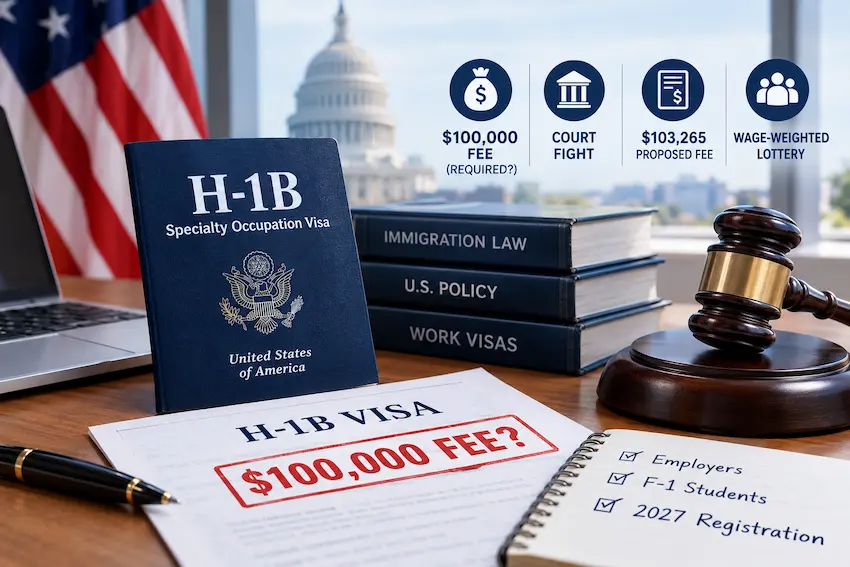
Status as of October 26, 2026: The $100,000 H-1B payment is BLOCKED — it is not being collected because of federal court orders, though the proclamation behind it has been extended to September 21, 2027 and the government is appealing.
A separate $103,265 fee on cap-subject petitions is PROPOSED. It is not final and has no effective date.
The standard USCIS fees are IN EFFECT, and the H-1B lottery is now weighted by wage level.
Who this affects:
- Employers hiring a worker from abroad
- F-1 students changing to H-1B
- Cap-subject nonprofits and small businesses
- Workers already in H-1B status
Verified October 26, 2026. This changes often — check the USCIS H-1B page before filing.
Does This H-1B Fee Apply to Me?
Answer four questions. The checker shows whether each fee would apply to your situation and what its status is today. Nothing you choose leaves this page.
Is the $100,000 H-1B Fee in Effect Right Now?
No. As of October 26, 2026, USCIS is not collecting the $100,000 payment, because two federal court orders block the agency policies that put it into practice.
On July 28, 2026, USCIS said it would comply with the court order and not collect the payment on H-1B cases. It also said that if the order is lifted, DHS still plans to collect.
In practice, employers filing for a worker abroad have not had to attach proof of a $100,000 pay.gov payment since USCIS updated its guidance in late July 2026.
“Blocked, not repealed” means three things are true at once:
- The proclamation still exists. Proclamation 10973 (September 19, 2025) was extended by Proclamation 11069 (September 18, 2026) through September 21, 2027.
- The courts set aside the implementing policies — the USCIS, DHS and State Department guidance used to collect the payment — not the proclamations themselves.
- The rulings are on appeal. A third court, in Washington, D.C., upheld the payment in December 2025, and that decision is also on appeal.
So the payment could return if a higher court rules for the government or pauses the orders. The next section dates every step.
The H-1B Fee Court Timeline
Two courts have blocked the $100,000 payment, one court upheld it, and all three cases are on appeal.
| Date | Court or agency | What happened | Status after |
|---|---|---|---|
| Sept 19, 2025 | President | Proclamation 10973 restricts entry of certain new H-1B workers unless the petition comes with a $100,000 payment. | Payment due from Sept 21 |
| Sept 21, 2025 | USCIS, State Department | Payment required for covered petitions filed at or after 12:01 a.m. Eastern. | IN EFFECT |
| Oct 20, 2025 | USCIS | Guidance: the payment covers new petitions for workers outside the U.S. without a valid H-1B visa, not changes of status, extensions or amendments granted inside the U.S. | IN EFFECT (narrowed) |
| Dec 23, 2025 | U.S. District Court, D.C. (Chamber of Commerce v. DHS) | Upheld the proclamation and its implementation as within the President’s authority over entry. The Chamber and the Association of American Universities appealed to the D.C. Circuit on Dec 29. | IN EFFECT; appeal pending |
| June 8, 2026 | U.S. District Court, Massachusetts (State of California v. Mullin, 20 states) | Held the payment an unlawful tax and found Administrative Procedure Act violations; vacated the policy materials implementing it. | BLOCKED |
| June 2026 | Same court | Days later, the court temporarily stayed its own ruling while the government asked the First Circuit for a stay (motion filed June 18). | Collected again on consular cases |
| July 24, 2026 | First Circuit (No. 26-1699) | Denied the government’s request to pause the ruling during the appeal. It did not decide the merits. | BLOCKED |
| July 28, 2026 | USCIS | Said it would comply and not collect; DHS still plans to collect if the order is lifted. | BLOCKED |
| Aug 25, 2026 | DHS | Proposed a separate $103,265 fee on cap-subject petitions (91 FR 54817). | PROPOSED |
| Sept 9, 2026 | DHS (CBP rule) | The $4,000 Public Law 114-113 fee began applying to extension petitions of covered employers. | IN EFFECT |
| Sept 18, 2026 | President | Proclamation 11069 extends the restriction for 12 months, effective Sept 21, 2026, through Sept 21, 2027. | Extended on paper; still BLOCKED |
| Sept 24, 2026 | DHS | Public comment period on the $103,265 proposal closed. | PROPOSED; no final rule |
| Sept 30, 2026 | U.S. District Court, N.D. California (Global Nurse Force v. Trump, No. 4:25-cv-08454) | Preliminary injunction: vacated the agency policies implementing the payment under both proclamations and barred enforcement until notice-and-comment rulemaking is done. It did not enjoin the proclamations themselves. | BLOCKED (second order) |
| Oct 9, 2026 | Ninth Circuit | Government appealed the California order and asked for a stay. | BLOCKED; stay request pending |
| Oct 16, 2026 | First Circuit | Merits briefing in the government’s appeal was expected to conclude. | BLOCKED; awaiting decision |
Sept 19, 2025 · President
Proclamation 10973 restricts entry of certain new H-1B workers unless the petition comes with a $100,000 payment.
Status after: payment due from Sept 21
Sept 21, 2025 · USCIS, State Department
Payment required for covered petitions filed at or after 12:01 a.m. Eastern.
Status after: IN EFFECT
Oct 20, 2025 · USCIS
Guidance: covers new petitions for workers outside the U.S. without a valid H-1B visa, not changes of status, extensions or amendments granted inside the U.S.
Status after: IN EFFECT (narrowed)
Dec 23, 2025 · District Court, D.C.
Chamber of Commerce v. DHS upheld the payment. Plaintiffs appealed to the D.C. Circuit on Dec 29.
Status after: IN EFFECT; appeal pending
June 8, 2026 · District Court, Massachusetts
State of California v. Mullin held the payment an unlawful tax and vacated the implementing policy.
Status after: BLOCKED
June 2026 · Same court
The court briefly stayed its own ruling while the government sought a First Circuit stay.
Status after: collected again on consular cases
July 24, 2026 · First Circuit
Denied the government’s stay request. Merits not decided.
Status after: BLOCKED
July 28, 2026 · USCIS
Will comply and not collect; DHS still plans to collect if the order is lifted.
Status after: BLOCKED
Aug 25, 2026 · DHS
Proposed a separate $103,265 fee on cap-subject petitions.
Status after: PROPOSED
Sept 9, 2026 · DHS (CBP rule)
$4,000 Public Law 114-113 fee now applies to covered employers’ extensions.
Status after: IN EFFECT
Sept 18, 2026 · President
Proclamation 11069 extends the restriction through Sept 21, 2027.
Status after: extended on paper; still BLOCKED
Sept 24, 2026 · DHS
Comment period on the $103,265 proposal closed.
Status after: PROPOSED; no final rule
Sept 30, 2026 · District Court, N.D. California
Global Nurse Force v. Trump: vacated the implementing policies under both proclamations until notice-and-comment rulemaking is done.
Status after: BLOCKED (second order)
Oct 9, 2026 · Ninth Circuit
Government appealed and asked for a stay.
Status after: BLOCKED; stay request pending
Oct 16, 2026 · First Circuit
Merits briefing was expected to conclude.
Status after: BLOCKED; awaiting decision
What each ruling did — and didn’t — decide
- Massachusetts (June 8): a final judgment on the merits in that court. It treated the payment as a tax only Congress can impose and vacated the implementing policy nationwide.
- First Circuit (July 24): only refused to pause that judgment during the appeal. The appeal itself is undecided.
- California (Sept 30): a preliminary ruling focused on procedure — the agencies skipped notice-and-comment rulemaking. It reached the 2026 extension too, but did not strike down either proclamation.
- D.C. (Dec 23, 2025): reached the opposite conclusion, finding the payment lawful. We found no reported D.C. Circuit decision as of October 26, 2026.
As of October 26, 2026, we found no reported ruling on the Ninth Circuit stay request and no reported Supreme Court action on the payment.
Who the $100,000 H-1B Payment Applied To
The payment applied mainly to new petitions for workers outside the U.S. — not to F-1 students or H-1B workers whose change of status or extension was approved inside the country.
Under USCIS’s October 20, 2025 guidance, the payment applied to:
- New H-1B petitions filed on or after September 21, 2025 for a worker outside the U.S. who did not hold a valid H-1B visa.
- Petitions asking for consular notification, port-of-entry notification or pre-flight inspection.
- Petitions for a worker inside the U.S. when USCIS denied the change of status or extension and approved the petition for consular processing instead.
It did not apply to:
- Petitions filed before September 21, 2025.
- Changes of status (for example, F-1 to H-1B), extensions and amendments that USCIS granted inside the U.S.
- Change-of-employer petitions granted inside the U.S.
- Workers already holding a valid H-1B visa, including when they later traveled and re-entered on an approved petition.
One point surprises many readers: cap-exempt employers were not carved out. A university hiring a researcher from abroad faced the same payment. A national-interest exception existed, but it was described as available only in rare cases.
The Proposed $103,265 H-1B Fee
DHS has proposed a separate $103,265 fee on every cap-subject H-1B petition — including those from small employers and cap-subject nonprofits — but it is PROPOSED, not final, and has no effective date.
The notice of proposed rulemaking, Fee for Certain H-1B Petitions, was published August 25, 2026 (91 FR 54817; RIN 1615-AD20; DHS Docket No. USCIS-2026-0298). Comments closed September 24, 2026.
As proposed, the fee would:
- Apply to every cap-subject petition — the regular cap and the U.S. master’s cap alike.
- Be payable at filing, on top of every other fee.
- Apply whether the worker is abroad or changing status inside the U.S., so it would reach F-1 to H-1B cap petitions.
- Not apply to cap-exempt petitions. DHS tied that exclusion to how it already exempts certain nonprofits from the Asylum Program Fee.
- Not apply to extensions, amendments or transfers of workers who were already counted against the cap.
Some early coverage said nonprofits were exempt. The rule text says otherwise: DHS describes the fee as applying to all cap-subject petitions, including small employers or nonprofits. Only cap-exempt employers fall outside it — see the cap-exempt section for why “nonprofit” alone isn’t enough.
DHS says the fee would fund immigration-related costs at USCIS, ICE, CBP, the immigration courts, the State Department and the Labor Department. It projects 85,000 petitions a year and about $8.8 billion in annual revenue, while acknowledging registrations may drop.
The proposal also says that if a proclamation payment is ever required at the same time, a petitioner would owe both amounts.
| Feature | $100,000 payment | $103,265 fee |
|---|---|---|
| Source of authority | Presidential proclamation restricting entry (10973, extended by 11069) | DHS fee regulation under the immigration fee statute (INA 286(m)) |
| Who pays | Employer filing a new petition for a worker outside the U.S. | Employer filing any cap-subject petition |
| When paid | Before filing; proof of pay.gov payment with the petition | At filing, with all other fees |
| Consular vs. change of status | Consular cases only; change of status exempt if granted | Both; location does not matter |
| Nonprofits | No nonprofit carve-out for consular cases | Cap-subject nonprofits included |
| Cap-exempt employers | Covered for new hires from abroad | Excluded |
| Status today | BLOCKED | PROPOSED |
$100,000 payment · BLOCKED
Authority: presidential proclamation (10973, extended by 11069)
Who pays: employer filing a new petition for a worker outside the U.S.
When: before filing, via pay.gov
Change of status: exempt if granted
Nonprofits: no carve-out for consular cases
Cap-exempt employers: covered for new hires from abroad
$103,265 fee · PROPOSED
Authority: DHS fee regulation (INA 286(m))
Who pays: employer filing any cap-subject petition
When: at filing, with all other fees
Change of status: included
Nonprofits: cap-subject nonprofits included
Cap-exempt employers: excluded
What’s still unknown
- Effective date. DHS must review comments and publish a final rule first. It has not announced timing.
- Final amount and scope. A final rule can differ from the proposal; DHS said related rulemakings could change the number.
- Refund if a petition is denied. We did not find a refund provision for denied petitions in the proposal.
- Transition rules for registrations already selected when a final rule takes effect.
How the Wage-Weighted H-1B Lottery Works
Each registration now gets one to four entries in the draw, based on the wage level of the offered pay — then USCIS picks at random from that weighted pool.
The final rule was published December 29, 2025, took effect February 27, 2026, and was first used for the FY2027 cap season, whose registration ran March 4–19, 2026.
When registering, the employer lists the job’s occupation code, the area of employment, and the highest Department of Labor OEWS wage level the offered wage equals or exceeds. Each unique beneficiary still counts once toward the cap.
| Wage level | Entries | What it means |
|---|---|---|
| Level I | 1 | Entry-level pay for the occupation and area. Still eligible. |
| Level II | 2 | Twice the entries of Level I. |
| Level III | 3 | Three times the entries of Level I. |
| Level IV | 4 | The most entries. Still not guaranteed. |
Why it’s still a draw: a Level IV registration is more likely to be picked than a Level I, but every selection is random. How likely any one registration is depends on how many others register at each level — which no one knows in advance. We don’t publish odds for that reason.
Two cautions:
- The level must be real. The Labor Condition Application and petition filed after selection must match the registration, and the rule includes consequences for misstating the level.
- The lottery level isn’t the same as the LCA prevailing wage determination, though both use OEWS data. Get them checked together.
FY2028 timing: registration is expected in March 2027. USCIS announces the exact dates, usually a few weeks ahead.
The Full Cost of an H-1B Petition
Today, the government fees for a new cap-subject petition at a 26-plus-employee employer come to $3,595 before premium processing or legal fees — and the blocked and proposed fees would sit on top of that.
That $3,595 is the $215 registration, $780 I-129 fee, $1,500 ACWIA fee, $500 fraud fee and $600 Asylum Program Fee. Premium processing adds $2,965. Use the calculator for your situation.
Employer H-1B Cost Calculator
Each line is labelled with its status. Scenario fees are shown separately and never added to today’s total.
| Fee | Amount | Who pays / when | Status |
|---|---|---|---|
| Registration | $215 | Employer; each cap registration | IN EFFECT |
| Form I-129 (H-1B) | $780; $460 for 1–25 FTE and nonprofits | Employer; every petition | IN EFFECT |
| Asylum Program Fee | $600; $300 for 1–25 FTE; $0 for nonprofits | Employer; every I-129 | IN EFFECT |
| ACWIA training fee | $1,500 (26+ FTE); $750 (1–25 FTE) | Employer; certain employers exempt; not on an amendment without an extension, or a second extension | IN EFFECT |
| Fraud Prevention and Detection | $500 | Employer; initial petitions and changes of employer | IN EFFECT |
| Public Law 114-113 | $4,000 | Employers with 50+ U.S. employees, over half in H-1B/L; now including extensions (since Sept 9, 2026) | IN EFFECT |
| Premium processing (optional) | $2,965 | Petitioner; 15-business-day action | IN EFFECT |
| Proclamation payment | $100,000 | Employer; new petitions for workers abroad | BLOCKED |
| Proposed H-1B fee | $103,265 | Employer; cap-subject petitions | PROPOSED |
Registration — $215 · IN EFFECT
Each cap registration.
Form I-129 — $780 · IN EFFECT
$460 for 1–25 FTE employers and nonprofits.
Asylum Program Fee — $600 · IN EFFECT
$300 for 1–25 FTE; $0 for nonprofits.
ACWIA fee — $1,500 · IN EFFECT
$750 for 1–25 FTE. Certain employers exempt; not on an amendment without an extension, or a second extension.
Fraud fee — $500 · IN EFFECT
Initial petitions and changes of employer.
Public Law 114-113 — $4,000 · IN EFFECT
50+ U.S. employees with over half in H-1B/L; includes extensions since Sept 9, 2026.
Premium processing — $2,965 · IN EFFECT
Optional.
Proclamation payment — $100,000 · BLOCKED
New petitions for workers abroad.
Proposed fee — $103,265 · PROPOSED
Cap-subject petitions.
Amounts verified October 26, 2026 from USCIS. Re-check on filing day.
What the H-1B Fees Mean for F-1 Students
F-1 students changing to H-1B inside the U.S. were exempt from the $100,000 payment, but would be covered by the $103,265 fee if it is finalized as proposed.
- The $100,000 payment: did not apply to an F-1 to H-1B change of status that USCIS approved. It could apply if USCIS denied the change of status and the student had to get a visa abroad.
- The $103,265 proposal: covers all cap-subject petitions, including change of status. Your employer would pay it, not you.
- The lottery: your offered wage level sets your entries. Many first jobs are Level I, which means one entry.
- Cap-gap: if you are selected and your employer files on time, cap-gap rules can extend your F-1 status and OPT work authorization while the petition is pending — under current rules, up to April 1 of the fiscal year. Confirm your own dates with your DSO.
Cap-exempt employers — universities and related nonprofits — remain outside both the lottery and the proposed fee. See the next section.
Talk to your international student office before you travel. Leaving the U.S. while a change of status is pending can change how your case is processed.
Cap-Exempt H-1B Employers
Cap-exempt employers skip the lottery and would be outside the proposed $103,265 fee — but being a nonprofit is not enough to qualify.
Cap-exempt employers generally include:
- U.S. institutions of higher education.
- Nonprofits related to or affiliated with those institutions.
- Nonprofit research organizations and government research organizations.
A charity, hospital or nonprofit school that doesn’t fit those categories is cap-subject. It enters the lottery and would pay the $103,265 fee if finalized. It may still get lower standard fees: the $460 I-129 rate and a $0 Asylum Program Fee.
Cap-exempt status did not exempt an employer from the $100,000 payment when hiring from abroad. Confirm your status with counsel; it depends on your organization’s structure and affiliations.
H-1B Workers Already in the U.S.
If you are already in H-1B status, neither the $100,000 payment nor the $103,265 proposal reaches an extension, amendment or transfer granted inside the U.S.
- Extensions and transfers: not cap-subject, so outside the $103,265 proposal. One exception to check: moving from a cap-exempt employer to a cap-subject one can make the petition cap-subject.
- The $4,000 fee: since September 9, 2026, covered employers (50+ U.S. employees, more than half in H-1B or L status) pay it on extensions too, including same-employer extensions.
- Travel: holders of a valid H-1B visa were not subject to the $100,000 payment when re-entering.
- Program reviews: a September 18, 2026 executive order directs agencies to coordinate H-1B reviews and consider employer layoffs. Watch for implementing guidance.
What employers can’t charge you
Under Department of Labor rules (20 CFR 655.731), the employer may not pass the ACWIA fee to you in any form. Deductions for the employer’s business expenses — which include the costs of preparing and filing the petition — can’t reduce your pay below the required wage.
Premium processing is treated differently in some situations. Ask your employer in writing who is paying for what.
New to the U.S. on an H-1B? Our guide to building U.S. credit as an immigrant covers your first months.
Paid the $100,000? The H-1B Refund Question
No refund mechanism has been announced for employers who paid the $100,000, and the court rulings so far haven’t resolved whether refunds are owed.
At a February 26, 2026 court hearing, a Justice Department attorney said about 70 employers had paid it — so the question affects a small group, but large sums.
Keep:
- The pay.gov confirmation and the bank record of the payment.
- The petition copy, receipt notice and approval or denial notice.
- Any request for evidence or USCIS correspondence about the payment.
- Evidence of where the worker was when you filed.
- Internal approvals and dates, in case a claims process opens.
Talk to immigration counsel about whether and how to pursue a refund. Be cautious of anyone offering a guaranteed refund for a fee.
What Happens Next With the H-1B Fees
Several separate decisions are pending, and any one of them could change the status of a fee. We describe the scenarios; we don’t predict outcomes.
- First Circuit merits decision (State of California v. Mullin): briefing was expected to end October 16, 2026. No decision date is set. A ruling for the government could restore collection; a ruling against it would keep the payment blocked.
- Ninth Circuit stay request (Global Nurse Force): even if granted, the Massachusetts judgment separately sets aside the same policies, so a Ninth Circuit stay alone would not restart collection.
- D.C. Circuit (Chamber of Commerce v. DHS): decides whether the 2025 ruling upholding the payment stands.
- Supreme Court: the government could ask it to pause the lower-court orders. If it did and a stay were granted, collection could resume quickly.
- DHS final rule on the $103,265 fee: needed before that fee can take effect, with an effective date. A final rule could also be challenged in court.
- Proclamation 11069: runs through September 21, 2027 unless changed.
- FY2028 registration: expected March 2027; USCIS will announce dates.
- Labor Department wage rule: DOL proposed higher prevailing wage levels on March 27, 2026 (91 FR 15454). If finalized, the pay that maps to each lottery level could change.
H-1B Checklists Before the March 2027 Registration
For employers
For F-1 students
H-1B Fee FAQ
Is the $100,000 H-1B fee still in effect?
No. As of October 26, 2026, it is BLOCKED. Two federal court orders bar the agencies from collecting it, and USCIS says it is complying.
Why was the fee blocked?
A Massachusetts court held it an unlawful tax and found procedural violations. A California court found the agencies skipped required notice-and-comment rulemaking. A D.C. court reached the opposite result, and all three cases are on appeal.
Was the fee extended?
Yes, on paper. Proclamation 11069 extended it through September 21, 2027, but the court orders still block collection.
Could the fee come back?
Yes. A ruling for the government on appeal or a stay from a higher court could restore it. DHS has said it plans to collect if the orders are lifted.
Did F-1 students have to pay the $100,000?
Not when USCIS approved the change of status inside the U.S. It applied if the change of status was denied and the student had to get a visa abroad.
What is the $103,265 H-1B fee?
A DHS proposal from August 25, 2026 to add $103,265 to every cap-subject H-1B petition, payable at filing on top of all other fees.
Is the $103,265 fee in effect?
No. It is PROPOSED. Comments closed September 24, 2026; there is no final rule and no effective date.
Does the $103,265 fee apply to nonprofits?
Yes, if the nonprofit is cap-subject. DHS’s proposal names small employers and nonprofits as covered. Only cap-exempt employers are excluded.
Does it apply to universities?
Not as proposed. Universities and affiliated nonprofits are generally cap-exempt, and cap-exempt petitions are excluded.
Would F-1 to H-1B petitions pay the $103,265?
Yes, if finalized as proposed. The fee follows the cap, not the worker’s location, so change-of-status cap petitions are covered.
How does the weighted H-1B lottery work?
Each registration gets one to four entries based on the OEWS wage level of the offered pay, and USCIS selects at random from that weighted pool.
Does a Level I wage still have a chance?
Yes. Level I registrations get one entry and can still be selected. They are less likely to be picked than higher levels.
When is the 2027 H-1B registration?
The FY2028 registration is expected in March 2027. USCIS announces exact dates; the FY2027 period ran March 4–19, 2026.
How much does an H-1B cost an employer in 2026?
For a new cap-subject petition at a 26-plus-employee employer, government fees are $3,595, or $6,560 with premium processing, before legal fees. Use the calculator for your case.
Can my employer make me pay H-1B fees?
Not the ACWIA fee, and deductions for petition costs can’t push your pay below the required wage under 20 CFR 655.731. Premium processing can be treated differently; ask in writing.
Can employers get the $100,000 back?
No refund mechanism has been announced. Keep every record and talk to immigration counsel.
Does the fee apply to H-1B extensions or transfers?
Neither the $100,000 payment nor the $103,265 proposal applies to extensions or transfers granted inside the U.S. The $4,000 Public Law 114-113 fee now applies to covered employers’ extensions.
What should I do if I’m laid off on an H-1B?
You generally have a grace period of up to 60 days, or until your authorized stay ends if sooner, to find a new sponsor, change status or leave. Confirm your dates with an immigration attorney. See our guides on final paycheck laws by state and whether to sign a severance agreement.
Sources
- USCIS — H-1B Specialty Occupations (current payment status and guidance)
- USCIS — Form G-1055 fee schedule
- Federal Register — Fee for Certain H-1B Petitions, NPRM, 91 FR 54817 (Aug 25, 2026)
- Federal Register — Weighted Selection Process for Registrants and Petitioners Seeking To File Cap-Subject H-1B Petitions, final rule (Dec 29, 2025)
- Proclamation 10973, 90 FR 46027 (Sept 2025); Proclamation 11069, 91 FR 60497 (Sept 23, 2026)
- Federal Register — 9-11 Response and Biometric Entry-Exit Fee for H-1B and L-1 Visas, final rule, 91 FR 51360 (Aug 10, 2026)
- AILA — First Circuit denies stay in State of California v. Mullin (Doc. No. 26072806)
- Ninth Circuit docket — Global Nurse Force v. Trump, No. 26-6667
- U.S. Chamber — Chamber of Commerce v. DHS case page
- eCFR — 20 CFR 655.731 (wage and deduction rules)
Last updated: . We re-verify this page weekly while the appeals and the DHS rule are pending.
This article is general information, not legal advice. Immigration rules and court orders change frequently; the statuses on this page were verified on October 26, 2026. AdvoraHQ is not a law firm and does not recommend any employer, law firm or staffing company. Talk to a qualified immigration attorney or your international student office (DSO) about your situation before you act.

Daniel Hayes is the founder and sole researcher at AdvoraHQ. He covers U.S. personal finance, insurance, and consumer law — working directly from IRS publications, federal and state statutes, court opinions, and SEC filings rather than secondary summaries. His focus is the gap between what readers think they know and what the source documents actually say. Daniel is not a licensed attorney, CPA, or financial advisor; his articles are educational and not personalized advice. Reach him at Daniel.Hayes@advorahq.com.