
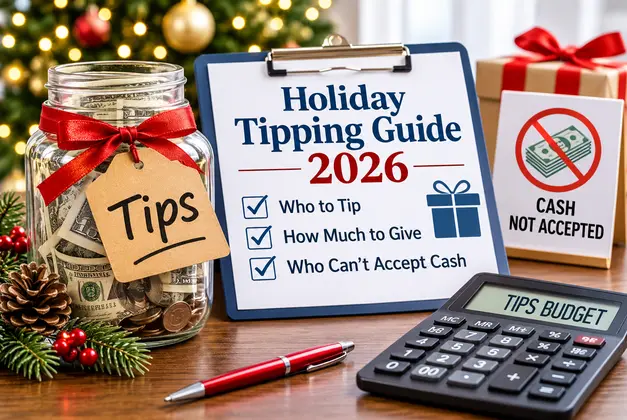
Most Americans say tipping is expected in more places than ever, and only about a third find it easy to know how much (Pew Research Center, 2023). Here’s the short version, then a calculator that fits your list to your budget.
The 30-Second Holiday Tipping Rules
- Anchor: about one week’s pay for in-home regulars (nanny, caregiver); the cost of one visit for everyone else (house cleaner, stylist, trainer).
- NO CASH — GIFT ONLY No cash for your mail carrier: a gift worth $20 or less is fine, and a store gift card is OK. A Visa or Mastercard gift card isn’t.
- CHECK RULES City trash crews may not be allowed any tip, in some cities not even cookies. Check whether your pickup is the city or a private company.
- TAX NOTE A nanny’s or housekeeper’s holiday bonus is wages, and gift cards count too.
Build your list and fit it to your budget ↓
Holiday Tipping Budget Calculator
Updated . Rules checked against federal ethics rules (5 CFR 2635), IRS, and city ethics sources.
The Holiday Tipping Cheat Sheet
Use two anchors: about one week’s pay for people who work in your home regularly, and the cost of one visit for everyone else.
These are conventions, not rules. Northwestern Mutual puts in-home help at 5–10% of monthly pay or one service. Fidelity suggests one session for a trainer or barber. The Emily Post Institute says up to the cost of one service.
If you can’t tip everyone, start with the people who work in your home or serve you most often. The tight-budget section shows how to scale the rest.
| Role | Suggested | Label | Note |
|---|---|---|---|
| Nanny / au pair | About one week’s pay | TAX NOTE | Common convention for regular in-home help. A bonus to a nanny you employ is wages. Au pair? Ask your program agency first. |
| Babysitter | The cost of one evening | CASH OK | Etiquette convention. A sitter you pay on a regular schedule may be a household employee; see the tax section. |
| House cleaner | The cost of one visit | CASH OK TAX NOTE | Through a company, cash is fine. If you employ the cleaner directly, the bonus is wages. |
| Dog walker / pet sitter | About one week’s pay | CASH OK | Etiquette convention. Use one visit if the sitter comes only now and then. |
| In-home caregiver | About one week’s pay | CHECK RULES TAX NOTE | If an agency placed the caregiver, check the agency’s policy first. If you hired directly, the bonus is wages. |
| Hairstylist / barber | The cost of one visit | CASH OK | If several people work on you, split it the way you would a regular tip. |
| Personal trainer | The cost of one session | CASH OK | Fidelity’s convention for trainers. |
| Building staff | Your planned total, split among staff; check rules first | CHECK RULES | Check your building’s policy. A group gift with neighbors works well. |
| Mail carrier | A gift worth $20 or less | NO CASH — GIFT ONLY | No cash or checks. A store gift card is OK; a Visa or Mastercard card is not. |
| Trash / recycling crew | Check rules first | CHECK RULES | City crew: many cities ban any tip, so send a thank-you note. Private company: ask the company. |
| Teacher (public school) | A note or group gift; check rules first | CHECK RULES | Limits are set by state and district. Check your district’s gift policy. |
| Teacher (private school / daycare) | A small or group gift; check rules first | CHECK RULES | A center may set its own policy. Ask the director. |
| Package delivery (FedEx, UPS, other) | A small gift or a thank-you note; check rules first | CHECK RULES | FedEx bars cash and gift cards. UPS encourages drivers to decline money. |
Who Can’t Legally Accept Cash
Federal employees such as mail carriers, many city sanitation workers, and some public-school staff can’t take cash, and some can’t take any tip at all.
Mail carriers (USPS)
NO CASH — GIFT ONLY
Federal ethics rules (5 CFR 2635.204(a)) let a carrier accept an unsolicited gift worth $20 or less per occasion, and no more than $50 a year from the same person. Cash and checks are never allowed, in any amount.
Cash-equivalent cards are out too: cards cobranded with Visa, Mastercard or American Express, and bank-issued cards. A store, restaurant or mall gift card, including an online-marketplace card such as Amazon, is fine within $20.
The carrier can’t pay the difference to keep a gift over $20. Check USPS’s current-year holiday notice before you buy.
City sanitation crews
CHECK RULES
First check whether pickup is a city service or a private company, then follow that rule.
In New York City, public servants may not take a tip or gratuity of any value, including baked goods. Two sanitation workers were fined $2,000 each for a $10 tip in 2013.
Philadelphia’s city guidance says tips are prohibited and lists a gift card from a resident for picking up bulk trash as an example. Honolulu’s Department of Environmental Services says city employees can’t accept cash or gift cards in any amount.
Private haulers set their own policies, so ask the company. For a city crew, a thank-you note or a compliment sent to the city is the safe route.
Public-school staff
CHECK RULES
Gift rules are set by each state and district, so we don’t quote a dollar limit. Check your district’s gift policy or ask the school office. A group gift or a handwritten note is the safest choice.
Agency home-health aides
CHECK RULES
Check the agency’s policy before you give cash or a gift card.
FedEx and UPS drivers
CHECK RULES
FedEx’s code of conduct bars gifts of cash or cash equivalents, such as gift cards, and says the rule doesn’t change during gift-giving season. Its gifts policy also caps small gifts per year.
UPS told Nexstar Media Wire that drivers are encouraged to respectfully decline money, while cookies, cards and mittens are appreciated. We couldn’t confirm a UPS dollar limit, so we don’t name one.
| Worker | Rule | Limit | Source | Verified |
|---|---|---|---|---|
| USPS mail carrier | No cash or checks. No cash-equivalent cards (cobranded Visa/Mastercard/Amex or bank-issued). Store, restaurant or mall gift cards are allowed within the limit. | $20 per occasion; $50 per year from the same giver. The carrier can’t pay the difference. | 5 CFR 2635.204(a); OGE Legal Advisory LA-15-04; USPS guidance | November 11, 2026. Re-check USPS’s current holiday notice. |
| NYC sanitation worker | No tip or gratuity of any value for doing a city job. | None ($0). Two sanitation workers were fined $2,000 each for a $10 tip (2013). | NYC Conflicts of Interest Board | November 11, 2026 |
| Philadelphia city worker | Tips are prohibited, including a gift card from a resident for picking up bulk trash. | None. | City of Philadelphia integrity guidance | November 11, 2026 |
| Honolulu city worker | No cash or gift cards. | None, in any amount. | Honolulu Dept. of Environmental Services, via the Star-Advertiser | November 11, 2026 |
| Public-school staff | Set by your state and district. | Varies. We don’t quote a figure. | Your district’s gift policy | Check your district’s current policy. |
| FedEx / UPS driver | FedEx: no cash or gift cards. UPS: drivers are encouraged to decline money. | FedEx caps small gifts per year. We couldn’t confirm a UPS limit, so we name none. | FedEx Code of Conduct; UPS statement reported by Nexstar Media Wire | November 11, 2026 |
Nanny and Housekeeper Bonuses: The Tax Side
A holiday bonus to a nanny or housekeeper you employ is wages, and a gift card is always wages.
TAX NOTE
That’s the IRS rule for household employees (Publication 926). The amount doesn’t change it: a $50 bonus is wages just as a $500 one is.
For 2026, paying one household employee $3,000 or more in cash wages makes all of that employee’s cash wages subject to Social Security and Medicare. That’s up from $2,800 in 2025, and your holiday bonus counts toward the total.
The $3,000 line decides Social Security and Medicare only. It never decides whether a bonus is wages.
A low-value holiday gift of property, such as a holiday turkey, can be a de minimis gift under IRS Publication 15-B. Cash and cash equivalents, including gift cards, never can be, however small. That’s how the rule works, not a way around payroll: a cash bonus belongs in your household payroll records.
| What you give | Treated as | Why |
|---|---|---|
| Cash bonus | Wages | Cash is wages at any amount. |
| Gift card | Wages | Cash equivalents, including gift cards, are never excludable as a de minimis benefit, however small. |
| Holiday turkey or small basket | Can be a de minimis gift | A low-value holiday gift of property can qualify. |
| Paid extra day off | Wages, if paid | You are paying for time not worked, which is pay. |
Federal income tax withholding isn’t required for household employees unless you and your employee agree to it. Wages paid to your spouse or your child under 21, and in limited cases your parent, don’t count as Social Security and Medicare wages.
Never pay a household employee off the books. Keep the bonus in your payroll records, and see the planning notes in our Year-End Tax Moves guide. State rules and federal unemployment tax can apply too.
This section is not tax advice. For your situation, read IRS Publication 926 or ask a tax professional.
How a tip is taxed for the person who receives it is a separate topic: see how to claim no tax on tips.
At Home
For people who work in your home, tip about one week’s pay or the cost of one service, and treat any bonus to an employee as wages.
Nanny and au pair
TAX NOTE
About one week’s pay is the common convention. For a part-time nanny, use a typical week of their pay. A bonus to a nanny you employ is wages, and gift cards count too.
Au pairs come through a program, so ask your agency what it recommends. A gift or a card is a safe choice.
Babysitter
CASH OK
The cost of one evening is a good anchor for a sitter you use regularly. A sitter you pay on a regular schedule may be a household employee, so see the tax section.
House cleaner
CASH OK TAX NOTE
The cost of one visit is the usual anchor, whether you’re weekly or biweekly. For a new cleaner, scaling down is common etiquette; half for a few months of service is a reasonable guide.
If a company employs your cleaner, tip as usual. If you employ the cleaner directly as a household employee, the bonus is wages.
Dog walker and pet sitter
CASH OK
About one week’s pay is the usual anchor. Use the cost of one visit if the sitter comes only now and then.
In-home caregiver
CHECK RULES TAX NOTE
About one week’s pay is the common convention. If an agency placed the caregiver, check the agency’s policy first. If you hired the caregiver directly, a bonus is wages.
Personal Care and Fitness
For a stylist, barber or trainer, the common convention is the cost of one visit or session.
Stylist, barber and nail tech
CASH OK
Fidelity suggests the cost of one session for a barber. If several people work on you, split the tip the way you would at a regular visit, as the Emily Post Institute advises.
If you tip at every visit, a holiday tip is a nice extra, not a requirement.
Personal trainer
CASH OK
The cost of one session is the usual anchor. A card alongside it is a nice touch.
Tipping the owner
If the owner does your hair or runs your sessions, tip as usual. If the owner doesn’t serve you personally, a card or a review is enough. That’s etiquette, not a rule.
Your Building
Check your building’s policy first, then give what fits your budget, alone or with neighbors.
CHECK RULES
Super, doorman and porter tips vary a lot by city and building, so we don’t set a number. Your building may have a policy on tips, so ask management before you give.
A group gift with neighbors, with one card everyone signs, spreads the cost and keeps things simple for staff.
School and Daycare
For a public-school teacher, check your district’s gift policy first; for a private school or daycare, ask the center.
CHECK RULES
Limits are set by state and district, so we don’t give a dollar amount. A handwritten note or a group gift from the class is usually the safest choice.
Daycare teachers often work in teams, so one card and gift for the whole room works well. Ask the director if the center has a policy.
On a Tight Budget
Scale the list down instead of skipping people, and add non-cash thanks that cost little.
Enter your budget in the calculator and it shrinks every amount by the same share, rounded down to the nearest $5. Then move a few dollars toward the people you see most.
A handwritten note, baked goods (where allowed), a group gift with neighbors, or a public review all land well. For workers who can’t accept any gift, such as NYC sanitation crews, a note or a compliment sent to the city is the way to go.
Need a plan for the season? See How to Make a Budget and Reduce Monthly Expenses. Splitting the list with a partner? See Split Finances With Your Partner.
How to Give It
Make your list in mid-November and give between Thanksgiving and the last service before the holiday.
- Make the list in mid-November; give between Thanksgiving and the last service before the holiday.
- Mail carrier: a small gift or store gift card of $20 or less, plus a card. Hand it over, or leave it with a note where that’s safe and local custom allows.
- Trash crew: first check whether it’s a city service. If private, hand it over in person on pickup day or ask the company how.
- Nanny or housekeeper you employ: add the bonus to payroll records; a small item of property (not a gift card) can be a separate gift.
- Business owner who serves you personally: tip as usual. If they don’t serve you, a card or a review is enough (etiquette, not a rule).
- New to a provider: scale down, for example half for a few months of service (etiquette).
- Tight budget: a handwritten note, baked goods (where allowed), a group gift with neighbors, or a public review.
FAQ
Quick answers to the questions people ask most.
Who should I tip during the holidays?
Tip the people who serve you regularly and whom you can reasonably thank: in-home help, personal-care providers, building staff and others on the cheat sheet. Tipping is optional, so give what fits your budget.
How much should I tip my mail carrier?
Give a gift worth $20 or less per occasion, and no more than $50 in a year from you. That’s the federal limit, and it covers a small gift or a store gift card, not a cash tip.
Can I give my mail carrier cash?
No. Federal ethics rules bar cash and checks in any amount. A small gift or a store gift card within $20 is the way to say thanks.
Can I give a mail carrier a Visa or Amazon gift card?
Not a Visa, Mastercard or American Express card, or a bank-issued card, because they work like cash. A store gift card, including an online-marketplace card such as Amazon, is allowed within $20.
Can I tip my garbage collectors?
It depends on who picks up your trash. Many cities ban any tip for city workers, so check your city’s rule and consider a note. A private hauler sets its own policy, so ask the company.
How much should I give my nanny for the holidays?
About one week’s pay is the common convention. For a part-time nanny, use a typical week of their pay. It’s an etiquette suggestion, not a requirement.
Is a nanny’s holiday bonus taxable?
Yes. A holiday bonus to a household employee is wages at any amount. The $3,000 line for 2026 decides only whether Social Security and Medicare apply to the employee’s cash wages. This is not tax advice.
Is a gift card to my nanny taxable?
Yes. Cash and cash equivalents, including gift cards, are wages and can’t be treated as a de minimis gift, however small. A low-value item of property, such as a holiday turkey, can be.
How much should I tip my house cleaner?
The cost of one visit is the usual anchor. If you employ the cleaner directly, the bonus is wages; if a company employs the cleaner, tip as usual.
Should I tip the owner of the cleaning company or salon?
If the owner serves you personally, tip as usual. If the owner doesn’t, a card or a review is enough. That’s etiquette, not a rule.
Do I tip my hairdresser at the holidays if I tip every visit?
It’s optional. The convention is a holiday tip up to the cost of one visit, but a card or a slightly larger tip at your usual visit also works.
How much should I tip building staff?
Check your building’s policy first. Amounts vary by city and building, so we don’t set a number. A group gift with neighbors is a good option.
Can public school teachers accept gifts?
It depends on your state and district. Check your district’s gift policy or ask the school office. A group gift or a handwritten note is usually the safest choice.
What if I’ve only used a provider for a few months?
Scale down. For example, give half for a few months of service. That’s etiquette, not a rule.
What if I can’t afford to tip everyone?
Enter your budget in the calculator to scale the list, start with the people you see most, and add a note, a group gift or a public review for the rest.
When should I give holiday tips?
Make your list in mid-November and give between Thanksgiving and the last service before the holiday.
Amounts in this guide are common etiquette suggestions, not requirements. Employer and government gift rules vary and change. Verified November 11, 2026. This guide is not tax advice.

Daniel Hayes is the founder and sole researcher at AdvoraHQ. He covers U.S. personal finance, insurance, and consumer law — working directly from IRS publications, federal and state statutes, court opinions, and SEC filings rather than secondary summaries. His focus is the gap between what readers think they know and what the source documents actually say. Daniel is not a licensed attorney, CPA, or financial advisor; his articles are educational and not personalized advice. Reach him at Daniel.Hayes@advorahq.com.
