
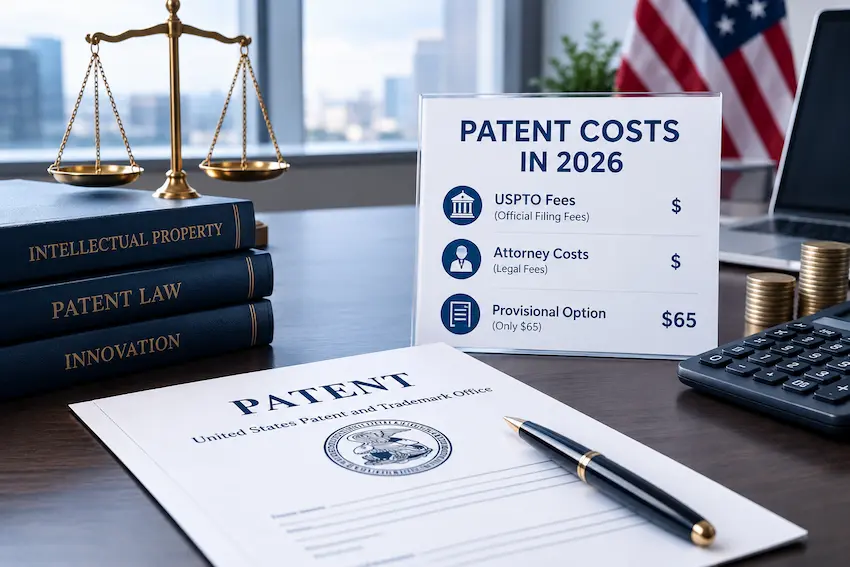
You can start a patent filing for $65 — but $65 doesn’t get you a patent.
The 4 numbers (USPTO fees, as of October 7, 2026)
- $65provisional filing fee, micro entity
- $400 / $730 / $2,000utility filing + search + exam (micro / small, filed electronically / large)
- $658basic micro-entity utility fees through issue
- $262,380micro-entity income limit since Sept. 15, 2026
Professional drafting usually costs far more than the government fees — often thousands. Fees are from the USPTO fee schedule (checked October 7, 2026).
→ Estimate your patent budget — and see the micro-entity rule that trips up married inventors (your income counts alone).
Patent Cost Estimator (2026) With a Micro-Entity Check
Enter your situation and this tool checks which USPTO entity size you can use, prices the government fees for each stage, and adds editable professional ranges so you can see a realistic budget range.
The professional ranges are typical market ranges from law-firm and marketplace cost guides, not USPTO fees and not quotes. Open the adjust panel below to replace them with numbers from a real estimate. Utility drafting by an attorney is commonly cited at $5,000 to $15,000 or more, and total attorney-assisted utility budgets at $10,000 to $30,000 or more.
Adjust professional price ranges (typical market ranges, editable)
How Much Does a Patent Cost in 2026? (Short Answer)
The USPTO fees for a basic utility patent run about $658 for a micro entity, $1,246 for a small entity filing electronically, or $3,290 undiscounted through issue — but professional help usually costs several times more than the government fees.
The cost depends on three choices: how much of the work you do yourself, which entity size you qualify for, and whether you file a utility patent (how an invention works) or a design patent (how it looks). Here are the three paths, with professional prices shown as typical ranges from cost guides, not quotes.
BUDGET PATH
Do-it-yourself provisional, then your own utility filing.
USPTO fees: $65 / $130 / $325 for the provisional (micro / small / large), then $658 / $1,246 / $3,290 through issue for a utility application. Your main cost is time, and the main risk is a thin description of the invention.
HYBRID PATH
You do part of the work and buy professional help for the parts that matter most.
USPTO fees plus selected help — for example, a professionally drafted provisional (commonly cited at $1,500 to $6,000), a prior-art search ($300 to $4,000), or drawings (often $40 to $150 per sheet).
FULL-SERVICE PATH
An attorney or agent handles the application through grant.
Utility drafting is commonly cited at $5,000 to $15,000 or more, and total attorney-assisted utility budgets at $10,000 to $30,000 or more, depending on complexity and office actions (UpCounsel and law-firm cost guides).
$65 starts a filing — it isn't a patent. The $65 is the micro-entity filing fee for a provisional application. A provisional is not examined and can never become a patent on its own.
The Real 2026 USPTO Fee Table
These are the fees on the USPTO's own schedule, which was effective January 19, 2025 and last revised August 14, 2026; they are listed here as checked on October 7, 2026.
Each column is an entity size. Most fees are 40% of the undiscounted amount for a small entity (a 60% discount) and 20% for a micro entity (an 80% discount). Law-firm pages sometimes show older or mismatched numbers for the same fee, so confirm anything you rely on against the USPTO fee schedule.
| Fee | Large | Small | Micro |
|---|---|---|---|
| Provisional filing | $325 | $130 | $65 |
| Utility basic filing | $350 | $140 | $70 |
| Utility basic filing, small entity filed electronically in Patent Center (fee code 4011) | n/a | $70 | n/a |
| Utility search | $770 | $308 | $154 |
| Utility examination | $880 | $352 | $176 |
| Utility filing + search + exam (electronic) | $2,000 | $730* | $400 |
| Utility issue | $1,290 | $516 | $258 |
| Design filing | $300 | $120 | $60 |
| Design search | $300 | $120 | $60 |
| Design examination | $700 | $280 | $140 |
| Design issue | $1,300 | $520 | $260 |
| Add-ons that can apply (utility unless noted) | |||
| Paper filing surcharge (nonprovisional utility only; no micro discount) | $400 | $200 | $200 |
| Non-DOCX filing surcharge | $430 | $172 | $86 |
| Each independent claim over 3 | $600 | $240 | $120 |
| Each claim over 20 | $200 | $80 | $40 |
| Multiple dependent claim | $925 | $370 | $185 |
| Application size fee, each additional 50 sheets over 100 (also applies to provisionals) | $450 | $180 | $90 |
| Information disclosure statement fee (when it applies) | $280 | $112 | $56 |
| Information disclosure statement size fees | Same for every entity size: $200 (over 50 items), $500 (over 100), $800 (over 200), less amounts already paid | ||
| Extension of time, first month | $235 | $94 | $47 |
| Request for continued examination, first request | $1,500 | $600 | $300 |
| Prioritized examination (Track One) request | $4,515 | $1,806 | $903 |
| Filing, or claiming benefit of an earlier application, more than six years after the earliest benefit date | $2,700 | $1,080 | $540 |
The table shows individual fees. This one adds them up by path, so you can see what the government charges in total for each route.
| Path | Micro | Small | Large |
|---|---|---|---|
| Provisional only | $65 | $130 | $325 |
| Utility: filing + search + exam (electronic) | $400 | $730 | $2,000 |
| Utility through issue (adds the issue fee) | $658 | $1,246 | $3,290 |
| Provisional, then utility through issue | $723 | $1,376 | $3,615 |
| Utility through issue plus all three maintenance fees | $3,552 | $7,034 | $17,760 |
| Provisional, then utility, through the last maintenance fee | $3,617 | $7,164 | $18,085 |
| Design: filing + search + exam | $260 | $520 | $1,300 |
| Design through issue (no maintenance fees) | $520 | $1,040 | $2,600 |
File electronically — paper costs more. A nonprovisional utility application filed on paper adds a $200 non-electronic surcharge for small and micro entities ($400 undiscounted), with no micro discount. Filing in Patent Center in DOCX format avoids both that surcharge and the non-DOCX surcharge.
Micro vs. Small vs. Large Entity: Who Pays Less
Micro entities pay 20% of most USPTO fees, small entities pay 40%, and everyone else pays full price — but micro status has strict rules on income, the number of earlier applications, and who owns rights in the invention.
To use the micro-entity rate on the income basis, every applicant, every inventor, and anyone else with an ownership interest in the invention must be a small entity first. Then four more requirements apply, all set out on the USPTO's micro entity status page (updated September 17, 2026).
The income limit: $262,380
For fees paid on or after September 15, 2026, the "maximum qualifying gross income" is $262,380. It was $251,190 for fees paid from September 9, 2025 through September 14, 2026. The limit is three times the median U.S. household income, so it changes every year, usually in September or October.
The test uses gross income for the calendar year before the year you pay the fee — the "total income" line on Form 1040. It is gross income, not adjusted gross income.
Married? Your income counts alone. If you file jointly with a spouse, the USPTO applies the limit to the income you would have reported filing a separate return — not your combined household income. A spouse who is not an inventor or owner is not part of the test; a spouse who is a co-inventor or co-owner is tested on their own income. If ownership is shared in any way, ask a registered practitioner.
The application limit: first five, not four
First five applications, not four. The rule says no one named as an inventor may appear on more than four previously filed applications, so normally your first five applications can qualify.
Counted toward the limit: earlier U.S. nonprovisional applications (utility, design, plant, continuations, divisionals), reissues, PCT national-stage applications, and Hague design applications designating the U.S. — whether they are pending, granted, or abandoned, and even if you paid full price. Not counted: provisional applications, foreign applications, and PCT applications where the U.S. national-stage fee was not paid.
One trap: once you have reached the limit through other filings, no later application naming you can use micro status — even a provisional, which does not count on its own.
Re-check every time you pay
You must re-evaluate micro status each time you pay a fee, because the income limit and your own income both change. If you lose eligibility, notify the USPTO on Form SB/460. If you claimed micro status by honest mistake, the USPTO allows you to correct it with an itemization and a deficiency payment. A false certification is different: the penalty is not less than three times the fees you failed to pay.
| Rule | What it means |
|---|---|
| Small entity first | Each applicant, inventor, and other owner must qualify as a small entity: a business with fewer than 500 employees (including affiliates), a nonprofit, or an individual who has not conveyed rights to a non-small entity. |
| Income limit | Gross income (Form 1040 "total income") for the preceding calendar year must be $262,380 or less for fees paid on or after Sept. 15, 2026. |
| Everyone is tested | The limit applies to every applicant, every inventor, and every other party with an ownership interest, even if unnamed or unrecorded. A company that holds rights is tested on its own total income from its federal tax return, and it must also have fewer than 500 employees. |
| Joint filers | Compute your income as if you filed a separate return. |
| Application limit | No one named as inventor on more than four previously filed applications; normally the first five qualify. |
| What does not count | Provisional applications, foreign applications, and PCT applications without a paid U.S. national-stage fee. |
| Employer exception | An earlier application can be excluded if all rights went to a former employer through that previous employment. |
| No big assignees | No assignment or license (or promise of one) to any party over the income limit. |
| Certification | File Form SB/15A at or before paying the first micro-rate fee. A university-based route uses Form SB/15B. |
| Re-evaluate | Check at every fee payment; report loss of status on Form SB/460. |
| Foreign-domiciled applicants | Since July 20, 2026, they must use a registered USPTO practitioner, and only a practitioner can sign the micro certification. |
The $65 Provisional: What It Does — and Doesn't — Do
A provisional application is a lower-cost first filing that establishes an official U.S. filing date for what it describes; it is not examined, never becomes a patent by itself, and expires after 12 months. (There is no such thing as a "provisional patent" — the correct term is provisional application.)
What you get for the filing fee ($65 micro, $130 small, $325 large):
- A filing date. If you file the real (nonprovisional) application within 12 months and it claims the provisional's benefit, your effective filing date can reach back to the provisional — but only for subject matter the provisional actually supports.
- The right to say "patent pending." It is a notice that an application is on file, not a grant of rights.
- Twelve months to decide. You can test the market before paying for examination.
What it does not do:
- It is not examined. No examiner reviews it, and it never matures into a patent unless you file a nonprovisional or convert it within 12 months.
- It cannot be extended. If you miss the 12 months, the USPTO allows a petition to restore the benefit within 14 months only if the delay was unintentional, and the petition carries its own fee. Do not plan on it.
- It does not give you enforceable rights or stop anyone else from using the invention.
- It cannot be improved after filing. Amendments are generally not allowed, so a thin description stays thin. The USPTO recommends making the disclosure as complete as possible.
- It is not available for designs.
Public disclosure clock. In the U.S., you generally have one year after your own public disclosure to file; waiting past it can end your U.S. rights, and a public disclosure can hurt rights abroad. See the USPTO's provisional application guide.
The $65 is also not the whole cost. Large filings add size fees ($90 for each additional 50 sheets over 100 at the micro rate), late cover sheets or fees add a surcharge, and the nonprovisional that follows brings the full filing, search, and examination fees. The USPTO also warns that some invention promotion firms misuse provisionals and leave inventors with no patent.
What Patent Attorneys and Agents Charge
Typical market ranges put attorney drafting of a utility application at roughly $5,000 to $15,000 or more, and total attorney-assisted utility budgets at $10,000 to $30,000 or more once office actions are included.
These are ranges from cost guides, not USPTO figures and not quotes. Attorney prices vary with the technology, how many claims you need, and how many rejections you receive. Treat every number below as a starting point for asking better questions.
| Service | Typical range | Where the range comes from |
|---|---|---|
| Provisional drafting | About $1,500 to $6,000 | Law-firm and UpCounsel cost guides (some firms cite more for complex inventions) |
| Utility drafting and filing | $5,000 to $15,000+ | UpCounsel and law-firm pages |
| Prior-art search | $300 to $4,000 | From low flat-fee search services to attorney-run searches |
| Drawings | About $40 to $150 per sheet | Illustrator and law-firm pages (up to $500 per sheet for complex work) |
| Each office-action response | About $1,500 to $4,000 | Law-firm cost guides |
| Total attorney-assisted utility budget | $10,000 to $30,000+ | UpCounsel and law-firm pages |
Where the money goes
Drafting is usually the biggest single cost: the written description and claims decide how much protection you can get. Responding to office actions — the examiner's rejections — is the second. Many utility applications receive at least one, so budget for it.
In an attorney-assisted budget, government fees are usually the smaller part, so the scope of work you buy tends to move the total more than the entity discount does. The discount is still worth claiming correctly, because it applies to every USPTO fee you pay.
Patent agent vs. patent attorney
Both are registered to practice before the USPTO and can prepare and prosecute applications. A patent attorney is also a licensed lawyer, which matters for legal advice beyond the application — for example on contracts, ownership, or infringement — while an agent is not licensed to give that kind of advice. Prices overlap, and agents often charge less.
Check any practitioner on the USPTO's practitioner search. For hiring tips, see our Intellectual Property Lawyer: Full Guide.
Filing Yourself: Savings and Risks
You can file a provisional or utility application yourself in Patent Center, which saves the professional fees, but the savings come with real risks that are hard to undo after filing.
What DIY involves: you create the specification, drawings, and (for utility) claims; file them in Patent Center; and pay the fees. The USPTO runs a Pro Se Assistance Program for people who file without an attorney or agent. The USPTO also says applicants unfamiliar with patent law and procedure should consult a registered practitioner.
The risks that matter
- A weak disclosure. Your filing date only covers what you described. New matter generally cannot be added later, and a provisional cannot be amended, so a vague description can cost you rights you thought you had.
- Weak claims. Claims define what you actually own. Poorly written claims can be easy to design around or invite repeated rejections.
- Fee mistakes. Excess claims, large filings, information disclosure statements, late fees, and extensions each add charges.
- Paper filing. Filing a utility application on paper adds the non-electronic surcharge, and a non-conforming file adds the non-DOCX surcharge.
- Micro-entity errors. A wrong certification can trigger a penalty of at least three times the fees you underpaid.
- Foreign domicile. If an applicant or inventor lives outside the U.S., a registered practitioner is required and DIY is not an option.
A common middle route is the HYBRID PATH: do the preparation and invention-facing work yourself, then pay a registered practitioner to review or draft the parts where mistakes are permanent.
The 20-Year Cost of a Utility Patent
A utility patent lasts up to 20 years from the earliest nonprovisional filing date, but you must pay three maintenance fees — at 3.5, 7.5, and 11.5 years after grant — which total $2,894 for a micro entity and $14,470 undiscounted.
| Due at | Large | Small | Micro |
|---|---|---|---|
| 3.5 years after grant | $2,150 | $860 | $430 |
| 7.5 years after grant | $4,040 | $1,616 | $808 |
| 11.5 years after grant | $8,280 | $3,312 | $1,656 |
| All three | $14,470 | $5,788 | $2,894 |
| Late payment within six months (surcharge on each fee) | $540 | $216 | $108 |
Miss a payment and the patent can expire. A petition for delayed payment is available but costs more: $2,260 / $904 / $452 (large / small / micro) if the delay is one year or less, and $3,000 / $1,200 / $600 if it is longer.
Putting it together, the government fees for a utility patent from filing through the last maintenance fee are about $3,552 for a micro entity, $7,034 for a small entity filing electronically, and $17,760 undiscounted (see the path table above). Add professional fees on top, and add $65 / $130 / $325 if you start with a provisional. The 20-year cost is a decision you can revisit: many owners stop paying maintenance fees if the patent is no longer worth keeping.
One limit on all of these numbers: a U.S. patent covers the United States only. Protection in other countries needs separate filings, usually started through a Patent Cooperation Treaty (PCT) application. On the USPTO schedule, the PCT transmittal fee is $285 / $114 / $57 and the PCT search fee is $2,400 / $960 / $480 (large / small / micro), before the WIPO international filing fee of about $1,542 and any handling charges. Each country's national-stage fees and local counsel come on top, so international budgets are a separate calculation. Ask a registered practitioner before you disclose the invention publicly, because foreign rights can be lost sooner than U.S. rights.
Design Patent vs. Utility Patent Cost
A design patent is cheaper over its life — about $520 in micro-entity government fees from filing through issue, with no maintenance fees — but it protects only how an article looks, not how it works.
| Point | Design | Utility |
|---|---|---|
| What it protects | The ornamental appearance of an article | How an invention works, is made, or is used |
| Term | 15 years from grant | Up to 20 years from the earliest nonprovisional filing date |
| Maintenance fees | None | 3.5, 7.5, and 11.5 years after grant |
| Provisional application | Not available | Available |
| Government fees through issue (micro / small / large) | $520 / $1,040 / $2,600 | $658 / $1,246 / $3,290 |
| Government fees for the full life (micro / small / large) | $520 / $1,040 / $2,600 | $3,552 / $7,034 / $17,760 |
| Where the cost goes | Drawings, which define the scope | Written description, claims, and office-action responses |
| Typical professional total | Often cited around $2,000 to $4,000 all-in for a simple design | $10,000 to $30,000+ attorney-assisted |
If your product's value is its shape, a design patent can be a fraction of the cost. If its value is how it works, a design patent will not cover that, and the two are sometimes filed together.
Do You Need a Patent at All?
Not always — a patent is one of several ways to protect a business, and it only makes sense if the invention is new, useful, and valuable enough to justify the cost of getting and keeping it.
- Patent: protects a new invention or design for a limited time, in exchange for publicly describing it.
- Trade secret: protects information by keeping it secret; it costs little but ends if the secret gets out.
- Trademark: protects the name or logo customers use to recognize your business, not the product itself. See How to Trademark a Business Name.
- Copyright: protects original expression, such as writing, images, and software code, not ideas. See Trademark vs. Copyright vs. Patent.
Used an AI tool while inventing or creating? Ownership rules can differ for AI-assisted work; read You Don't Own the AI Content You Just Created first.
Before you spend on a patent, search for existing ones with the USPTO's free Patent Public Search. A patent that someone else already holds changes the whole decision.
Invention Scams and How to Spot Them
Invention promotion scams charge high fees by promising profits or manufacturer deals they cannot deliver, so the safest rule is that no one can guarantee your invention will make money.
The FTC says dishonest promoters promise a proven market, guarantee success, and claim special manufacturer relationships — then charge thousands of dollars for little in return. Federal law gives you the right to specific written disclosures before you sign, including the number of inventions evaluated, how many customers the firm has had, how many made a net profit, and how many received license agreements (35 U.S.C. § 297, as described by the FTC). Read the FTC's invention marketing scams guide and the USPTO's scam prevention page.
Scam Red-Flag Checklist and Questions to Ask
Tick any red flag you have seen in an offer, then run the check. You can also copy the full checklist and questions to take into a call.
Questions to ask before you pay anyone
- How many inventions have you evaluated in the past five years, and how many got positive and negative evaluations?
- How many customers have you had in the past five years, how many made a net profit from your services, and how many received license agreements?
- Are you a USPTO-registered practitioner? (Check the USPTO practitioner search.)
- What exactly will I get, and when? What is the total cost, including every later fee?
- Will a registered patent attorney or agent prepare my application, and will I get a copy of everything filed?
- Are all your promises in the written contract?
If you already paid and think you were misled, the FTC says you may be able to sue under the American Inventors Protection Act, and you can report the company to the USPTO and the FTC at ReportFraud.ftc.gov.
Free and Low-Cost Patent Help
If you cannot afford a practitioner, the USPTO runs three free programs — the Patent Pro Bono Program, the Pro Se Assistance Program, and the Law School Clinic Certification Program — plus free search tools.
- Patent Pro Bono Program. A nationwide network of independent regional programs that match volunteer patent practitioners with financially under-resourced inventors and small businesses. You must meet income and other criteria, and help covers preparing and filing a patent application.
- Pro Se Assistance Program. Outreach and education for inventors who file without an attorney or agent.
- Law School Clinic Certification Program. Law students at participating schools draft and file applications under faculty supervision. Each school has its own criteria for accepting clients.
- Inventors Assistance Center. Staffed by former examiners who answer general questions about patent policy and procedure; the USPTO lists IndependentInventor@uspto.gov for inventor questions.
- Patent Public Search. Free, from the USPTO, for checking whether your invention already exists.
Start with the USPTO's intellectual property legal assistance page. Free help is not guaranteed; programs have eligibility limits and capacity limits.
Paying for It
Most inventors pay for patents out of savings or business funds, but loans and phased spending can spread the cost.
The phased approach works with the paths above: start with a search and a provisional, then decide within 12 months whether the invention justifies a full utility filing. If you are financing a business, see Business Loans in 2026 and our SBA Loan Guide.
One ownership check before you file: if you invented something while employed, an invention-assignment agreement may give your employer the rights. Read your agreements, and see Are Non-Competes Enforceable? for how employee agreements can reach further than people expect.
Frequently Asked Questions
These answers use USPTO fees as checked on October 7, 2026, and typical market ranges for professional help.
How much does a patent cost in 2026?
USPTO fees for a basic utility patent run $658 (micro), $1,246 (small, filed electronically), or $3,290 (undiscounted) through issue, plus maintenance fees later. Professional help usually adds thousands; total attorney-assisted utility budgets are commonly cited at $10,000 to $30,000 or more.
How much does it cost to patent an idea?
A patent covers a described invention, not a bare idea, so the cost starts with describing it well. Many people begin with a prior-art search (free through Patent Public Search) and a provisional application ($65 micro, $130 small, $325 large in USPTO fees), then decide whether to continue.
Is the $65 provisional fee real — and is that the whole cost?
The fee is real: $65 is the micro-entity provisional filing fee on the USPTO schedule. It is not the whole cost, because it buys only a provisional filing, not a patent, and professional drafting, size fees, and the later nonprovisional application are separate.
Does a provisional patent protect my idea?
Only in a narrow sense: a provisional application establishes a filing date for what it actually discloses and lets you say "patent pending." It is not examined, it cannot become a patent on its own, and it does not give you enforceable rights.
What happens after 12 months?
The provisional expires and cannot be extended. You must file a nonprovisional application claiming its benefit within 12 months; the USPTO allows a petition to restore the benefit within 14 months only if the delay was unintentional, and that petition costs extra.
Can I file a provisional patent myself?
Yes, through Patent Center with a cover sheet and the fee. The main risk is a thin description, because a provisional generally cannot be amended after filing, so make the disclosure as complete as you can or have a registered practitioner review it.
How much does a utility patent cost with an attorney?
Typical market ranges put attorney drafting at $5,000 to $15,000 or more, and total budgets at $10,000 to $30,000 or more once office-action responses and USPTO fees are added. These are ranges from cost guides, not quotes.
What are the 2026 micro entity fees?
At the micro rate: provisional $65; utility filing $70, search $154, and examination $176 (total $400); utility issue $258; design filing $60, search $60, examination $140, and issue $260; and utility maintenance $430, $808, and $1,656. Check the USPTO fee schedule before paying.
What is the micro entity income limit?
$262,380 for fees paid on or after September 15, 2026, measured against gross income (Form 1040 "total income") for the preceding calendar year. It was $251,190 from September 9, 2025 through September 14, 2026, and it changes every year.
How many applications can I file as a micro entity?
Normally your first five. The rule is that no one named as an inventor may be on more than four previously filed applications.
Do provisional applications count toward the limit?
No, provisional applications, foreign applications, and PCT applications without a paid U.S. national-stage fee do not count. But if you have already reached the limit through other filings, you cannot claim micro status on a later provisional either.
My spouse and I file jointly — does our combined income count?
No. The USPTO applies the limit to the income you would have reported filing a separate return. Every inventor, applicant, and owner is tested individually, though, so a spouse who is a co-inventor or co-owner is tested on their own income.
Micro vs. small entity — what's the difference?
A micro entity pays about 20% of most fees (an 80% discount) and a small entity about 40% (a 60% discount). Micro status requires small-entity status plus the income limit, the application limit, and no rights going to a party over the income limit.
Is a design patent cheaper than a utility patent?
Usually yes over the life of the patent: design government fees through issue are $520 / $1,040 / $2,600 (micro / small / large) with no maintenance fees, versus $3,552 / $7,034 / $17,760 for a utility patent including maintenance. A design patent only protects appearance.
Do design patents have maintenance fees?
No. A design patent lasts 15 years from grant with no maintenance fees, according to the USPTO.
How much are patent maintenance fees?
For a utility patent, $2,150, $4,040, and $8,280 undiscounted; $860, $1,616, and $3,312 for a small entity; and $430, $808, and $1,656 for a micro entity, due 3.5, 7.5, and 11.5 years after grant. A six-month grace period adds a surcharge.
Can I patent an idea without a prototype?
Often yes. A prototype is not required, but the application must describe the invention well enough for someone skilled in the field to make and use it. Building or sketching a prototype often helps you write a better description.
Patent agent vs. patent attorney?
Both are registered with the USPTO and can prepare and prosecute applications. An attorney is also a licensed lawyer who can give broader legal advice; agents are not licensed to do that, and prices overlap. Verify either one on the USPTO practitioner search.
How do I avoid invention promotion scams?
Never pay a large upfront fee based on a promise of profits, ask for the written disclosures federal law requires, check complaints, and get every promise in writing. Use the checklist above and the FTC and USPTO scam guides.
Can I get free help filing a patent?
Possibly. The USPTO's Patent Pro Bono Program offers free income-based help, the Pro Se Assistance Program supports people who file themselves, and participating law school clinics help clients at no charge. Each has its own eligibility rules.
Last updated: . Fees are re-checked each October and the micro-entity limit each September.
This article is for educational purposes only and is not legal advice. It does not create an attorney-client relationship; for advice about your invention, talk to a registered patent attorney or agent. USPTO fees and limits are as of October 7, 2026 and are subject to change. Professional prices are typical ranges from cost guides, vary widely, and are not quotes or recommendations of any firm or service.

Daniel Hayes is the founder and sole researcher at AdvoraHQ. He covers U.S. personal finance, insurance, and consumer law — working directly from IRS publications, federal and state statutes, court opinions, and SEC filings rather than secondary summaries. His focus is the gap between what readers think they know and what the source documents actually say. Daniel is not a licensed attorney, CPA, or financial advisor; his articles are educational and not personalized advice. Reach him at Daniel.Hayes@advorahq.com.
