
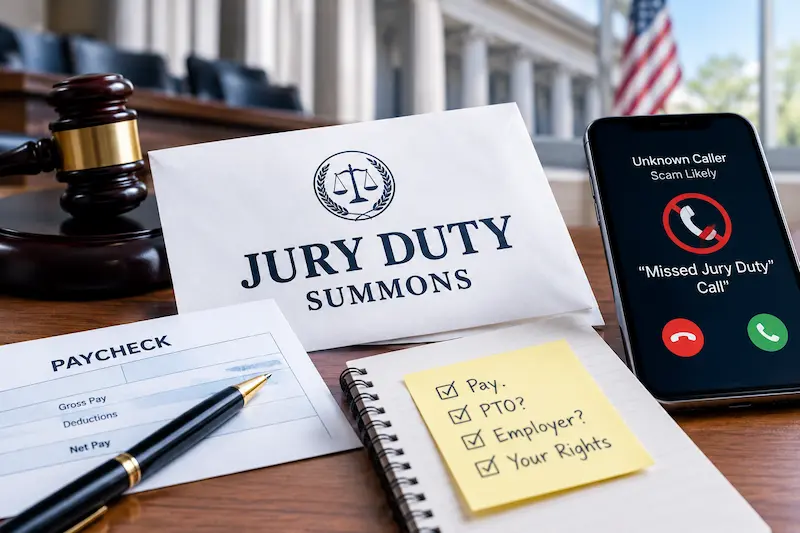
Got a call or text saying you missed jury duty and must pay a fine to avoid arrest? It’s a scam. Courts do not demand payment by phone, and real law enforcement does not text or email arrest warrants.
Quick answer
Federal law generally does not require a private employer to pay you for jury duty, but some state laws do. Federal law protects permanent employees from retaliation for federal jury service. The rules can depend on where you work, the court, your employer’s size, your schedule, and how long you serve. Illinois is scheduled to require covered employers with 26 or more employees to pay the employee’s regular rate for jury-service time starting January 1, 2027. A salaried exempt employee generally must receive the full salary for any workweek in which they perform any work; the employer may offset jury fees received for that week.
See what you’re owed in your state →
Reviewed October 19, 2026. This is general information, not legal advice. Rules can depend on the precise facts and the court handling your summons.
Jury Duty Paycheck Estimator
This is a screening estimate for nonexempt private-sector employees. It assumes that each day entered is both a day of jury service and a scheduled paid workday you miss. It does not model part-days, irregular schedules, every statutory exception, union contracts, public-sector payroll, or mileage and expense reimbursements. Salaried exempt employees should select that option to see why a daily-wage calculation would be misleading.
EMPLOYER PAY
A state rule may require some or all regular pay.
COURT PAY
Depends on the court and the days served.
POSSIBLE PAY GAP
A rough comparison with the wages you would otherwise have earned.
Use the daily court fee from your summons for Alabama, Louisiana, Illinois, Tennessee, or another state if you know it. For a Connecticut temporary-help agency placement, enter the exact number of days in the position; the statute requires more than 90 days. Do not include mileage or expense reimbursements as wages. The tool does not estimate salaried-exempt pay in dollars.
The dollar estimate assumes the service days and missed paid workdays line up. If they differ, or if your service is only part of a workday, treat the result as a rough screen only. If jury service has led to a threat or dismissal, review your rights and consider speaking with an employment lawyer or your state labor agency.
The Federal Rule: No Pay Mandate, But Your Job Is Protected
No federal law makes a private employer pay you for jury duty, but federal law does protect your job if you serve on a federal jury.
Under the Jury System Improvements Act (28 U.S.C. § 1875), an employer may not fire, threaten, intimidate or coerce a permanent employee because of federal jury service. Remedies can include lost wages and benefits, reinstatement, a civil penalty of up to $5,000, and community service.
Private employers are not required by federal law to pay wages for jury duty, but some states require employer pay under specific conditions. Federal courts pay their jurors an attendance fee; federal government employees generally receive their regular salary instead of that fee.
States With Statewide Employer-Pay Rules
Several states, plus Washington, D.C., require some employers to pay or maintain compensation for jury duty under specific conditions. Illinois’s new employer-pay requirement begins January 1, 2027.
New York’s jury fee is $72 for service on or after June 9, 2025
Employers with more than 10 employees pay the lower of $72 or the juror’s daily wage for the first three days of jury service. When daily wages are below $72, the state generally makes up the difference. See the New York Courts’ juror pay guidance.
Illinois: a new employer-pay rule starts January 1, 2027
Employers with more than 25 employees must pay the employee’s regular rate for time serving on jury duty. The new pay requirement does not apply to employers with 25 or fewer employees.
YOUR EMPLOYER OWES
In these places, only the amount, days and conditions in the table. Conditions include full-time status, employer size, tenure and a day limit.
| State | Who’s covered | Days | Amount | Statute | Verified |
|---|---|---|---|---|---|
| Alabama | Full-time employees. | No day limit in the text. | Usual compensation for full-time employees. An employer may not require or request annual, vacation, unpaid or sick leave. The statute expressly refers to jury service in U.S. or Alabama courts. | Ala. Code § 12-16-8(b)–(c) | 10/19/2026 |
| Colorado | Employees. Part-time, temporary and casual workers count if their hours can be determined from the prior 3 months. | First 3 days (or part of a day). | Regular wages up to $50 a day for the first 3 days or part-days. State compensation generally begins on day 4. | C.R.S. § 13-71-126 | 10/19/2026 |
| Connecticut | Full-time employees (regularly 30+ hours a week). Temp-agency workers count after 90 days. | First 5 days (or part of a day). | Regular wages. The state pays $50 a day from day 6. Part-time, temporary, or casual jurors may qualify for reimbursement of necessary expenses during days 1–5, generally $20–$50 per day; this is not the same as wage replacement. | Conn. Gen. Stat. § 51-247 | 10/19/2026 |
| District of Columbia | Full-time employees working for employers with more than 10 employees. | Up to 5 days. | Usual compensation for qualifying full-time employees at employers with more than 10 employees, for service of 5 days or less. D.C. Courts list $57/day for jurors not paid by their job and a $7 travel stipend when usual salary is paid; jurors whose employer pays regular compensation generally do not receive the $57 attendance fee. | D.C. Code § 15-718(c) | 10/19/2026 |
| Illinois (from 1/1/2027) | Employees of employers with more than 25 employees (26+). Service on or after January 1, 2027 only. | No day limit in the summary we verified. | Regular rate of pay for time on jury duty. | Public Act 104-0683 (HB 4844) | 10/19/2026 |
| Louisiana | Employees summoned to a state petit or grand jury, or a central jury pool. | Up to 1 day. | Pay for that day. An employer may not reduce your sick, emergency or personal leave. | La. R.S. 23:965(B) | 10/19/2026 |
| Massachusetts | Employees. Part-time, temporary and casual workers count if their hours can be determined. | First 3 days (or part of a day), unless a court finds extreme hardship to the employer. | Regular wages. The Commonwealth pays $50 a day after day 3. | M.G.L. ch. 234A §§ 48, 49, 51 | 10/19/2026 |
| Nebraska | Employees. | No day limit in the text. | No loss of pay, sick leave or vacation because of jury service, but the employer may reduce pay by the court compensation received (not expense reimbursements). Nebraska district/county court juror pay is $35/day plus mileage. Violations are a Class IV misdemeanor. | Neb. Rev. Stat. § 25-1674 (formerly § 25-1640) | 10/19/2026 |
| New York | Employees of employers with more than 10 employees. Part-time workers count. | First 3 days. | For the first 3 days of jury service, an employer with more than 10 employees may not withhold the first $72 of daily wages, up to the employee’s actual daily wage. If the daily wage is below $72, the state generally pays the difference. After day 3, the state generally pays $72 for days the employer does not pay wages. The $72 rate took effect for service on or after June 9, 2025. | N.Y. Judiciary Law §§ 519, 521 | 10/19/2026 |
| Tennessee | Employees of employers with 5 or more regular employees. Temporary employees with under 6 months on the job are excluded. | Time actually served and traveled. | Usual compensation, less the jury fee. | Tenn. Code § 22-4-106(b) | 10/19/2026 |
Alabama — full-time employees
- Who’s covered
- Full-time employees.
- Days
- No day limit in the text.
- Amount
- Usual compensation for full-time employees. An employer may not require or request annual, vacation, unpaid or sick leave. The statute expressly refers to jury service in U.S. or Alabama courts.
- Statute
- Ala. Code § 12-16-8(b)–(c)
- Verified
- 10/19/2026
Colorado — first 3 days, up to $50 a day
- Who’s covered
- Employees. Part-time, temporary and casual workers count if their hours can be determined from the prior 3 months.
- Days
- First 3 days (or part of a day).
- Amount
- Regular wages up to $50 a day for the first 3 days or part-days. State compensation generally begins on day 4.
- Statute
- C.R.S. § 13-71-126
- Verified
- 10/19/2026
Connecticut — first 5 days, full-time
- Who’s covered
- Full-time employees (regularly 30+ hours a week). Temp-agency workers count after 90 days.
- Days
- First 5 days (or part of a day).
- Amount
- Regular wages. The state pays $50 a day from day 6. Part-time, temporary, or casual jurors may qualify for reimbursement of necessary expenses during days 1–5, generally $20–$50 per day; this is not the same as wage replacement.
- Statute
- Conn. Gen. Stat. § 51-247
- Verified
- 10/19/2026
District of Columbia — up to 5 days, full-time
- Who’s covered
- Full-time employees working for employers with more than 10 employees.
- Days
- Up to 5 days.
- Amount
- Usual compensation for qualifying full-time employees at employers with more than 10 employees, for service of 5 days or less. D.C. Courts list $57/day for jurors not paid by their job and a $7 travel stipend when usual salary is paid; jurors whose employer pays regular compensation generally do not receive the $57 attendance fee.
- Statute
- D.C. Code § 15-718(c)
- Verified
- 10/19/2026
Illinois (from 1/1/2027) — from Jan. 1, 2027, 26+ employees
- Who’s covered
- Employees of employers with more than 25 employees (26+). Service on or after January 1, 2027 only.
- Days
- No day limit in the summary we verified.
- Amount
- Regular rate of pay for time on jury duty.
- Statute
- Public Act 104-0683 (HB 4844)
- Verified
- 10/19/2026
Louisiana — up to 1 day
- Who’s covered
- Employees summoned to a state petit or grand jury, or a central jury pool.
- Days
- Up to 1 day.
- Amount
- Pay for that day. An employer may not reduce your sick, emergency or personal leave.
- Statute
- La. R.S. 23:965(B)
- Verified
- 10/19/2026
Massachusetts — first 3 days
- Who’s covered
- Employees. Part-time, temporary and casual workers count if their hours can be determined.
- Days
- First 3 days (or part of a day), unless a court finds extreme hardship to the employer.
- Amount
- Regular wages. The Commonwealth pays $50 a day after day 3.
- Statute
- M.G.L. ch. 234A §§ 48, 49, 51
- Verified
- 10/19/2026
Nebraska — no loss of pay; fee may be offset
- Who’s covered
- Employees.
- Days
- No day limit in the text.
- Amount
- No loss of pay, sick leave or vacation because of jury service, but the employer may reduce pay by the court compensation received (not expense reimbursements). Nebraska district/county court juror pay is $35/day plus mileage. Violations are a Class IV misdemeanor.
- Statute
- Neb. Rev. Stat. § 25-1674 (formerly § 25-1640)
- Verified
- 10/19/2026
New York — first 3 days, up to $72 a day
- Who’s covered
- Employees of employers with more than 10 employees. Part-time workers count.
- Days
- First 3 days.
- Amount
- For the first 3 days of jury service, an employer with more than 10 employees may not withhold the first $72 of daily wages, up to the employee’s actual daily wage. If the daily wage is below $72, the state generally pays the difference. After day 3, the state generally pays $72 for days the employer does not pay wages. The $72 rate took effect for service on or after June 9, 2025.
- Statute
- N.Y. Judiciary Law §§ 519, 521
- Verified
- 10/19/2026
Tennessee — usual pay less the jury fee
- Who’s covered
- Employees of employers with 5 or more regular employees. Temporary employees with under 6 months on the job are excluded.
- Days
- Time actually served and traveled.
- Amount
- Usual compensation, less the jury fee.
- Statute
- Tenn. Code § 22-4-106(b)
- Verified
- 10/19/2026
Every other state
This screening article does not identify a comparable statewide private-employer pay mandate. Check your summons, state law, employer policy, and any union or employment contract.
Rules verified October 19, 2026 from statute text.
Salaried vs. Hourly: Why Your Pay Type Matters
Hourly and salaried nonexempt workers are generally paid for hours worked, subject to state laws that require jury-duty pay. A salaried exempt employee is treated differently under the federal salary-basis rule: the employer generally cannot deduct salary for jury-duty absences in a workweek in which the employee performs work, but it may offset jury fees received for that week.
Salaried exempt? A week you worked any part of is a full-pay week
That is the federal rule, 29 CFR 541.602(b)(3).
YOUR EMPLOYER OWES
The exempt rule has three parts:
1. The employer generally may not deduct salary for jury-duty absences in a workweek in which you perform work.
2. The employer may offset jury fees you receive against salary due for that same week.
3. Federal salary-basis rules do not require salary for a workweek in which you perform no work at all.
Example. You earn $1,200 a week, are properly classified as salaried exempt, and perform work during the same week you serve on a jury. The employer generally must pay the full $1,200 salary for that week, but may offset jury fees received against the salary due for that week. If you perform no work at all during a particular workweek, federal salary-basis rules generally do not require salary for that week; a state law or contract may provide additional rights.
An hourly worker at $20 an hour who misses an 8-hour paid workday has $160 in gross wages at stake. In New York, an employer with more than 10 employees may not withhold the first $72 of the juror’s daily wages for the first three days of jury service, subject to the statute’s terms.
| Situation | Hourly (non-exempt) | Salaried exempt |
|---|---|---|
| Partial week served | Pay only for hours worked, unless a state mandate or employer policy applies. | Full salary for the week. The employer may offset juror fees. |
| Full week served with no work | No pay required for the week unless a state mandate or employer policy applies. | Federal rule requires no salary for that week. A state mandate may still apply to covered days. |
| Juror fee offset | Nebraska and Tennessee allow an offset. D.C. has a separate payment formula; when an employer pays regular compensation, D.C. Courts list a $7 travel stipend rather than the $57 attendance payment. | Allowed for that week’s salary under 29 CFR 541.602(b)(3). |
Unpaid wages after you are let go? See final paycheck laws by state.
What the Court Pays You
Federal courts pay a standard attendance fee of $50 for each day of jury service. State and local fees differ; some jurisdictions pay different amounts depending on the court, service length, or whether an employer continues wages.
THE COURT PAYS
The daily fee, plus travel reimbursement. In federal court the fee rises to up to $60 a day after day 10 on one petit-jury case if the judge orders it, and after day 45 for grand jurors.
The federal attendance fee is $50 a day. Petit jurors may be eligible for up to $60 a day after 10 days if the presiding judge orders it; grand jurors may be eligible for up to $60 a day after 45 days. Federal jurors may also receive eligible travel reimbursements and subsistence for required overnight stays. GSA’s privately owned automobile reimbursement rate is 76 cents per mile effective July 1, 2026; the court’s actual travel rules and eligible mileage control.
In Connecticut and Massachusetts, $50 state compensation generally begins after the first five and first three days, respectively. Colorado provides $50/day after the first three days. New York’s $72 daily jury fee can be paid by the employer, the state, or split between them depending on wages and service day. Check your summons or the official court website for eligibility. If a payment check goes uncashed, how to find unclaimed money shows how to look.
| Court | Daily fee | Notes |
|---|---|---|
| Federal | $50 | Up to $60 after day 10 (petit jury) if the judge orders; grand jurors after day 45. 28 U.S.C. § 1871. |
| Connecticut | $50 | From day 6, after the employer-paid days. Part-time, temporary, or casual jurors may qualify for reimbursement of necessary expenses during days 1–5, generally $20–$50 per day; this is not the same as wage replacement. |
| Massachusetts | $50 | After day 3, once the employer-paid days end. |
| Colorado | $50 | From day 4 under the state juror-compensation rule. |
| District of Columbia | $57 | D.C. Courts list $57/day for jurors not paid by their job; jurors paid their usual salary may receive a $7 travel stipend instead. |
| New York | $72 | For service on or after June 9, 2025. In the first 3 days the state generally makes up the difference when a covered employer pays less than $72; after day 3 it generally pays days the employer does not pay. |
| Nebraska | $35 | Employer may reduce pay by this fee. |
| Your state | See your summons | Fees and start days differ by court. |
Can Your Employer Make You Use PTO?
Whether an employer can require you to use accrued PTO depends on the state law, the type of leave, and the facts. Do not assume the same rule applies nationwide. Alabama expressly bars requiring or requesting several forms of leave; Louisiana and Nebraska protect specified leave or benefits as described below.
Alabama: an employer may not require or request annual, vacation, unpaid or sick leave for jury-service time (Ala. Code § 12-16-8(b)). Louisiana: covered jury service of up to one day must be granted without loss of wages or sick, emergency, personal leave, or other benefits (La. R.S. 23:965(B)). Nebraska: an employer may not reduce pay, sick leave or vacation because of jury service, although it may offset court compensation received (Neb. Rev. Stat. § 25-1674). New York has separate employer-pay rules; do not assume its PTO rules match these states without checking the applicable law and policy.
YOU MAY LOSE
Leave you didn’t choose to spend. If you used PTO in a place where your state rule above covers the day, ask HR whether it should be restored.
If you are salaried and exempt, the federal rule generally protects your salary from deductions for jury-duty absences during a workweek in which you perform work. That is separate from whether your employer can charge accrued PTO, which may depend on state law and policy. Ask HR to explain both items in writing.
Can You Be Fired or Punished?
Federal law protects permanent employees from being fired, threatened, intimidated, or coerced because of federal jury service. Many states also protect people serving on state-court juries, but the scope, notice requirements, and remedies differ.
For federal service, 28 U.S.C. § 1875 applies to permanent employees and allows remedies that can include lost wages and benefits, reinstatement, a civil penalty of up to $5,000 per violation per employee, and community service. Check the law for your state-court service and follow its notice requirements. If an employer threatens you, document it.
What to document: your summons and service dates, your written notice to your employer, any messages that mention your job or schedule, proof of attendance from the court, and the dates your pay or leave changed.
If you are fired or punished, see our guide to wrongful termination. For unpaid wages, see wage and hour help and final paycheck laws by state. A state labor agency may also take complaints.
Postponing or Asking to Be Excused
You ask to postpone or be excused through the court’s own process, using the instructions on your summons, and the court decides.
Many courts let you pick a new date or ask for a hardship excusal through the jury office, often by a deadline. Give true, accurate reasons and any papers the court asks for.
Don’t ignore a summons, and don’t give false information to get out of service. Federal law allows a court to impose a fine of up to $1,000, imprisonment for up to three days, community service, or a combination for certain failures to comply with a summons; state penalties vary. Follow the postponement or hardship process on your summons and submit truthful information.
The “Missed Jury Duty” Payment Scam
A call or text claiming you missed jury duty and must immediately pay a fine to avoid arrest is a scam. The FTC says courts do not demand payment over the phone; verify any concern by contacting the court through a number you find independently on its official website.
Courts don’t call to collect fines
Most federal-court contact with prospective jurors is by U.S. mail. A court may use legitimate contact methods for logistics, but a demand for money or sensitive information by phone, text, or email is a red flag.
In a June 11, 2026 consumer alert, the FTC warned that scammers impersonate U.S. Marshals or local police, threaten arrest, and may send fake warrant documents by text or email. Real law enforcement does not text or email arrest warrants, and courts do not demand payment over the phone. Demands for gift cards, cryptocurrency, payment apps, or wire transfers are strong scam indicators. See the FTC alert and the U.S. Courts juror-scam guidance.
In June 2026, the Geauga County Court of Common Pleas and sheriff’s office also warned residents about callers using threats, fake case information, and demands for immediate payment. See the court’s public alert.
If you already paid, call your bank or payment app right away; see Zelle scam refund and bank rules. Texts about “unclaimed money” are another common scam; how to find unclaimed money shows safe ways to check.
Is This Jury Duty Message Real?
Go through all seven. If any answer is a red flag, stop and verify.
- 1. Is it an unexpected demand for money? Do not treat a caller ID, badge number, or official-looking document as proof. Verify directly with the court.
- 2. Asking for money now? Courts do not demand payment over the phone; independently verify any real case.
- 3. Gift cards, cryptocurrency, wire transfer, or pressure to use a payment app? Treat it as a scam and verify independently.
- 4. A “warrant” by text or email? The FTC says real law enforcement does not text or email arrest warrants.
- 5. Pressure to stay on the line? Hang up.
- 6. Check it yourself: call your local court’s jury office at a number from the court’s official website.
- 7. Report it: ReportFraud.ftc.gov, IC3.gov, and your local police non-emergency line.
Jury Duty Pay FAQ
Short answers to the questions people ask most about jury duty and pay.
Does my employer have to pay me for jury duty?
Not under federal law. Some states require private employers to pay for a limited number of days, and some employers pay voluntarily. Check the state table above, then your employee handbook or HR.
Which states have employer-pay rules covered here?
This article summarizes rules for Alabama, Colorado, Connecticut, the District of Columbia, Louisiana, Massachusetts, Nebraska, New York and Tennessee. Illinois’s new employer-pay requirement begins January 1, 2027. The table is not a substitute for checking the law and court instructions for your jurisdiction.
What does New York require now?
For the first three days of jury service, employers with more than 10 employees may not withhold the first $72 of daily wages, up to the juror’s actual daily wage. If the daily wage is below $72, the state generally makes up the difference. Later state payments depend on whether the employer continues paying wages. The $72 rate applies to service on or after June 9, 2025 (Judiciary Law §§ 519, 521).
What changes in Illinois in 2027?
For jury service on or after January 1, 2027, employers with more than 25 employees must pay the employee’s regular rate for time serving. Employers with 25 or fewer employees are excluded from this new pay requirement (Public Act 104-0683).
Do hourly workers get paid for jury duty?
Only if a state rule or your employer’s policy says so. With no mandate, an employer generally doesn’t have to pay an hourly worker for hours not worked.
Can my salaried pay be docked for jury duty?
If you are exempt, not for any week in which you do any work. The employer may offset the juror fee, and need not pay salary for a full week in which you do no work at all (29 CFR 541.602(b)(3)).
Can my employer subtract the juror fee from my pay?
For a salaried exempt employee, the federal rule allows an offset for that week. For other employees, it depends on state law. Nebraska and Tennessee allow statutory offsets; D.C. has a separate formula, and jurors whose employer pays regular compensation generally do not receive the $57 attendance fee. Check the applicable statute and court guidance.
How much does federal jury duty pay?
$50 a day, with a possible increase to up to $60 a day after day 10 for petit jurors if the judge orders it, or after day 45 for grand jurors. Eligible travel reimbursements and, for overnight stays, subsistence are extra. Federal employees generally receive their regular salary in lieu of the attendance fee.
How much do state courts pay jurors?
It varies. Nebraska pays $35 a day, Colorado, Connecticut and Massachusetts pay $50 a day on the days after the employer-paid period, and New York pays $72. Your summons states your court’s fee.
How long does it take to get paid?
It varies by court. Your summons or the court’s jury website explains how and when payment is issued. If it doesn’t arrive, ask the jury office.
Can my employer make me use vacation days?
The answer depends on state law and the leave type. Alabama expressly bars requiring or requesting specified leave, Louisiana protects specified leave for covered jury service, and Nebraska prohibits loss of sick leave or vacation due to service. See the PTO section.
Can I be fired for jury duty?
Federal law bars firing, threatening or coercing a permanent employee over federal jury service (28 U.S.C. § 1875), and many states also protect state-court jurors. The coverage and remedies differ by state.
What if my boss pressures me to get out of it?
Don’t misstate anything to the court. Tell your employer your dates in writing, keep your summons and the messages, and see the job protection section. A threat over your service may be unlawful.
How do I postpone jury duty?
Follow the instructions on your summons. Many courts accept a postponement request through the jury office, often by a deadline, and give you a new date.
Can I be excused for financial hardship?
Some courts consider hardship requests through their official process, and the court decides. Use the form or number on your summons and answer truthfully.
Will the court call me if I missed jury duty?
Most federal-court contact with prospective jurors is through U.S. mail, though legitimate logistical contact can vary. A call or text demanding money or threatening immediate arrest is a scam. Hang up and contact the jury office using a number on the court’s official website.
Can I pay a jury duty fine over the phone?
Courts do not demand payment by phone. A caller who threatens arrest unless you pay immediately by gift card, cryptocurrency, wire transfer, or payment app is using a common scam. Verify through the court’s official number.
Where do I report a jury duty scam?
Report it at ReportFraud.ftc.gov and IC3.gov, and tell your local police non-emergency line and the court’s jury office.
Official Sources to Check
Use the official statute or court page for your exact jurisdiction. The key rules summarized here are supported by these sources:
- U.S. Courts: Juror Pay and U.S. Courts: Juror Scams; GSA: Mileage Reimbursement Rates.
- 29 CFR § 541.602: Salary Basis and 28 U.S.C. § 1875: Protection of Jurors’ Employment.
- Alabama Code § 12-16-8; Colorado Judicial Branch: Jury Duty and Employer Pay; Connecticut General Statutes § 51-247.
- D.C. Code § 15-718 and D.C. Courts: About Your Jury Duty; Illinois Public Act 104-0683.
- Louisiana Revised Statutes § 23:965; Massachusetts Court System: Jury Duty Compensation; Nebraska Revised Statute § 25-1674.
- New York Courts: Juror FAQs and Pay; Tennessee Code § 22-4-106; FTC Consumer Alert, June 11, 2026.
This page is general information, not legal advice. State rules have conditions and change. Rules verified October 19, 2026; last updated . Check your summons, your state court’s jury website and your employer’s policy.

Daniel Hayes is the founder and sole researcher at AdvoraHQ. He covers U.S. personal finance, insurance, and consumer law — working directly from IRS publications, federal and state statutes, court opinions, and SEC filings rather than secondary summaries. His focus is the gap between what readers think they know and what the source documents actually say. Daniel is not a licensed attorney, CPA, or financial advisor; his articles are educational and not personalized advice. Reach him at Daniel.Hayes@advorahq.com.