
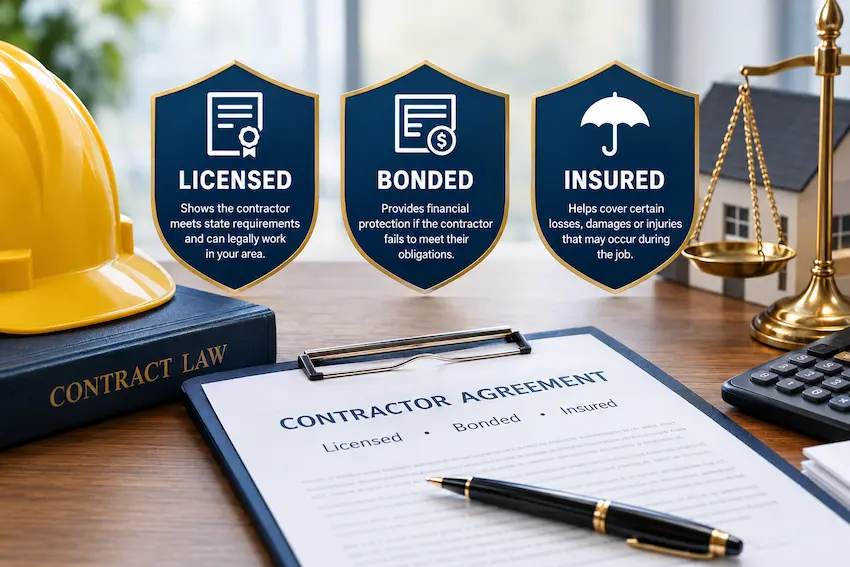
If a $70,000 remodel goes wrong, the bond alone rarely makes you whole. Protecting yourself before you pay matters more.
See how much of your job a bond might actually cover
Verified October 25, 2026. Bond amounts and claim rules are set by each state.
Licensed
PROTECTS Shows the state allows them to do this kind of work, and gives you a regulator to complain to.
DOESN’T PROTECT Doesn’t guarantee good work, a fair price, or that you will be repaid if it goes wrong.
HOW TO CHECK Look up the license number on your state board’s site and match the name and address.
Bonded
PROTECTS Where a state requires it, a license bond may pay some of the damage from license-law violations, up to the bond amount.
DOESN’T PROTECT It isn’t insurance for you. It is small, shared with other claimants, and the contractor must repay the surety.
HOW TO CHECK Find the surety and bond number on the license record (California), or look for lawsuits against the bond in the state’s lookup (Washington).
Insured
PROTECTS Liability insurance generally pays for property damage or injuries the work causes to other people.
DOESN’T PROTECT It generally doesn’t pay to fix, finish, or redo the contractor’s own faulty or unfinished work.
HOW TO CHECK Ask for a certificate of insurance sent by their agent, and confirm workers’ comp if they have employees.
| Word | Protects | Doesn’t protect | How to check |
|---|---|---|---|
| Licensed | Shows the state allows them to do this kind of work, and gives you a regulator to complain to. | Doesn’t guarantee good work, a fair price, or that you will be repaid if it goes wrong. | Look up the license number on your state board’s site and match the name and address. |
| Bonded | Where a state requires it, a license bond may pay some of the damage from license-law violations, up to the bond amount. | It isn’t insurance for you. It is small, shared with other claimants, and the contractor must repay the surety. | Find the surety and bond number on the license record (California), or look for lawsuits against the bond in the state’s lookup (Washington). |
| Insured | Liability insurance generally pays for property damage or injuries the work causes to other people. | It generally doesn’t pay to fix, finish, or redo the contractor’s own faulty or unfinished work. | Ask for a certificate of insurance sent by their agent, and confirm workers’ comp if they have employees. |
Is the Bond Enough? See the Gap
A bond is a fixed amount, so the useful number is the gap between what you could lose and what the bond might hold.
Result
Next: how to sue in small claims court and how to collect a small claims judgment.
“Licensed”: What It Proves and What It Doesn’t
A license proves the state has approved a contractor to do certain work and gives you a regulator to complain to; it doesn’t prove the work will be good or that you will be repaid.
PROTECTS Confirms the state allows this person or company to do the work, and gives you a board that can investigate complaints and discipline the license.
DOESN’T PROTECT A license says nothing about quality, price, or whether the contractor can finish. A complaint to the board is not a refund.
HOW TO CHECK Search the license number on your state board’s website. Match the business name, address, license status, and any discipline on record.
States don’t all handle this the same way. Washington registers general and specialty contractors under chapter 18.27 RCW. To register, an applicant files a bond and proof of insurance and pays a fee, according to the House bill report on the 2023 law.
Washington’s electricians and plumbers are certified separately, and L&I’s lookup lets you check them too.
The practical point is the same everywhere: look the contractor up on the official site before you sign, and treat a missing or inactive record as a reason to stop.
“Bonded”: Why the Bond Isn’t Insurance for You
A license bond is a three-party guarantee that the contractor will follow the law, and if the surety pays a claim, the contractor has to pay the surety back, so it isn’t insurance for you.
PROTECTS In states that require one, the bond may pay people the contractor harms, such as homeowners, workers, and suppliers, up to a fixed amount.
DOESN’T PROTECT It doesn’t scale with your job, it is shared with every other claimant, and it only answers for the kinds of harm the state’s law covers.
HOW TO CHECK Find the surety company and bond number on the state’s license record (California), or check the lookup for lawsuits against the bond (Washington).
The three parties
- The contractor (the principal) buys the bond.
- The state (the obligee) requires it. In California the bond runs in favor of the State of California (B&P § 7071.5); in Washington the state is named as obligee (RCW 18.27.040).
- The surety company guarantees payment to people the contractor harms, within the bond amount.
That repayment duty is why bonds are cheap. The contractor pays a small percentage of the bond amount each year, about 0.5% to 3% for well-qualified applicants on license bonds, and more with weaker credit. These are commonly quoted industry ranges. The premium doesn’t build a fund for customers.
One pot, many claimants
The bond amount is set by statute, not by the size of your project. California’s single $25,000 amount applies to every licensed contractor (B&P § 7071.6).
How a short bond is divided depends on the state. California splits it in proportion to the claims and reserves most of it for homeowners. Washington uses a ranked order and protects at least half for homeowners. Both are explained below.
What the bond answers for
A bond doesn’t pay for every bad outcome. California’s bond covers people damaged by a violation of the contractor licensing law, and those harmed by willful violations or fraud (B&P § 7071.5). Washington’s bond is conditioned on the contractor paying labor, taxes, suppliers, and amounts a court adjudges for breach of contract, including improper work (RCW 18.27.040).
“Insured”: What Their Policy Pays — and What It Doesn’t
Contractor liability insurance generally pays for damage or injuries the work causes to other people or their property, not for the cost of fixing or finishing the contractor’s own work.
PROTECTS Property damage or injury the work accidentally causes to someone else, subject to policy limits and exclusions.
DOESN’T PROTECT The cost to redo faulty work, finish an abandoned job, or refund your deposit.
HOW TO CHECK Ask for a certificate of insurance sent directly by their agent. For workers’ comp, see workers’ comp requirements by state.
Here is how that plays out. A roofer’s flawed roof leaks and stains your drywall. The policy will usually not pay to replace the roof, but it will often pay for the damaged drywall and other property. If a subcontractor did the flawed work, the contractor’s policy may respond differently. Policies vary, so read the exclusions.
Workers’ comp
Workers’ compensation covers the contractor’s employees if they are hurt on the job. If a worker with no coverage is injured at your home, you can face exposure, and the rules differ by state. Check your state’s rules in our state guide and ask your own insurer. In Washington, L&I’s lookup shows whether a contractor has an active workers’ comp account.
One line on your own policy: your homeowners coverage and the contractor’s coverage are different protections. See homeowners insurance hidden coverages.
| Situation | Liability insurance | Workers’ comp | Bond |
|---|---|---|---|
| Damage to your property | Often pays for accidental damage the work causes to your other property, within limits. | Not applicable. | May help if the damage comes from a covered violation or judgment, but only up to what is left in the bond. |
| Worker injured | Generally excludes injuries to the contractor’s own employees. | Built for this: covers the contractor’s employees. | No. |
| Abandoned job | Generally no. It is not accidental damage. | No. | May help, if it is a covered violation (California) or a judgment for breach of contract (Washington). Shared and capped. |
| Poor workmanship | Generally doesn’t pay to redo the work itself. May pay for resulting damage to other property. | No. | May help on the same terms as an abandoned job. |
| Employee theft | Generally not what it is for. | No. | Only a fidelity or business-service bond, with its own terms (see the cleaners section). |
California: The $25,000 Bond in Practice
California requires every licensed contractor to keep a $25,000 bond, and that one pot has to answer to every homeowner, worker, and other claimant the contractor leaves behind.
California at a glance
- Bond amount
- $25,000, since January 1, 2023 (it was $15,000).
- Who can claim
- Homeowners hiring for home improvement on their own residence, owners building a single-family home not for sale, people harmed by willful violations or fraud, and employees owed wages.
- Homeowner share
- Homeowners can claim up to the full $25,000. All other claim types together are capped at $7,500.
- Where to file
- With the surety named on the license record. Lawsuits go to court; CSLB says claims above $10,000 must be in superior court.
- Extra protection
- LLC contractors post a separate $100,000 bond for employee wage and benefit claims. Homeowners can’t collect from it.
- Statute
- B&P Code §§ 7071.5, 7071.6, 7071.6.5, 7071.11.
Washington at a glance
- Bond amount
- $30,000 general contractor, $15,000 specialty, for registrations filed or renewed since July 1, 2024 (it was $12,000 and $6,000).
- Who can claim
- Anyone with a claim for labor, materials, equipment, or breach of contract, including improper work.
- Homeowner share
- Payments to claimants other than residential homeowners can’t exceed half the bond, so at least half is reserved for homeowners.
- Where to file
- A lawsuit against the contractor and the bond in superior court.
- Extra protection
- Homeowner Recovery Account, from July 1, 2026: up to $25,000 per contractor per parcel after a judgment, or the unpaid amount if less.
- Statute
- RCW 18.27.040 and 18.27.410.
| California | Washington | |
|---|---|---|
| Bond amount | $25,000, since January 1, 2023 (it was $15,000). | $30,000 general, $15,000 specialty, for registrations filed or renewed since July 1, 2024 (it was $12,000 and $6,000). |
| Who can claim | Homeowners hiring for home improvement on their own residence, owners building a single-family home not for sale, people harmed by willful violations or fraud, and employees owed wages. | Anyone with a claim for labor, materials, equipment, or breach of contract, including improper work. |
| Homeowner share | Homeowners can claim up to the full $25,000. All other claim types together are capped at $7,500. | Payments to other claimants can’t exceed half the bond, so at least half is reserved for homeowners. |
| Where to file | With the surety named on the license record. CSLB says claims above $10,000 must be filed in superior court. | A lawsuit against the contractor and the bond in superior court. |
| Extra protection | LLC contractors post a separate $100,000 bond for employee wage and benefit claims. Homeowners can’t collect from it. | Homeowner Recovery Account, from July 1, 2026: up to $25,000 per contractor per parcel after a judgment, or the unpaid amount if less. |
| Statute | B&P Code §§ 7071.5, 7071.6, 7071.6.5, 7071.11. | RCW 18.27.040 and 18.27.410. |
The bond amount and who can claim
The bond is $25,000 under B&P § 7071.6. Senate Bill 607 raised it from $15,000, and the new amount became operative on January 1, 2023. A contractor can post a cashier’s check instead of a bond, and a license that is inactive on the board’s records doesn’t need one.
Section 7071.5 names who the bond is for: a homeowner who hired for home improvement on their personal family residence and was damaged by a violation of the contractor law; an owner building a single-family dwelling that isn’t for sale; a person damaged by a willful and deliberate violation or by fraud; and employees owed wages or fringe benefits.
How the pot is divided
If the bond can’t pay every claim in full, § 7071.11 says it is distributed in proportion to the size of each claim.
Section 7071.6 adds a reserve. Excluding homeowners who hired for home improvement on their personal residence, the surety’s total liability on all other claims is capped at $7,500, and the rest of the bond is reserved for those homeowners. Separately, § 7071.11(a) caps the surety’s liability on a claim for wages and fringe benefits at $4,000.
The LLC wage bond
An LLC contractor must also post a $100,000 bond. It is for employees owed wages, interest, or fringe benefits, and it is meant as an extra safeguard for workers (§ 7071.6.5). Homeowners can’t collect from it.
Where and when to claim
You file a bond claim directly with the surety. CSLB doesn’t process claims against surety companies, and it investigates complaints against the license separately. CSLB’s consumer guide says that if the surety’s response doesn’t satisfy you, you can use small claims court for amounts up to $10,000, and claims above $10,000 must be filed in superior court.
If the contractor posted a cashier’s check instead of a bond, you must sue the licensee and the CSLB Registrar, and CSLB can pay only under a court order.
Deadlines matter. Under § 7071.11, an action against the bond generally must be brought within two years after the expiration of the license period in which the act or omission occurred. You can still claim if the license has been revoked, if the problem happened before the revocation. Wage claims have a shorter six-month window from discovery.
What happens to the contractor after the surety pays
The surety must notify the registrar within 30 days of paying. The contractor gets at least 15 days to protest before a settlement. If there is no protest, the contractor has 90 days from the board’s notice to prove repayment, or the license is suspended by operation of law. While the surety remains unreimbursed, a licensee under suspension or discipline for this can’t renew, reissue, or reinstate the license (§ 7071.11).
The deposit limit
After the downpayment, the contractor may not request or accept payment that exceeds the value of the work performed or material delivered, and the contract must include a schedule of payments. Violating the downpayment or payment rules is cause for discipline and can be a misdemeanor.
One exception: a contractor who furnishes a performance and payment bond (or an equivalent the registrar approves) covering full performance and payment is exempt from those limits. If a contractor offers that bond to justify a bigger deposit, ask to see it and confirm it with the surety.
A reported example
NBC’s Southern California I-Team reported on homeowners who paid a company $84,000 and $200,000 before it abandoned their projects, then learned its bond was $25,000, with any payout split among everyone who filed a claim. A CSLB spokesperson told the I-Team that $25,000 may not be enough. (NBC 4 Los Angeles I-Team, published September 30, 2024, and also posted by NBC San Diego.)
Washington: The $30,000 Bond and the New Homeowner Recovery Account
Washington requires a $30,000 bond for general contractors and $15,000 for specialty contractors, protects at least half of it for residential homeowners, and since July 1, 2026 has a state account that can pay part of an unpaid judgment.
The bond
The amounts took effect July 1, 2024, up from $12,000 and $6,000 (2SHB 1534, 2023). A contractor already registered on June 30, 2024 is in compliance until the next renewal, so some still carry the older bond. Ask for the amount in force.
The bond is conditioned on the contractor paying people who work for them, taxes owed to the state, suppliers, and amounts a court adjudges for breach of contract, including improper work (RCW 18.27.040).
Claims are lawsuits
You sue the contractor and the bond together in superior court, and the surety is named as a party. Service goes through L&I with three copies of the summons and complaint and a fee.
A residential homeowner must file within two years of when the work was substantially completed or abandoned. Other claimants have one year. The prevailing party in a homeowner’s breach-of-contract suit is entitled to costs, interest, and reasonable attorneys’ fees.
How the bond is split
Payments to claimants other than residential homeowners can’t exceed half of the bond, which protects at least half for homeowners. If pending claims exceed what is left, the statute pays in this order: employee labor, then breach-of-contract claims by a party to the construction contract, then registered or licensed subcontractors and suppliers, then state taxes, then costs, interest, and fees.
A final judgment that impairs the bond automatically suspends the contractor’s registration until the bond is restored.
The Homeowner Recovery Account
Beginning July 1, 2026, a homeowner who wins a judgment and can’t collect it may apply to L&I for payment from the Homeowner Recovery Account (RCW 18.27.410). To be eligible, all of these must be true:
- You own and live in the home: a single-family house, or a dwelling of up to four units. Condominiums are excluded.
- You have a final judgment against a registered contractor on a claim brought under RCW 18.27.040(3), and the judgment states your actual damages. L&I says the judgment must be entered after July 1, 2026.
- You proceeded against any bond covering the contractor.
- The judgment hasn’t been paid in full.
- You apply within 90 days after the lawsuit ends.
The limits are strict. The account pays up to $25,000 per contractor per parcel, or the unpaid judgment amount if less, and only for actual damages after the bond. It doesn’t pay attorneys’ fees, court costs, or punitive damages. Yearly payouts are capped at 80% of the prior year-end balance, and eligible applicants beyond that go on a waitlist. Payment is discretionary, so being eligible isn’t a right to payment.
L&I says review takes about 14 business days. You assign your judgment to L&I when it pays, and L&I may pursue the contractor for reimbursement, including payment plans of up to 36 months.
Check L&I’s lookup for lawsuits against a contractor’s bond before you sign. Start with the Homeowner Recovery Fund page if you need the account.
Other States: How to Find Your Bond Rules
Bond amounts, who can claim, and where claims are filed are set state by state, so the fastest way to learn your rules is your state contractor board’s website.
Look for these answers on the board’s consumer pages:
- Whether your trade needs a license or registration, and whether a bond is required.
- The bond amount, and whether it is raised for larger contractors.
- Who may claim, and how a short bond is split or ranked.
- Where claims go: the surety, the board, or a court.
- Filing deadlines.
- Whether the state has a homeowner recovery fund.
- The small claims limit, which varies by state. See how to sue in small claims court.
Before You Sign
Eight checks before the first payment do more to protect you than any bond.
Check a contractor
Start with the official lookup for your state. In another state, search for your state contractor board.
CSLB’s license page includes a “Contractor’s Bond History” link that shows which surety wrote the bond in place when you signed.
- Look up the license on your state board’s site. Match the name and address exactly.
- Find the bond on the license record. Note the surety company and bond number.
- Ask for a certificate of insurance sent directly from their agent. See our certificate of insurance guide.
- Confirm workers’ comp, or a valid exemption, if they have employees. See workers’ comp requirements by state.
- Check complaints and disciplinary actions on the board’s site.
- Limit the deposit and pay in stages tied to completed work. In California, the downpayment can’t exceed $1,000 or 10%, whichever is less. Elsewhere, ask for the same structure.
- Get a written contract with scope, schedule, and payment milestones.
- Ask about a performance bond for a large project, and who pays for it. Ask to see the bond and confirm it with the surety.
If It Went Wrong: Filing a Bond Claim
Move quickly and keep paper: in California you file with the surety named on the license record, and in Washington you start a lawsuit against the contractor and the bond.
- Stop paying. Document everything: the contract, payments, texts, and photos.
- Get a written estimate from another licensed contractor to finish or fix the work.
- File a complaint with the state board.
- File the bond claim with the surety named on the license record. In Washington, start the lawsuit against the contractor and the bond.
- Washington: check your eligibility for the Homeowner Recovery Account after a judgment.
- Choose small claims or superior court, depending on the amount and your state. See suing in small claims court and collecting a judgment.
- Talk to an attorney if your loss exceeds the bond or other claimants are lining up.
Timelines and what to expect
In California, CSLB’s guide says the surety will investigate, may ask you for more information, and then decides whether to pay. The guide gives no payout deadline, so ask the surety in writing when you can expect an answer. The contractor is told about the claim and can contest it.
A board complaint and a bond claim are separate tracks. CSLB and the surety resolve their matters independently, and a board investigation does not guarantee money back.
In Washington, timing depends on the court. After judgment, L&I says it takes about 14 business days to review a Homeowner Recovery Account application, and payment depends on available funds.
Whatever your state, watch the filing deadline. In California it is generally two years after the license period in which the problem occurred. In Washington, homeowners have two years from substantial completion or abandonment.
“Bonded” Cleaners, Movers and Other Services
When a cleaning company says it is “bonded,” it usually means a fidelity or business-service bond for employee theft, and the claim rules can be stricter than people expect.
These bonds differ from a contractor license bond. They exist to answer for employee dishonesty inside a customer’s home or office. Movers and other services that send workers into your property may carry similar bonds, so ask for the terms.
- Conviction clause. Some require the employee to be convicted before the bond pays. One bond company’s published terms for janitorial bonds say so, and add that the clause doesn’t apply in at least one state. Terms vary by bond and state.
- Claims may route through the business. The same company says customers usually claim against the cleaning service, which then claims on the bond, instead of the customer claiming directly. Other sellers describe direct claims, so read the actual bond.
- Limits vary. The bond amount caps what can be paid. It doesn’t mean automatic payment.
- The business repays the surety. As with a license bond, the cleaning company must reimburse the surety for a claim it pays.
- Accidental damage is a different coverage. A bond aimed at theft doesn’t replace liability insurance for a broken vase.
Ask for the bond’s written terms, its amount, whether it has a conviction clause, how claims are routed, and a certificate of insurance for accidental damage.
License Bond vs. Performance Bond vs. Payment Bond
These bonds protect different people: a license bond answers to the state’s rules, a performance bond to your specific project, and a payment bond to the people who supply it.
| Bond | Who it protects | When it’s used | Who repays |
|---|---|---|---|
| License bond | The people the state’s law names, such as homeowners, workers, and suppliers, from a shared pot. | Required with a contractor license or registration in states that ask for it. | The contractor repays the surety. |
| Performance bond | The owner of a specific project, if the contractor fails to perform. | Common on public projects. Rare on ordinary home jobs unless the homeowner requires and pays for one. | The contractor repays the surety. |
| Payment bond | Subcontractors and suppliers on a specific project, if they aren’t paid. | Common on public projects. Rare on ordinary home jobs. | The contractor repays the surety. |
| Fidelity / business-service bond | Customers, for employee theft, on the bond’s terms. | Cleaning companies and other services that send workers into your property. | The business repays the surety. |
Performance and payment bonds are tied to one project. If you ask for one on a home job, expect the contractor to pass the cost on to you.
In California, offering a full performance and payment bond can let a contractor take larger payments up front under § 7159.5, which is a reason to verify that the bond is real.
For Business Owners: Getting Bonded
Getting bonded means paying a small premium, passing underwriting, and signing a promise to repay the surety for any claim it pays.
- Cost. Premiums for license bonds typically run about 0.5% to 3% of the bond amount per year for well-qualified applicants, and more with weaker credit. At 1%, a $25,000 bond would cost about $250 a year. These are industry ranges, not quotes.
- Credit. Surety underwriting looks at your credit and finances, so your score affects your price.
- The indemnity agreement. You, and often the business’s owners, agree to repay the surety for claims it pays. Washington practitioners point out that owners who signed face repaying up to the full bond amount.
- After a claim. In California, the surety notifies the board, and you can protest within 15 days before a settlement. Without a protest, you have 90 days after the board’s notice to show repayment or your license is suspended, and you can’t renew or reinstate it while the surety remains unreimbursed. In Washington, a judgment that impairs the bond suspends your registration until the bond is restored. If the Homeowner Recovery Account pays a homeowner, L&I can seek reimbursement from you.
- LLCs in California. You also post the $100,000 wage and benefit bond.
A bond isn’t insurance for your business either. For coverage, see small business insurance and business insurance for LLCs.
FAQ
What does licensed, bonded and insured mean?
Licensed means the state allows the work. Bonded usually means a license bond filed with the state that may pay damaged claimants from a shared, capped pot. Insured means liability insurance, and workers’ comp if they have employees. None of the three guarantees finished, quality work.
What’s the difference between bonded and insured?
Insurance is a policy the contractor buys to pay for covered losses. A bond is a guarantee to the state, and if the surety pays a claim, the contractor must repay the surety.
Does a contractor’s bond protect the homeowner?
Partly. California’s bond is for homeowners damaged by license-law violations, and Washington reserves at least half of its bond for homeowners. But the bond is small and shared, so it often covers far less than the job.
How much is a contractor bond?
California requires $25,000. Washington requires $30,000 for general contractors and $15,000 for specialty contractors on registrations filed or renewed since July 1, 2024. Other states vary, so check your state board.
What if several people claim against the same bond?
In California, a short bond is split in proportion to the claims, and claimants other than homeowners are capped at $7,500 in total. In Washington, claims are paid in a ranked order and at least half of the bond is protected for homeowners. Either way, later claimants can get less than they are owed.
How do I check if a contractor is bonded?
Use your state board’s license lookup. In California, the license record shows bond information, and the “Contractor’s Bond History” link shows the surety on the bond when you signed. In Washington, L&I’s Verify tool shows registration and lawsuits against the bond.
How do I find the contractor’s surety company?
In California, open the contractor’s license detail page on CSLB’s site and use the bond history link. In other states, ask the board or the contractor for a copy of the bond, including the bond number.
How do I file a claim against a contractor bond?
In California, contact the surety named on the license record and send your contract, payment records, and evidence. In Washington, you file a lawsuit against the contractor and the bond in superior court. In other states, ask the board.
How long does a bond claim take?
There is no single timeline. In California, the surety investigates and may ask for more information. In Washington, it depends on the court. L&I says a Homeowner Recovery Account application takes about 14 business days to review. The filing deadlines are firmer than the payout timing, so watch them.
Can I claim if the contractor’s license was revoked?
In California, yes. CSLB says you can still file if the problem happened before the revocation, within two years of the license’s original expiration date. In other states, ask the board.
What is Washington’s Homeowner Recovery Account?
A state account, open for applications since July 1, 2026, that can pay an eligible homeowner up to $25,000 per contractor per parcel, or the unpaid judgment amount if less, after a court judgment and a claim against the bond. Payment is discretionary and depends on funds.
Does contractor insurance pay to finish an abandoned job?
Generally no. Liability insurance responds to damage the work causes, not to the cost of finishing or redoing the work. A bond may help, within its limits.
What if an uninsured worker gets hurt at my house?
You can face exposure, and the rules vary by state. See our workers’ comp guide and ask your own insurer. Checking the contractor’s workers’ comp before work starts is the best prevention.
What does “bonded” mean for a cleaning service?
Usually a fidelity or business-service bond for employee theft. Some require a conviction before paying, some route claims through the business, and limits vary. Never assume automatic payment.
Do I need a performance bond for a home project?
Usually not, and they are rare on home jobs. For a large project, you can ask about one, but expect to pay for it. Verify any bond with the surety.
How much does it cost a contractor to get bonded?
About 0.5% to 3% of the bond amount per year for well-qualified applicants on license bonds, and more with weaker credit. At 1%, that is roughly $250 a year for a $25,000 bond. The premium isn’t a fund for customers.
Who pays back a surety bond claim?
The contractor, and often the owners who signed the indemnity agreement. In Washington, if the Homeowner Recovery Account pays a homeowner, L&I can seek reimbursement from the contractor, with payment plans of up to 36 months.
Can I sue a contractor who isn’t bonded?
Yes. You can sue a contractor for breach of contract whether or not a bond exists. A bond only adds a possible source of payment, and a judgment still has to be collected. See collecting a judgment. Talk to an attorney about your situation.
Sources
- Cal. Bus. & Prof. Code § 7071.5
- Cal. Bus. & Prof. Code § 7071.6
- Cal. Bus. & Prof. Code § 7071.6.5
- Cal. Bus. & Prof. Code § 7071.11
- Cal. Bus. & Prof. Code § 7159.5
- CSLB, A Guide to Contractor License Bonds (rev. 8/2025)
- CSLB, Bond Basics
- RCW 18.27.040
- RCW 18.27.410
- WAC 296-200A (Homeowner Recovery Program rules, 296-200A-9100 to 9135)
- Washington L&I, Homeowner Recovery Fund
- Washington L&I, Verify a Contractor, Tradesperson or Business
- House Bill Report, 2SHB 1534 (2023)
- NBC 4 Los Angeles I-Team, “Homeowners duped by contractor got little relief from the bond required by state” (September 30, 2024); also posted by NBC San Diego
- A bond company’s published janitorial bond terms (conviction clause example)
- American Bar Association, Insurance Coverage for Construction Defect Claims Made Simple
- Construction Dive, liability insurance surprises for contractors
Last updated:
This article is general information, not legal advice. Bond amounts, claim procedures, and recovery programs are set by state law and were verified on October 25, 2026; they can change. Talk to an attorney about your situation, especially if your loss is more than the bond or you are heading to superior court.

Daniel Hayes is the founder and sole researcher at AdvoraHQ. He covers U.S. personal finance, insurance, and consumer law — working directly from IRS publications, federal and state statutes, court opinions, and SEC filings rather than secondary summaries. His focus is the gap between what readers think they know and what the source documents actually say. Daniel is not a licensed attorney, CPA, or financial advisor; his articles are educational and not personalized advice. Reach him at Daniel.Hayes@advorahq.com.