
- OK TO WAIT Your (or your spouse’s) current employer has 20 or more employees. Stop HSA contributions 6 months before you sign up.
- SIGN UP AT 65 Fewer than 20 employees, COBRA, retiree coverage, or a marketplace plan.
- THE COST OF GETTING IT WRONG: +10% on Part B for each full year you were late. That is $20.94 a month per year late at the 2027 premium, for as long as you have Part B.
Skip the reading — get your answer and deadlines in 30 seconds →
WATCH OUT Signing up for Part B too early can start your one-time Medigap window before you need it.
2027 premiums from CMS (); rules verified .
Should I Sign Up for Medicare Now?
Answer a few short questions about your 65th-birthday month, your coverage, your employer’s size, your HSA, and your benefits to see whether you can wait, which Medicare parts to consider, your enrollment dates, and the warnings that apply to you.
We ask for no name, Social Security number, Medicare number, or full birth date. Nothing is saved or sent.
Your result appears here after you press the button.
The penalty in 2027 dollars:
- 1 full year late: +$20.94 a month
- 2 full years late: +$41.88 a month
- 3 full years late: +$62.82 a month
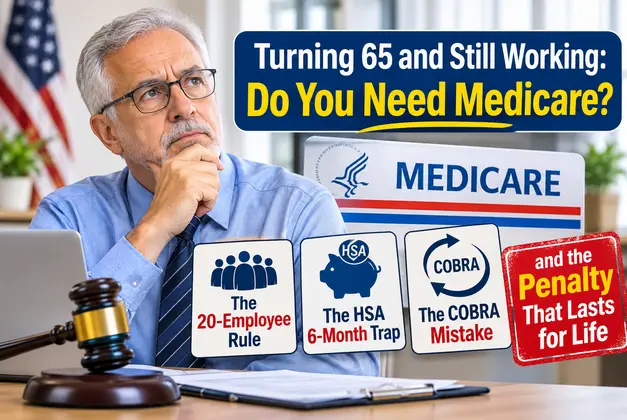
The 20-Employee Rule
If you or your spouse actively works for an employer with 20 or more employees, that group plan generally pays first and you can delay Part B without penalty, but with fewer than 20, Medicare generally pays first, so plan to sign up at 65.
Part B is the part of Medicare that covers doctor and outpatient care. It has a monthly premium. Part A covers hospital care.
Who pays first
The plan that pays first is called the primary payer. The other plan is the secondary payer and looks only at what is left.
- OK TO WAIT 20 or more employees: the job plan generally pays first. You can sign up for Part B later, during a Special Enrollment Period.
- SIGN UP AT 65 Fewer than 20: Medicare generally pays first. Without Medicare, the job plan may pay little or nothing for care Medicare would have covered.
A fine point: job coverage from current work at a small employer can still give you a penalty-free sign-up later, according to Medicare’s welcome booklet. That does not protect you from unpaid bills while you wait.
How the 20 employees are counted
- The employer needs 20 or more employees on each working day in 20 or more calendar weeks of this year or last year (42 CFR 411.170). The weeks do not have to be in a row.
- Full-time and part-time employees both count (CMS guidance). Self-employed people in the plan do not.
- Count the employer, not the people enrolled in the health plan. Related companies may have to be added together.
Multi-employer plans
Some unions and trade groups run one plan for many employers. If any one of those employers has 20 or more employees, the 20-or-more rule generally applies to everyone in it.
The plan may ask Medicare for a small employer exception for people tied to an employer with fewer than 20. If it is granted, Medicare pays first for them. Ask the plan whether you are on that list.
Under 65 with disability-based Medicare
A different line applies. The employer plan generally pays first only if the employer had 100 or more employees on at least half of its business days last calendar year (42 CFR 411.101).
Coverage That Doesn’t Let You Wait
COBRA, retiree plans, marketplace or individual plans, and VA coverage do not qualify you for the Special Enrollment Period, because only group coverage based on current work, yours or your spouse’s, lets you sign up for Part B later without a late penalty.
A Special Enrollment Period is an extra sign-up window outside the usual ones. Medicare’s enrollment guide says these do not open it.
- SIGN UP AT 65 COBRA is a temporary continuation of a former job’s plan. It is not current employment. It may pay only a small part of your bills once you are eligible for Medicare. See COBRA costs and rules.
- SIGN UP AT 65 Retiree coverage comes from a former employer. It may not pay for care unless you have both Part A and Part B.
- SIGN UP AT 65 Marketplace or individual plans are not job coverage. Once you can get premium-free Part A, you generally cannot keep getting marketplace premium tax credits.
- SIGN UP AT 65 VA coverage does not open the Special Enrollment Period. The VA warns that delaying Part B can bring a penalty.
| Your coverage | Can you delay Part B? |
|---|---|
| Your current job, 20+ employees | YES |
| Your current job, under 20 | NO. Medicare generally pays first. |
| Spouse’s current job, 20+ | YES |
| Spouse’s current job, under 20 | NO. Medicare generally pays first. |
| COBRA | NO |
| Retiree plan | NO |
| Marketplace or individual | NO |
| VA only | NO |
| TRICARE | NO, if you want to keep it. TRICARE For Life requires Part B. Active-duty family members have different rules. |
TRICARE: retirees and their families with Part A generally must have Part B to keep TRICARE. Active-duty family members can wait while the sponsor is on active duty.
Federal employees (FEHB): while you are actively working, you can defer Part B; once retired, Part B is your choice, but signing up late can bring the penalty.
Part A: Take It or Skip It?
Most people pay no premium for Part A, so taking it at 65 usually makes sense unless you want to keep contributing to a health savings account, and if you already get Social Security benefits, Part A generally starts automatically.
- Cost: about 99% of people with Medicare pay no Part A premium (CMS). It still has a deductible: $1,776 per benefit period in 2027. A benefit period starts when you are admitted and ends after 60 days in a row out of hospital and skilled nursing care.
- WATCH OUT HSA: if you want to keep contributing, delay Part A and delay Social Security.
- Already getting Social Security or Railroad Retirement? You are generally enrolled in Parts A and B automatically at 65. To delay Part B, follow the instructions that come with your Medicare card and send the card back before coverage starts. If you keep the card, you keep Part B and pay for it. (Residents of Puerto Rico must sign up for Part B themselves.)
- Not getting benefits? You must sign up yourself.
Your first window is the Initial Enrollment Period: seven months, from three months before your 65th-birthday month to three months after it. Born on the 1st? It all shifts one month earlier. Sign up before your birthday month so coverage is not delayed.
Still deciding when to claim? Compare Social Security at 62, 67, and 70, and see the 2027 Social Security COLA.
The HSA 6-Month Trap
If you sign up for Part A after 65, coverage can reach back six months, turning HSA contributions for those months into excess that may face a 6% tax, so stop your own and your employer’s contributions six months before you apply.
An HSA (health savings account) is a tax-free account paired with a high-deductible health plan. See how HSA accounts work and HSA vs. FSA.
- WATCH OUT Any part of Medicare, even free Part A, makes your contribution limit zero from the first month of coverage (IRS Publication 969).
- The look-back: Part A goes back up to 6 months from when you apply, but not before you first became eligible at 65 (Medicare & You 2027).
- Example: you apply in September 2027 at age 67. Part A starts March 1, 2027. Your last eligible HSA month is February 2027.
- Your yearly limit shrinks: it is figured by the month. In the example, you get 2 months out of 12.
- The tax: excess money may owe a 6% excise tax for each year it stays in. You can generally avoid it by withdrawing the excess and its earnings by your tax-return due date. Ask a tax professional.
- Spending is still fine: you can use HSA money tax-free for qualified medical costs. After 65 that includes Medicare premiums, but not Medigap premiums.
- Your spouse: a spouse who is HSA-eligible, including under family high-deductible coverage, can still contribute to an HSA in the spouse’s own name.
The Lifetime Penalty, in 2027 Dollars
The Part B penalty adds 10% of the standard premium for each full 12 months you could have had Part B but did not, which in 2027 means $20.94 more every month per full year, paid for as long as you have Part B.
- Months covered by a group plan from current work, with a timely Special Enrollment sign-up, do not count against you.
- Only full 12-month periods count. 23 months late counts as one period.
- The dollar amount changes whenever the premium changes.
- Medicare rounds your premium plus penalty to the nearest 10 cents (Medicare.gov). One year late: $230.34 becomes $230.30.
| Full years late | Monthly penalty | Yearly |
|---|---|---|
| 1 year late | $20.94 | $251.28 |
| 2 years late | $41.88 | $502.56 |
| 3 years late | $62.82 | $753.84 |
Lifetime Part B Penalty Calculator
Your estimate appears here. Social Security decides the actual number of months.
The Part D penalty and creditable coverage
Part D is Medicare drug coverage. Creditable coverage is drug coverage expected to pay, on average, at least as much as Medicare’s.
- WATCH OUT Go 63 days or more in a row without Part D or creditable coverage after your first chance to join, and a penalty can apply.
- It is 1% of the national base beneficiary premium ($41.33 in 2027) for each full month without coverage, rounded to the nearest 10 cents.
- Example: 14 months adds $5.80 a month in 2027, on top of the plan premium, generally for as long as you have Part D.
- Ask your employer for its creditable coverage notice and keep it. A job plan can be fine for delaying Part B yet not creditable for drugs.
- People who get Extra Help (a program for limited incomes) do not pay this penalty.
Compare options in our Medicare Part D 2027 guide.
| Item | 2026 | 2027 |
|---|---|---|
| Part B standard monthly premium | $202.90 | $209.40 |
| Part B yearly deductible | $283 | $292 |
| Part A deductible per benefit period | $1,736 | $1,776 |
How to Sign Up When You Retire
You can sign up any time while covered through current work, and for up to 8 months after the job or coverage ends, whichever comes first, by sending Social Security form CMS-40B with form CMS-L564, ideally before your coverage ends.
- 1. Get the forms. CMS-40B is your Part B application. CMS-L564 is where the employer confirms your coverage.
- 2. Fill in your part. You complete Section A of CMS-L564. Your employer completes Section B. For a spouse’s plan, ask the spouse’s employer.
- 3. Name your start date. In the remarks, write “I want Part B coverage to begin (month/year).” Part B starts on the first of a month. Pick one that leaves no gap.
- 4. Send it to Social Security online, by fax, or by mail. Coverage typically begins the month after Social Security gets a completed request, so apply early.
- 5. If you do not yet have Part A, tell Social Security you are applying for both, and check your HSA stop date first.
If your employer is gone or cannot sign
Fill in Section B as well as you can, but do not sign it. Add proof of job-based coverage. Social Security’s instructions list the accepted proof; check the current list. Examples include:
- W-2s showing pre-tax medical contributions
- Pay stubs showing health premium deductions
- Tax forms showing health premiums you paid
- Health insurance cards with a policy start date
- Explanations of benefits, or premium payment receipts
If you miss the window
The General Enrollment Period runs January 1 to March 31 each year. Coverage starts the month after you sign up, and a penalty may apply.
| Window | When | What it’s for |
|---|---|---|
| Initial Enrollment Period | 3 months before your 65th-birthday month through 3 months after | First chance to get Medicare |
| Special Enrollment Period | While covered through current work, and 8 months after job or coverage ends | Part B (and Part A) without penalty |
| General Enrollment Period | Jan. 1 – Mar. 31 | Late sign-up; penalty may apply |
| Medigap Open Enrollment | 6 months from the month you are 65+ and have Part B | Buying a Medigap policy with federal protections |
Drug coverage has a shorter clock. Join a plan with drug coverage before you go 63 days without creditable coverage. Once you have Medicare, see how Medicare Advantage plans compare with Original Medicare.
Don’t Sign Up Too Early: The Medigap Window
Your one-time, 6-month Medigap Open Enrollment Period starts the first month you are 65 or older and have Part B, so taking Part B while still on a large employer plan starts that clock early and can make Medigap harder to buy.
Medigap is private insurance that helps pay costs Original Medicare leaves to you. During the window, you can buy any Medigap policy sold in your state (Medicare’s Medigap guide). Afterward, insurers in many cases may ask health questions, charge more, or say no.
- WATCH OUT On a 20-or-more employer plan, Part B now means paying a premium and using up your window while the job plan still pays first.
- OK TO WAIT If you delay Part B properly, the window waits until Part B starts.
- SIGN UP AT 65 If you need Part B now, because of a small employer, COBRA, or retiree coverage, do not delay it to save the window. Shop for Medigap during those 6 months.
Some states give extra rights. See Medigap rights and state rules.
The Younger Spouse
Your Medicare covers only you, so a spouse under 65 who depends on your job plan needs separate coverage before it ends, usually through the spouse’s own job, an ACA marketplace plan, or COBRA, which sometimes lasts up to 36 months.
- Spouse’s own job: losing your coverage usually lets the spouse join. The deadline is short, often 30 days. Ask that employer now.
- ACA marketplace: losing job coverage opens a Special Enrollment Period, generally 60 days before or after the loss. Choosing to drop COBRA later does not open one.
- COBRA: after your job ends, the usual limit is 18 months. If you became entitled to Medicare less than 18 months before the job ended, your spouse can get up to 36 months counted from your Medicare start date (29 U.S.C. § 1162).
Example: your Medicare starts January 2027 and you retire at the end of December 2027. Your spouse’s COBRA can run 36 months from January 2027, which is about 24 months after you retire.
See health insurance without a job and COBRA.
High Earners Still Working: IRMAA
People with higher incomes pay an extra amount for Part B and Part D, called IRMAA, which Social Security usually bases on your tax return from two years earlier, so your working-year income can raise your premiums after you retire.
IRMAA means income-related monthly adjustment amount. If retiring or cutting hours lowers your income, you can ask Social Security to use a newer estimate with form SSA-44. See how IRMAA brackets work (2026 figures); for 2027 amounts, use the CMS 2027 fact sheet.
Your Retirement-Month Checklist
Start planning at least three months before your job ends, earlier if you have an HSA, by gathering the employer form and drug coverage notice, applying for Part B, choosing drug and supplemental coverage, and protecting a younger spouse from a gap.
- 1. Three months before the job ends: ask HR for CMS-L564 and the creditable coverage notice.
- 2. Stop HSA contributions (yours and your employer’s) 6 months before the month you will apply. This usually means starting well before step 1.
- 3. Apply for Part B with CMS-40B and CMS-L564 so coverage starts with no gap after employer coverage ends.
- 4. Pick a Part D plan, or a Medicare Advantage plan with drug coverage, within your window. Do not go 63 days without creditable drug coverage.
- 5. Your 6-month Medigap window starts when Part B starts (age 65 or older). If you want Medigap with Original Medicare, apply early in it.
- 6. Arrange coverage for a younger spouse.
- 7. Don’t rely on COBRA as your bridge past 65.
FAQ
Most Medicare-at-65 answers depend on two facts, whether your coverage comes from current work and how many people that employer has, so you should confirm both first, then check your HSA, your drug coverage, and your deadline before you decide anything.
Do I need Medicare if I have employer insurance?
Not always. With current-work coverage from an employer with 20 or more employees, you can generally delay Part B. With fewer than 20, sign up at 65.
Am I enrolled automatically at 65 if I’m still working?
Only if you already get Social Security or Railroad Retirement benefits. Otherwise you must sign up.
What happens if my employer has fewer than 20 employees?
Medicare generally pays first. Without it, your job plan may leave you with large bills. Check for a multi-employer plan, and get any different answer in writing.
How does Medicare count the 20 employees?
Full-time and part-time employees, on each working day in 20 or more calendar weeks of this year or last year.
Can I delay Part B if I’m on my spouse’s employer plan?
Generally yes, if your spouse is actively working and that employer has 20 or more employees. Ask the plan whether it requires you to take Medicare.
Does COBRA count?
No. COBRA does not qualify you for the Special Enrollment Period and does not extend your 8 months.
Does retiree insurance count?
No. It is not based on current employment. Sign up when first eligible.
Should I take Part A at 65?
Usually, if it is premium-free for you and you are not contributing to an HSA.
When do I stop contributing to my HSA?
Six months before the month you apply for Medicare or Social Security if you are past 65. If you enroll at 65, stop before your Medicare starts.
Can my spouse keep contributing to an HSA?
Yes, to the spouse’s own HSA, if the spouse still meets the HSA rules.
How much is the Part B penalty in 2027?
$20.94 a month for each full 12 months late, based on the $209.40 standard premium.
Is the penalty really for life?
In general, yes: you pay it as long as you have Part B. Some people with limited incomes can get state help with premiums.
What is creditable drug coverage?
Drug coverage expected to pay, on average, at least as much as Medicare drug coverage. Your plan must tell you whether it qualifies.
How long do I have to sign up after I retire?
Up to 8 months after the job or the coverage ends, whichever is first. Apply sooner to avoid a gap.
What is form CMS-L564?
The Request for Employment Information. It shows you had group coverage based on current employment.
What if my employer is out of business?
Complete Section B as best you can without signing it, and send other proof of coverage such as W-2s, pay stubs, or insurance cards.
When does my Medigap window start?
The first month you are 65 or older and have Part B. It lasts 6 months and does not repeat.
What happens to my younger spouse’s insurance?
It does not move to Medicare. Look at the spouse’s own job, a marketplace plan, or COBRA before your coverage ends.
This is general information, not insurance, tax, or legal advice. Medicare rules and 2027 premiums are from CMS, Medicare.gov, and the other official sources linked above, verified on Nov. 26, 2026. Your employer’s plan rules and your situation control. Last updated: .

Daniel Hayes is the founder and sole researcher at AdvoraHQ. He covers U.S. personal finance, insurance, and consumer law — working directly from IRS publications, federal and state statutes, court opinions, and SEC filings rather than secondary summaries. His focus is the gap between what readers think they know and what the source documents actually say. Daniel is not a licensed attorney, CPA, or financial advisor; his articles are educational and not personalized advice. Reach him at Daniel.Hayes@advorahq.com.
