
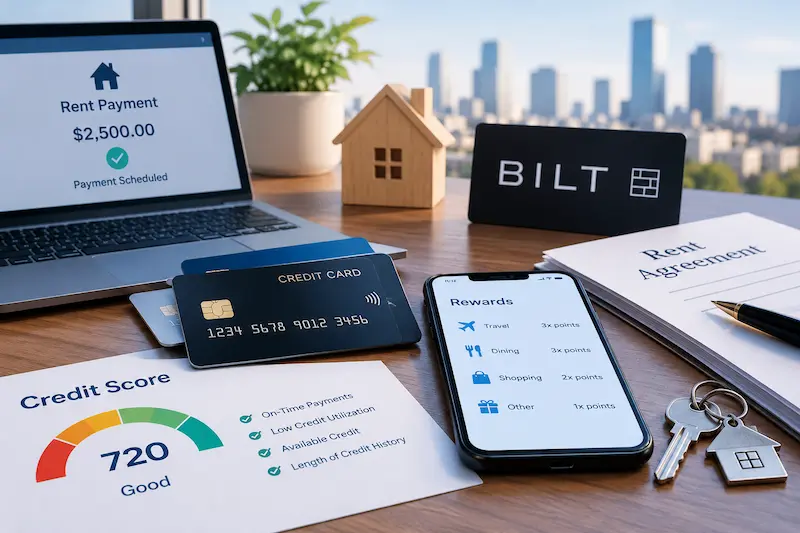
Quick answer: Yes, you can — usually through a landlord portal or a payment service that charges a fee, often around 2.5% to 3%. It only pays off if your rewards are worth more than that fee. For most everyday cards they aren’t. The common exceptions are meeting a sign-up bonus, or a setup that waives the fee. And if you can’t pay the card in full, it’s a loss every time.
The deciding number: your rewards rate × point value, minus the fee. If that’s below zero, you’re paying to use your card.
Run your rent through the math →
Fees and Bilt rules verified October 25, 2026. These change often — check the service’s own fee page before paying.
Is It Worth It? Rent Calculator
Estimate only. Fees, rewards, and how your issuer codes the payment vary. Not financial advice. Verified October 25, 2026.
Every Way to Pay Rent With a Credit Card
You can usually pay rent by card through a landlord portal, a third-party payment service, or Bilt, and most charge a fee.
If your landlord only takes checks, a third-party service can often send a check or bank transfer for you. Allow extra days for delivery, and confirm the landlord got it.
| Method | Typical fee | Works if landlord only takes checks? | Watch out for |
|---|---|---|---|
| Landlord portal | Often about 2.5%–3%+ | No; the landlord must offer it | State surcharge rules and your lease |
| Third-party service | Often about 2.5%–3%+ | Often yes; the service sends a check or transfer | Delivery time; how your issuer codes it |
| Bilt, own card | No fee under the tiered option; the Bilt Cash option works out to about 3% for 1x | Confirm in the Bilt app | Spend needed for the earning tier |
| Bilt, another card | 3% per Bilt’s terms | Confirm in the Bilt app | The fee can exceed your rewards |
| Debit card via portal | Check the portal; may be lower than credit | No; the landlord must offer it | No credit rewards |
The Math: When the Fee Beats the Rewards
Rewards beat the fee only when your rewards rate times your point value is higher than the fee percentage.
At a 3% fee, a 2% cash-back card loses 1 cent on every dollar. On $2,000 of rent, that’s $20 a month. Point value matters: see how much credit card points are worth. For broader rewards planning, see credit card rewards strategy.
WORTH IT: rewards beat the fee and you pay in full.
BREAK-EVEN: only with a sign-up bonus or a fee waiver.
LOSING MONEY: rewards are below the fee, or you carry a balance.
| Fee | Rewards rate needed at 1¢ per point | Example card earning 2%: net on $2,000 rent |
|---|---|---|
| 2.5% | 2.5 points per $ | -$10 per month |
| 2.9% | 2.9 points per $ | -$18 per month |
| 3.0% | 3.0 points per $ | -$20 per month |
| 3.5% | 3.5 points per $ | -$30 per month |
The Exception: Using Rent to Hit a Sign-Up Bonus
A sign-up bonus is the one case where most people come out ahead, because the bonus can be worth more than the fees.
Worked example: $2,000 rent, 3% fee, a 2% card, a $200 bonus after $4,000 in 3 months, and $1,000 of other spending. Rent covers the remaining $3,000 in 2 payments. Fees are $120, rewards are $80, so the net is $200 + $80 − $120 = $160.
It stops paying once the bonus is earned: the net goes back to a loss of $20 a month. If you’d hit the bonus anyway, rent adds nothing. A new account also has credit-score effects.
Bilt in 2026: What Changed and How It Works Now
In 2026, Bilt moved its card from Wells Fargo to three cards issued by Column Bank N.A. through Cardless, with two ways to earn on housing.
The new cards launched February 7, 2026. Preorders opened January 14, and on January 16 Bilt added a second earning option after member confusion. For a similar real-world move, see changing card issuers.
| Option | How you earn on rent | What you give up | Spend needed for 1x on $2,000 rent |
|---|---|---|---|
| Tiered points | Rate depends on everyday spend as a share of rent: 25% earns 0.5x, 50% earns 0.75x, 75% earns 1x, 100%+ earns 1.25x | No Bilt Cash on everyday spend | $1,500 (75% of rent) |
| Bilt Cash | 4% Bilt Cash on everyday spend; $3 of Bilt Cash per 100 points on housing, up to the payment amount | Higher tiers; effectively a 3% cost for 1x | $1,500 (4% = $60 for 2,000 points) |
Below the first tier, the tiered option earns 250 points a month. The 100,000 rent-point cap was removed. Other cards can pay rent through Bilt with a 3% fee. Mortgage payments now earn points too.
This page doesn’t cover how a Bilt housing payment posts on your card. Check Bilt’s help pages. This is a description, not a recommendation. Sources: Bilt support, Bilt newsroom.
Is It a Cash Advance?
Whether it’s a cash advance depends on how your card issuer codes the payment, not on what the payment service calls it.
Your card issuer — not the payment service — decides whether it’s a cash advance.
A cash advance usually means an upfront fee and interest from day one, with no grace period. Full math: credit card cash advances.
How to check: read your card’s terms for cash-advance rules, ask the issuer before a large payment, and review your first statement.
Can Your Landlord Charge a Card Fee?
Sometimes, but it depends on your state’s surcharge law, card network rules, and your lease, so there’s no single answer.
A surcharge and a convenience fee are treated differently under many rules. Read your lease for card terms, then see credit card surcharge law by state. Your state attorney general’s office can confirm local rules.
What It Does to Your Credit Score
Paying rent by card affects your score mainly through utilization, and it does not report your rent history.
Pay before your statement closes, not just before it’s due. Issuers generally report the statement balance, so a full rent charge can lift reported utilization even if you pay in full by the due date. See credit utilization and interest after paying the statement balance.
Paying rent by card doesn’t report your rent history. It builds the card’s payment history, not a rent record. Rent-reporting services are a separate thing; check how any service works before you sign up.
| Factor | Effect | How to manage it |
|---|---|---|
| Utilization | Rent can push reported balance up | Pay before the statement closes |
| Payment history | On-time card payments help the card’s record | Pay in full, on time |
| New account (bonus) | Usually a hard inquiry and a younger average account age | Open only if you’d want the card anyway |
| Rent history | Not reported as rent | Research rent-reporting services separately |
If You Can’t Pay It Off
If you can’t pay the full balance, putting rent on a card turns your biggest bill into high-interest debt.
If you can’t pay in full, the interest erases any reward. At 24% APR, carrying $2,000 for one month costs about $40 in interest, on top of the fee.
See how credit card interest works. For a short-term gap, consider asking your landlord in writing about a short extension or payment plan, or looking into local rental assistance programs.
Security Deposits and Mortgages
Some landlords accept cards for deposits, and mortgage payments through Bilt now earn points.
State laws often govern how deposits are held and returned; see what to do if your landlord won’t return your deposit. Card fees apply to deposits too, so run the math first.
Before You Pay
Run through these eight steps before putting rent on a card.
- 1. Find the real fee on the service’s or portal’s own page, and check whether a debit card is cheaper.
- 2. Check how your issuer treats it: search your card terms for cash-advance rules, and review the first statement.
- 3. Check your lease for card terms and fees, then your state’s surcharge rules.
- 4. Do the math with the calculator: fee vs. rewards, and the bonus window.
- 5. Know your statement closing date and pay before it if you care about utilization.
- 6. Pay the card in full, or don’t do it.
- 7. Keep the receipts: the payment confirmation and the landlord’s receipt, in case a payment is delayed.
- 8. Have a backup plan for the month the service is slow; know your lease’s late-fee and grace-period terms.
FAQ
Can you pay rent with a credit card?
Usually yes, through a landlord portal, a payment service, or Bilt, often for a fee.
How much does it cost?
Often around 2.5%–3%+. Check the service’s current fee page.
Is there a way to pay rent with a credit card with no fee?
Under Bilt’s published terms, the tiered points option has no fee on housing when you use a Bilt card. Confirm current rules in the Bilt app.
Is it worth it for rewards?
Only if rewards rate × point value exceeds the fee. For most everyday cards it doesn’t.
Can I use rent to meet a sign-up bonus?
Yes, and it’s the most common case where it pays. See the worked example.
Is paying rent with a credit card a cash advance?
Your card issuer decides. Check your terms and first statement.
Can my landlord charge me a fee?
It depends on state law, card network rules, and your lease.
Does it hurt my credit score?
It can raise reported utilization if the statement closes with the rent balance on it. Paying before the statement closes helps.
Does it build credit?
It builds the card’s payment history if you pay on time.
Does it report my rent history?
No. Paying by card doesn’t report rent as rent.
How does Bilt work in 2026?
Two options on housing: tiered points or Bilt Cash. See the Bilt section.
What is Bilt Cash?
Under Bilt’s published terms, 4% back on everyday spend that you can redeem at $3 per 100 points on housing.
How much do I need to spend for 1x on rent with Bilt?
Per the tiers, spend equal to 75% of your rent. On $2,000 rent, that’s $1,500.
Can I pay rent with a non-Bilt card through Bilt?
Per Bilt’s terms, yes, with a 3% fee. Verify in the app.
Can I pay a security deposit with a credit card?
Some landlords accept cards for deposits. Ask, and compare the fee to your rewards.
What if my landlord only accepts checks?
A third-party service can often send a check for you. Allow extra time.
Last updated: . Re-verify Bilt rules and processor fees monthly.
Disclaimer: This page is general information, not financial advice. Fees, card terms, and Bilt’s program rules change and were verified on October 25, 2026. AdvoraHQ is not affiliated with any card issuer or payment service mentioned.

Daniel Hayes is the founder and sole researcher at AdvoraHQ. He covers U.S. personal finance, insurance, and consumer law — working directly from IRS publications, federal and state statutes, court opinions, and SEC filings rather than secondary summaries. His focus is the gap between what readers think they know and what the source documents actually say. Daniel is not a licensed attorney, CPA, or financial advisor; his articles are educational and not personalized advice. Reach him at Daniel.Hayes@advorahq.com.