
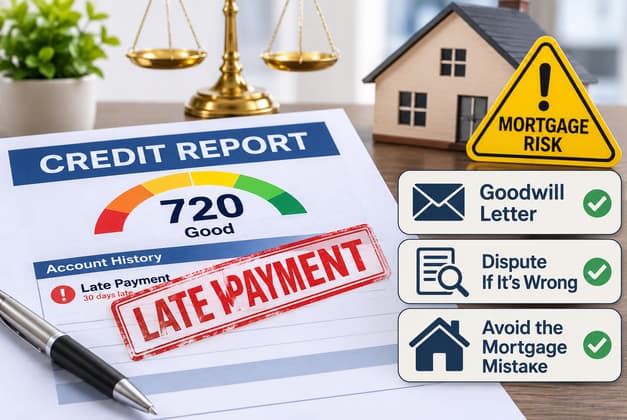
Quick answer: If the late payment is wrong, you have a legal right to dispute it, and the company must generally investigate within 30 days. If it’s accurate, no law forces removal: your only route is asking the lender for a goodwill adjustment, which sometimes works for a single late on an otherwise clean account. Either way, it falls off seven years after the original delinquency, and its hit to your score fades long before that.
Applying for a mortgage in the next few months? Don’t dispute an accurate late payment first. It can stall your approval. Jump to the mortgage warning
Find your route and your drop-off date in 30 seconds. Go to the Route Finder
- DISPUTE
It’s wrong. You have legal rights. - ASK
It’s accurate. Request goodwill. - WAIT
They said no. Time works for you.
Not legal or credit-repair advice.
Late Payment Route Finder
Answer what you can. Don’t enter names, account numbers, or balances.
When a Late Payment Actually Hits Your Report
Creditors generally report a payment as late once it is 30 or more days past due.
A payment 1–29 days late usually brings a fee, not a credit-report mark (see Credit Card Late Fee One Day Late). Some creditors wait longer. Federal student loans are different: servicers report delinquencies after 90 or more days.
The clock that matters is the original delinquency date: the first missed payment in a series, even if you caught up the next month.
How Much It Hurts, and How Fast That Fades
A 90-day late hurts more than a 30-day late, and a recent late hurts more than an old one.
30 days late
Reported at 30+ days past due. Smaller impact. Falls off 7 years from the original delinquency.
60 days late
Reported the next cycle. Larger impact. Falls off 7 years from the original delinquency.
90 days late
Reported the next cycle. Larger still. Falls off 7 years from the original delinquency.
120+ days late
Ongoing reporting. Severe impact. Falls off 7 years from the original delinquency.
Charge-off or collection
Reported after long delinquency. Most severe. Falls off 7 years from the original delinquency.
1–29 days late is usually not reported; a fee may apply. Source: 15 U.S.C. § 1681c. Verified November 7, 2026.
| Status | When it’s usually reported | Relative impact | When it falls off |
|---|---|---|---|
| 1–29 days | Usually not reported | None on the report; a fee may apply | Not applicable |
| 30 days | At 30+ days past due | Smaller | 7 years from original delinquency |
| 60 days | Next cycle | Larger | 7 years from original delinquency |
| 90 days | Next cycle | Larger still | 7 years from original delinquency |
| 120+ days | Ongoing | Severe | 7 years from original delinquency |
| Charge-off / collection | After long delinquency | Most severe | 7 years from original delinquency |
Older illustrative example, not a prediction: FICO once illustrated that a single 30-day late could take roughly 90–110 points from a 780 and 60–80 from a 680. Higher scores fall further. The effect fades well before the seven years end, helped by on-time payments and low utilization.
Route 1: It’s Wrong — Dispute It
If the late payment is inaccurate, you can dispute it with the bureau, directly with the lender, or both.
A dispute is for errors. A goodwill letter is for accurate marks. Mixing them up wastes your best shot.
Through a bureau: under 15 U.S.C. § 1681i, the bureau must investigate, generally within 30 days, or 45 days if you send more information during the investigation. You get results within 5 business days after it finishes. Dispute with each bureau that shows the error. A bureau may treat a dispute as frivolous or irrelevant (15 U.S.C. § 1681i(a)(3)) and decline to investigate, so be specific and attach proof.
Directly with the lender: FCRA § 623(a)(8) (15 U.S.C. § 1681s-2(a)(8)) and Regulation V (12 C.F.R. § 1022.43) allow a direct dispute, with a 30-day investigation. The lender must investigate only if you send it to the address the lender designates for disputes, so check its credit-reporting notice or website first. If the lender decides the dispute is frivolous or irrelevant, it must tell you within 5 business days and say what information it needs.
Do both when it’s wrong: a bureau dispute and a direct dispute can run at the same time. Keep dated copies and proof of delivery.
Evidence that wins: bank statements, payment confirmation numbers, autopay logs, and dated messages with the servicer.
If it comes back “verified” but is still wrong: that means the lender confirmed its records, not that you’re mistaken. Send a direct dispute with your proof and file a CFPB complaint. If the account isn’t yours, go to Someone Opened a Credit Card in My Name.
Route 2: It’s Accurate — Ask for a Goodwill Adjustment
Goodwill is a favor, not a right, and it sometimes works.
No law requires a lender to delete an accurate late payment. Experian notes that lenders have “a legal and contractual obligation to accurately report the history of the account.”
It tends to work best with a clean prior history, a real reason, an account that is already current, and a prompt request. Phone first: ask for the department that handles credit-reporting adjustments, note the date and the name, then follow up in writing. Include the facts and a plain request. Never include threats, legal claims, or untrue statements. If they say no, wait three to six months of on-time payments and ask once more with new information.
Who to address and what to leave out: address the credit-reporting or customer-relations department, not the collections line. Keep it to one account and one late. Never say you’ll sue, never claim the lender made an error if it didn’t, and don’t ask for a deletion in exchange for payment unless you’re negotiating with a collector. Ask once, then wait before asking again.
Route 3: They Said No — Let Time Work
Every late payment is removed automatically seven years after the original delinquency.
Meanwhile, its impact fades. Pay on time, keep utilization low, and avoid new lates. There is nothing to file when the date arrives; the bureaus remove it.
Applying for a Mortgage? Read This Before You Dispute
Disputing an accurate late payment right before a mortgage application can stall or derail your approval.
Disputing an accurate late before a mortgage can stall your approval.
Fannie Mae’s Desktop Underwriter (DU) flags disputed tradelines. It first assesses the loan with the disputed tradeline included. If DU doesn’t approve, it reassesses without it, and the lender must then determine whether you’re responsible for the account. If you are and the tradeline is accurate, the loan isn’t eligible as a DU loan (Selling Guide B3-5.3-09). The lender may still be able to manually underwrite, but many avoid it. Rules vary by loan type, so ask your loan officer.
Rapid rescore: only your lender can order it, and it cannot remove accurate negative items. It helps after a genuine correction has been made. Consumers generally aren’t charged directly, but ask your lender whether any cost is passed on. Talk to your loan officer before you change anything. More in How to Get Preapproved for a Mortgage.
Student Loan Late Payments in 2025–2026
Federal student loans generally aren’t reported late until 90 days, so a 30-day or 60-day late on one is worth checking.
Federal student loans generally aren’t reported late until 90 days, so a 30-day late on one is worth checking.
Default generally comes at 270 days (CRS, Oct. 23, 2026). The Congressional Research Service reports the 2023 servicing transfers may have contributed to nearly 2 million credit reporting errors, and the CFPB found servicers made basic payment-processing errors. Some borrowers’ on-time histories may not have carried forward through transfers, and a single debt can appear twice. Request your payment history from your servicer and compare it with your reports. Reporting resumed after the pandemic payment pause, so check any delinquency that appeared in 2025–2026 against your actual payment dates. Private student loans follow the usual 30-day norm. See SAVE Plan Ended: IBR vs RAP.
Special Situations
- Autopay or bank error: dispute with bank records.
- Servicer transfer: treat as a possible error; gather both servicers’ histories.
- Pandemic accommodation: under CARES Act § 4021 (15 U.S.C. § 1681s-2(a)(1)(F)), if a lender granted an accommodation during the covered period (January 31, 2020 until 120 days after the national emergency ended) and you met its terms, the account should have been reported current or not advanced in delinquency. It doesn’t apply to charged-off accounts, and most early-2020 lates age off in 2027 anyway.
- Authorized user: being removed from the account may remove its late payments from your file. Confirm with the issuer and each bureau.
- Closed accounts: a closed account’s late payment stays for the same seven years, and you can still ask the lender for goodwill, though a closed account gives you less leverage than a current one.
- Collections and charge-offs: goodwill rarely works, and pay-for-delete is not guaranteed.
- Buy now, pay later: see BNPL and Your Credit Report.
Credit Repair Companies: What They Can’t Do
Nobody can legally remove accurate, timely information for a fee.
Nobody can legally remove accurate, timely information for a fee.
Under the Credit Repair Organizations Act, these companies can’t charge before the work is fully performed. Red flags: payment up front, promises to “erase” accurate items, advice to dispute everything, or advice to create a new credit identity. Everything they do, you can do yourself for free. Report scams to the FTC.
Your Letters
Use last four digits only. Fill in the [brackets] and keep copies. Be honest in every letter.
1. Goodwill letter (accurate late, account current)
2. Direct dispute to the lender (inaccurate late)
3. Dispute to a credit bureau (inaccurate late)
4. Follow-up after a goodwill “no”
Send bureau disputes through the bureau’s official dispute channel.
Compare Your Options
| Route | When it fits | Can it remove the mark? | Typical timeline | Main risk |
|---|---|---|---|---|
| DISPUTE | It’s wrong | Yes, if inaccurate | About 30–45 days | Frivolous finding; mortgage risk if accurate |
| ASK | It’s accurate | Only if the lender agrees | Varies | None to your score |
| WAIT | They said no | Falls off at 7 years | Impact fades sooner | None |
| Account | When lates are usually reported | Special rules | Where to look |
|---|---|---|---|
| Credit card | At 30+ days past due | Possible pandemic accommodation protection | Issuer’s credit-reporting department |
| Auto loan | At 30+ days past due | Lender-specific | Lender, then the bureaus |
| Mortgage | At 30+ days past due | Carries heavy weight in later underwriting | Servicer, before any new application |
| Federal student loan | After 90+ days | Servicing-transfer errors documented | Servicer payment history; studentaid.gov |
| Private student loan | Usually 30+ days | Lender-specific | Lender |
| BNPL | Varies by provider | Reporting practices are still changing | The BNPL provider; see BNPL and Your Credit Report |
| Option | Who you contact | Legal right? | Cost | What it can’t do |
|---|---|---|---|---|
| Dispute | Bureau and/or lender | Yes (FCRA) | Free | Remove accurate, verified information |
| Goodwill | Lender | No | Free | Force the lender to agree |
| Credit repair company | A company | Regulated by CROA | Fees (none allowed before work is fully performed) | Remove accurate, timely information |
Related guides: How to Fix Your Credit Score Fast · Credit Score Dropped for No Reason · Credit Card Hardship Program · How to Check Your Credit Score Free
FAQ
Can a late payment be removed from my credit report?
If it’s inaccurate, yes, through a dispute. If it’s accurate, only if the lender agrees to a goodwill adjustment. Otherwise it falls off after seven years.
Is a payment 15 days late reported?
Generally no. Creditors usually report at 30 or more days past due, though you may owe a fee.
How long does a late payment stay on my report?
Seven years from the original delinquency date, the first missed payment in the series.
Does a goodwill letter actually work?
Sometimes. It works best for one late on an otherwise clean account that is now current. No law requires the lender to agree.
Can I dispute an accurate late payment?
No. Disputes are for errors. Disputing accurate information can be treated as frivolous and can backfire, especially before a mortgage.
What does “verified” mean after a dispute?
The lender confirmed its records. If you still have proof it’s wrong, send a direct dispute and consider a CFPB complaint.
Should I dispute a late payment before applying for a mortgage?
Only if it’s genuinely wrong, and tell your loan officer first. Disputing an accurate late can leave a disputed tradeline that stalls underwriting.
Can a rapid rescore remove a late payment?
No. It can only update a genuine correction, and only your lender can order it.
Why does my federal student loan show a late payment?
Federal servicers generally report after 90 days, so a 30- or 60-day late is worth checking against your servicer’s payment history.
When exactly will my late payment fall off?
About seven years after the original delinquency date, the first missed payment in the series. The bureaus remove it automatically.
How many points does a 30-day late payment cost?
It depends on your score and profile. FICO’s older illustrative example showed a 30-day late taking about 90–110 points from a 780 and 60–80 from a 680. That is not a prediction for you.
Does a late payment hurt less over time?
Yes. Recent lates hurt more than old ones, and the effect fades well before the seven years end.
Is it better to call or write?
Call first to reach the right department and note the name and date, then follow up in writing.
Can a goodwill letter hurt my credit?
Asking doesn’t affect your score. It only matters if the lender agrees or declines.
What should I do if my goodwill request is denied?
Let time work. After three to six more months of on-time payments, send letter 4 with new information.
How long does a credit dispute take?
Generally 30 days, or 45 if you send more information during the investigation, plus up to 5 business days for results.
Does paying off the account remove the late payment?
No. Paying it makes the account current or closed, but the late stays for the seven-year period.
Can a credit repair company remove late payments?
Not accurate, timely ones. Nobody can legally remove them for a fee, and these companies can’t charge before the work is fully performed.
This article is general information, not legal or credit-repair advice. Results depend on your lender, the credit bureaus, and your records. Rules verified November 7, 2026.
Last updated:

Daniel Hayes is the founder and sole researcher at AdvoraHQ. He covers U.S. personal finance, insurance, and consumer law — working directly from IRS publications, federal and state statutes, court opinions, and SEC filings rather than secondary summaries. His focus is the gap between what readers think they know and what the source documents actually say. Daniel is not a licensed attorney, CPA, or financial advisor; his articles are educational and not personalized advice. Reach him at Daniel.Hayes@advorahq.com.
