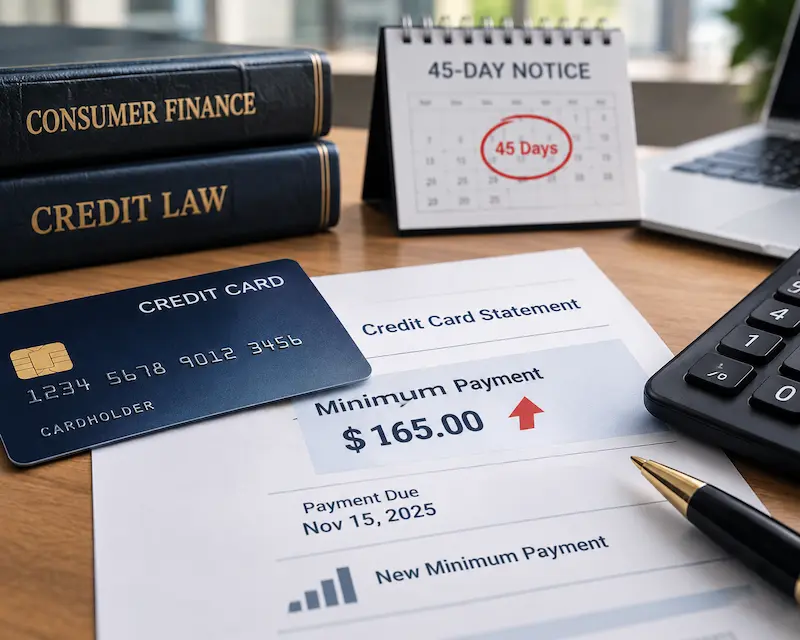
Quick answer. Your minimum payment usually rises for one of a few reasons: your balance grew, your interest charge grew (a variable rate rose, a 0% promo ended, or a penalty rate kicked in), a missed payment or fee was added, or an installment plan payment was folded in. If your issuer changes its formula, federal rules require 45 days’ written notice, but you can’t reject that change. A rate that rises with its index needs no notice at all.
Rebuild your minimum line by line and see what minimum-only really costs →
Rules verified October 22, 2026 against Regulation Z and federal bank regulator guidance. This guide covers credit cards, meaning open-end credit not secured by your home.
Decode Your Minimum Payment
Enter numbers from your statement to rebuild the minimum line by line, then see what paying only the minimum costs compared with a 36-month payoff.
8 Reasons Your Minimum Went Up
Eight things can raise a minimum payment, and only some of them come with advance notice.
Each reason carries one tag. NOTICE REQUIRED means the issuer must warn you in writing first. NO NOTICE means it can happen without a warning. ALREADY ON YOUR STATEMENT means the cause is a line item you can find on the statement itself.
- 1. Balance grew
- 2. Variable rate rose
- 3. Promo rate ended
- 4. Penalty rate applied
- 5. Past-due amount added
- 6. Fees added
- 7. Installment plan added
- 8. Formula changed
1. Your balance grew
NO NOTICE
If your formula is a percentage of the balance, a bigger balance means a bigger minimum. New purchases, a cash advance, and interest added to the balance all count. Any amount over your credit limit is usually added on top. Nothing about the rules changed, so no notice is sent.
How to spot it: “New Balance” is higher than last month. If you are over your limit, the statement usually shows an over-limit amount.
What to do: Decode the minimum above. Paying more than the minimum shrinks the balance the formula works from.
2. A variable APR rose with its index
NO NOTICE
Many card rates move with an index, often the Prime Rate. When the index rises, your APR rises, your interest charge rises, and the interest part of your minimum rises. Regulation Z does not require advance notice for this kind of increase.
How to spot it: The APR printed on the statement is higher than last cycle, and “Interest Charged” is higher with a similar balance.
What to do: Confirm your rate is variable in your agreement, then rerun the calculator with the new APR.
3. A 0% or promotional APR ended
NO NOTICE
A promotional rate that ends on a date you were told about in advance does not require a new warning. Interest starts or rises on that balance, and the interest part of your minimum grows. With a deferred interest offer, an unpaid balance at the end can bring a large interest charge all at once.
How to spot it: Check the promotional balance line and its end date. “Interest Charged” jumps in the cycle after the promo ends.
What to do: If the rate after the promo is higher than what was disclosed up front, or you never saw the end date, ask the issuer to show you where it was disclosed.
4. A penalty APR applied
NOTICE REQUIRED
If an event in your agreement, such as a late payment, triggers a penalty rate, the issuer must send written notice at least 45 days before the higher rate takes effect. The notice must come after the triggering event. Your minimum then rises because the interest part grows.
How to spot it: A notice in the mail or on your statement, then a higher APR and higher “Interest Charged” once it takes effect.
What to do: Pay on time. See the 45-day rule below and call the issuer if the notice looks wrong.
5. A past-due amount was added
ALREADY ON YOUR STATEMENT
If you missed a payment or paid less than the minimum, the shortfall is usually added to the next minimum. A late fee can come with it.
How to spot it: Look for “Past Due Amount” near the minimum payment due.
What to do: Pay the whole minimum, past-due part included, by the due date. If you can’t, call before the due date.
6. Fees were added
ALREADY ON YOUR STATEMENT
Late fees, cash advance fees, balance transfer fees, foreign transaction fees, and returned payment fees all land in the “Fees” section. When the formula is “percentage plus interest and fees,” they go straight into the minimum.
How to spot it: Check the “Fees” section and its total for the cycle.
What to do: Ask whether a one-time fee can be waived, and avoid the action that triggered it next cycle.
7. An installment plan payment was folded in
ALREADY ON YOUR STATEMENT
Some issuers let you turn a purchase into a fixed monthly plan. That monthly plan payment is added to your minimum on top of the regular formula.
How to spot it: A line labeled as an installment or “pay over time” plan, with a monthly amount and often a remaining term.
What to do: Ask how many payments remain. The minimum falls back when the plan ends.
8. The issuer changed the formula
NOTICE REQUIRED
An increase in the required minimum periodic payment counts as a significant change in account terms. The issuer must send written notice at least 45 days before it takes effect. You cannot reject this change.
How to spot it: A “change in terms” notice that arrived 45 or more days earlier, sometimes printed on or with a statement.
What to do: Use the call script in the statement check to ask which parts make up this month’s minimum.
| Reason | Tag | Where it shows on your statement | What to do |
|---|---|---|---|
| 1. Balance grew | NO NOTICE | “New Balance” is higher; an over-limit amount may appear | Decode the minimum; pay above it if you can |
| 2. Variable APR rose with its index | NO NOTICE | Higher APR and “Interest Charged” | Confirm the rate is variable in your agreement |
| 3. 0% or promo APR ended | NO NOTICE | Promotional balance end date; “Interest Charged” jumps | Find where the end date was disclosed |
| 4. Penalty APR applied | NOTICE REQUIRED | A notice 45+ days earlier, then a higher APR | Pay on time; call if the notice looks wrong |
| 5. Past-due amount added | ALREADY ON YOUR STATEMENT | “Past Due Amount” near the minimum due | Pay it in full by the due date, or call first |
| 6. Fees added | ALREADY ON YOUR STATEMENT | The “Fees” section and its total | Ask whether a one-time fee can be waived |
| 7. Installment plan payment folded in | ALREADY ON YOUR STATEMENT | A plan line with a monthly amount | Ask how many payments remain |
| 8. Issuer changed the formula | NOTICE REQUIRED | A change-in-terms notice mailed 45+ days earlier | Read the notice; use the call script below |
No New Charges, Higher Minimum?
Yes, a minimum can rise even if you never touched the card, because interest, ended promos, past-due amounts, and fees all feed it.
Interest. Unpaid balances keep earning interest, and interest charged last cycle can become part of this cycle’s balance. If you paid your statement balance and still saw interest, read why you were charged interest after paying the statement balance.
A promo that ended. A balance that carried 0% interest begins to accrue interest, so the interest piece of the minimum goes from nothing to something.
A missed or short payment. The unpaid part is typically added to the next minimum, along with any late fee.
Fees. A fee from a previous cycle can still be in the balance this cycle and, under some formulas, inside the minimum.
How Your Minimum Is Calculated
Issuers build the minimum from three common patterns, and the right one for you is in your cardholder agreement.
These are patterns, not any named issuer’s formula. We use a $3,000 balance at a 24% APR throughout. Monthly interest is $3,000 × 24% ÷ 12 = $60. Real issuers calculate interest daily, so your statement will differ a little. For how that works, see how credit card interest works.
Pattern 1: the greater of a floor or a percentage of the balance. With a $35 floor and 1%: 1% of $3,000 = $30. The floor is higher, so the minimum is $35. Notice that $35 is less than the $60 of interest. The balance grows by about $25 that month. Statements for this situation show the “never pay off” version of the warning box (see below).
Pattern 2: a percentage of the balance plus that cycle’s interest and fees. With 1%: $30 + $60 interest + $0 fees = $90. Of that, $60 covers interest and $30 reduces the balance.
Pattern 3: the whole balance if it is below the floor. If your balance is $28 and the floor is $35, the minimum is $28.
| Pattern | How it works | Example ($3,000 at 24%) | When the minimum equals your whole balance |
|---|---|---|---|
| Greater of floor or percentage | Pay the larger of a flat dollar amount or a percentage of the balance | 1% = $30; floor = $35; minimum = $35 | When the balance is below the floor |
| Percentage plus interest and fees | Percentage of the balance, plus that cycle’s interest and fees, then apply any floor | $30 + $60 + $0 = $90 | When the total would exceed the balance |
| Whole balance below the floor | If you owe less than the floor, pay it all | Balance $28, floor $35, minimum $28 | Always |
Why many formulas add interest and part of the principal. In January 2003, the federal banking agencies (OCC, FDIC, Federal Reserve, and OTS) jointly issued “Account Management and Loss Allowance Guidance for Credit Card Lending.” It covers minimum payments and negative amortization, which is when payments fall short of the charges and the balance keeps building. Formulas that cover interest and a slice of principal avoid that outcome. The exact percentage is each issuer’s choice.
Where to Find Your Exact Formula
Your exact formula is in your cardholder agreement, and the CFPB’s public database probably has a copy.
Your exact formula is in your cardholder agreement, and you’re entitled to a copy.
- Find the issuer’s name. The name on the front of the card may not be the issuer. A store or co-brand name is often just the brand. The agreement or the back of the statement names the bank.
- Open the CFPB Credit Card Agreement Database at consumerfinance.gov/credit-cards/agreements. It holds agreements from more than 600 issuers, collected quarterly under the CARD Act.
- Search by issuer name, open the newest file, and check its date.
- Find the paragraph titled “Minimum Payment” or “Minimum Payment Due.” It states the percentage, the floor, and what gets added.
- Your own agreement may be a different version from the one in the database. Ask your issuer for a copy of your agreement. Issuers must provide one on request (12 CFR 1026.58(e)).
The 45-Day Rule: What You Can’t Reject
An issuer must give you written notice at least 45 days before it raises your required minimum payment, and Regulation Z does not give you a right to reject that change.
A formula change needs 45 days’ notice, but you can’t reject it.
Under 12 CFR 1026.9(c)(2), an “increase in the required minimum periodic payment” is a significant change in account terms. The notice must describe the increase and its effective date. If it comes with a statement, the information must appear on the front of a page of the statement.
For many other significant changes, the notice must tell you that you can reject the change before it takes effect. The rule carves out the minimum payment. Section 1026.9(c)(2)(iv)(B) says this information “is not required to be provided in the case of an increase in the required minimum periodic payment.” The same carve-out covers APR changes and changes that follow a payment more than 60 days late. The Federal Reserve Board, which wrote the rule, decided in 2010 not to apply a right to reject to minimum-payment increases.
A variable rate can raise your minimum with no notice at all.
No advance notice is needed when a variable APR rises because its index rose, if the index is not under the issuer’s control and is available to the public. The Prime Rate is the usual example. The Federal Reserve’s moves influence Prime, but your agreement ties the rate to the index, not to the Fed directly.
| Change | Advance notice? | Can you reject it? |
|---|---|---|
| Formula or minimum payment increase | Yes, written notice at least 45 days before | No |
| APR increase by the issuer | Yes, at least 45 days before | The reject-the-change statement is not required for APR changes; see our APR guide for what the increase can apply to |
| Variable APR rising with its index | No notice | Nothing to reject; no term changed |
| Promotional rate ending as previously disclosed | No advance notice | Nothing to reject; the end date was already disclosed |
| Penalty APR | Yes, written notice at least 45 days before the higher rate takes effect, sent after the triggering event | See our APR guide |
| Minimum returns to its prior level after a hardship arrangement | No new notice, if the terms were disclosed before the arrangement began | Nothing to reject; the terms were agreed up front |
| Credit line reduced | No notice for the cut itself; 45 days before an over-limit fee or penalty rate imposed solely because of the new lower limit | Not applicable |
Rate increases follow their own rules about which balances are affected. We cover them in Credit Card Interest Rate Going Up?, including notices and protected balances.
Reading the Minimum Payment Warning
The Minimum Payment Warning is a box your statement must show, with the time and cost of paying only the minimum.
The rule is in 12 CFR 1026.7(b)(12), based on 15 U.S.C. 1637(b)(11). Here is the box, one line at a time.
A bold “Minimum Payment Warning” heading: if you make only the minimum payment each period, you will pay more in interest and it will take you longer to pay off your balance.
How long paying only the minimum would take. Under 2 years it is shown in months; otherwise in years, rounded to the nearest whole year.
The estimated total of all the payments you would make under that plan.
They use the balance shown on this statement and assume you make only minimum payments and add nothing new to the balance.
The estimated monthly payment that would pay off the statement balance in 3 years.
The total you would pay under the 36-month plan, and what you would save compared with minimum-only.
A toll-free number for information about credit counseling. Through it, the issuer must give you the name, address, phone, and website of at least three approved organizations, to the extent that information is available from the U.S. Trustee or a bankruptcy administrator.
If your minimum is less than the interest charged, the box instead says you will never pay off the balance shown, because the payment is less than the monthly interest. It adds that paying more than the minimum means less interest and an earlier payoff. It still shows the 36-month payment and the counseling number.
Why the 36-month row may be missing. The regulation lists exactly three situations, in 12 CFR 1026.7(b)(12)(i)(F)(2):
- The minimum-only payoff estimate shown, after rounding, is 3 years or less.
- The 36-month payment, after rounding, is less than the minimum payment required for that cycle.
- The account has both a revolving balance whose minimums won’t pay it off in a fixed time and a fixed-repayment balance that pays off in a fixed time shorter than 36 months.
A balance being “low” or an account being “closed” is not on that list.
When the whole box may be missing. Section 1026.7(b)(12)(v) exempts three cases: charge card accounts that require payment in full each cycle; a billing cycle that follows two straight cycles in which you paid in full, had a zero balance, or had a credit balance; and a cycle where the minimum due pays the entire balance.
Statement figures use the federal method in Appendix M1, so they can differ from the calculator’s.
What Paying Only the Minimum Costs
On a $3,000 balance at 24%, paying only the minimum took about 12 and a half years and about $4,442 in interest in our model, versus about $1,237 over 36 months.
All three paths below use the same math as the calculator: each month, interest is balance × APR ÷ 12; the minimum is 1% of the balance plus that month’s interest, with a $35 floor, and never more than the balance plus interest. No new charges, APR unchanged.
| Path | Monthly payment | Months | Total interest |
|---|---|---|---|
| Minimum only (1% + interest, $35 floor) | Starts at $90.00 and falls as the balance falls | 150 (12 years 6 months) | $4,441.81 |
| Fixed payment for 36 months | $117.70 | 36 | $1,237.15 |
| Minimum plus a fixed extra $50 each month | Starts at $140.00 and falls | 43 | $1,287.70 |
| For comparison: greater of $35 or 1%, no interest added | $35.00 | Does not pay off; the balance grows | Not applicable |
The 36-month path saves about $3,204.66 in interest compared with minimum-only (4,441.81 − 1,237.15). The fixed extra $50 gets most of that benefit with a smaller commitment.
Where extra money goes. Under 12 CFR 1026.53, amounts you pay above the minimum generally go first to the balance with the highest APR. That is one reason to pay more than the minimum if you carry a cash advance or penalty-rate balance.
When you’re ready to build a payoff plan, see how to pay off credit card debt fast.
Does the Minimum Affect Your Score?
The size of your minimum payment is not itself a scoring factor, but a bigger balance can raise your utilization and a missed minimum can hurt your credit.
Utilization is how much of your limit you are using. If the balance grows, utilization rises. Paying the minimum on time keeps the account in good standing. Missing it is what can be reported as a late payment. For details, see the credit utilization ratio.
If You Can’t Afford the New Minimum
Call your issuer before the due date, not after.
Can’t pay the new minimum? Call before the due date, not after.
- Call and ask for options. Ask about a hardship or payment plan. Our guide to credit card hardship programs explains what to ask. If a hardship arrangement ends, the minimum can return to its earlier level without a new 45-day notice, as long as those terms were disclosed to you before it began.
- Get free guidance. The toll-free number in your statement’s warning box connects you to information about approved nonprofit credit counseling organizations. You can also look up approved agencies through the U.S. Trustee Program.
- Consider consolidation as one option. A balance transfer is one route some people look at. Compare it against alternatives in balance transfer vs. debt consolidation.
What not to do. Don’t skip the payment. That can mean late fees, a penalty rate after notice, and a late mark on your credit report. Don’t take a cash advance to cover the minimum. It usually carries fees and its own interest.
Statement Check and Call Script
This eight-step check finds the cause of your new minimum in about ten minutes.
- Compare “New Balance” with last month. Up? That alone raises a percentage-based minimum.
- Find “Interest Charged.” Higher than last month? Check whether your APR changed and why (index, promo end, penalty).
- Look for “Past Due Amount.” A missed or short payment is usually added to this month’s minimum.
- Look for fees: late, cash advance, balance transfer, foreign transaction, returned payment.
- Look for a plan payment line (an installment or “pay over time” plan).
- Check whether you’re over your limit.
- Check your mail and messages for a “change in terms” notice from the last 45+ days.
- Still unexplained? Request your cardholder agreement, or find it in the CFPB database, and read the “Minimum Payment” paragraph.
Call script (select and copy):
“My minimum payment went from $[old] to $[new]. Can you tell me which components make up this month’s minimum, and whether the minimum-payment formula on my account has changed? If it has, when was the notice sent?”
Frequently Asked Questions
Why did my minimum payment go up?
One of eight things: your balance grew, a variable rate rose, a promo ended, a penalty rate applied, a past-due amount or fees were added, an installment plan was folded in, or the issuer changed its formula. See the eight reasons.
Why did my minimum payment double?
A doubling usually comes from two things stacking up, such as a promo ending (interest starts) plus a past-due amount and a late fee. Check each line in the statement check.
Why did it go up if I didn’t use my card?
Interest, a promo ending, a past-due amount, or fees can all raise it without new purchases. See the section above.
How is a credit card minimum payment calculated?
Commonly as the greater of a floor or a percentage of the balance, or as a percentage plus that cycle’s interest and fees, or the whole balance if it is below the floor. Your agreement has the exact version. See the formula section.
What is a typical minimum payment percentage?
There is no single standard. Many agreements use a percentage of about 1% to 2% of the balance, often plus interest and fees, with a dollar floor. Read your own agreement. The calculator’s 1% and $35 are placeholders.
Where can I find my card’s minimum payment formula?
In your cardholder agreement, under “Minimum Payment.” Search the issuer in the CFPB Credit Card Agreement Database, or ask your issuer for a copy. See where to find it.
Can my credit card company increase my minimum payment?
Yes, if it follows the rules. It must send written notice at least 45 days before an increase in the required minimum takes effect.
Do they have to notify me first?
For a formula or minimum-payment increase, yes. Not for a variable rate rising with its index, a previously disclosed promo ending, or your own balance growing.
Can I reject a minimum payment increase?
No. Regulation Z does not require the reject-the-change statement for a minimum-payment increase. You can still call your issuer, pay more than the minimum, or ask about a hardship program.
Why didn’t I get notice when my APR went up?
Most likely a variable rate moved with its index, a previously disclosed promotional rate ended, or a disclosed hardship arrangement ended. None of those needs advance notice. A discretionary rate increase or a penalty rate does.
What happens when a 0% APR ends?
The disclosed standard rate begins on the remaining balance, so interest and the interest part of your minimum go up. With deferred interest, unpaid balances can be charged interest back to the purchase date. See deferred interest.
What is the Minimum Payment Warning on my statement?
A required box showing how long minimum-only takes, what it costs, the 36-month alternative, and a credit counseling number. See how to read it.
Why doesn’t my statement show a 36-month payment?
Only three situations allow it: the minimum-only estimate is 3 years or less after rounding, the 36-month payment is lower than your minimum, or a mixed-balance account situation applies. The whole box can also be omitted in three cases covered in the warning-box section.
How long will it take to pay off my card with minimum payments?
It depends on your balance, APR, and formula. In our $3,000 at 24% example it was about 12 and a half years. Use the calculator for your numbers.
Does paying only the minimum hurt my credit score?
Paying the minimum on time does not by itself hurt it. A high balance raises utilization, which can. See credit utilization.
Can I lower my minimum payment?
The formula is set by your agreement, so you can’t change it yourself. Paying down the balance lowers a percentage-based minimum over time. You can also ask the issuer about a hardship program. See hardship programs.
What happens if I pay less than the minimum?
Your payment is late. That can bring a late fee, a past-due amount, a penalty rate after notice, and a late mark on your credit report. If you can’t pay the minimum, call before the due date.
Does an installment plan raise my minimum?
Yes. The plan’s monthly payment is typically added on top of the regular minimum until the plan ends.
Sources
- 12 CFR 1026.9, subsequent disclosure requirements, including (c)(2) change-in-terms notices and (g) penalty-rate notices. Retrieved October 22, 2026.
- 12 CFR 1026.7(b)(12) and Appendix M1, repayment disclosures. Retrieved October 22, 2026.
- 15 U.S.C. 1637(b)(11), statutory minimum payment warning.
- 12 CFR 1026.53, allocation of payments.
- OCC HelpWithMyBank, notice and no-notice cases for credit card changes.
- CFPB Credit Card Agreement Database.
- OCC Bulletin 2003-1 (January 8, 2003), “Account Management and Loss Allowance Guidance for Credit Card Lending,” issued jointly by the OCC, FDIC, Federal Reserve, and OTS.
General information, not financial or legal advice. Minimum payment formulas vary by issuer and account; your cardholder agreement and periodic statement control. Calculator results are estimates. Rules verified on October 22, 2026.

Daniel Hayes is the founder and sole researcher at AdvoraHQ. He covers U.S. personal finance, insurance, and consumer law — working directly from IRS publications, federal and state statutes, court opinions, and SEC filings rather than secondary summaries. His focus is the gap between what readers think they know and what the source documents actually say. Daniel is not a licensed attorney, CPA, or financial advisor; his articles are educational and not personalized advice. Reach him at Daniel.Hayes@advorahq.com.