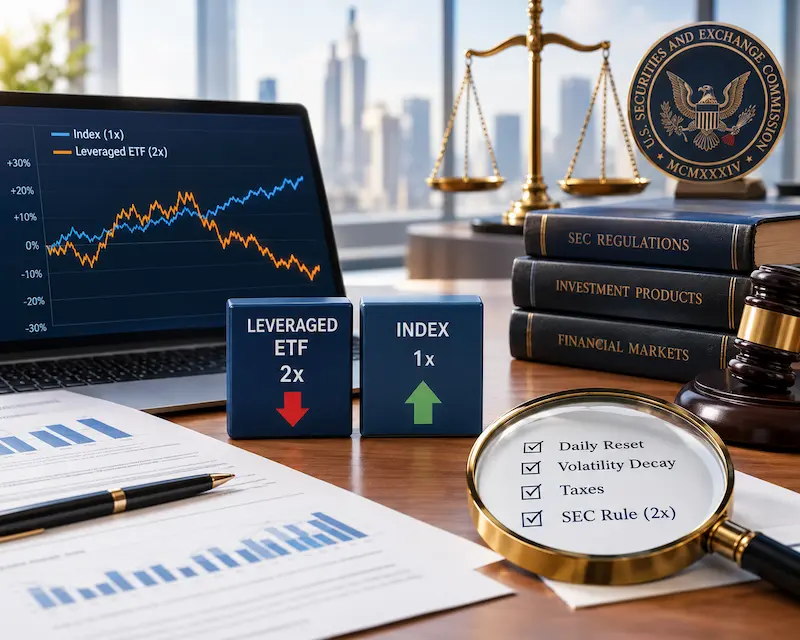
| Index move | 2x fund | 3x fund |
|---|---|---|
| Day 1: +10% | +20% | +30% |
| Day 2: −10% | −20% | −30% |
| Result: index −1% | −4% | −9% |
Try your own numbers, or your fund’s actual daily moves → Open the simulator
Verified October 24, 2026. Examples are hypothetical and exclude fees and financing costs.
Leveraged ETF Decay Simulator
Pick a multiple and a market path to see how the daily reset compounds. Nothing you enter is stored or sent anywhere.
Up to 260 values, each between −99 and 300.
How to check your own fund
Enter the index’s daily percentage moves in the Custom box, in order, and compare the simulated result with what your fund actually did over the same days.
- Use the same start day, end day and number of trading days as your own holding period.
- Use the index’s daily closing moves, not the fund’s, so the simulator applies the multiple itself.
- Add the fund’s expense ratio in the last box if you want the stated fee included.
A small remaining gap is normal. Your real result can still differ from the simulation because of:
- Financing costs and tracking error inside the fund, which the simulator leaves out.
- Buying part-way through a day. The fund’s daily target runs from one close to the next, so the first partial day follows different math.
- The difference between the market price you paid and the fund’s NAV.
- Distributions and taxes.
The SEC/FINRA bulletin also warns that a fund may fail to meet its daily objective on a given day. A large unexplained gap is a reason to read the fund’s annual report and its prospectus.
What a Leveraged ETF Actually Promises
A leveraged ETF promises a multiple of the index’s return for a single day, not for the weeks or months you own it.
THE RULES
The SEC and FINRA say these funds typically aim at their stated objectives for one day. Over longer periods, performance can differ significantly and can bring significant and sudden losses. The joint investor bulletin (updated August 29, 2023) calls them specialized products that generally are not suited to buy-and-hold investors, while noting that some trading or hedging strategies may involve keeping them longer than a day.
FINRA Regulatory Notice 09-31 (June 11, 2009) said daily-reset leveraged and inverse ETFs typically are unsuitable for retail investors who plan to keep them longer than one trading session, and it told firms to apply a customer-specific suitability analysis. FINRA’s FAQ adds that they are typically inappropriate as intermediate or long-term investments, while recognizing closely monitored trading or hedging uses.
To reach the daily multiple, funds use swaps, futures and other derivatives. A 2x fund aims for twice the day’s index move. An inverse fund aims for the opposite move, so a −1x fund aims to fall 1% when the index rises 1%.
The prospectus words matter. A typical objective reads “daily investment results, before fees and expenses.” If your fund’s objective line says daily, the promise is daily.
The 2x or 3x applies to one day, not to your holding period.
For the baseline of what an ordinary ETF does, see Index Funds vs ETFs. For a sibling case where the label is not the return, see Option-Income ETF Yield.
The Daily Reset, Explained With Two Days of Math
Each day the fund starts over with a new value, so a gain or loss is applied to a bigger or smaller base than the day before.
THE MATH
Ending value = start × (1 + multiple × day 1 move) × (1 + multiple × day 2 move) × and so on. The same formula applies to every daily-reset fund.
| Day | Index | 2x | 3x | −2x |
|---|---|---|---|---|
| Start | $100 | $100 | $100 | $100 |
| Day 1: index +10% | $110 | $120 | $130 | $80 |
| Day 2: index −10% | $99 | $96 | $91 | $96 |
| Result | −1% | −4% | −9% | −4% |
Check the 2x column yourself. Day 1 takes $100 to $120. Day 2 takes away 20% of $120, which is $24, leaving $96. The index lost only 10% of $110, which is $11, leaving $99.
The 2x fund gained $20 and then lost $24. The index gained $10 and then lost $11. Doubling each percentage move more than doubles the net loss, because Day 2’s loss is taken from a bigger base. The SEC’s own bulletin uses a similar two-day example (down first, then up) and notes that the 2x fund lost about four times the index’s loss, not two times.
That gap is the cost of the reset. It is why the result depends on the order of the daily moves, not just on where the index ends.
A flat index can still leave a leveraged fund down.
When Compounding Helps — and When It Hurts
Compounding helps when moves run steadily in one direction and hurts when the market swings back and forth.
| Path | Index | 2x | 3x | Compared with 2× and 3× the index |
|---|---|---|---|---|
| Steady +1% a day | +22.0% | +48.6% | +80.6% | Better: 2× the index is +44.0%, and 3× is +66.1% |
| Steady −1% a day | −18.2% | −33.2% | −45.6% | Smaller losses than 2× (−36.4%) and 3× (−54.6%) the index |
| Alternating ±2% (starting up) | −0.4% | −1.6% | −3.5% | Worse: 2× the index is −0.8%, and 3× is −1.2% |
Steady up: +1% a day for 20 days
Index: +22.0%. 2x fund: +48.6%. 3x fund: +80.6%.
Better than 2× the index (+44.0%) and 3× the index (+66.1%). Hypothetical, before fees.
Steady down: −1% a day for 20 days
Index: −18.2%. 2x fund: −33.2%. 3x fund: −45.6%.
A smaller loss than 2× (−36.4%) and 3× (−54.6%) the index. Hypothetical, before fees.
Back and forth: ±2% for 20 days
Index: −0.4%. 2x fund: −1.6%. 3x fund: −3.5%.
Worse than 2× (−0.8%) and 3× (−1.2%) the index. Hypothetical, before fees.
THE MATH
Direction and steadiness help. Back-and-forth hurts. Volatility is the cost.
See why in the back-and-forth path. One up-then-down pair multiplies the index by 1.02 × 0.98 = 0.9996, a 0.04% loss. The 2x fund multiplies by 1.04 × 0.96 = 0.9984, a 0.16% loss. The 3x fund multiplies by 1.06 × 0.94 = 0.9964, a 0.36% loss.
The drag per pair is 4 times as large for 2x and 9 times as large for 3x. It grows with the square of the multiple.
In the steady paths nothing reverses, so each day builds on the last. In the up path, gains stack on gains and end above the multiple. In the down path, each day’s loss is taken from a smaller base, so the total loss ends smaller than the multiple would suggest. That is still a large loss: the 3x fund falls 45.6%.
The regulators’ bulletin gives a real-world case of the opposite kind. Over a four-month period, an index gained about 2% while a 2x leveraged fund fell about 6%. It also describes a 3x fund that fell 53% while its index rose about 8%. These are the regulators’ figures, not ours.
THE UNKNOWNS
Which path comes next. Real markets are rarely this tidy, and the result for any fund depends on the order of its daily moves, not only on where the index ends.
Inverse ETFs: The Same Math in Reverse
Inverse funds reset daily and compound the same way, so over weeks they rarely deliver the clean opposite of the index.
THE MATH
In Table 1, the −2x fund ends at −4% after the index ends at −1%. The −3x fund ends at −9%. The same compounding applies to inverse funds as to long ones.
On the 20-day steady paths (hypothetical, before fees), the index falls 18.2% when it drops 1% a day, yet a −1x fund gains 22.0%, more than the 18.2% you might expect. When the index rises 1% a day for a total of +22.0%, the −1x fund falls 18.2%.
On the back-and-forth path, a −2x fund ends at −1.6%, the same as a 2x fund.
The point for anyone using an inverse fund as a hedge: the hedge is matched day by day, not week by week. After many days, the fund’s result can differ from the opposite of the index’s total move.
Single-Stock Leveraged ETFs
A single-stock leveraged fund adds a second risk: it follows one company, so there is no diversification to soften a bad day.
THE RULES
The SEC’s Office of Investor Education and Advocacy said in July 2022 that these funds are riskier than holding the stock, a traditional ETF, or even a leveraged index fund. They aim for returns over extremely short periods, in some cases a single day, and they track one stock instead of an index.
Because a leveraged single-stock fund amplifies one stock’s moves, the SEC said holders can experience even greater volatility than holders of the stock itself. The SEC/FINRA investor bulletin repeats that single-stock funds eliminate the benefits of diversification.
A single company can fall far more in one day than a broad index ever does. That matters for the “can it go to zero” math later in this article.
Why the SEC Drew the Line at 2x — and Why TQQQ Still Exists
Rule 18f-4 lets new leveraged funds registered under the 1940 Act go up to 2x, and it exempted 3x funds that were already operating on October 28, 2020.
THE RULES (status as of October 24, 2026; this area is changing)
The SEC adopted Rule 18f-4 on October 28, 2020, and it appeared in the Federal Register on December 21, 2020. In plain English, it limits a fund’s value-at-risk to 200% of the value-at-risk of a designated reference portfolio, or an absolute value-at-risk of 20% of net assets.
For leveraged and inverse funds, that works out to 2x for new funds. Funds that were operating on October 28, 2020, had public shares outstanding, and had disclosed a leveraged objective above 200% in their prospectus were grandfathered. They were exempted from the value-at-risk limit. Under the rule, no new fund registered under the 1940 Act may go above 200%.
That is why a 3x index fund that launched before the cutoff can still trade. Two examples readers often search for: TQQQ launched on February 9, 2010, and SOXL launched on March 11, 2010, both before the cutoff. Whether a particular fund qualifies is stated in that fund’s own filings. This is a fact about timing, not a view on any fund.
Single-stock leveraged ETFs did not exist in the U.S. until 2022, so none of them were grandfathered. Reports through March 2026 said no 3x single-stock ETF trades in the U.S.
No 3x single-stock ETF trades in the U.S.; existing 3x index funds were grandfathered. (Per reports through March 2026; see Table 4.)
The 2025 and 2026 actions
In early December 2025, SEC staff posted nine nearly identical letters to issuers that had filed for 3x to 5x funds, including Direxion, ProShares and Tidal. The letters said a fund must measure its risk against its actual underlying asset. Measured that way, anything above 2x fails the limit. Issuers were told to revise their objectives or withdraw the filings. ProShares asked to withdraw certain 3x filings the next day.
On March 2, 2026, in a brief group call, the SEC’s Division of Investment Management told independent trustees and fund counsel to relay that issuers should not move forward, or go effective, with the proposed funds, some of which sought up to 5x.
A different legal category: October 2, 2026
On October 2, 2026, the SEC approved a Cboe BZX rule change (Release No. 34-106577) allowing the exchange to list six 3x products from Volatility Shares’ VS Trust. They are based on futures for gold, silver, crude oil, natural gas, Bitcoin and Ether. The order calls them commodity-based trust shares, which places them outside the Investment Company Act framework that Rule 18f-4 governs.
The order approves the listing rule only. It does not say when the products begin trading, and press reports in early October said a separate registration step remained. The daily-reset math in this article applies to them in the same way.
| Product | Allowed? | Why | Date |
|---|---|---|---|
| New 2x funds under the 1940 Act | Yes | Rule 18f-4 allows value-at-risk up to 200% of the reference portfolio | Rule adopted Oct 28, 2020 |
| 3x index funds existing on Oct 28, 2020 (grandfathered) | Yes, still operating | Exempt from the value-at-risk limit; no new fund above 200% | Oct 28, 2020 |
| New 3x–5x funds under the 1940 Act | Not moving forward | Staff said the underlying asset is the reference portfolio, so above 2x fails; issuers told not to go effective | Letters early Dec 2025; call Mar 2, 2026 |
| 3x single-stock funds | None reported trading | Single-stock funds began in 2022, after the grandfathering date; new funds capped at 2x | Reports through Mar 2026 |
| 3x commodity-based trust products (not 1940 Act funds) | Listing rule approved; trading is a separate step | Order treats them as commodity-based trust shares | Oct 2, 2026 |
What Happens When a Leveraged ETF Closes
A leveraged fund can close, and when it does, the issuer’s notice and the prospectus decide what happens next, not the index.
THE UNKNOWNS
Whether and when a fund closes. A fund can close for several reasons, and one is a swap counterparty ending its contract, as in the LCDL case below. The prospectus section on termination says what can trigger it.
Closing usually involves dates: a last trading day and a liquidation date. ETF shares trade at a market price, which can differ from the net asset value (NAV), and an issuer’s notice says so. Around a closing, that gap can be wide, so read both numbers.
The LCDL case
GraniteShares 2x Long LCID Daily ETF (LCDL) was a U.S.-listed 2x fund on Lucid Group stock. On July 14, 2026, GraniteShares announced that the fund had closed out its entire Lucid position that day, at a loss that made its NAV negative. GraniteShares said it would start delisting the fund from Nasdaq. The notice does not describe any payout to shareholders.
Press coverage, citing GraniteShares, said the swap counterparty exercised its contractual right to terminate after an extreme one-day drop in Lucid, with the headline putting that drop at about 50%. That figure comes from the press, not the notice. Coverage described it as the first shutdown of a U.S.-listed single-stock leveraged ETF.
The issuer’s own risk language, in the same notice, states that over periods longer than a day the fund will lose money if the stock is flat and that an investor could lose the full principal in a single day.
A leveraged fund can close — read the prospectus section on termination.
Can a Leveraged ETF Go to Zero?
Yes: if the index falls about 50% in a day, a 2x fund’s value reaches zero, and for a 3x fund the threshold is about 33.3%.
THE MATH
A fund reaches zero when its multiple × the day’s move equals −100%. So 2x × (−50%) = −100%, and 3x × (−33.3%) = −100%. For inverse funds, the same thresholds apply to rises: about +50% for −2x and about +33.3% for −3x. These figures are before fees.
Short of zero, the damage is still deep. If the index falls 40% in one day, a 2x fund falls 80%, so $10,000 becomes $2,000. You can test this by choosing Custom in the simulator and entering −40.
Recovery is also lopsided. A fund down 50% needs a 100% gain to get back to even. A fund down 80% needs a 400% gain. The multiple makes deep losses easier to reach and harder to climb out of.
A broad index rarely moves that far in a day. A single stock can. That is why single-stock funds carry a higher chance of this outcome.
THE UNKNOWNS
Funds may act before the math reaches zero. Fund documents and swap agreements can allow a counterparty to close out a position after an extreme one-day move, as in the LCDL case. Read the prospectus language on this.
Fast moves and gaps also affect other order types. See Stop-Loss Sold Below Stop Price for why an exit can fill far from the price you set. If you trade these funds actively, our note on the pattern day trader rule replacement covers what changed for frequent traders.
Taxes and Costs
Leveraged ETFs cost more than plain index ETFs and may be less tax-efficient, so check both before you rely on a result.
THE RULES
The SEC/FINRA bulletin, fund prospectuses and state regulators’ investor alerts say daily resets can cause these funds to realize short-term capital gains that losses may not offset, which can be distributed to shareholders. That makes them potentially less tax-efficient than traditional ETFs. The bulletin also says these funds may cost more than traditional ETFs.
Short-term gain distributions are generally reported as ordinary dividends and taxed at your own ordinary-income rate. Shares owned for a year or less produce short-term gain or loss when sold. This article is not tax advice, and the fund’s own tax section and IRS Publication 550 are the sources to check.
THE UNKNOWNS
Distributions and costs vary by fund and by year. Many funds pay no capital gains in a given year, and others do. Check each fund’s distribution history instead of assuming.
Costs come in two layers. The expense ratio is the stated fee. Financing costs for swaps and futures sit inside the fund and show up in its annual report and in how closely it tracks its daily target. The simulator’s expense box covers only the stated ratio.
For how distributions work, see Mutual Fund Capital Gains Distributions. For how losses can offset gains, see the Tax-Loss Harvesting Calculator.
Leveraged ETF vs. Buying on Margin
A leveraged ETF bought in a cash account cannot trigger a margin call and can lose no more than you put in, while margin losses can exceed your deposit.
| Item | Maximum loss | Margin call possible? | Cost of leverage | How leverage changes over time | Tax reporting |
|---|---|---|---|---|---|
| Leveraged ETF in a cash account | The amount invested, which can fall to zero in extreme cases | No margin call on the fund | Expense ratio plus financing costs inside the fund | Resets daily to the stated multiple | Typically Form 1099; check the fund’s tax section |
| Buying securities on margin | Can exceed the deposit | Yes, if equity falls below the maintenance requirement | Interest your broker charges on the loan | Drifts with prices: leverage rises after losses and falls after gains; no reset | Same as owning the securities |
THE MATH
The difference shows up in a drop. With margin, a loss comes out of your equity and the loan stays, so the loan grows as a share of the position. With a leveraged ETF, the fund resets each day, so leverage stays near its multiple and your loss is capped at your investment.
That does not make a leveraged ETF safer. A loss capped at your investment is still a loss of most or all of it, and the daily reset has its own cost. They are different risks.
If you buy a leveraged ETF on margin, your broker’s requirements apply too, and FINRA raised margin requirements for these funds in 2009. Check your broker’s schedule. For another leverage regime, see US Forex Leverage Rules.
Before You Buy or Keep Holding
This checklist covers what to read and decide before any position in a daily-reset fund. It is a list of questions, not a recommendation.
- Read the fund’s objective line. Is it daily? What multiple? Index or single stock?
- Find the prospectus section on termination and swap counterparties. What happens if the counterparty ends the swap?
- Check costs: the expense ratio and the financing costs disclosed in the annual report.
- Check the distribution history for capital gains distributions in past years.
- Decide your holding period in advance and how often you will check the position.
- Know the difference between the market price and NAV, especially if a fund announces closing.
- Use a cash account if you don’t want margin exposure.
- Ask: would I be comfortable if the path were choppy instead of trending? Run the simulator on a back-and-forth path.
FAQ
Why do leveraged ETFs lose value over time?
Each day’s gain or loss applies to a new base, so swings cost more than steady moves, and fees and financing costs come on top. The result depends on the order of daily moves, not just where the index ends.
Why did my leveraged ETF go down when the index went up?
A choppy path can do it. Hypothetically, if the index rises 10% and then falls 9%, it ends up 0.1%. A 2x fund ends down 1.6% and a 3x fund ends down 5.1%, before fees.
What is volatility decay?
It is the drag that back-and-forth moves cause when each day compounds on a new base. In the ±2% example, one up-down pair costs 0.04% for the index, 0.16% for a 2x fund and 0.36% for a 3x fund.
Can you hold a leveraged ETF long term?
FINRA’s 2009 notice said daily-reset funds are typically unsuitable for retail investors who plan to keep them longer than one trading session, while recognizing closely monitored trading or hedging uses. This article does not tell you what to do with a position.
Do leveraged ETFs always lose money?
No. In a steady trend, compounding can lift the result above the multiple (Table 2). But a flat index with swings tends to cost money, and fund issuers’ own risk language says so.
When does a leveraged ETF beat 2x or 3x of the index?
When daily moves run steadily in one direction with little back-and-forth. In the steady +1% path, a 2x fund gains 48.6% against 44.0% for 2× the index (hypothetical, before fees).
Do inverse ETFs decay too?
The same compounding applies. Over many days an inverse fund can differ from the opposite of the index’s total move.
What does “daily reset” mean?
The fund re-sets its exposure each day to the stated multiple of its current value. Each day starts a new calculation.
Can a leveraged ETF go to zero?
Yes. A one-day index fall of about 50% takes a 2x fund to zero, and about 33.3% takes a 3x fund there, before fees. Funds may also close before that point.
What happens to my shares if a leveraged ETF closes?
It depends on the issuer’s notice and the prospectus. Shares trade at market price, which can differ from NAV, and in the LCDL case the issuer’s notice did not describe any payout. Read the notice for dates and terms.
Why are there no 3x single-stock ETFs in the U.S.?
Rule 18f-4 caps new leveraged funds registered under the 1940 Act at 2x, and single-stock leveraged funds began after the October 28, 2020 grandfathering date. Reports through March 2026 said none trade.
Why do 3x index funds like TQQQ still exist?
Funds operating on October 28, 2020, with a disclosed objective above 200%, were grandfathered. TQQQ launched on February 9, 2010. Whether any fund qualifies is stated in its filings.
What is SEC Rule 18f-4?
The SEC’s derivatives rule for funds, adopted October 28, 2020. It limits value-at-risk to 200% of a reference portfolio’s (or 20% of net assets on an absolute basis) and sets the 2x line for new leveraged funds.
Are leveraged ETFs taxed differently?
They may be less tax-efficient because daily resets can realize short-term gains that are distributed. Those are generally taxed at your ordinary-income rate. This is not tax advice.
Do leveraged ETFs pay capital gains distributions?
Some do in some years and many do not. Check each fund’s distribution history.
Is a leveraged ETF safer than margin?
It is different. In a cash account, no margin call is possible and the loss is capped at the amount invested, but that amount can still fall to zero. See Table 3.
Can a leveraged ETF trigger a margin call?
Not in a cash account. If you buy it on margin, your broker’s margin rules apply to the position.
Why doesn’t my result match the simulator?
The simulator leaves out financing costs, tracking error, the price-versus-NAV gap, distributions and taxes, and it assumes you were in the fund from one close to the next. See “How to check your own fund” above.
Why doesn’t my fund’s price match its NAV?
ETF shares trade at a market price set by buyers and sellers. NAV is the calculated value of the fund’s assets per share. They can differ, especially in fast markets and around a closing.
Sources and Dates
Regulatory positions were checked on October 24, 2026 and may change.
- SEC and FINRA, Updated Investor Bulletin: Leveraged and Inverse ETFs (Investor.gov, updated August 29, 2023)
- SEC Office of Investor Education and Advocacy, Statement on Single-Stock Levered and/or Inverse ETFs (July 2022)
- FINRA Regulatory Notice 09-31 (June 2009) and FINRA’s Non-Traditional ETF FAQ
- SEC Rule 18f-4 adopting release, Federal Register, December 21, 2020
- SEC staff comment letter to issuers on 3x–5x funds, December 2025 (EDGAR)
- Reuters, ProShares withdraws some highly leveraged ETF plans, December 4, 2025
- Bloomberg, SEC pushes back on 5x leveraged ETF plans, March 3, 2026
- GraniteShares, LCDL fund delisting notice, July 14, 2026
- SEC Release No. 34-106577, October 2, 2026
- IRS Publication 550, Investment Income and Expenses
Federal Reserve Regulation T and FINRA Rule 4210 set the margin requirements described in Table 3.
Last updated:
This article is general information, not investment or tax advice. All examples are hypothetical and exclude fees, financing costs, and taxes. Regulatory positions described were verified on October 24, 2026 and may change. Leveraged and inverse funds can lose most or all of their value.

Daniel Hayes is the founder and sole researcher at AdvoraHQ. He covers U.S. personal finance, insurance, and consumer law — working directly from IRS publications, federal and state statutes, court opinions, and SEC filings rather than secondary summaries. His focus is the gap between what readers think they know and what the source documents actually say. Daniel is not a licensed attorney, CPA, or financial advisor; his articles are educational and not personalized advice. Reach him at Daniel.Hayes@advorahq.com.