
By AdvoraHQ. Last updated . Educational only; not investment advice.
The 10-second answer
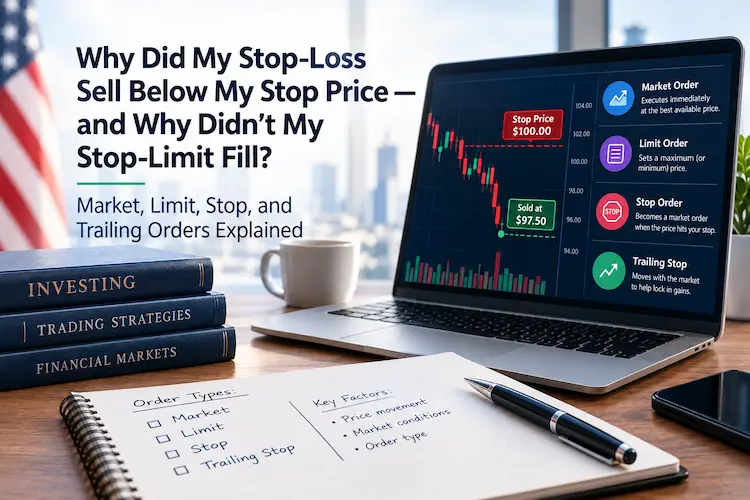
Your stop price is a trigger, not a guaranteed sale price. A regular stop-loss turns into a market order once it’s triggered, so after a gap or a fast drop it sells at whatever price is available, which can be well below your stop. A stop-limit protects your minimum price instead, but if the stock jumps past your limit, it may not sell at all.
| Order | Guarantees | Biggest risk |
|---|---|---|
| Market | Execution | Price can differ from the quote |
| Limit | Your price or better | May never fill |
| Stop (stop-loss) | Execution once triggered | Fill far below the stop on a gap |
| Stop-limit | Price no worse than your limit | Triggered but unfilled |
| Trailing stop | A stop that follows the price up | Same gap risk as a stop |
→ Run the Worst-Case Gap Calculator
→ Diagnose what happened to your order
And the 2026 twist: overnight trading is arriving, but at some brokers a stop-loss still won’t work in those sessions, so check yours before you rely on it.
Worst-Case Gap Calculator
Enter a hypothetical position to see how far a gap can push a stop-loss fill below your stop, and what a stop-limit would do instead. This tool illustrates mechanics. It does not predict prices.
Stop Price vs. Limit Price vs. Fill Price
A stop price decides when your order wakes up, a limit price sets the worst price you’ll accept, and the fill price is whatever actually traded. Most “my order did the wrong thing” stories come from treating these three as the same number.
A stop is a trigger, not a price
According to Investor.gov, once a stop order is triggered it becomes a market order. A market order prioritizes getting executed, not getting a particular price.
| Price | What it means | Guaranteed? |
|---|---|---|
| Stop price | The level that triggers your order. It does not set what you receive. | No. It only starts the order. |
| Trigger reference price | The price your broker or venue checks to decide the stop was hit (last sale or quotes, depending on the firm). | No. Methods differ between firms. |
| Chart price | What your chart shows. It may use a different data feed or session than your trigger. | No. It is not the trigger and not the fill. |
| Limit price | The worst price you’ll accept on a limit or stop-limit order. | Your sell won’t execute below it, but a fill isn’t guaranteed. |
| Fill (execution) price | The price at which shares actually traded. | Not for market or stop orders. |
Every order problem falls into one of three tiers. This article tags each section so you can see which kind of risk you’re dealing with.
PRICE RISK
You get out, but at a worse price than you expected. This is the stop-loss problem.
FILL RISK
You protected your price, but the order didn’t execute, or only partly did. This is the limit and stop-limit problem.
TIMING RISK
The order wasn’t active when you needed it: wrong session, a halt, or an expired GTC.
New to placing orders at all? Start with How to Buy Your First Stock, then come back here.
Why Your Stop-Loss Sold Below Your Stop Price
Your stop-loss became a market order the moment it triggered, and a market order takes whatever price is available, which in a gap or a fast drop can be far below the stop.
PRICE RISK. You got the exit but not the price. All numbers below are hypothetical.
Say you own 100 shares bought at $55, with a stop at $50. Your planned loss at the stop is $500 ($5 × 100 shares). What actually happens depends on how the price gets through $50.
A normal drop
The stock slides through $50 trade by trade. The stop triggers, the market order finds buyers close to $50, and you fill within a few cents. This is the case most people picture.
A fast drop
The price falls quicker than your order can reach the market. By the time it arrives, the best bids are lower, say $49.40, and the order sells there. The difference is slippage.
A gap at the open
The stock closes at $55, bad news arrives overnight, and the next trade is $44. No trades happened at $50, so there was nothing to fill at your stop. The stop triggers at the open and the market order sells near $44: a $1,100 loss instead of the planned $500, so $600 of extra loss from the gap. Schwab’s educational material gives a similar example, a stock that gapped from above $34 to about $32 between one close and the next open, where stop orders fill at the post-gap price.
Thin liquidity
If few shares are offered near your price, a market order works down through the available bids. Larger orders, lower-volume stocks, and extended-hours sessions make this more likely.
$55: current price. You place the stop. Nothing happens yet.
$50: your stop price. Reaching it only wakes the order up. A regular stop becomes a market order here.
$48: your stop-limit’s limit price. The lowest price a stop-limit will accept.
$44: the open after the gap. The stop sells near $44. The stop-limit sees $44 is below $48 and stays unfilled; you still hold the shares.
This is usually how stops are designed to work, not a broker error. You can still check your order history for the fill time and compare it with the open or a news release. For how routing and execution quality fit in, see Is Commission-Free Trading Actually Free?
To run your own numbers, use the Worst-Case Gap Calculator.
Why Your Stop-Limit Didn’t Fill
A stop-limit becomes a limit order when triggered, so if the price jumps past your limit price, the order can sit unfilled while the stock keeps falling.
FILL RISK. Your minimum price was protected. The sale was not.
Stop-limit: price protected, sale not guaranteed
With a $50 stop and a $48 limit, the order triggers at $50 but will only sell at $48 or better. If the stock opens at $44, there are no buyers at $48, so the order waits. You still own the shares and still carry the loss on paper.
The buffer tradeoff
The distance between the stop and the limit is a tradeoff, not a rule. A wider gap, for example a $50 stop with a $47 limit instead of $49.50, lowers the chance the price skips past your limit. The cost is a lower worst-case sale price. A narrow gap gives a tighter floor but a higher chance the order never fills. Seeking Alpha has discussed this tradeoff using similar numbers. Neither choice removes the risk; each trades one risk for the other.
Partial fills
Investor.gov also points out that short-term price swings can activate a stop or stop-limit order, so the prices you choose matter. If only some shares trade at or above your limit, you may be partly sold. Whether the rest stays working or is cancelled depends on the order’s duration and your broker. Check your order history for the remaining quantity.
Why Your Stop Never Triggered
A stop only triggers when the price your broker or venue watches reaches your stop, and that price is not always the one on your chart.
TIMING RISK. The order wasn’t looking at the price you were looking at.
- Trigger method. According to Investor.gov, firms and venues may use the last sale or the quotes (bid and ask) to decide a stop was hit, and the methods differ. A stop that waits for a trade at your price won’t fire on a quote alone, and the reverse is also possible.
- Chart price is not the trigger reference. Your chart may show a different feed, include extended-hours prints, or draw a candle low that your broker’s trigger rule did not count.
- Session. Some brokers don’t allow stop orders to execute in extended-hours sessions. Schwab, for example, says stop orders aren’t eligible for execution in extended-hours sessions.
- Duration. A day order that expired, or a GTC order that reached its limit, can no longer trigger. See GTC below.
Check your order status first: “working” or “pending” means it never triggered, while “triggered” or “filled” means it did. Ask your broker which price triggers stops (see Questions to Ask Your Broker).
Market Order vs. Limit Order
A market order prioritizes getting executed, not the price, and a limit order executes only at your price or better and may not execute at all. That’s how Investor.gov describes the two.
FILL RISK for limits; PRICE RISK for market orders.
Why a market order filled at a different price
The quote you saw is a snapshot. By the time the order reaches the market, the price may have moved, the spread may be wide, or the order may be larger than the shares offered at the best price. The order then takes the next prices up or down. This is common in fast markets and with thinly traded stocks.
Why a limit order didn’t fill when the price touched it
Touching your price doesn’t mean your shares traded. Other orders may have been placed at that price before yours and get filled first. The trade that touched your price may have been small or may have happened on a different venue. Your order may fill only partly, or not at all, even though the chart shows the level was hit. A price that moves through your limit is more likely to fill you than one that only touches it.
If you place many orders each day, also read The $25,000 Day Trading Rule Is Gone.
Do Stop-Loss Orders Work After Hours?
Often not: many brokers accept only limit orders outside regular hours, and Schwab, for one, says stop orders aren’t eligible for execution in extended-hours sessions. Check your broker’s rules rather than assuming.
TIMING RISK. A stop that works at 10 a.m. may not be live at 6 p.m.
| Order | Regular hours | Pre & after hours | Overnight |
|---|---|---|---|
| Market | Accepted | Varies; some brokers accept only limit orders | Robinhood example: market orders not supported overnight |
| Limit | Accepted | Commonly accepted; check your broker | Robinhood example: whole-share limit orders only |
| Stop | Accepted | Schwab example: not eligible for execution in extended-hours sessions | Varies by broker; check before relying on it |
| Stop-limit | Accepted | Schwab example: not accepted in extended hours; varies elsewhere | Varies by broker |
| Trailing stop | Accepted | Varies by broker | Varies by broker |
Liquidity is usually thinner outside regular hours, so spreads can be wider and prices can move more on less volume. For the broader risks of trading outside regular hours, see Can You Trade Stocks After Hours?
Overnight and 23/5 Trading in 2026: What Changes for Your Orders
Overnight sessions add more hours when you can trade, but they don’t automatically add more hours when your stop works.
TIMING RISK. More hours, same need to check order eligibility.
24-hour trading ≠ 24-hour stops
Whether your stop-loss works overnight is up to your broker and the venue it routes to, not just the exchange clock.
- It’s 23/5, not 24/7. Nasdaq has said it is targeting Dec. 6, 2026 for its move to 23-hour trading, five days a week. Reports on the plan describe an overnight session from 9 p.m. to 4 a.m. ET, and the launch depends on market-data and regulatory readiness. Check Nasdaq’s newsroom for the latest status. Some brokers already offer overnight trading through alternative trading systems; Robinhood’s 24 Hour Market, for example, runs from Sunday 8 p.m. ET through Friday 8 p.m. ET.
- Regulators are preparing. The SEC held a public roundtable on preparations for 24-hour trading on Sept. 17, 2026.
- Broker support may lag exchange hours. A new exchange session doesn’t mean every broker lets you place every order type in it.
- One broker’s example. Robinhood’s 24 Hour Market page says it accepts only whole-share limit orders, executes through ATS venues where a security won’t trade outside set price bands (an ATS may reject limit prices outside them), and allows GTC orders for up to 90 calendar days. Its extended-hours page adds that its venues don’t support market orders in extended or overnight trading.
Practically: if your broker offers overnight trading, find the page that lists which order types it accepts before you assume a stop will protect you.
Trading Halts and LULD Pauses
A trading halt doesn’t cancel your stop; it pauses trading or limits the prices at which orders can execute.
TIMING RISK. The market was closed to your order.
During regular hours, the Limit Up-Limit Down (LULD) rules set a price band above and below a stock’s average price over the preceding five minutes. According to Investor.gov, if the price reaches the band and doesn’t move back within 15 seconds, trading in that stock pauses for five minutes. Trading venues must prevent executions outside the band, so a stop may trigger but can’t execute outside the allowed prices. When trading resumes, the price can differ from where it paused, so a stop-loss may fill well away from your stop.
News halts and regulatory halts can last longer. If a stock stays halted for a long time or is delisted, see Stock Delisted or Company Bankrupt?
Can a GTC Order Expire?
Yes: good-til-canceled doesn’t mean forever, and each broker sets its own limit. Investor.gov notes that duration varies by broker.
TIMING RISK. An expired order protects nothing.
GTC doesn’t mean forever
Examples in the wild range from 90 to 180 calendar days. Robinhood’s 24 Hour Market page says up to 90 calendar days; Schwab’s extended-hours page says up to 180 calendar days for GTC plus extended-hours orders.
Write down the expiration date when you place the order, and check whether your broker notifies you before it lapses. A corporate action, such as a stock split, can also change or cancel open orders at some brokers, so ask yours how it handles them.
Trailing Stop vs. Stop-Loss
A trailing stop moves up with the price, but once it triggers it behaves like the type of stop it is built on, so a plain trailing stop has the same gap risk and no price guarantee. Investor.gov describes it this way.
PRICE RISK. The moving trigger doesn’t change how the sale executes.
| Point | Trailing stop | Stop-loss |
|---|---|---|
| Where the stop sits | Follows the price up by a set amount or percentage | Stays where you put it until you change it |
| When the price falls | The stop stays put; it doesn’t move down | The stop stays put |
| After it triggers | Becomes a market order (or a limit order if it is a trailing stop-limit); a plain trailing stop has no price guarantee | Becomes a market order; no price guarantee |
| Gap risk | Same as a stop | Yes |
| Setting choice | A tight trail triggers more easily; a wide trail gives up more before it triggers | You decide the level and update it yourself |
| After hours | Varies by broker | Varies by broker; see the session table |
Investor.gov also notes that a trailing stop is a stop or stop-limit order whose stop price is set as an amount or percentage rather than a fixed price, and that venues may use different standards for deciding whether the stop price was reached. Stop, stop-limit, and trailing stop orders may not be available at every brokerage firm.
A trailing stop can still lose money. If the stock keeps rising and then falls, it sells below the peak, and if you set the trail too far from the price you may sell below your purchase price.
Diagnose Your Order
Answer four questions to see the most likely reason your order did something unexpected, and what to check next. This tool is a guide to common causes, not a verdict on your order.
| What went wrong | Likely cause | What to check or change (a tradeoff) |
|---|---|---|
| Stop sold far below my stop | Gap, fast move, or thin liquidity; the stop became a market order | Compare fill time with the open or news. A stop-limit sets a floor but may not sell. |
| Stop-limit never sold | Price moved past the limit | Check whether it triggered. A wider stop-to-limit gap lowers skip risk but accepts a lower worst price. |
| Stop never triggered | Trigger method, ineligible session, or expired order | Ask which price triggers stops and whether the session allows them. |
| Limit touched, no fill | Queue priority, small volume, or a different venue | Check for partial fills. A price slightly through your limit fills more often but gives up some price. |
| Market order at a different price | Spread, speed, or size above the displayed shares | Compare with the quote at order time. A limit order controls price but may not fill. |
| Order disappeared | Day or GTC expiry, session end, or a venue price band | Check duration and expiration in your order history. |
| Trouble around a halt | Trading paused or prices limited | Check the halt notice and reopening price. |
Which Order Should You Use?
The order that fits depends on whether you care most about getting out, getting a price, or being protected automatically. These cards match goals to mechanics; they are not recommendations.
Goal: I must get out now
Order: Market
Tradeoff: The price isn’t guaranteed and may differ from the quote.
Goal: I want a set price
Order: Limit
Tradeoff: It may never fill.
Goal: Automatic exit, any price
Order: Stop
Tradeoff: It becomes a market order when triggered; the fill can be far below the stop on a gap.
Goal: Automatic exit with a floor
Order: Stop-limit
Tradeoff: It may not sell if the price falls past your limit.
Goal: Follow a rising stock
Order: Trailing stop
Tradeoff: Same gap risk once triggered; the trail distance is its own tradeoff.
Goal: Trading after hours or overnight
Order: Usually limit only; check your broker
Tradeoff: It may not fill, and liquidity is thinner.
To compare brokers’ order rules, start with Best Online Stock Brokers 2026, then read the order-type pages of the one you use. For routing and execution quality, see Is Commission-Free Trading Actually Free?
Questions to Ask Your Broker
Five questions answer most “why did my order do that” surprises before they happen. Also confirm your broker offers stop, stop-limit, and trailing stop orders at all, since not every firm does.
- Which price triggers stops: the last trade, or the bid and ask?
- Do stops work in extended-hours or overnight sessions?
- How long does a GTC order last?
- How do you handle trading halts?
- Do partial fills cancel the rest of the order?
Taxes When a Stop Sells
A sale triggered by a stop is a sale like any other, so it can create a taxable gain or loss. How it’s taxed depends on how long you held the shares and your own situation. See Capital Gains Tax 2026 for how gains are taxed, and Tax-Loss Harvesting for how losses can be used, including the wash-sale rule that can apply if you buy the same stock back soon after a loss. A tax professional can answer questions about your own account.
Frequently Asked Questions
Short answers to the 20 questions people ask most after a bad fill or an unfilled order.
Why did my stop-loss sell below my stop price?
Because a regular stop becomes a market order once triggered. After a gap, a fast drop, or in thin trading, the market order sells at the available price, which can be below your stop.
Does a stop-loss guarantee my price?
No. A stop-loss guarantees execution once triggered, not the price. Investor.gov notes that the fill can be well below the stop in fast markets or gaps.
Is a stop-loss the same as a stop-market order?
In most cases, yes. A basic stop-loss is a stop that becomes a market order when triggered. Check your order ticket to confirm which one you placed.
Why didn’t my stop-limit order fill?
It triggered, but the price had moved past your limit, so there were no buyers at or above it. A stop-limit protects your minimum price but doesn’t guarantee a sale.
Can a stop-limit trigger but not execute?
Yes. This is the main risk of a stop-limit: it can become a live limit order that never fills if the price stays below your limit.
What happens when a stock gaps below my stop?
A regular stop triggers at the open or first available price and sells near the post-gap price. A stop-limit triggers too, but won’t sell if that price is below your limit.
How far apart should my stop and limit prices be?
There’s no single answer. A wider gap lowers the chance of being skipped but accepts a lower worst price; a narrower gap does the opposite. It’s a tradeoff you weigh for your own situation.
Why didn’t my stop trigger when the chart touched it?
Your chart price may not be the price your broker uses as the trigger. Methods differ, and the touch may have been a quote, a different feed, or an extended-hours print that your trigger rule ignored.
Does the stop use the last price or the bid/ask?
It depends on the firm and venue. Investor.gov says methods differ, so ask your broker which one it uses.
Why did my market order fill at a different price?
A market order prioritizes execution, not price. The quote can move before the order arrives, and a wide spread or a large order can push the fill away from the price you saw.
Why didn’t my limit order fill when the price touched it?
Other orders may have been ahead of yours at that price, or the trade that touched it may have been small or on another venue. Touching a price doesn’t mean every order there was filled.
Do stop-loss orders work after hours or in pre-market?
Often not. Many brokers accept only limit orders in extended hours, and Schwab says stop orders aren’t eligible for execution in extended-hours sessions. Check your broker.
Do stops work in overnight trading?
It depends on your broker. Robinhood’s 24 Hour Market, for example, accepts only whole-share limit orders overnight. Check your broker’s order-type list for the overnight session.
What is 23/5 trading, and when does it start?
It means trading about 23 hours a day, five days a week. Nasdaq has said it is targeting Dec. 6, 2026 for the move. It is not 24/7, and your broker may support it later than the exchange does.
What happens to my stop during a trading halt?
It isn’t cancelled by an LULD pause, but trading stops or prices are limited, so the stop can’t execute outside allowed prices. After trading resumes, the fill can be far from where it paused.
Does a GTC order expire?
Yes. Duration varies by broker; examples range from 90 to 180 calendar days. Note the expiration date when you place the order.
How does a trailing stop work?
The stop level follows the price as it moves in your favor and stays put when it moves against you. Once triggered, it behaves like a stop order, with no price guarantee.
Can a trailing stop lose money?
Yes. It can trigger below your purchase price, and a gap can push the fill below the trailing level.
Is selling with a stop-loss taxable?
Yes, a sale triggered by a stop is a sale like any other and can create a taxable gain or loss. See the tax section above.
What order type is safest?
No order type is safe against every risk. Market orders risk the price, limit orders risk not filling, and stops risk both a gap fill and the wrong session. The right fit depends on which risk matters more to you.
Disclaimer: This article is for educational purposes only and is not investment advice. Order handling varies by broker and market conditions. Broker examples are illustrative and dated; they are not rankings or endorsements, and rules may have changed since this was reviewed on October 6, 2026.

Daniel Hayes is the founder and sole researcher at AdvoraHQ. He covers U.S. personal finance, insurance, and consumer law — working directly from IRS publications, federal and state statutes, court opinions, and SEC filings rather than secondary summaries. His focus is the gap between what readers think they know and what the source documents actually say. Daniel is not a licensed attorney, CPA, or financial advisor; his articles are educational and not personalized advice. Reach him at Daniel.Hayes@advorahq.com.