
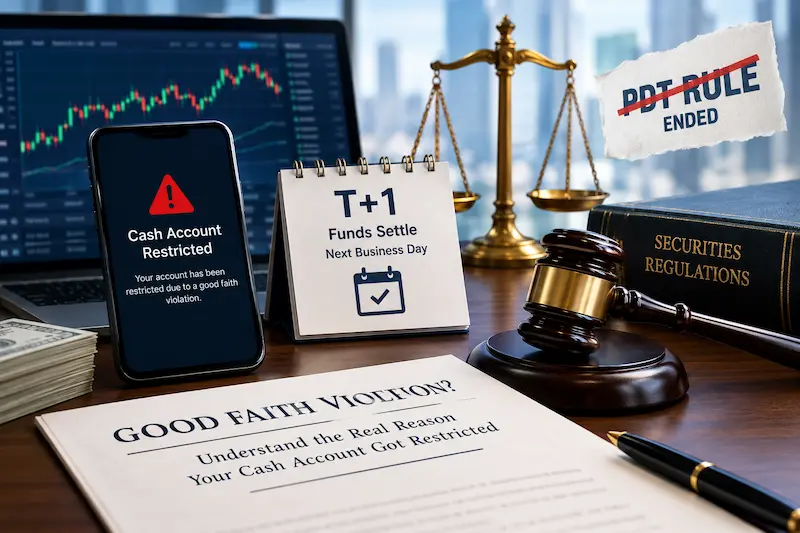
One violation is usually a warning. Restrictions typically start after repeated violations — or after a single free-riding violation. See how penalties work →
The June 2026 PDT change applied to margin accounts. Cash-account settlement rules did not change. What changed and what didn’t →
Find your first safe day to sell →
Verified . Broker policies differ — your broker’s notice controls.
Safe-to-Sell Date Calculator
Enter how you paid for the purchase and the dates, and this tool shows the first day you can sell without a good faith violation under T+1.
It skips weekends, market holidays, and the bank-holiday days when markets are open but settlement is closed. It covers stocks and ETFs only. The result depends on YOUR TIMING: which cash paid for the buy and the day you sell.
Your trade
Not needed if the purchase used settled cash already in the account.
Your result
Settled vs. Unsettled Money, in One Minute
Settled cash is money that has fully cleared in your account; unsettled cash is sale or deposit money your broker shows you before it has finished settling.
Under T+1, a stock or ETF sale settles one business day later. Sell on Monday and the cash settles on Tuesday.
Your broker screen may show a bigger number called buying power or cash available to trade. That number can include unsettled proceeds.
Look for a line such as settled cash. Labels differ by broker, so confirm what each line means in your account.
Where your idle settled cash sits is a separate question. See Brokerage Cash Sweep.
How to read this page
Every rule here belongs to one of three tiers. The tier word is always written.
- FEDERAL RULE
Regulation T and SEC settlement rules: the payment period, the free-riding freeze, and T+1 itself.
- YOUR BROKER’S POLICY
How violations are counted, how long a restriction lasts, deposit credit, and any review.
- YOUR TIMING
Which cash paid for the purchase, and the day you sell.
The Three Cash-Account Violations
A cash account has three common violations — good faith, free riding, and cash liquidation — and only free riding comes straight from federal Regulation T.
Good faith violation
YOUR BROKER’S POLICY
What it is: you sell a security bought with unsettled sale proceeds before those proceeds settle.
Who enforces: your broker. The name echoes Regulation T’s “good faith” wording.
Penalty: often a warning first. Repeats lead to settled-cash-only trading. Fidelity’s published rule: three in 12 months.
Free riding
FEDERAL RULE
What it is: you buy a security and sell it before paying for it in full.
Who enforces: Regulation T, 12 CFR 220.8(c), through your broker.
Penalty: a 90-day freeze on delayed payment. Purchases must be paid in full on the trade date. Fidelity restricts after one in 12 months.
Cash liquidation violation
YOUR BROKER’S POLICY
What it is: you buy without enough settled cash, then sell other holdings after the purchase to cover it.
Who enforces: your broker, under industry settlement rules.
Penalty: Fidelity’s published rule: three in 12 months lead to settled-cash-only trading for 90 calendar days.
| Violation | What triggers it | Federal rule or broker policy | Common penalty | Example |
|---|---|---|---|---|
| Good faith | Selling a security bought with unsettled sale proceeds before those proceeds settle | Broker policy. The name echoes Regulation T’s “good faith” wording. | Often a warning first; repeats lead to settled-cash-only trading (Fidelity: three in 12 months) | Monday: sell XYZ, buy ABC with the proceeds, sell ABC the same day |
| Free riding | Buying a security and selling it before paying for it in full | Federal rule: Regulation T, 12 CFR 220.8(c) | 90-day freeze on delayed payment; purchases paid in full on the trade date (Fidelity: one in 12 months) | Monday: buy ABC with no cash. Wednesday: sell ABC to cover it |
| Cash liquidation | Buying without enough settled cash, then selling other holdings after the purchase to cover it | Broker policy under industry settlement rules | Fidelity: three in 12 months lead to settled-cash-only trading for 90 calendar days | Monday: buy ABC. Tuesday: sell XYZ to pay for it |
Good faith violation: Monday to Wednesday
YOUR BROKER’S POLICY YOUR TIMING
The violation path:
- Monday morning. You sell XYZ for $1,000. That cash is unsettled until Tuesday.
- Monday afternoon. You buy ABC with that $1,000.
- Monday, later. You sell ABC. Violation: ABC was sold before the cash that paid for it settled.
The safe path:
- Monday. Same sale of XYZ, same purchase of ABC.
- Tuesday. The XYZ sale settles. ABC is now paid for with settled cash. Selling ABC is safe.
- Wednesday. If you sold ABC on Tuesday, those proceeds settle today. The clock restarts with each sale.
Free riding: Monday to Wednesday
FEDERAL RULE
- Monday. You buy $1,000 of ABC without the cash to pay for it. Many brokers block this order; the example shows what the rule covers.
- Tuesday. The settlement date passes and no payment arrives.
- Wednesday. You sell ABC to cover the cost. You bought and sold before paying: free riding.
Regulation T withdraws the privilege of delayed payment for 90 calendar days after the sale. The freeze does not apply if full payment arrives within the payment period and the proceeds were not withdrawn first (12 CFR 220.8(c)(2)).
Cash liquidation: Monday to Wednesday
YOUR BROKER’S POLICY
- Monday. You buy $1,000 of ABC without enough settled cash.
- Tuesday. ABC settles, and you need settled cash now. You sell fully paid XYZ to raise it.
- Wednesday. The XYZ sale settles, a day after ABC’s bill was due. That is a cash liquidation violation.
How Long a Good Faith Violation Lasts
Brokers count good faith violations over a rolling period and a restriction commonly lasts 90 calendar days, but both numbers are your broker’s, not federal law.
Two clocks, not one
YOUR BROKER’S POLICY
The count clock. Fidelity’s published rule restricts an account after three good faith violations, three cash liquidation violations, or one free-riding violation in a 12-month period.
Other brokers differ. Firstrade’s published policy, for example, limits you to settled funds at three good faith violations and adds a 90-calendar-day restriction at four, with each one staying on the account for 12 months. Your broker’s notice states its own count.
The restriction clock. Fidelity states 90 calendar days. Other brokers may state a different length. Never assume one national number.
The federal freeze
FEDERAL RULE
For free riding, Regulation T withdraws delayed payment for 90 calendar days after the date of sale. During the freeze, every purchase must be paid in full on the trade date.
Source: 12 CFR 220.8(c) and the SEC’s freeze explainer.
What “settled cash only” feels like day to day
You can still sell. You can still buy. But a buy must be covered by cash that has already settled.
Money from today’s sale cannot fund a purchase until the next business day. Fidelity’s FAQ says the cash available to trade excludes unsettled sale proceeds while the restriction applies.
In practice, each dollar can be reused once per settlement cycle.
Does a violation go away?
A violation stops counting when it ages out of your broker’s window. A restriction ends on the date in your broker’s notice. Confirm both dates in writing.
Violation Clock
Enter up to five violations and this tool shows how many fall inside a rolling 12-month window and when each one leaves it.
Your clock
When Your Money Actually Settles Under T+1
Under T+1, a stock or ETF sale settles on the next business day, and a business day here means both the markets and the settlement system are open.
FEDERAL RULE
SEC Rule 15c6-1 made T+1 the standard settlement cycle for most broker-dealer trades entered on or after May 28, 2024. See the SEC adopting release, No. 34-96930.
Regulation T defines its payment period as the settlement cycle's business days "plus two business days" (12 CFR 220.2). Under T+1 that is commonly T+3.
That payment period is the federal outer limit for paying for a purchase. It is not when your sale proceeds become settled cash.
| Event | When | Notes |
|---|---|---|
| Trade date (T) | The day your order executes | A weekday when the market is open. |
| Settlement | T+1 business day | A sale on Monday settles on Tuesday. |
| Reg T payment period | Commonly T+3 | Settlement cycle plus two business days. A purchase on Monday has a federal outer limit of Thursday. Many brokers want payment sooner. |
| Weekend | Skipped | A sale on Friday settles on Monday. |
| Market holiday | Skipped | Markets are closed. A sale on Wednesday, November 25, 2026 settles on Friday, November 27, because Thursday is Thanksgiving. |
| Bank-holiday settlement gap | Skipped | Markets are open but settlement is closed. A sale on Tuesday, November 10, 2026 settles on Thursday, November 12, because Wednesday is Veterans Day. |
A worked week
Here is one ordinary week with no holidays. You sell Stock A on Monday, buy Stock B the same day with those proceeds, and want to know when you can sell Stock B.
- Monday, October 5, 2026, sell: you sell Stock A. The proceeds are unsettled until Tuesday.
- Monday, October 5, 2026, buy: you buy Stock B with those unsettled proceeds. Selling Stock B today would be a good faith violation.
- Tuesday, October 6, 2026, settlement: the Stock A proceeds settle (T+1).
- Tuesday, October 6, 2026, earliest safe sell: you can sell Stock B without a good faith violation.
| Day | What happens | Status of the cash | Sell Stock B? |
|---|---|---|---|
| Monday, October 5, 2026 | Sell Stock A | Proceeds unsettled | Not applicable yet |
| Monday, October 5, 2026 | Buy Stock B with those proceeds | Still unsettled | No. This would be a good faith violation. |
| Tuesday, October 6, 2026 | Stock A proceeds settle (T+1) | Settled | Yes. This is the earliest safe day. |
Settlement-gap days to know
These are weekdays when markets are open but settlement is closed:
- Wednesday, November 11, 2026 (Veterans Day)
- Monday, October 11, 2027 (Columbus Day)
- Thursday, November 11, 2027 (Veterans Day)
The 2027 dates follow the Federal Reserve holiday calendar. The calculator also skips every NYSE market holiday for 2026 and 2027.
Options and mutual funds
Options settle T+1. Mutual funds may follow fund-specific settlement. The calculator covers stocks and ETFs only.
The PDT Rule Ended in June 2026 — So Why Am I Still Restricted?
The June 2026 change replaced the pattern day trader rule for margin accounts, and it did not touch cash-account settlement, so a good faith violation works the way it did before.
FEDERAL RULE
The SEC approved FINRA's elimination of the pattern day trader designation and the $25,000 minimum on April 14, 2026. It took effect June 4, 2026, replaced by an intraday margin framework under Rule 4210.
FINRA's Regulatory Notice 26-10 lets firms phase in the change through October 20, 2027.
Cash accounts were never subject to the pattern day trader designation. That rule applied to margin accounts.
| Account type | Before June 4, 2026 | After June 4, 2026 | What it means for you |
|---|---|---|---|
| Margin account | PDT designation and a $25,000 minimum equity for pattern day traders | Intraday margin framework under Rule 4210; PDT designation and $25,000 minimum removed (firms may phase in through October 20, 2027) | Margin day-trading limits changed. Your broker's migration date matters. |
| Cash account | Settlement, good faith, and free-riding rules applied. PDT never applied. | Unchanged | The same settled-cash rules still apply. |
For the margin side, read PDT Rule Replaced and The $25,000 Day Trading Rule Is Gone. The margin detail lives there.
Can You Day Trade in a Cash Account?
Yes, but only with settled cash, and that limits how often the same money can be reused.
YOUR TIMING
Buying and selling the same stock in one day is not a violation if settled cash paid for the buy. The sale proceeds, though, are unsettled until the next business day.
- Monday. You buy ABC with settled cash and sell it the same day for $1,000. No violation.
- Monday, later. You buy DEF with the $1,000 of unsettled proceeds. Selling DEF before Tuesday would be a good faith violation.
- Tuesday. The ABC proceeds settle. DEF is now safe to sell.
That is the real constraint: each settled dollar can complete one sell-and-rebuy cycle per settlement cycle without risk of a violation.
A margin account swaps these limits for borrowing and its own rules. Neither account type is a free pass. See PDT Rule Replaced for the margin side.
You Just Got a Violation Notice: What to Do Today
Read the notice for the trade, the count, and the end date, then trade only with settled cash until your broker confirms where you stand.
1. Read exactly what the notice says
Note the violation type, the trade that triggered it, and any restriction end date. Screenshot it.
2. Confirm the count and the dates
Ask which violations are counted and when each expires. The Violation Clock gives you a rough check.
3. Don't trade unsettled funds until it's clear
Buy only with cash your broker shows as settled. Use the calculator before any sell you are unsure about.
4. Ask your broker in writing
Use the message below. Asking is fine. Outcomes vary, and nothing here promises a broker will remove or forgive a violation.
Can a violation be removed?
FEDERAL RULE
For free riding, Regulation T lists a narrow exception. The freeze does not apply if full payment arrives within the payment period and the proceeds were not withdrawn before it.
Section 220.8(d) also lets a firm's examining authority consider the firm's own application to extend a payment period or waive a freeze for exceptional circumstances. It requires such applications to be filed and acted on before the payment period ends.
YOUR BROKER'S POLICY
For good faith and cash liquidation violations, any review is your broker's choice.
Message to Your Broker (copy and edit)
Replace each [bracket] before you send it through your broker's secure message center.
Hello — my cash account received a [good faith / free-riding] violation notice on [date] for a sale of [symbol] on [date]. Could you confirm: (1) the trade that triggered it, (2) how many violations are currently counted on my account and when each expires, (3) whether a restriction applies and its exact end date, and (4) whether a first-time violation can be reviewed. I'd also like to know when deposits are treated as settled cash for selling. Thank you.
Seven Habits That Prevent Violations
Most violations come from selling too soon after a sale, so build the settlement day into every plan.
1. Check settled cash, not buying power
Buying power can include unsettled money. Settled cash is what protects you.
2. Wait one business day after a sale
Before you plan to sell something bought with sale proceeds, wait for those proceeds to settle. Monday's sale settles Tuesday.
3. Watch weekends and holidays
A Friday sale settles on Monday. A sale the day before Veterans Day or Columbus Day settles a day later than you expect.
4. Don't sell on instant-deposit credit
Instant buying power is a broker credit, not settled cash. Ask when your deposit counts as settled.
5. Watch orders that can sell for you
A stop or trailing order that triggers is still a sale. If it fires before your funding cash settles, it can count as a violation. See Why Did My Stop-Loss Sell Below My Stop Price?
6. Keep a cash buffer
Leave settled cash for the buys you plan. If you hold options, you may need cash at expiration; see Option Expires In the Money.
7. Choose your account type with care
Cash accounts trade freedom for settlement limits. Margin accounts trade settlement limits for borrowing and their own rules.
Check your broker's cash-account policy before you trade, and read the one for the broker you actually use. This page does not rank or recommend brokers; for broker background see Best Online Stock Brokers. If you ever move accounts, the account type matters at transfer: How to Transfer Stocks Without Selling.
FAQ
Short answers to the 18 questions readers ask most after a violation notice.
What is a good faith violation?
It happens in a cash account when you buy with unsettled sale proceeds and sell that position before those proceeds settle. Your broker counts it.
How long does a good faith violation last?
Fidelity's published policy counts violations over a rolling 12 months and restricts for 90 calendar days after its threshold. Other brokers differ, so your notice controls.
How many good faith violations before my account is restricted?
Fidelity restricts after three good faith violations, three cash liquidation violations, or one free-riding violation in 12 months. Firstrade's published policy sets a 90-calendar-day restriction at four good faith violations. Check your broker.
Does a good faith violation go away?
It stops counting when it ages out of your broker's window. A restriction ends on the date your broker's notice states.
What is free riding?
It means buying and selling a security before paying for it. Regulation T does not permit it, and it may require your broker to freeze the account for 90 days.
What's the difference between free riding and a good faith violation?
Free riding is a federal Regulation T problem: payment never arrives. A good faith violation is a timing problem your broker counts: the funding cash does arrive, but after you sold.
What is a 90-day restriction?
Fidelity describes it as settled-cash-only buying for 90 calendar days. The federal freeze means every purchase must be paid in full on the trade date.
Can I still trade during a restriction?
Generally yes, with settled cash. Purchases must be covered by cash that has already settled. Your notice lists your broker's exact limits.
What is a cash liquidation violation?
It happens when you buy without enough settled cash and then sell other fully paid holdings after the purchase to cover the cost. Your broker enforces it.
How long does it take for stock sale money to settle?
One business day for stocks and ETFs under T+1, skipping weekends, market holidays, and bank-holiday settlement gaps.
Do trades settle on weekends or holidays?
No. A Friday sale settles on Monday, and a market holiday adds a day.
Why didn't my funds settle on Columbus Day?
Stock markets are typically open that day, but DTC's 2026 schedule lists Columbus Day and Veterans Day as open without settlement services. Settlement moves to the next day.
Did the PDT rule change affect cash accounts?
No. The June 4, 2026 change applied to margin accounts. Cash accounts were never subject to the PDT designation, and their settlement rules did not change.
Can I day trade in a cash account?
Yes, with settled cash only. Each dollar can be reused once per settlement cycle without risk of a violation.
Is instant deposit money settled cash?
No. Instant buying power on a pending deposit is a broker credit. Ask your broker when a deposit counts as settled.
Can my broker remove a violation?
Review policies vary by broker. You can ask, but outcomes vary and nothing is guaranteed. Regulation T has its own narrow rules for the free-riding freeze, covered above.
Do options trades cause good faith violations?
They can at brokers that apply cash-account rules to options. Options settle T+1. The calculator covers stocks and ETFs only, so check your broker.
Should I switch to a margin account?
That is your decision and this page is not advice. A margin account removes settlement limits but adds borrowing and its own rules. Read PDT Rule Replaced first.
Sources
These are the primary sources and broker pages behind the figures on this page, all checked on October 27, 2026.
- 12 CFR 220.8, Cash account (Regulation T)
- 12 CFR 220.2, Definitions, including payment period
- SEC Release No. 34-96930, Shortening the Securities Transaction Settlement Cycle
- Investor.gov: Freeriding
- SEC: Updated Investor Bulletin, Trading in Cash Accounts
- FINRA Regulatory Notice 26-10, Intraday margin standards
- NYSE Group 2026, 2027 and 2028 holiday calendar
- DTC Settlement Anticipated Holiday Schedule: 2026
- SIFMA holiday schedule
- Fidelity: Avoiding cash account trading violations (example of a published broker threshold)
- Firstrade: What is a good faith violation (example of a different published count)
Last updated:
This page is general information, not investment or legal advice. Federal rules are cited as of October 27, 2026. Broker policies vary and change, and your broker's records and notices control.

Daniel Hayes is the founder and sole researcher at AdvoraHQ. He covers U.S. personal finance, insurance, and consumer law — working directly from IRS publications, federal and state statutes, court opinions, and SEC filings rather than secondary summaries. His focus is the gap between what readers think they know and what the source documents actually say. Daniel is not a licensed attorney, CPA, or financial advisor; his articles are educational and not personalized advice. Reach him at Daniel.Hayes@advorahq.com.