
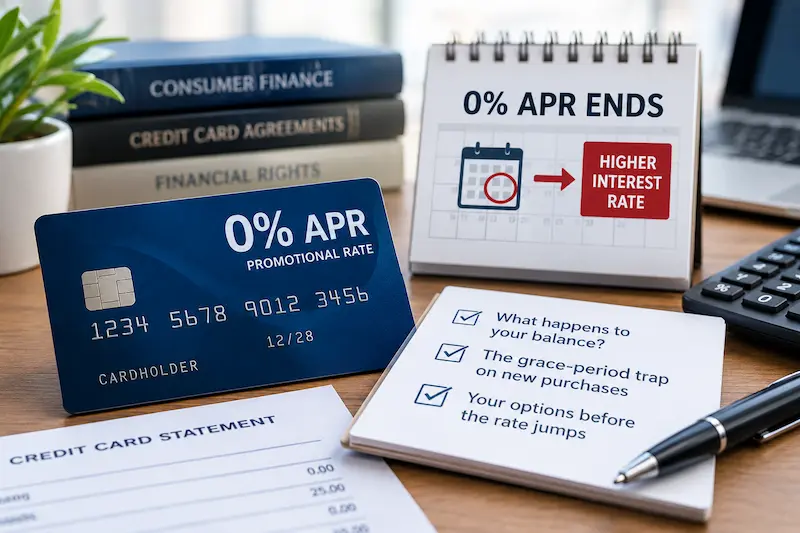
Quick answer: When a true 0% intro APR ends, the card’s regular rate applies to whatever balance is left, not to what you’ve already paid off.
There’s no back-interest unless your offer was “deferred interest” (common on store cards).
The bigger surprise: while any promo balance sits on the card, new purchases may be charged interest from day one.
What it costs: $3,000 left at 21% is roughly $52 in interest in the first month (21% divided by 12 is 1.75% a month; an estimate). It’s more if you keep charging new purchases.
Planner: Find the payment that clears it before the deadline
Your card agreement controls.
“Before the 0% Ends” Planner
Enter your numbers to see the balance left when the promo ends and the payment that gets you to $0 in time. Don’t enter card numbers or account details; the tool only needs amounts.
Fees are commonly 3%–5% of the amount transferred. Blank counts as 0%.
What Happens the Day Your 0% Ends
On a true 0% offer, your card’s regular APR starts applying to whatever balance is still unpaid on the end date, and only to that balance.
YOU CONTROL
Every dollar you pay off before the end date is a dollar that never meets the regular rate. That’s why the payment amount matters more than anything else on this page.
Example: $3,000 left at 21% costs about $52.50 in the first month ($3,000 × 21% ÷ 12). With $600 left, it’s $10.50.
Both are estimates using a monthly approximation; your issuer calculates interest daily.
YOUR CARD AGREEMENT SAYS
Your terms set which regular rate applies (purchase or balance transfer), the exact end date, and how the minimum payment is calculated.
The end date is often tied to your account opening or transfer date. Find it on your statement or in your account instead of counting months.
THE LAW SAYS
A promotional rate has to last at least six months (12 CFR §1026.55(b)(1)).
When a disclosed promo ends on its disclosed date and moves to the disclosed rate, no 45-day change-in-terms notice is required (12 CFR §1026.9(c)(2)(v)(B)).
Some issuers print the date on statements, but don’t count on a warning.
Interest typically starts accruing the day after the promo ends and shows up on your next statement.
Your minimum payment often rises then, because interest becomes part of the calculation. See why your minimum payment went up.
For how notices work, see the interest rate increase notice guide. For the mechanics, see how credit card interest works.
For context, the Federal Reserve’s G.19 release (October 7, 2026; preliminary August 2026 data) puts the average stated card APR at 21.19% across all accounts and 22.36% for accounts charged interest. Your rate may differ.
Real 0% or Deferred Interest?
With a true 0% intro APR, interest starts only on what’s left; with deferred interest, interest that quietly built up since the purchase can be charged all at once.
No back-interest on a true 0%, but deferred interest is different.
If your terms say “no interest if paid in full” by a date, read the deferred-interest rules before you rely on any payment plan. Our deferred interest trap guide covers the store-card version in detail.
| Feature | True 0% | Deferred interest |
|---|---|---|
| Interest during the promo | None is charged and none is tracked. | Interest is calculated in the background from the purchase date, but isn’t charged if you meet the terms. |
| If not paid in full by the end date | The regular APR applies to the balance remaining. Nothing is added for earlier months. | The issuer can charge all the interest that built up since the purchase, on top of what you still owe. |
| Where it’s common | Bank-issued intro offers on purchases and balance transfers. | Store cards and retailer financing plans. |
| Payment-allocation rule | Payments above the minimum go to the highest-rate balance first (§1026.53(a)). | Same rule, except in the last two billing cycles before expiration, when the excess goes to the deferred-interest balance first (§1026.53(b)(1)). |
“Real 0% or Deferred Interest?” Check
Answer three questions from your terms and statement. Choose “Not sure” if you can’t tell.
The Grace-Period Trap on New Purchases
On most cards, once a promo balance is on the account, new purchases can be charged interest from the day you make them unless you pay the entire statement balance, promo balance included, by the due date.
A promo balance can switch off your grace period on new purchases.
Check your own card agreement’s grace-period clause. Terms vary, and the clause controls.
A grace period normally means purchases are interest-free if you pay the full statement balance by the due date.
A promo balance is part of that statement balance. Pay only part of it and you’re carrying a balance, so most cards stop giving you the interest-free window on new purchases.
THE LAW SAYS
The CFPB addressed this in Bulletin 2014-02 (September 3, 2014).
It explained that a consumer who accepts a promotional APR offer and keeps using the card loses the grace period on new purchases unless they pay the entire statement balance, including the promotional balance, by the due date.
The CFPB warned issuers that failing to disclose this clearly risks being deceptive or abusive.
Note what that is and isn’t: it’s guidance on how offers are marketed. It doesn’t create a federal grace period for people who carry a balance.
YOUR CARD AGREEMENT SAYS
Look for the grace-period clause. It usually says purchases don’t accrue interest only if you paid the previous balance in full by the due date. It also explains what it takes to get the grace period back.
YOU CONTROL
Which card you use for new purchases. Putting everyday spending on a different card, one where you pay the full statement balance each month, keeps the promo card from adding interest while you pay it down.
A worked example
Promo balance: $3,000 at 0%. Regular purchase APR: 21%. You charge $500 in groceries and pay only the minimum.
If the card has no grace period while the promo balance remains, interest on the $500 starts at the purchase date.
Estimate: $500 × (21% ÷ 365) × 25 days carried is about $7.19 for the month. Charge $500 every month and it repeats.
Assumptions: 21% APR, 25 days carried on average, no grace period. Actual terms vary.
Extra payments must go to your highest-rate balance first.
Once purchases carry interest, they’re your highest-rate balance, not the 0% promo balance. Payments above the minimum go to them first, so the promo balance shrinks more slowly. See Table 2 for the rule.
How to get the grace period back
Pay the entire statement balance, including the promo balance, by the due date. Some issuers require this for more than one billing cycle in a row; that’s issuer-specific, so ask.
Even then, you may see a final “residual interest” charge on the next statement. Our guide on being charged interest after paying the statement balance explains why.
Should you use a balance transfer card for purchases?
Usually not while a promo balance remains. A different card that you pay in full each month keeps its own grace period on your purchases.
That also keeps your payments aimed at the promo balance. The planner’s grace-period estimate shows what purchases on this card could cost.
What the Law Protects, and What It Doesn’t
Regulation Z limits rate increases on an existing promo balance, but it doesn’t erase late fees, guarantee a grace period, or require a warning when a disclosed promo ends on schedule.
Less than 60 days late: your existing promo balance is protected, new purchases may not be.
A payment that’s late by up to 60 days can still lead to a penalty APR on new transactions after a 45-day notice. It can’t be applied to the protected balance. Late fees apply either way (see our late fee guide).
| Situation | What the issuer can do | Rule |
|---|---|---|
| Promo length | A temporary rate must last at least six months. After the disclosed end date, the disclosed rate can apply. | 12 CFR §1026.55(b)(1) |
| Rate on an existing balance before the promo ends | Generally can’t raise it. The main exception is an account more than 60 days late; a few narrow others exist. | 12 CFR §1026.55(a), (b) |
| Late by 60 days or less | Can charge a late fee. Can apply a penalty APR to new transactions after a 45-day notice. Can’t raise the rate on the protected promo balance. | 12 CFR §1026.9(g); §1026.55(b) |
| More than 60 days late | Can raise the rate on the existing balance after a 45-day notice. If you then make six consecutive on-time required minimum payments, the prior rate must be restored; the notice must tell you. | 12 CFR §1026.55(b)(4); §1026.9(g) |
| Payments above the minimum | Must go first to the balance with the highest APR, then down in order. Special rule for deferred interest in the last two billing cycles. The minimum payment itself can be applied as your terms allow. | 12 CFR §1026.53(a), (b)(1) |
| Scheduled expiration of a disclosed promo | No 45-day change-in-terms notice is required if the end date and the following rate were disclosed in advance. | 12 CFR §1026.9(c)(2)(v)(B) |
The payment-allocation rule in plain English
When you pay more than the minimum, the rule says the excess goes first to the balance with the highest annual percentage rate
and then to the rest in descending order. A 0% promo balance is last in line.
That helps when you carry a high-rate cash advance or purchase balance.
It surprises you when you’re clearing the promo balance and extra money goes elsewhere. Deferred-interest balances get a special rule: in the last two billing cycles before expiration, the excess goes to that balance first.
The 60-day rule, read correctly
The 60-day limit is about existing balances. An issuer can’t use a short delinquency to reprice your promo balance.
It can still charge late fees, and a penalty APR on new purchases can follow after notice.
Official Interpretation (Comment 55) walks through dated examples. The notice for an existing-balance increase is tied to the account becoming more than 60 days delinquent.
None of this makes a missed payment cheap. Late fees, credit reporting and a possible penalty rate on new purchases are real costs. Keep paying at least the minimum every month.
For how notices work, see our interest rate increase notice guide.
Your Options Before the Rate Jumps
You have six realistic moves, and the right one depends on whether you can clear the balance in time: pay it down, transfer it again, take a loan, ask the issuer, use a hardship program, or at least stop adding purchases.
This article doesn’t recommend or rank specific cards. For transfer offers, see our guides to balance transfer cards and no-fee balance transfer cards.
| Option | Upfront cost | Credit impact | When it fits | Watch out |
|---|---|---|---|---|
| Pay it down before the deadline | None. You avoid the regular rate on whatever you clear. | Lower utilization; no new account. | The planner shows you can reach $0 in time. | Keep paying at least the minimum on every account. Don’t add new purchases to this card. |
| Another balance transfer | A transfer fee, commonly 3%–5% of the amount transferred (some offers have none). | A hard inquiry and a new account. A new credit line can lower utilization. | Too much to clear in time, and the fee is less than the interest you’d avoid. | Most issuers don’t allow transfers between their own cards. The fee is usually added to the balance. The new card has its own grace-period rules. |
| Personal loan (compare) | Varies: some loans charge an origination fee; others don’t. | A hard inquiry and a new installment account. Paying off the card can lower utilization. | You want a fixed payoff date and the loan’s total cost is below your card’s regular APR. | Compare the APR including fees. Don’t run the card balance back up. |
| Ask the issuer for a lower rate or new promo | None. | Ask whether the request involves a credit check. | Good payment history and a balance you can mostly clear. | No one is entitled to an extension. Get any change in writing. |
| Hardship program (guide) | Often none, but terms vary. | May include card restrictions or closure and may be reported; ask how. | You can’t afford the payments you’d need. | Ask about the rate, fees, and credit reporting before agreeing. |
| Stop new purchases on this card | None. | None. | Always, while a promo balance remains. | Move subscriptions and autopays to another card first. |
A new card or loan application means a hard inquiry and a new account, both of which can lower your score for a time. Weigh that against the interest you’d avoid.
The 60-Day Plan
Start about 60 days before the end date: confirm the date, run the planner, stop new purchases, decide on a transfer early, and call your issuer at least 30 days out.
- 60 days out: Find the exact end date on your statement or in your account. Check whether it’s true 0% or deferred. Run the planner. Stop new purchases on this card and move any autopays.
- 45 days out: Decide: pay it down, or apply for a transfer or loan. Approval and funding can take time, and some offers have a window for requests. Read the terms.
- 30 days out: Call your issuer with the script below. Ask about lower rates, the grace period, and how payments are applied. Ask for any change in writing.
- 14 days out: If you transferred, confirm it posted. Set your payment to clear the remainder, and schedule it to be credited before the end date.
- End date: Confirm the balance is $0, or the amount you planned. If you have a deferred-interest balance, it needs to be paid in full by the deadline.
- First statement after: Check that interest was charged only on the remaining balance (true 0%). Compare to your agreement and ask about any difference. Reset your autopay amount.
| When | Action |
|---|---|
| 60 days out | Find the exact end date on your statement or in your account. Check whether it’s true 0% or deferred. Run the planner. Stop new purchases on this card and move any autopays. |
| 45 days out | Decide: pay it down, or apply for a transfer or loan. Approval and funding can take time, and some offers have a window for requests. Read the terms. |
| 30 days out | Call your issuer with the script below. Ask about lower rates, the grace period, and how payments are applied. Ask for any change in writing. |
| 14 days out | If you transferred, confirm it posted. Set your payment to clear the remainder, and schedule it to be credited before the end date. |
| End date | Confirm the balance is $0, or the amount you planned. If you have a deferred-interest balance, it needs to be paid in full by the deadline. |
| First statement after | Check that interest was charged only on the remaining balance (true 0%). Compare to your agreement and ask about any difference. Reset your autopay amount. |
Through all of it, keep paying at least the minimum on every account each month. Missing payments to “save up” for a payoff can cost late fees and credit damage.
Should You Close the Card After?
Paying the balance off matters far more than whether you close the card, and closing it can work against you if it’s one of your older accounts or has a large credit limit.
Closing a card removes its limit from your total available credit, which can raise your utilization. Over time, it can also shorten your average account age.
Many people keep a no-annual-fee card open after paying it down and use it for something small.
If the card has an annual fee or you can’t trust yourself with it, closing may still be right. Our guide on how to cancel a credit card covers the steps and the credit effects.
Call Your Issuer: The Script
Call at least 30 days before the end date and ask four specific questions; you may not get a better rate, but you’ll learn how your card actually works.
What to listen for
- If they offer a new rate: ask how long it lasts and what the rate becomes afterward.
- If the grace period is gone: ask exactly what it takes to get it back.
- If they won’t change anything: ask for the written terms and the exact end date.
FAQ
What happens when my 0% APR ends?
Your card’s regular APR applies to the balance still unpaid on the end date. Your minimum payment may rise, and new purchases may start accruing interest if you carry a balance. A deferred-interest offer works differently.
Do I pay interest on the original balance or just what’s left?
On a true 0% offer, only what’s left. On deferred interest, the issuer can charge interest that built up on the original purchase if it isn’t paid in full by the deadline.
Is there retroactive interest when 0% ends?
Not on a true 0% offer. Yes on deferred-interest offers if the balance isn’t paid in full on time. See the deferred interest guide.
When does interest start after the promo ends?
Usually the day after the end date stated in your terms, on the balance still owed. It appears on your next statement. Confirm the exact date in your terms or account.
Why am I being charged interest on new purchases?
Most likely you’ve lost the grace period because a promo balance is still on the card. See the grace-period trap.
How do I get my grace period back?
Pay the entire statement balance, including the promo balance, by the due date. Some issuers require that for more than one cycle. You may also see residual interest on the next statement; see this guide.
Can one late payment cancel my 0% APR?
Not on the existing promo balance unless the account is more than 60 days late. A shorter delinquency can still bring a late fee and, after a 45-day notice, a penalty APR on new transactions.
What happens if I’m more than 60 days late?
The issuer can raise the rate on the existing balance after a 45-day notice. If you then make six consecutive on-time required minimum payments, the prior rate must be restored. The notice has to tell you about that path.
How are my payments applied across balances?
Your terms control how the minimum payment is applied. Payments above the minimum must go to the highest-rate balance first, with a special rule for deferred interest in the last two billing cycles.
Will my issuer warn me before the promo ends?
Not necessarily. If the end date and the following rate were disclosed in advance, a 45-day change-in-terms notice isn’t required when the promo ends on schedule. Many issuers show the date on statements, but check yours.
Can I extend my 0% APR?
You aren’t entitled to an extension, but you can ask. Use the call script and get any offer in writing.
Can I transfer the balance to another card from the same bank?
Most issuers don’t allow transfers between their own cards. Check the offer terms; a different issuer is the usual route.
Is another balance transfer worth the fee?
It can be when the fee, commonly 3%–5%, is less than the interest you’d avoid and you’ll actually pay the balance down during the new promo. The planner’s transfer comparison estimates this.
Will a new balance transfer card hurt my credit?
A new application means a hard inquiry and a new account, which can lower your score for a time. A new credit line can also lower your utilization. The net effect depends on your file.
Is a personal loan better than a second transfer?
It depends on the fee, the loan’s APR, and whether you want a fixed payoff date. See balance transfer vs debt consolidation.
Does my minimum payment go up after the promo?
Often, because interest becomes part of the calculation. See why your minimum payment went up.
Should I close the card after paying it off?
Not necessarily. Closing can raise utilization and shorten your account history. See the section above.
What’s the difference between 0% APR and deferred interest?
With true 0%, interest starts only on what’s left. With deferred interest, interest that accrued since the purchase can be charged if the balance isn’t paid in full by the deadline. See Table 1 and the deferred interest guide.
Sources
- CFPB Bulletin 2014-02, Marketing of Credit Card Promotional APR Offers (September 3, 2014)
- 12 CFR §1026.55, Limitations on increasing annual percentage rates and Official Interpretation (Comment 55)
- 12 CFR §1026.53, Allocation of payments
- 12 CFR §1026.9(c) and (g), Change-in-terms and penalty-rate notices
- Federal Reserve G.19, Consumer Credit (October 7, 2026 release)
Last updated:
This article is general information, not financial advice. Rules are cited from 12 CFR Part 1026 and CFPB guidance, verified October 28, 2026. Your card agreement and statements control.

Daniel Hayes is the founder and sole researcher at AdvoraHQ. He covers U.S. personal finance, insurance, and consumer law — working directly from IRS publications, federal and state statutes, court opinions, and SEC filings rather than secondary summaries. His focus is the gap between what readers think they know and what the source documents actually say. Daniel is not a licensed attorney, CPA, or financial advisor; his articles are educational and not personalized advice. Reach him at Daniel.Hayes@advorahq.com.