
Quick answer
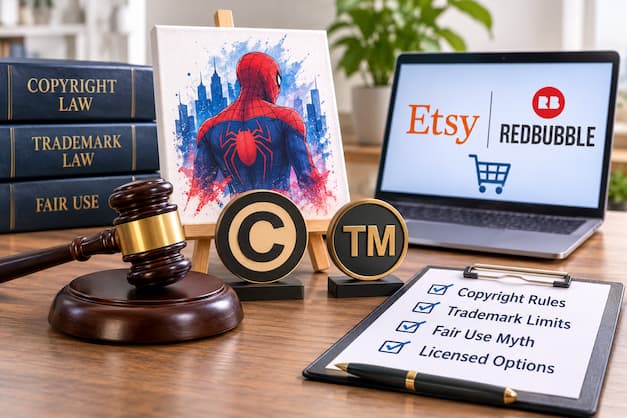
Usually not without permission. If your piece shows a recognizable character someone still owns, selling it is generally infringement, even if you drew every line yourself. Two things change your risk the most: whether the character’s name or logo is in your listing, and whether the owner runs a licensing program. An original character in a similar style is a different and far safer question.
- Check the risk level of what you’re making →
- Got a takedown, letter, or CCB notice? See your deadline →
- Character vs. style
- Copyright vs. trademark
- Fair use
- Etsy & Redbubble
- Notices & deadlines
- What’s at stake
- Legal ways to sell
- Public domain 2027
Last updated and verified: . On January 1, 2027, works from 1931 enter the U.S. public domain; see what that does and doesn’t free up.
Fan Art Risk Check
Answer five questions to see a general risk tier, the rights involved, and what to check next.
Nothing you pick is stored or sent anywhere.
Your result
Why “I Drew It Myself” Isn’t the Answer
Because copyright protects the character as well as the drawing, a new picture of someone else’s character is generally a derivative work, and only the owner can authorize it.
Copyright gives an owner the exclusive right to prepare derivative works (17 U.S.C. § 101, § 106(2)). A derivative work is a new work based on an existing one. Your drawing is yours as a drawing. The character in it still belongs to the owner.
Characters can be protected on their own when they are sufficiently distinctive. In DC Comics v. Towle, 802 F.3d 1012 (9th Cir. 2015), the Ninth Circuit held that the Batmobile qualified as a protected character.
That court’s test asks whether the character has physical and conceptual qualities, stays recognizable as the same character each time it appears, and is especially distinctive rather than a stock figure. Other courts phrase the test differently.
Character vs. Style: The Distinction Artists Need
Copyright does not give anyone ownership of a style, so drawing in the manner of a show is a different question from drawing the show’s character.
Their character, in your style
Still their character. A new pose, a new outfit, or different linework doesn’t change whose character it is. This is a derivative work.
Your character, in their style
Your character, as long as you haven’t copied the other character’s protected design, and your listing doesn’t use the show’s name or logo. Style alone isn’t protected.
In practice, similarity is what gets tested. A character that borrows a protected character’s distinctive design, name, and role is closer to a copy than to a style. A character with its own design, name, and story is yours.
THE LAW
A new drawing of a protected character is generally a derivative work (17 U.S.C. § 106(2)), and only the owner can authorize it.
THE PLATFORM
Marketplaces act on owner reports. They don’t ask whether you drew it yourself or whether your style is your own.
THE OWNER’S CHOICE
An owner can tolerate fan work, license it, or enforce against it. Tolerance isn’t permission unless it is written down.
Two Different Rights: The Art and the Name
Copyright covers the art; trademark covers the names and logos that tell buyers who made or sponsors a product, and one listing can raise both.
Copyright asks whether you copied protected expression. Trademark infringement generally requires a likelihood of confusion about the source or sponsorship of your product.
Likelihood of confusion, in plain English: would an ordinary buyer think the owner made, approved, or licensed your item? A listing title that starts with a show’s name tells the buyer whose product they are getting.
That is why a name in your listing title, tags, or on the product creates a separate risk from the art. Platforms act on trademark reports as well as copyright ones, and they act on your listing text.
| Right | Protects | Typical trigger in a listing | Legal test | Platform process | Counter-notice available? |
|---|---|---|---|---|---|
| Copyright | Original expression: the art itself, and distinctive characters as expressed in a work. | The artwork shows a recognizable character someone else owns. | Whether you copied protected expression. A new drawing of a protected character is generally a derivative work. Fair use is a defense. | A copyright report; the platform removes the listing after a compliant notice. | Yes, for copyright reports. Etsy accepts DMCA counter notices for U.S.-based copyright reports only. |
| Trademark | Names, logos, and other marks that tell buyers who makes or sponsors a product. | A character name, show title, or logo in your listing title, tags, description, or on the product. | Generally, a likelihood of confusion about the source or sponsorship of your product. | An intellectual property report through the platform; the platform acts on the report without a court deciding confusion. | No DMCA counter-notice. Etsy’s published policy describes counter notices for copyright only, so the usual route is asking the reporting party to withdraw. |
Copyright
- Protects
- Original expression: the art itself, and distinctive characters as expressed in a work.
- Typical trigger in a listing
- The artwork shows a recognizable character someone else owns.
- Legal test
- Whether you copied protected expression. A new drawing of a protected character is generally a derivative work. Fair use is a defense.
- Platform process
- A copyright report; the platform removes the listing after a compliant notice.
- Counter-notice available?
- Yes, for copyright reports. Etsy accepts DMCA counter notices for U.S.-based copyright reports only.
Trademark
- Protects
- Names, logos, and other marks that tell buyers who makes or sponsors a product.
- Typical trigger in a listing
- A character name, show title, or logo in your listing title, tags, description, or on the product.
- Legal test
- Generally, a likelihood of confusion about the source or sponsorship of your product.
- Platform process
- An intellectual property report through the platform; the platform acts on the report without a court deciding confusion.
- Counter-notice available?
- No DMCA counter-notice. Etsy’s published policy describes counter notices for copyright only, so the usual route is asking the reporting party to withdraw.
Respelling a name, burying it in tags, or using coded keywords doesn’t change what you are selling. It doesn’t change the legal analysis, and it can look like willfulness.
For the full three-way comparison including patents, see our guide to trademark vs. copyright vs. patent.
THE LAW
Copyright asks whether you copied protected expression. Trademark asks whether buyers are likely to be confused about who made or sponsors the product.
THE PLATFORM
Platforms act on trademark reports without a court deciding confusion, and they read your listing text.
THE OWNER’S CHOICE
A brand owner decides which marks to police and which sellers to report.
Fair Use: What It Asks and Why Merch Rarely Wins
Fair use is a defense that a court decides case by case, and selling a character on a shirt, print, or mug rarely fits it.
The statute lists four factors (17 U.S.C. § 107). A court weighs them together:
- Purpose and character of the use, including whether it is commercial.
- Nature of the original work.
- How much of the original was used, and how central it was.
- Effect on the market for the original and its licensed versions.
Commercial use weighs against fair use but is not automatically fatal (Campbell v. Acuff-Rose Music, 510 U.S. 569 (1994)). Campbell involved a parody, meaning a work that comments on the original itself.
Andy Warhol Foundation v. Goldsmith, 598 U.S. 508 (2023), narrowed what counts as “transformative.” A new use that serves the same commercial purpose as the original gets less credit, even when it adds a new look.
A character on a shirt or sticker sells the same appeal the owner sells, and owners often license that merchandise. That weighs on the market factor.
Parody vs. “homage.” Parody comments on the original. A tribute, an “inspired by,” or a mashup that only borrows the character is not parody.
The same framework applies to music. For the music-specific points, see can you use copyrighted music. The Copyright Office keeps a fair use index of cases.
Myths that don’t hold up
“I changed 10% of it, so it’s mine.”
The rule: There is no percentage rule. A court asks whether you copied protected expression and whether the result is substantially similar to it. Changing a pose or a color doesn’t make a protected character yours.
“I gave credit, so it’s fair use.”
The rule: Credit isn’t one of the four fair use factors. A credit line can also show that you knew whose work you were using.
“I labeled it ‘unofficial’ or ‘not affiliated.’”
The rule: A label doesn’t cure copyright infringement, and it doesn’t reliably remove confusion about sponsorship either. “Inspired by [show]” in a listing is also a use of the show’s name.
“If I respell the name or use coded tags, I’m fine.”
The rule: Those tactics don’t change the legal analysis. They change how the listing looks, and they can look like willfulness, which raises the damages range in federal court.
“The owner loves fan art, so I have permission.”
The rule: Tolerance isn’t a license. Permission needs the owner’s written terms, and an owner can change its mind.
“I only sell a few, so the law doesn’t apply.”
The rule: Sale size doesn’t decide whether something infringes. It mostly affects how much money is at stake and whether an owner acts. Commercial use weighs against fair use.
THE LAW
A court weighs four factors case by case. Commercial use weighs against fair use but isn’t automatically fatal.
THE PLATFORM
Platforms don’t run a fair use analysis. They remove items on a compliant report.
THE OWNER’S CHOICE
An owner may ignore a parody or pursue it. If it reaches a court, the court decides whether it is fair use.
What Etsy, Redbubble, and Conventions Actually Do
Platforms and events set their own rules and act on reports, and what they allow is a separate question from what the law allows.
Etsy
Etsy’s Intellectual Property Policy says it removes material cited for alleged infringement when it receives a report that complies with the policy. Etsy acts on reports filed by rights owners. It does not decide disputes.
Etsy may terminate selling privileges for repeat or multiple infringement notices, at its discretion. If it believes a terminated member opened a new shop, it may refuse that member all services, and this can reach associated accounts.
Etsy’s 2024 Transparency Report says it permanently bans sellers who repeatedly violate its policies, and that in 2024 most of those actions came from alleged violations of its Intellectual Property Policy and Creativity Standards.
The Creativity Standards are a separate rulebook from the IP policy. A listing can pass one and fail the other.
Redbubble
Redbubble’s Fan Art Program lets artists submit designs for participating brands. Approved designs are officially licensed.
Its help pages say the license covers sales on the Redbubble marketplace, and that selling the design elsewhere can get it removed and, in some cases, the account suspended. Approved designs are allowed for sale for the duration of the brand’s partnership.
The brand list and each brand’s guidelines change, so check the current list before you design. This guide doesn’t state royalty splits because Redbubble doesn’t publish them in those pages.
Conventions and artist alley
Each convention writes its own artist-alley rules, and organizers can remove a table whether or not the law would protect you. An event that allows fan art isn’t speaking for the owner.
Read the event’s current fan art rule in its artist application. Then check whether the owner has a program or policy that covers sales.
Owners’ fan-content policies
Some game and media owners publish fan-content policies. Many allow non-commercial use only, and some permit limited sales. Read the current text of the owner’s own policy and don’t rely on a summary of it.
THE LAW
Platform rules sit on top of the law. Following a platform’s rule doesn’t make an item non-infringing, and a takedown doesn’t mean a court found infringement.
THE PLATFORM
Etsy, Redbubble, and each convention write their own rules and can enforce them whatever the law says.
THE OWNER’S CHOICE
Owners choose whether to join a licensing program, publish a fan-content policy, or send reports.
What’s Really at Stake
The money ranges from nothing, for a removed listing, to tens of thousands of dollars per work in federal court, and whether the owner registered the work often decides which.
| Where | Possible outcome | Maximum money | Deadline | Can you opt out? | Attorney’s fees |
|---|---|---|---|---|---|
| Platform report | Listing removed. Repeat or multiple notices can end selling privileges. | No damages from the platform process itself. | A counter-notice (copyright only) is optional. Restoration comes 10 to 14 business days after a valid one, unless the claimant reports a lawsuit. | Not a proceeding, so there is nothing to opt out of. You can respond with a counter-notice for a copyright report. | None in the platform process. |
| Copyright Claims Board | A binding determination on damages. The CCB cannot find willfulness for statutory damages. | $15,000 per timely registered work and $30,000 per proceeding. For works not timely registered: $7,500 per work and $15,000 total. The smaller-claims track is capped at $5,000. | 60 days from service to opt out. | Yes, within 60 days of service. Opting out ends that CCB claim, and the owner can still sue in federal court. | Only on a finding of bad faith. |
| Federal court | A judgment, which can include damages, an injunction, and court costs. | Actual damages and profits, or statutory damages of $750 to $30,000 per work, up to $150,000 per work if willful, and as low as $200 for innocent infringement. | The answer date on the summons, generally 21 days after service. | No. | The court may award them. Statutory damages and attorney’s fees generally require timely registration (17 U.S.C. § 412). |
Platform report
- Possible outcome
- Listing removed. Repeat or multiple notices can end selling privileges.
- Maximum money
- No damages from the platform process itself.
- Deadline
- A counter-notice (copyright only) is optional. Restoration comes 10 to 14 business days after a valid one, unless the claimant reports a lawsuit.
- Can you opt out?
- Not a proceeding, so there is nothing to opt out of. You can respond with a counter-notice for a copyright report.
- Attorney’s fees
- None in the platform process.
Copyright Claims Board
- Possible outcome
- A binding determination on damages. The CCB cannot find willfulness for statutory damages.
- Maximum money
- $15,000 per timely registered work and $30,000 per proceeding. For works not timely registered: $7,500 per work and $15,000 total. The smaller-claims track is capped at $5,000.
- Deadline
- 60 days from service to opt out.
- Can you opt out?
- Yes, within 60 days of service. Opting out ends that CCB claim, and the owner can still sue in federal court.
- Attorney’s fees
- Only on a finding of bad faith.
Federal court
- Possible outcome
- A judgment, which can include damages, an injunction, and court costs.
- Maximum money
- Actual damages and profits, or statutory damages of $750 to $30,000 per work, up to $150,000 per work if willful, and as low as $200 for innocent infringement.
- Deadline
- The answer date on the summons, generally 21 days after service.
- Can you opt out?
- No.
- Attorney’s fees
- The court may award them. Statutory damages and attorney’s fees generally require timely registration (17 U.S.C. § 412).
In federal court, statutory damages run from $750 to $30,000 per work, up to $150,000 per work if the infringement was willful, and as low as $200 for innocent infringement (17 U.S.C. § 504(c)). “Per work” means per work infringed, not per sale or per listing. An owner can instead choose actual damages and profits.
Statutory damages and attorney’s fees generally require timely registration (§ 412): registration before the infringement began, or within three months of first publication. A suit generally requires the Copyright Office to have made a registration decision first (Fourth Estate v. Wall-Street.com, 586 U.S. 296 (2019)). Major studios register their works, so for big-franchise characters assume these conditions are met.
In the CCB, the caps are $15,000 per timely registered work and $30,000 per proceeding, and the CCB cannot find willfulness for statutory damages.
Criminal liability exists only for willful infringement for commercial advantage or private financial gain (17 U.S.C. § 506), and it is rare.
If you earn money from sales, tax rules apply: see our 1099-K threshold guide.
THE LAW
Damages depend on registration and willfulness. The CCB has lower caps and cannot find willfulness.
THE PLATFORM
The platform consequence is removal, and for repeat notices, the loss of selling privileges.
THE OWNER’S CHOICE
The owner decides how far to take it: a report, a letter, the CCB, or a lawsuit.
The Legal Ways to Sell Fan-Adjacent Work
Your lower-risk routes are a license, a written fan-content policy that permits sales, direct permission, an original character, or a public-domain original.
Licensing programs
A program lets you sell fan work with the owner’s permission. Approval is for the venue and period the program names, so read each brand’s guidelines before you design.
Fan-content policies
Check whether the policy allows sales at all. Many allow non-commercial use only. If it permits limited sales, note the limits on products, price, and venue.
Asking permission
Write to the owner. Name the character, the products, where you will sell, and how many. Ask for a written yes.
Permission covers only what it says, and no answer is not a yes.
Original characters
An original character is the cleanest route, and you own it. If you want to protect your own originals, registration timing matters: see how to copyright your work.
Commissions vs. mass sales
A private commission is still a sale of a derivative work. Fewer sales change the exposure, not the law. A client asking for it doesn’t change who owns the character.
THE LAW
A license or written permission changes the answer, because the owner has authorized the derivative work.
THE PLATFORM
A program approval covers the venue and period it names.
THE OWNER’S CHOICE
Programs and policies exist because some owners prefer to license. Others don’t, and don’t have to.
Public Domain in 2027: What Opens Up and the Trademark Trap
On January 1, 2027, works published in 1931 enter the U.S. public domain, but only their original versions are free, and trademarks can still limit merchandise.
Precedents
2024
The original Steamboat Willie version of Mickey Mouse.
2025
Early Popeye.
2026
The original Betty Boop and the first version of Pluto, which was first named Rover. Duke’s Center for the Study of the Public Domain’s 2026 review covers them.
The 1931 class
Works published in 1931 enter the public domain on January 1, 2027. They include Universal’s Frankenstein and Dracula films and Charlie Chaplin’s City Lights.
What opens up
The original 1931 versions, including the monster as shown in the 1931 Frankenstein film. Mary Shelley’s novel has long been in the public domain.
What stays closed
Traits added in later works stay protected until their own terms end. A design first shown in a 1935 sequel, for example, stays protected until January 1, 2031. Trademarks and an actor’s right of publicity can also limit merchandise.
The Dracula caveat
The 1931 Dracula film is based partly on a stage play, and commentators have questioned whether the play’s separate copyright history affects what is free. Frankenstein also adapts a stage play. Check each against Duke’s list on January 1, and ask an IP attorney before you build a product line on either.
Before you sell public-domain art
- Identify the exact version and its publication date.
- Compare against later versions, and leave out any later-added traits.
- Search the USPTO trademark database for the name and look.
- Avoid anything that suggests the product comes from or is endorsed by a studio.
THE LAW
Expired copyright frees only what appeared in the original published version.
THE PLATFORM
Marketplaces can still act on a trademark report about a name or logo on public-domain merchandise.
THE OWNER’S CHOICE
The owner of later versions and trademarks decides whether to enforce those rights.
AI Fan Art
Using an AI tool doesn’t change who owns the character.
An AI-generated picture of a protected character raises the same derivative-work question as a hand drawing. Whether you can own the output is a separate question, covered in our guide to copyright for AI-generated work.
Fan Art Risk Ladder
Risk climbs as you get closer to the owner’s actual art, characters, and names.
| What you make | Rights involved | Typical risk | What to check |
|---|---|---|---|
| A trace or copy of official art | Copyright, because it reproduces the owner’s work itself. Trademark too if logos appear. | High | Whether any part is the owner’s actual artwork. Tracing and copying are the plainest form of copying. |
| Your own drawing of their character | Copyright, as a derivative work of a protected character. | High | Whether the character is protectable, and whether the owner runs a licensing program. Fair use rarely covers merchandise. |
| Your drawing, plus a name or logo in the listing | Copyright and trademark. | High | Your title, tags, description, and product text. Respelling or hiding a name doesn’t change the analysis. |
| Parody or commentary about the work | Copyright, with fair use as a possible defense. Trademark if names or logos appear. | Elevated | Whether the piece comments on the original itself. A tribute or homage is not parody. A court decides case by case. |
| An original character in a similar style | Possibly neither, if the character and its design are your own. Trademark if you use the work’s name or logo. | Lower | That your character doesn’t copy a protected design, and that your listing doesn’t use the work’s name or logo. |
| A public-domain original | Expired copyright for the original published version only. Trademarks and later-added traits can remain. | Lower, rising to Elevated if later traits or trademarks are involved | Which exact version you are using and when it was published. Search for trademarks. Check Duke’s public domain list. |
| A licensed design (approved program) | Copyright and trademark, covered by the license within its terms. | Lower, within the license | The venue, term, product types, tagging rules, and any legal lines the program requires. |
A trace or copy of official art
- Rights involved
- Copyright, because it reproduces the owner’s work itself. Trademark too if logos appear.
- Typical risk
- High
- What to check
- Whether any part is the owner’s actual artwork. Tracing and copying are the plainest form of copying.
Your own drawing of their character
- Rights involved
- Copyright, as a derivative work of a protected character.
- Typical risk
- High
- What to check
- Whether the character is protectable, and whether the owner runs a licensing program. Fair use rarely covers merchandise.
Your drawing, plus a name or logo in the listing
- Rights involved
- Copyright and trademark.
- Typical risk
- High
- What to check
- Your title, tags, description, and product text. Respelling or hiding a name doesn’t change the analysis.
Parody or commentary about the work
- Rights involved
- Copyright, with fair use as a possible defense. Trademark if names or logos appear.
- Typical risk
- Elevated
- What to check
- Whether the piece comments on the original itself. A tribute or homage is not parody. A court decides case by case.
An original character in a similar style
- Rights involved
- Possibly neither, if the character and its design are your own. Trademark if you use the work’s name or logo.
- Typical risk
- Lower
- What to check
- That your character doesn’t copy a protected design, and that your listing doesn’t use the work’s name or logo.
A public-domain original
- Rights involved
- Expired copyright for the original published version only. Trademarks and later-added traits can remain.
- Typical risk
- Lower, rising to Elevated if later traits or trademarks are involved
- What to check
- Which exact version you are using and when it was published. Search for trademarks. Check Duke’s public domain list.
A licensed design (approved program)
- Rights involved
- Copyright and trademark, covered by the license within its terms.
- Typical risk
- Lower, within the license
- What to check
- The venue, term, product types, tagging rules, and any legal lines the program requires.
Before You List
Run these eight checks on every new design, and again on older listings if you have had a notice.
Before You List: Checklist
- Is the character, logo, or name owned by someone else, and is it still under copyright?
- Is it my character in their style, or their character in my style?
- Are names, titles, or logos in my title, tags, description, or product?
- Does the owner run a licensing or fan-content program, and does it allow sales?
- If it’s public domain: am I using only the original version, with no later traits and no trademarks?
- Does the convention or platform have its own fan art rule?
- Am I keeping creation files and dates in case I need to show my work?
- Have I had a notice before? If yes, review every similar listing now.
FAQ
Short answers to the questions sellers ask most.
Is it legal to sell fan art?
Usually not without permission. If your piece shows a recognizable character someone still owns, selling it is generally infringement, even if you drew it yourself. It changes if the owner has licensed the sale, a fair use defense fits, or the character is in the public domain.
Can I sell fan art if I drew it in my own style?
Your style isn’t what is protected; the character is. Their character in your style is still a derivative work. An original character in a similar style is a different question. See character vs. style.
Can I sell an original character in an anime style?
Copyright doesn’t protect a style. What matters is whether your character copies a protected one, and whether your listing uses a show’s name or logo. A character that is recognizably a specific show’s character is that show’s character, whatever the style.
Is there a 10% change rule?
No. No percentage of change turns a protected character into your own. A court asks whether you copied protected expression and whether the result is substantially similar.
Does “unofficial” or “inspired by” protect me?
Not for copyright. A label doesn’t cure copyright infringement, and it doesn’t reliably remove confusion about sponsorship. “Inspired by [show]” is also a use of the show’s name.
Is fan art fair use?
Sometimes, but rarely for merchandise. Fair use is decided case by case on four factors. Commercial use weighs against it without automatically defeating it, and after Warhol v. Goldsmith a new use serving the same commercial purpose gets less credit. See fair use.
Can I use a character’s name in my Etsy tags?
A name in your tags means platform risk plus possible trademark risk, not automatic infringement. It is the part of a listing owners most easily find and report. A name used exactly as a license or program directs is a different situation.
What’s the difference between a copyright and a trademark report on Etsy?
Both come through Etsy’s reporting system. What differs is what is claimed and what you can do. Etsy accepts DMCA counter notices for U.S.-based copyright reports only. For a trademark report the usual route is asking the reporting party to withdraw. Check your removal email.
How does a DMCA counter-notice work?
After a valid copyright notice, the platform removes the listing. You may send a counter-notice stating, under penalty of perjury, that you believe in good faith it was removed by mistake or misidentification. Unless the claimant reports filing a lawsuit, the listing is restored 10 to 14 business days later (17 U.S.C. § 512(g)(2)(C)). A knowing false counter-notice can create liability (§ 512(f)).
Can Etsy close my shop for fan art?
Yes. Etsy’s policy lets it terminate selling privileges for repeat or multiple infringement notices, and its Terms of Use let it end accounts without advance notice. Its 2024 Transparency Report says most permanent-ban actions that year came from alleged Intellectual Property Policy and Creativity Standards violations.
Can I sell fan art on Redbubble?
Through its Fan Art Program, for participating brands, by following each brand’s guidelines. Approved designs are officially licensed, and the license covers sales on the Redbubble marketplace for the length of the partnership. Check the current brand list.
Can I sell fan art at conventions?
Two rules apply. The convention’s artist-alley policy decides whether you can have a table. The law decides whether the owner can object. An event that allows fan art doesn’t speak for the owner, so read the event’s rule and check for an owner program.
How much can I be sued for?
From nothing, for a removed listing, to statutory damages of $750 to $30,000 per work in federal court, up to $150,000 per work if willful, or actual damages and profits. In the CCB the caps are $15,000 per timely registered work and $30,000 per proceeding. See what’s at stake.
What is the Copyright Claims Board?
A voluntary small-claims tribunal inside the U.S. Copyright Office. You have 60 days from service to opt out. If you don’t, the proceeding becomes active and binding. See ccb.gov.
What happens if I ignore a CCB notice?
If you don’t opt out within 60 days, the proceeding becomes active and the CCB’s decision binds you. If you then stop participating, the CCB can enter a default determination after written notice, and its own pages say vacating a final determination is rare.
Is Frankenstein public domain in 2027?
The original 1931 Universal film enters the U.S. public domain on January 1, 2027, as a work published in 1931, and Mary Shelley’s novel has long been free. Later films and added traits are not, and trademarks may still apply. Verify against Duke’s list on publication day.
Can I sell Steamboat Willie Mickey art?
The Steamboat Willie version of Mickey entered the public domain in 2024. Later Mickey designs did not, and trademark rights remain, so avoid anything that suggests the product comes from or is endorsed by Disney.
Is anime fan art treated differently in the U.S.?
No. U.S. law doesn’t treat anime fan art differently. Tolerance of fan work in some places is an owner’s custom or policy, not a rule of U.S. law, and a written policy is what you can rely on.
Sources
- 17 U.S.C. § 106, § 107, § 412, § 504, § 506, § 512, § 1506.
- U.S. Copyright Claims Board: ccb.gov, including proceeding phases and missed deadlines. U.S. Copyright Office fair use index.
- Cases: Campbell v. Acuff-Rose Music, 510 U.S. 569 (1994); Andy Warhol Foundation v. Goldsmith, 598 U.S. 508 (2023); Fourth Estate v. Wall-Street.com, 586 U.S. 296 (2019); DC Comics v. Towle, 802 F.3d 1012 (9th Cir. 2015).
- Etsy: Intellectual Property Policy and the 2024 Transparency Report.
- Redbubble: Fan Art Program help page.
- Duke Center for the Study of the Public Domain: Public Domain Day 2026. Its 2027 list is the one to check on January 1, 2027.
This is general information, not legal advice. Whether something infringes, and whether fair use applies, depends on the facts. Platform policies change. Verified on November 9, 2026. Consult an IP attorney about your situation, and before you respond to any lawsuit, CCB claim, or large demand.

Daniel Hayes is the founder and sole researcher at AdvoraHQ. He covers U.S. personal finance, insurance, and consumer law — working directly from IRS publications, federal and state statutes, court opinions, and SEC filings rather than secondary summaries. His focus is the gap between what readers think they know and what the source documents actually say. Daniel is not a licensed attorney, CPA, or financial advisor; his articles are educational and not personalized advice. Reach him at Daniel.Hayes@advorahq.com.
