
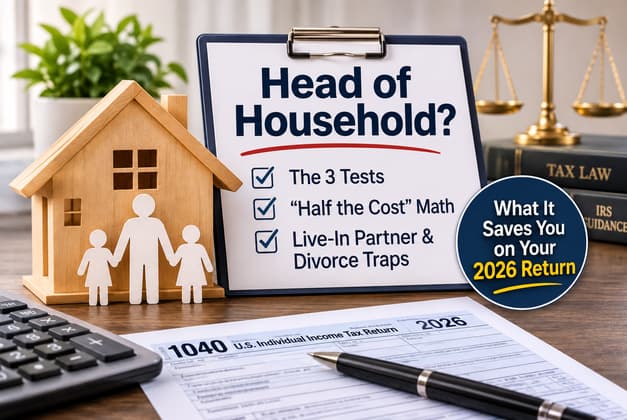
Quick answer: For tax year 2026, you can file head of household if, on December 31, you’re unmarried (or considered unmarried), you paid more than half the cost of keeping up your home, and a qualifying person (usually your child, sometimes a parent or other relative) lived with you more than half the year. A boyfriend or girlfriend never qualifies you, even if you support them.
What it’s worth: a $24,150 standard deduction instead of $16,100, plus wider brackets. With $60,000 of wage income and no other breaks, that’s about $1,072 less federal income tax.
Run the “half the cost” test and your savings →
Filing in California? You must attach form FTB 3532, or the state will deny the status.
- The 3 tests
- Who qualifies you
- Half the cost
- Divorce & custody
- Savings
- IRS letter
- California
- Other statuses
Figures for tax year 2026 (returns filed in 2027), from IRS Rev. Proc. 2025-32. Figures verified November 9, 2026.
Head of Household Eligibility Check
The Three Tests, in Plain English
These are the head of household requirements for 2026: all three tests must be met for the same tax year.
Who Can — and Can’t — Qualify You
Who qualifies as head of household depends on who lives with you: your child is the usual qualifying person; a parent or other relative can work too, but a partner or friend never can.
| Person | Must live with you? | Must be your dependent? | Income limit? | Qualifies you? |
|---|---|---|---|---|
| Your child | Yes, over half the year | Must meet qualifying child tests | No | Yes |
| Stepchild or foster child | Yes | Same tests | No | Yes |
| Sibling, niece, nephew | Yes | Child tests or relative tests | Under $5,300 if a relative | Yes, if tests met |
| Parent | No, if you pay over half their home’s cost | Yes | Under $5,300 | Yes, if tests met |
| Grandparent, aunt, uncle, in-law | Yes | Yes | Under $5,300 | Yes, if tests met |
| Partner, boyfriend, girlfriend | Not relevant | May be a dependent | Not relevant | No |
| Friend or roommate | Not relevant | May be a dependent | Not relevant | No |
A relative you can claim only through a multiple support agreement doesn’t qualify you. Births and deaths during the year, and a married child who files jointly, have special rules; check Publication 501.
The “More Than Half the Cost” Test
You pass Test 2 only if you personally paid over 50% of the year’s total household costs.
| Counts | Doesn’t count |
|---|---|
| Rent or mortgage interest | Clothing |
| Property taxes | Education |
| Home insurance | Medical treatment |
| Repairs and maintenance | Vacations, life insurance, transportation |
| Utilities | Rental value of a home you own |
| Food eaten in the home | The value of your own services |
Roommates split costs, so count only your share against the household total. Two unrelated adults sharing one home generally can’t both be head of household for that household.
Half the Cost + Savings Calculator
Part A: annual 2026 amounts for the whole household.
Part B
Divorce, Separation, and Shared Custody
For head of household, the parent the child lived with for more nights is the one who can use that child; a decree doesn’t override the tax rules.
Who is the custodial parent?
The parent with more nights. See Is 50/50 Custody the Default for how nights are counted.
Exactly equal nights
The parent with the higher adjusted gross income is generally treated as custodial (Treas. Reg. § 1.152-4(d)(4)). Confirm against the current regulation.
Two children, one with each parent
Divorced parents can each file head of household with different children who live with each of them, if each meets all three tests.
Married but separated
You need to be “considered unmarried”: separate return, over half the home’s cost paid, spouse out of the home for the last six months, and a child living with you over half the year. Otherwise, compare married filing separately.
Related: Child Tax Credit 2026, child support, divorce cost, alimony, dependent care.
What Head of Household Saves You in 2026: Standard Deduction and Tax Brackets
Head of household cuts tax by a larger standard deduction and wider low-rate brackets, not by making any money tax-free.
| Item | Single | Head of household |
|---|---|---|
| Standard deduction | $16,100 | $24,150 |
| 10% bracket up to | $12,400 | $17,700 |
| 12% bracket up to | $50,400 | $67,450 |
| 22% bracket up to | $105,700 | $105,700 |
| 24% bracket up to | $201,775 | $201,750 |
| 32% bracket up to | $256,225 | $256,200 |
| 35% bracket up to | $640,600 | $640,600 |
| 37% bracket | Above $640,600 | Above $640,600 |
| Tax on $40,000 income | $2,620 | $1,585 |
| Tax on $60,000 income | $5,020 | $3,948 |
| Tax on $90,000 income | $10,970 | $7,548 |
Credits (Child Tax Credit, EITC), itemizing, and the age 65+ or blind additional standard deduction (reported as $2,050 for unmarried filers; confirm in Rev. Proc. 2025-32) change your real result. The separate $6,000 senior deduction also applies on top. If you qualify, you can check head of household on your W-4 so withholding matches; if you don’t, don’t. See How Tax Brackets Work and 2027 vs. 2026 brackets.
Head of Household vs. Single, and Other Filing Statuses
If head of household doesn’t fit, the status you use depends mostly on your marriage and who depends on you.
| Your situation | Likely status to check | Why |
|---|---|---|
| Unmarried, child lived with you, you paid over half the home | Head of household | All three tests appear met |
| Unmarried, no qualifying person | Single | Test 3 fails |
| Married and living together | Married filing jointly or separately | Head of household isn’t available |
| Separated, not “considered unmarried” | Married filing separately | The Test 1 conditions aren’t all met |
| Spouse died in 2026 | Married filing jointly for 2026 | Generally allowed in the year of death |
| Spouse died in a prior year, dependent child at home | Qualifying surviving spouse | Up to two years after the year of death; joint brackets and the $32,200 deduction |
If the IRS Questions Your Status
Notice CP85A is a request to confirm your filing status, not an audit.
Send proof for each test (see the checklist below). If you filed head of household by mistake, correct it with an amended return on Form 1040-X (amend your filing status). Claiming a status you know you don’t qualify for can mean back taxes, interest, and penalties. Paid preparers must ask you head of household questions, which is why yours does.
Proof folder checklist
- 1. Lease or mortgage statements for 2026
- 2. Property tax and home insurance bills
- 3. Utility bills in your name
- 4. Receipts or bank records showing who paid what
- 5. The child’s school, daycare, or medical records showing your address
- 6. The custody order or parenting schedule, plus a calendar of nights
- 7. If separated: proof your spouse lived elsewhere July through December
- 8. If a parent: nursing home or housing bills you paid, and proof of the parent’s income
- 9. If California: a completed FTB 3532 attached to the return
California and Other State Rules
California requires you to attach form FTB 3532 to claim head of household; since 2018, a missing form means the status is denied.
Common denials: two people claiming the same person or address, or a married filer claiming a qualifying relative. Most states follow the federal status, but check your own state’s rules. See the California FTB head of household page and Publication 1540.
FAQ
Can I file head of household without a dependent, or with no kids?
Usually not. You need a qualifying person who lived with you (or, for a parent, whose home you support).
Can I file head of household if I live with my boyfriend or girlfriend?
Only if someone else qualifies you, such as your own child. Your partner can’t.
Can my girlfriend’s child qualify me?
Generally no, unless the child is also your qualifying child under the tests. Check Publication 501.
Can I file head of household for my elderly parent?
Possibly, if the parent is your dependent and you pay over half the cost of their main home.
Does my parent have to live with me?
No, if you pay over half the cost of keeping up your parent’s main home.
What if my parent lives in a nursing home?
The nursing home counts as the parent’s home, so you can still qualify if the other tests are met.
Can I file head of household for an adult child?
Yes, if the adult child is your dependent (for example, a full-time student under the age limit, or a permanently disabled child) and lived with you more than half the year. An adult child with their own support and no dependent status doesn’t qualify you.
Can both divorced parents file head of household?
Only with different children who each live mainly with a different parent.
Does signing Form 8332 give my ex head of household?
No. It releases the dependency claim only.
Who files head of household with 50/50 custody?
With exactly equal nights, the higher-AGI parent is generally treated as custodial.
Can I file head of household if I’m married but separated?
Only if you’re “considered unmarried” (see Test 1).
My child is away at college — does that count?
Temporary absences for school count as time at home, if the child otherwise meets the tests.
What counts as keeping up a home?
See Table 2: rent or mortgage interest, taxes, insurance, repairs, utilities, and food eaten at home.
Can roommates both file head of household?
Not for the same household. Each must meet all three tests on their own facts.
How much does head of household save?
About $1,035 at $40,000, $1,072 at $60,000, and $3,422 at $90,000 of wage income for 2026, before credits.
What is the 2026 head of household standard deduction?
$24,150, versus $16,100 for single filers (tax year 2026).
What is IRS notice CP85A?
A request to confirm your filing status. It isn’t an audit.
What if I filed head of household by mistake?
File Form 1040-X to correct it and consider talking to a tax professional.
Do I need a special form in California?
Yes, FTB 3532.
Sources: IRS Publication 501, Rev. Proc. 2025-32, IRS Interactive Tax Assistant, Form 8332, IRC § 2(b) and § 152, Treas. Reg. § 1.152-4, IRS notice CP85A, California FTB form 3532 and Publication 1540.
Last updated:
Disclaimer: General information, not tax advice. Amounts are for tax year 2026 from IRS Rev. Proc. 2025-32. Rules depend on your specific facts. Verified November 9, 2026. See IRS Publication 501 or consult a tax professional.

Daniel Hayes is the founder and sole researcher at AdvoraHQ. He covers U.S. personal finance, insurance, and consumer law — working directly from IRS publications, federal and state statutes, court opinions, and SEC filings rather than secondary summaries. His focus is the gap between what readers think they know and what the source documents actually say. Daniel is not a licensed attorney, CPA, or financial advisor; his articles are educational and not personalized advice. Reach him at Daniel.Hayes@advorahq.com.
