
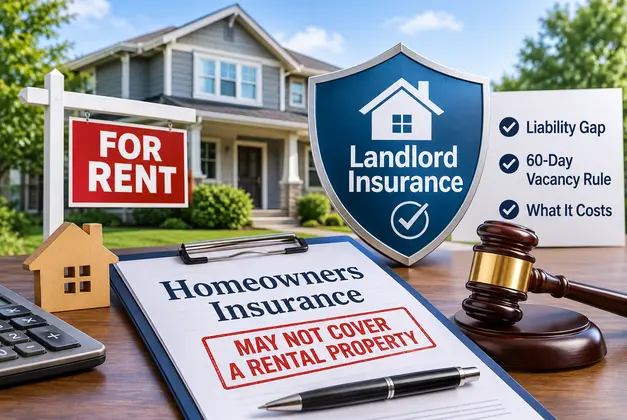
Quick answer: A homeowners policy is written for a home you live in. If you move out and rent the whole house, you generally need a landlord (dwelling) policy, usually a DP-3, starting the day you move out. Call your insurer before the tenant moves in; don’t wait for a claim.
The surprise: Many landlord policies don’t include liability (a tenant’s guest slips on your stairs) or theft unless they’re added. Check your declarations page for both.
Which policy fits your situation? →
Does the rent still cover your costs with the new premium? →
Verified November 9, 2026. Policy forms vary by insurer and state; your declarations page and policy wording control.
Which Policy Do You Need?
Answer five questions to get a checklist of what to ask your agent. Nothing you enter is stored or sent anywhere.
Why Your Homeowners Policy Assumes You Live There
A homeowners policy (HO-3) is written for the home where you live, so renting out the whole house is a change your insurer needs to hear about.
Your homeowners policy assumes you live there
The policy is built around a “residence premises” you occupy. Once a tenant lives there instead, the risk is different, and so is the form that usually fits.
You are not the only one in this spot. Zillow’s analysis, published March 11, 2026, found that 2.3% of homes listed for rent on Zillow had recently been listed for sale. That is the second-highest share in its nearly six-year record, behind 2.4% in November 2022. Texas and Florida hold 7 of the top 10 metros, and Denver led at 4.9%.
A common driver is mortgage lock-in: owners with 3–4% loans who would face mid-6% rates if they sold and bought again, in a market where homes sit longer.
When you compare landlord insurance vs homeowners insurance, the question is not which is “better.” They are written for different situations. When you move out and rent the whole home, coverage under a homeowners policy can be limited or a claim can be disputed under the policy terms. What happens to you depends on your wording and what you told the insurer.
Insurers generally require you to report a change in occupancy. Tenant-occupied homes are usually written on a dwelling form (DP-1, DP-2 or DP-3) or a landlord package.
Homeowners (HO-3) vs. landlord (DP-3), side by side
Homeowners (HO-3)
Built for: a home you live in (the residence premises).
Dwelling: open peril on the building.
Your belongings: named perils.
Tenant belongings: not applicable.
Liability: personal liability coverage is part of the form.
Theft: a named peril on your personal property.
Loss of use: pays extra living costs if you cannot live there after a covered loss.
Vacancy rule: vacancy conditions exist; a move-out can start the clock. Read yours.
Settlement basis: typically replacement cost on the dwelling when insured to about 80% of replacement value; wording varies.
Landlord (DP-3)
Built for: a dwelling someone else lives in.
Dwelling: open peril on the building. DP-1 and DP-2 are named peril.
Your belongings: generally named peril, and limited to items you own and leave at the property.
Tenant belongings: not covered. Tenants need renters insurance.
Liability: not built in. Added by supplement, endorsement or a lessor’s risk policy.
Theft: not built in. Needs a theft endorsement.
Fair rental value: pays lost rent after a covered loss makes the home unlivable. Limits vary.
Vacancy rule: vandalism and malicious mischief are excluded after 60+ consecutive days vacant; other limits may apply.
Settlement basis: typically replacement cost, which requires insuring to about 80% of replacement value.
| Feature | Homeowners (HO-3) | Landlord (DP-3) |
|---|---|---|
| Built for | A home you live in (the residence premises) | A dwelling someone else lives in |
| Dwelling | Open peril on the building | Open peril on the building (DP-1 and DP-2 are named peril) |
| Your belongings | Named perils | Generally named peril, limited to items you own and leave at the property |
| Tenant belongings | Not applicable | Not covered; tenants need renters insurance |
| Liability | Personal liability coverage is part of the form | Not built in; added by supplement, endorsement or a lessor’s risk policy |
| Theft | A named peril on your personal property | Not built in; needs a theft endorsement |
| Loss of use vs. fair rental value | Loss of use: extra living costs if you cannot live there after a covered loss | Fair rental value: lost rent after a covered loss makes the home unlivable; limits vary |
| Vacancy rule | Vacancy conditions exist; a move-out can start the clock. Read yours. | Vandalism and malicious mischief excluded after 60+ consecutive days vacant; other limits may apply |
| Settlement basis | Typically replacement cost on the dwelling when insured to about 80% of replacement value; wording varies | Typically replacement cost, which requires insuring to about 80% of replacement value |
For the tenant’s side of the picture, see What Renters Insurance Covers. If you are weighing a few rooms instead of the whole house, jump to your situation.
Landlord Policies Explained: DP-1, DP-2, DP-3
A landlord (dwelling) policy comes in three common forms, and for a tenant-occupied house the DP-3 is the one to ask about first.
STANDARD: DP-1 covers named perils and is typically paid at actual cash value. DP-2 covers a broader list of named perils. DP-3 is open peril on the dwelling and typically paid at replacement cost. Personal property in a DP-3 is generally named peril. Fair rental value (loss of rents) coverage exists in dwelling forms; limits vary.
ADD-ON: Extended coverage and vandalism are often optional on a DP-1. Ordinance or law, water backup and higher fair rental value limits are worth asking about on any form.
NEVER COVERED: Wear and tear, your tenant’s belongings and unpaid rent. The exclusions section below covers these.
What “open peril” and “replacement cost” mean here
Open peril means the building is protected against any cause of loss unless the policy lists it as an exclusion. Named peril means only the listed causes count.
Replacement cost pays to rebuild without subtracting depreciation. Actual cash value subtracts it. That difference matters most on an older roof or older systems.
A DP-3 on replacement cost typically requires insuring to about 80% of replacement value. Set the dwelling limit at the cost to rebuild, not at your mortgage balance or what the house would sell for. If the limit falls short, a claim can be reduced; our coinsurance penalty guide explains how that math works.
| Form | Perils | Settlement | Typical use | Watch for |
|---|---|---|---|---|
| DP-1 | Named perils: fire, lightning, internal explosion; extended coverage and vandalism are often optional | Typically actual cash value | A lower-cost option for older or lower-value homes | Depreciation reduces payments, and the list of perils is short |
| DP-2 | Broader list of named perils | Varies by insurer; ask whether it is replacement cost or actual cash value | A middle option some insurers offer | Only listed perils apply; check the list against the risks you worry about |
| DP-3 | Open peril on the dwelling; personal property generally named peril | Typically replacement cost, with an insure-to-about-80% condition | A common fit for a house rented to a tenant | Exclusions and vacancy conditions still apply; set the limit at rebuild cost |
Fair rental value is the part many new landlords overlook. It can reimburse lost rent while a covered loss makes the home unlivable. Ask how many months it pays and whether the limit is a dollar amount or a percentage. It is not rent-default insurance, which is covered in the exclusions section.
The Liability Gap Most New Landlords Miss
ISO dwelling forms contain no liability coverage, so liability, and theft, has to be added on purpose.
Many landlord policies have no liability until you add it
A dwelling policy protects the building. It does not, by itself, respond if someone is injured at the property and sues you.
Picture a tenant’s guest who slips on your front steps and is hurt. A homeowners policy includes personal liability coverage that is built to respond to claims like that. A dwelling form does not include it. If your declarations page shows no liability line, you may be paying legal costs and damages yourself.
STANDARD: Many insurer landlord packages include both liability and theft. They are packaged, so you will not see them as separate add-ons.
ADD-ON: On a bare ISO dwelling form, liability is added with the Personal Liability Supplement (often form DL 24 01 or similar), a homeowners-type endorsement, or a commercial lessor’s risk policy. Theft is added with a theft endorsement.
NEVER COVERED: Liability that was never added. No supplement on the declarations page means there is nothing to respond to the claim.
Three questions to ask your agent
- Is personal liability on my declarations page, and at what limit?
- Is theft on it, and what does it apply to while a tenant lives there?
- If I have an umbrella policy, does it extend to the rental, and what underlying limits does it require?
An umbrella sits on top of your underlying liability coverage. If you already have one, tell that insurer about the rental. If your limits feel low for a rental, our umbrella insurance guide covers when extra liability makes sense.
The simplest check is on paper: get the declarations page for the new policy and look for the words “liability” and “theft” with dollar limits beside them. If either is missing, ask why before the tenant moves in.
The Move-Out Window and the 60-Day Vacancy Rule
Under ISO dwelling forms, vandalism and malicious mischief are excluded once a home has been vacant for more than 60 consecutive days, and some carriers use shorter periods such as 30 days.
Empty for 60+ days? Vandalism may not be covered
The risk in the move-out window is rarely that you have no policy. It is that the policy has conditions that limit what it pays after the home has sat empty.
STANDARD: Many forms also limit glass breakage, water damage or theft-type losses during vacancy, or reduce payments on other losses. The exact list depends on the policy.
ADD-ON: A vacancy permit, or a vacant-dwelling policy, if the home will sit empty longer than your policy allows.
NEVER COVERED: Whatever your wording excludes during vacancy. Ask for the vacancy conditions in writing before you rely on the policy for an empty house.
Vacant is not the same as unoccupied
“Vacant” usually means empty of contents and people. “Unoccupied” usually means furnished but with no one living there. Policies can treat the two differently, so check how yours defines them.
When the clock runs
The gap can build up faster than you expect. Moving, repairs, painting, listing and screening a tenant can each add weeks. A house listed for sale and not yet rented has the same issue.
- Write down your move-out date, the date you list the home, and the tenant’s move-in date.
- Mark day 31 and day 60 on a calendar.
- Ask your insurer which period applies to your policy, and when the count starts.
- If the home may pass that line, ask for a vacancy permit before it does.
Freezing and water are part of this too. Many policies expect heat to be kept on, or the water system drained, in a home with no one living there. Ask what yours requires, especially going into winter. If your insurer declines to renew once it learns of the rental, see our non-renewal guide.
What It Costs — and Whether the Rent Still Works
Landlord policies are commonly reported to cost more than homeowners policies, but by how much depends on your quotes, so use the cash-flow check with your own numbers.
Vendor estimates of the gap vary widely, and many are unsourced, so this article does not print an average. Your price depends mostly on your own home and market.
What drives the premium
- Where the home is, including storm, wildfire and theft exposure
- The age and condition of the roof, wiring, plumbing and heating
- The cost to rebuild, which sets the dwelling limit
- The form you choose (DP-1, DP-2 or DP-3) and your deductible
- The liability limit and add-ons such as theft or higher fair rental value
- Claims history and, in many states, other rating factors
- Whether the home will sit vacant
Quotes vary a lot from insurer to insurer for the same home, so get more than one.
Rental Cash-Flow Check
Enter your own figures. Amounts are monthly unless the label says annual. Nothing is stored or sent anywhere.
Loss-of-rent coverage doesn’t pay when a tenant stops paying.
Fair rental value pays after a covered loss makes the home unlivable. A tenant who stops paying is a different problem, and a different product.
Use the result as a starting point, not a verdict. If the numbers are close, a change in the insurance quote, the vacancy allowance or the maintenance percentage can move them. If you are weighing keep or sell, our 1031 exchange guide covers one way owners move from one property to another.
Your Situation: Room, Condo, Family, Vacant, Short-Term
The right policy depends on what you are renting and to whom, so match your situation below and take those questions to your agent.
Renting the whole house
Ask for: a landlord (dwelling) policy, usually a DP-3, or your insurer’s landlord package, effective the day you move out.
Watch for: liability and theft on the declarations page, fair rental value months, and the vacancy period.
Renting a room while you live there
Ask for: a rented-room or home-sharing endorsement on your homeowners policy. Some insurers handle this with an endorsement; others require a landlord policy.
Watch for: limits on liability and any limit on the number of rooms or length of stay.
Renting a condo unit
Ask for: a unit-owner rental endorsement or a landlord condo policy. An HO-6 is written for an owner-occupied unit.
Watch for: the HOA’s master policy, rental caps, approval rules and minimum lease terms.
House empty and for sale
Ask for: vacant-dwelling coverage or a vacancy permit.
Watch for: the 60-day clock (or a shorter one), freezing and water conditions, and how your policy defines vacant and unoccupied.
Short-term rentals
Ask for: a short-term rental endorsement or a specialty policy. This is a different risk from a long-term lease.
Watch for: exclusions for stays under 30 nights. Read Does Homeowners Insurance Cover Airbnb.
Renting to a family member
Ask for: the same landlord policy as any other tenant. Tell your insurer who lives there.
Watch for: the tax rules, which differ. Renting below fair rental value can make the home personal use for tax purposes.
| Your situation | What to ask for | Watch for |
|---|---|---|
| Whole house | A landlord (dwelling) policy, usually a DP-3, or the insurer’s landlord package, effective the day you move out | Liability and theft on the declarations page, fair rental value months, the vacancy period |
| A room | A rented-room or home-sharing endorsement on your homeowners policy; some insurers require a landlord policy instead | Liability limits; limits on the number of rooms or length of stay |
| Condo unit | A unit-owner rental endorsement or a landlord condo policy (an HO-6 is written for an owner-occupied unit) | The HOA’s master policy, rental caps, approval rules, minimum lease terms |
| Vacant and for sale | Vacant-dwelling coverage or a vacancy permit | The 60-day clock (or a shorter one); freezing and water conditions; vacant vs. unoccupied |
| Short-term | A short-term rental endorsement or a specialty policy | Exclusions for stays under 30 nights; see the Airbnb guide |
| Family | The same landlord policy as any other tenant; tell your insurer who lives there | Tax rules differ: renting below fair rental value can make the home personal use |
For short stays, see Does Homeowners Insurance Cover Airbnb.
What Landlord Insurance Won’t Pay For
Landlord insurance protects the building and your rental income after a covered loss, and it leaves several things to other products.
NEVER COVERED: Rent a tenant does not pay, your tenant’s belongings, wear and tear, and flood or earthquake unless you buy separate coverage. A liability claim is also not covered if liability was never added.
| Situation | Why | What covers it instead |
|---|---|---|
| Tenant stops paying | Fair rental value pays after a covered loss makes the home unlivable, not for non-payment | A rent-guarantee product, your lease terms and the legal process in your state |
| Tenant’s belongings | The landlord policy protects your property, not theirs | Renters insurance (see What Renters Insurance Covers) |
| Wear and tear | Insurance is not a maintenance contract; gradual deterioration is generally excluded | A maintenance budget |
| Flood | Flood is typically excluded from dwelling forms | NFIP or private flood insurance |
| Earthquake | Earth movement is typically excluded from dwelling forms | An endorsement or a separate policy |
| Liability not added | ISO dwelling forms contain no liability coverage | The Personal Liability Supplement, a homeowners-type endorsement, a lessor’s risk policy, or an umbrella |
A ceiling leak can raise a question about whose policy responds, yours or your tenant’s. Our ceiling leak guide walks through it.
Your Lender, HOA, and Tenant
Three other parties have rules about your rental, so contact each one before the tenant moves in.
Your lender
Most loans list the lender as the mortgagee on your policy. When you change policies, the mortgagee information has to be updated, and your escrow payment will adjust. Our guide, Why Did My Mortgage Payment Go Up, explains why.
Occupancy is the bigger point. Standard Fannie Mae and Freddie Mac security instruments include an occupancy covenant. It commonly asks you to occupy the home as your principal residence within 60 days and to continue for at least one year, unless the lender agrees otherwise in writing. Consent is not to be unreasonably withheld, and extenuating circumstances can matter. Moving out early can raise lender issues, so read your own loan documents and call your servicer.
Do not try to hide a rental from your insurer or your lender. Tell them, in writing, before the tenant moves in.
Your HOA or condo association
Associations can set rental caps, require approval, set minimum lease lengths or ban short-term stays. Check the governing documents and the master policy. For a condo, the master policy and your unit policy split coverage according to the association’s documents, so read both.
Your tenant
Your policy does not cover your tenant’s belongings or their liability. They need renters insurance. Many leases require it, and rules differ by state, so confirm what yours allows. Ask to be listed as an interested party. That generally means you are notified if the policy is cancelled; it does not make you an insured. Additional insured status can give you some rights under their liability coverage, but wording and availability vary.
Put the requirement in the lease. See Security Deposit Rights for the deposit and move-in paperwork.
Taxes for Accidental Landlords
Insurance on a rental is a deductible rental expense, but renting out your home also starts a clock on your home-sale tax break.
Deducting the premium
The premium for insurance on a rental is generally a deductible rental expense. It is reported on Schedule E, on the line labeled Insurance (line 9 on the current form; confirm in the instructions for your tax year). If a policy period covers both months you lived there and months you rented, a CPA can help you divide it.
Renting to family
Renting to a relative below fair rental value can make the home “personal use” for tax purposes, which limits your deductions. IRS Publication 527 treats a relative who uses the home as their main home and pays a fair rental price differently. Talk to a CPA before you set the rent.
The home-sale exclusion clock
To use the §121 home-sale exclusion, you generally must have owned the home and lived in it as your main home for 2 of the last 5 years before the sale. Once you move out and rent, that window keeps moving. Wait too long to sell and you may fall short of the 2 years.
Depreciation on a rental is deducted each year, and the depreciation you take can be taxed when you sell, even if you qualify for the exclusion. Ask a CPA to model your numbers. See Selling Your House Before 2 Years for the clock in detail.
Before the Tenant Gets the Keys
This checklist covers the steps to finish before move-in day. You can copy it into your notes.
- Call your agent: switch to a landlord/dwelling policy effective your move-out date.
- Confirm liability and theft are on the declarations page.
- Set the dwelling limit at rebuild cost, and confirm replacement cost and the 80% rule.
- Choose fair rental value months.
- Ask about vacancy rules if the home will sit empty.
- Tell your lender; update the mortgagee clause and escrow.
- Check HOA or condo rental rules and the master policy.
- Lease: require renters insurance and list yourself as an interested party.
- Photograph every room; record meter readings.
- Test smoke and CO detectors; show the tenant the water shutoff.
- Consider an umbrella if your liability limit feels low.
FAQ
Can I rent my house with homeowners insurance?
A homeowners policy is written for a home you live in. If you rent out the whole house, tell your insurer first; many will move you to a landlord (dwelling) policy. Whether a policy responds depends on its wording and what you disclosed, so ask before the tenant moves in.
Do I need to tell my insurance company I’m renting my house?
Insurers generally require you to report a change in occupancy, and renting the home is one. Call before move-in and ask for the change in writing.
What happens if I rent without changing my policy?
The risk is a dispute. A claim can be limited or contested under the policy terms, depending on the wording, your state and what was disclosed. We cannot say what yours would do. Ask your agent and fix it before a loss, not after.
What’s the difference between DP-3 and HO-3?
Both are open peril on the building. An HO-3 is for a home you live in and includes liability and theft on your belongings. A DP-3 is for a dwelling you rent out, with no liability or theft built in, and fair rental value in place of loss of use. See Table 1.
Does landlord insurance include liability?
Not always. ISO dwelling forms have no liability coverage; it is added with the Personal Liability Supplement, a homeowners-type endorsement or a lessor’s risk policy. Many insurer landlord packages include it. Confirm on the declarations page.
Does landlord insurance cover theft?
Theft is not built into dwelling forms. It needs a theft endorsement, or comes bundled in some landlord packages. Ask what it applies to while a tenant lives there.
How much more does landlord insurance cost?
Landlord policies are commonly reported to cost more than homeowners policies, and estimates vary. This article prints no average. Get your own quotes and enter them in the cash-flow check.
How long can a rental be vacant?
Under ISO dwelling forms, vandalism and malicious mischief are excluded after more than 60 consecutive days vacant. Many forms also limit glass breakage, water damage or theft-type losses, or reduce payments. Some carriers use shorter periods such as 30 days. Check your policy, and ask about a vacancy permit.
Does loss of rent cover a tenant who stops paying?
No. Fair rental value pays after a covered loss makes the home unlivable. Non-payment is a different problem, handled by a rent-guarantee product, your lease and the legal process in your state.
Does landlord insurance cover my tenant’s belongings?
No. Your policy protects your property. Tenants need renters insurance. See What Renters Insurance Covers.
Can I require tenants to have renters insurance?
Many leases do, and many landlords ask to be listed as an interested party (for notification) or as an additional insured. Rules differ by state, so confirm what your lease can require.
Do I need landlord insurance to rent to family?
For insurance, a relative paying rent is generally still a tenant, so tell your insurer. The tax rules are different: renting below fair rental value can make the home personal use under IRS Publication 527.
What if I rent out just a room?
Some insurers handle this with a homeowners endorsement; others require a landlord policy. Ask which applies and what limits come with it.
How do I insure a condo I rent out?
An HO-6 is written for an owner-occupied unit. A rented unit typically needs a unit-owner rental endorsement or a landlord condo policy. Also check the HOA’s master policy and rental rules.
Do I need to tell my mortgage lender?
Yes, tell your servicer. The policy change affects the mortgagee clause and escrow, and standard loan documents often include an occupancy covenant. Read yours and ask the lender in writing.
Is landlord insurance tax deductible?
Insurance on a rental is generally a deductible rental expense, reported on the Insurance line of Schedule E. A CPA can confirm how it applies to you.
Will renting my house affect the tax when I sell?
It can. The home-sale exclusion generally requires that you owned and lived in the home for 2 of the last 5 years. The longer you rent, the harder that gets. See Selling Your House Before 2 Years.
Do I need an umbrella policy as a landlord?
Many landlords consider one if their liability limit feels low. An umbrella sits above your underlying liability coverage. Ask your umbrella insurer whether it extends to the rental and what underlying limits it requires. See the umbrella insurance guide.
Sources
- Zillow Research: Number of “Accidental Landlords” Rises to Three-Year High (March 11, 2026)
- ISO dwelling forms DP 00 01, DP 00 02 and DP 00 03, and the Personal Liability Supplement (DL 24 01), through your state insurance department or published form summaries
- NAIC: A Consumer’s Guide to Home Insurance
- NAIC: Leaving home, insurance considerations for a move
- Insurance Information Institute: What type of insurance do I need if I’m renting out my home?
- IRS Publication 527, Residential Rental Property
- IRS Instructions for Schedule E (Form 1040)
- IRS Publication 523, Selling Your Home
- Fannie Mae Selling Guide: Occupancy Types, and the Fannie Mae/Freddie Mac uniform security instrument (occupancy covenant)
This article is general information, not insurance, tax, or legal advice. Coverage depends on your policy wording, your insurer and your state. Verified on November 9, 2026. Last updated . Confirm with a licensed agent, your lender, and a tax professional.

Daniel Hayes is the founder and sole researcher at AdvoraHQ. He covers U.S. personal finance, insurance, and consumer law — working directly from IRS publications, federal and state statutes, court opinions, and SEC filings rather than secondary summaries. His focus is the gap between what readers think they know and what the source documents actually say. Daniel is not a licensed attorney, CPA, or financial advisor; his articles are educational and not personalized advice. Reach him at Daniel.Hayes@advorahq.com.
