
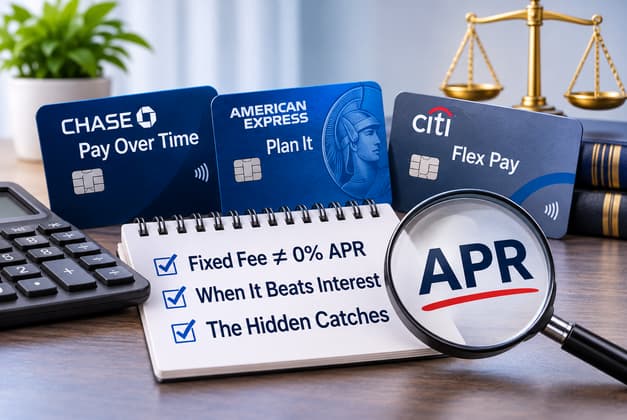
The honest line: if you pay your statement in full every month, a plan only costs you money, unless the fee shown is $0. If you would otherwise carry the balance, it can be cheaper. Run your numbers.
Turn the fee in your app into a real APR →
Program terms verified November 9, 2026. Fees are set per offer; use the fee shown in your account.
True Cost Calculator
Enter the fee shown in your app and this calculator returns the APR it equals, then sets it next to your card and any alternative you list.
What Credit Card Installment Plans Are
A credit card installment plan splits one purchase into equal monthly payments, billed on the card you already have.
Plans come in two pricing styles. Fee-based plans charge no interest but add a fixed monthly fee: Chase Pay Over Time after purchase (formerly My Chase Plan), Amex Plan It, Citi Flex Pay on a purchase you already made, and U.S. Bank ExtendPay. Fixed-APR plans charge interest at a rate set when the plan starts: Chase’s plans at checkout on Amazon.com, and some Citi Flex Pay plans offered at checkout.
The timing matters too. An after-purchase plan starts from a charge already on your statement. An at-checkout plan is chosen while you pay. Chase runs both, and they are priced differently.
These are not the same as BNPL apps or store cards. A BNPL app is a separate lender and a separate account. A plan is a feature of your own card, so the balance stays on that card. A deferred-interest store card is a different product again; see deferred interest on store cards and how BNPL affects credit.
The Real APR Behind a “Fixed Fee”
A fixed fee looks like a small percentage, but it is charged on the original amount while you owe less every month, so the annual rate it equals is much higher.
The fee is charged on the original amount, not what you still owe. Chase says its fee is based on the original purchase amount and stays the same until the plan is paid. Amex bases the fee on the amount planned, the plan duration, and the APR that would otherwise apply.
Worked example, $1,000 over 12 months at a 1.00% monthly fee:
WHAT YOU SEE: a $10.00 fee on top of $83.33 of principal, so $93.33 a month and $120.00 in total fees.
WHAT IT EQUALS: an effective APR of about 21.5%, even though 1.00% × 12 is only 12%.
WHAT TO COMPARE: a card at 24% APR, paid down evenly over the same year, would charge roughly $130 in interest (approximate). A new 0% card with a 3% transfer fee would cost $30, but it needs an application and approval.
Same $1,000 and 12 months at Chase’s stated maximum of 1.72%:
WHAT YOU SEE: a $17.20 fee, so $100.53 a month and $206.40 in total fees.
WHAT IT EQUALS: an effective APR of about 36.1%.
WHAT TO COMPARE: the APR on your card statement, plus any 0% or lower-rate option you already qualify for.
Chase says the “up to 1.72%” is a ceiling. Your own fee depends on the amount, the number of billing cycles, and other factors, so always use the fee shown in your app.
| Monthly fee | 6-month plan | 12-month plan |
|---|---|---|
| 0.50% | 10.2% | 10.9% |
| 0.90% | 18.3% | 19.4% |
| 1.00% | 20.3% | 21.5% |
| 1.72% | 34.6% | 36.1% |
For the basics of how a card turns an APR into daily interest, see how credit card interest works.
Plan vs. Carrying a Balance vs. a 0% Card vs. BNPL
The cheapest option is whichever has the lowest total cost for your amount, your timeline, and the offers you actually qualify for, and a plan only wins when the fee beats what the alternative would charge you.
Three checks keep the comparison honest:
1. Do you need the plan at all? If you would pay the statement in full anyway, interest on that purchase is $0 and the plan adds its fees.
2. Is the 0% card really available to you? A 0% intro card needs an application, a hard credit check, and approval. Moving an existing purchase onto it usually costs a balance transfer fee, commonly 3% to 5%. See balance transfer cards and what happens when a 0% APR ends.
3. What does the loan cost in full? A personal loan or BNPL plan has its own APR and sometimes fees. See personal loan rates.
The calculator’s break-even line gives the card APR above which the plan’s fees are lower than carrying the balance. Below that APR, carrying the balance costs less.
| Option | Typical cost | Credit check? | Effect on utilization | Flexibility | Watch out for |
|---|---|---|---|---|---|
| Installment plan on your card | A fixed monthly fee or a fixed APR, shown before you confirm | Issuers describe it as a feature of your existing card; check your issuer | Balance stays on the card until paid | Fixed payments; early payoff is generally allowed | The fee runs on the original amount; the payment is added to your minimum due |
| Revolving at your card’s APR | Your purchase APR on the unpaid balance | No new check | Balance counts until paid | Pay any amount above the minimum | Interest can start on new purchases; see interest after paying the statement balance |
| 0% intro card | 0% for the intro period; often a 3% to 5% transfer fee on a moved purchase | Yes: application, hard pull, approval | New credit line plus a new balance | Flexible within the intro period | The rate after the intro period; see 0% APR ending |
| BNPL app | Varies by app and offer, from no interest to a high APR | Varies by app | Not on your card; reporting varies | Set schedule | A separate lender and due date; see BNPL and credit |
| Personal loan | A fixed APR, sometimes plus an origination fee | Yes, usually a hard pull | Usually installment debt, not card utilization | Fixed term | Fees and the rate you are actually offered |
| Deferred-interest store card | No interest during the promotion if paid in full | Yes, to open the card | Counts on the store card | Promotion deadline | Interest charged back to the purchase date if unpaid; see deferred interest |
The Autopay Setting That Changes Everything
Your autopay setting decides whether a plan runs on schedule, pays off early, or leaves interest running on everything else.
Autopay set to “Statement balance” pays the whole plan off early. On Chase, that is the setting that clears the plan; “Interest saving balance” is the one that keeps it on schedule.
Chase. After you set up a plan, Chase shows a payment option called “Interest saving balance.” Per Chase, paying it keeps the plan on schedule and avoids interest on new purchases. Paying the statement balance pays the plan off early.
Amex. With an active plan you will see an “Adjusted Balance.” Amex says paying it by the due date avoids interest on purchases, and anything you pay above it goes to your remaining plan balance, which pays billed plans off early.
Where extra money goes. Under the CARD Act rules in Regulation Z (12 CFR 1026.53), payments above the minimum generally go to the highest-APR balance first. Issuers describe how they route plan balances on their own pages, so read yours. For the grace-period side, see charged interest after paying the statement balance.
Autopay Setting Check
Does a Plan Hurt Your Credit Score?
A plan does not add a new loan to your credit report, but the balance sits on your card until it is paid, and that is where the effect shows up.
Utilization over time. The plan balance stays in your card balance, so it counts toward utilization for as long as it is there. Citi’s guide says the purchase is initially charged in full against your available credit. Amex says a plan does not raise your credit limit.
No new account. Issuers describe plans as a feature of the card you have, not a new account. Whether setting one up involves any credit check varies by issuer, so check yours.
Missed payments. A missed plan payment is a missed card payment. Issuers generally report a payment as late to the credit bureaus once it is 30 days past due.
See credit utilization ratio for how the percentage is figured, and why your minimum payment went up for how plan payments raise what is due each month.
Returns, Disputes, and Missed Payments
What happens depends on the issuer and on which Chase product you used, and in a few cases you have to ask before a credit reaches your plan.
Returned the item? The credit may not reach your plan until you ask. For Chase after-purchase plans, you call Chase to have the credit applied to your plan balance. For U.S. Bank ExtendPay, the disclosures say a return is credited to your card balance, not your plan balance.
Missing a payment doesn’t pause the plan fee. Chase says it charges the plan fee every month until the plan balance is paid in full, whether or not you miss a payment.
Chase at checkout on Amazon. These plans carry a fixed APR instead of a fee, and per Chase, refunds apply directly to the plan balance. If you miss the minimum payment, a late fee and interest can apply.
Disputes. Chase says a purchase you have disputed or reported as fraud is not eligible for a new after-purchase plan. What a dispute does to a purchase already in a plan varies, so check your issuer. See how to dispute a credit card charge and how long a refund takes.
| Event | Chase | Amex | Others |
|---|---|---|---|
| You return the item | After-purchase: call Chase to have the credit applied to the plan. At Amazon checkout: refunds apply directly to the plan balance. | Travel refunds can be requested to apply to the plan balance. Check U.S. terms for others. | U.S. Bank: credited to the card balance, not the plan. Citi: check your issuer. |
| You dispute the charge | Disputed or fraud-reported purchases are not eligible for a new plan. For one already in a plan, check Chase. | Check your issuer. | Check your issuer. |
| You miss a payment | The plan fee is charged every month until the plan is paid in full. | A missed plan payment is a missed card payment. No new plans if an account is delinquent. | U.S. Bank: the fee is charged each month while a balance remains. Citi: check your issuer. |
| You pay extra | Amounts above the interest saving balance go to the plan balance. | Amounts above the Adjusted Balance go to the remaining plan balance. | Check your issuer. |
| Autopay is set to statement balance | Pays the whole plan off early. | Paying more than the Adjusted Balance pays billed plans off early. | Check your issuer. |
You return the item
Chase: After-purchase, call Chase to have the credit applied to the plan. At Amazon checkout, refunds apply directly to the plan balance.
Amex: Travel refunds can be requested to apply to the plan balance. Check U.S. terms for others.
Others: U.S. Bank credits the card balance, not the plan. Citi: check your issuer.
You dispute the charge
Chase: Disputed or fraud-reported purchases are not eligible for a new plan. For one already in a plan, check Chase.
Amex and others: Check your issuer.
You miss a payment
Chase: The plan fee is charged every month until the plan is paid in full.
Amex: A missed plan payment is a missed card payment. No new plans if an account is delinquent.
Others: U.S. Bank charges the fee each month while a balance remains. Citi: check your issuer.
You pay extra
Chase: Amounts above the interest saving balance go to the plan balance.
Amex: Amounts above the Adjusted Balance go to the remaining plan balance.
Others: Check your issuer.
Autopay is set to statement balance
Chase: Pays the whole plan off early.
Amex: Paying more than the Adjusted Balance pays billed plans off early.
Others: Check your issuer.
Paying Off Early (and Why You Can’t Cancel)
You can generally pay a plan off early, which stops future fees, but issuers describe this as paying the plan off, not undoing it.
Chase. There is no penalty for paying off early. Once the plan is on a statement, pay the full statement balance. Before that, pay the current balance. In other words, early payoff means paying the card’s balance, not just the plan.
Amex. You cannot direct extra payments to one plan. Paying more than the Adjusted Balance pays billed plans off early. TIME’s guide to U.S. Plan It says you cannot cancel a plan or change its duration once created; confirm that in your account.
U.S. Bank. Once the plan balance is paid in full, no further ExtendPay fees are charged.
Fees already billed. Fees already charged generally stay charged. Early payoff stops the fees still to come.
Do not apply Amex UK or Canada cancellation terms to a U.S. account; they differ.
All Four Programs Compared (2026)
All four programs add a fixed fee or rate to a purchase you already made, but they differ on minimums, limits, early payoff, and refunds.
| Program (former name) | Cost type | Minimum purchase | Terms | Limits | Early payoff | Refunds | Pay this to avoid interest on new purchases |
|---|---|---|---|---|---|---|---|
| Chase Pay Over Time (My Chase Plan) | After purchase: fixed monthly fee, up to 1.72% of the amount. At Amazon checkout: fixed APR. | $100 after purchase; $50 cart at Amazon checkout | 3 to 24 months | Not purchases older than 90 days, over $99,999, or disputed or fraud-reported | No penalty; pay the full statement balance once the plan is on a statement, otherwise the current balance | After purchase: call Chase. At checkout: applied to the plan. | Interest saving balance |
| Amex Plan It | Fixed monthly fee, a percentage based on plan duration, the APR that would otherwise apply, and other factors | $100 | 1 to 3 durations offered | Up to 10 plans; no new plans if an Amex account is delinquent, in a payment program, or had a returned payment; no credit limit increase | Pay more than the Adjusted Balance | Travel refunds can be requested; check U.S. terms | Adjusted Balance |
| Citi Flex Pay | A set monthly plan fee on a purchase you already made; plans at checkout may carry a fixed APR instead | $75 | Shown when you set up the plan | Account must be current and under its limit | Check your issuer | Check your issuer | Check your issuer |
| U.S. Bank ExtendPay | Fixed monthly fee, based on the original amount, your purchase APR, and other factors | $100 | Shown at enrollment | Up to 50% of your credit line in eligible purchases | No more fees once the plan is paid in full | Credited to the card balance, not the plan balance | Check your issuer |
Before You Tap “Pay Over Time”
Seven questions, answered before you confirm, cover most of what goes wrong.
1. Would I pay this purchase in full this month anyway? If yes, the plan only adds cost (unless the fee is $0).
2. What’s the effective APR of the fee shown? (Use the calculator.)
3. Is there a cheaper option I already qualify for: a 0% offer on this card, or a lower-rate loan?
4. Check my autopay setting before the next statement.
5. Plan payments raise my minimum due. Can I make it every month?
6. If I might return it, keep the receipt and know I may need to call to apply the credit to the plan.
7. Keep at least one month of plan payments in checking so a miss doesn’t trigger fees.
FAQ
Short answers to the questions people ask most.
What happened to My Chase Plan?
It was renamed Chase Pay Over Time. The after-purchase version is the old My Chase Plan; Chase also offers a second, separate version at checkout on Amazon.com with a fixed APR.
How much is the Chase Pay Over Time fee?
For after-purchase plans it is up to 1.72% of the amount per month. Chase sets it when the plan is created, based on the original amount, the number of billing cycles, and other factors, and it stays the same until the plan is paid.
Is 1.72% a month a lot?
On a 12-month plan it equals about a 36% APR (see Table 2). Whether that is a lot depends on what your card charges and what other options you have, so compare the two numbers.
How do I convert a plan fee to an APR?
Find the monthly rate r where the amount equals the sum of each payment divided by (1 + r) raised to the payment number, with payment = amount ÷ months + fee. Multiply r by 12. The True Cost Calculator does this for you.
Is Amex Plan It worth it?
That depends on the fee shown for your plan and what you would otherwise pay. Amex says the fee is based on plan duration, the APR that would otherwise apply, and other factors. Enter your fee and card APR in the calculator and compare.
Does Citi Flex Pay charge interest or a fee?
Citi’s guide describes a set monthly fee for Flex Pay on a purchase you already made. Plans offered at checkout may have a fixed APR instead of a plan fee. Read the offer shown to you.
Can I cancel a plan after I create it?
Issuer pages mostly describe paying a plan off, not cancelling it. TIME’s guide says you cannot cancel an Amex Plan It plan or change its duration. Check your own account for the options it shows.
Can I pay off a plan early?
Generally yes. Chase has no penalty, and U.S. Bank charges no more fees once the plan is paid in full. On Chase, early payoff means paying the full statement balance once the plan is on a statement, or the current balance before that.
Does a plan payment count toward my minimum payment?
Yes. Chase, Amex, Citi, and U.S. Bank each add the plan payment to your minimum payment due. See why your minimum payment went up.
Which autopay setting should I use with a plan?
The setting decides the outcome, so match it to your goal. On Chase, “Interest saving balance” keeps the plan on schedule and “Statement balance” pays it off early. On Amex, the Adjusted Balance does the same job. Try the Autopay Setting Check above.
Does an installment plan affect my credit score?
It does not add a new loan to your report, but the plan balance stays in your card balance and counts toward utilization until paid. A missed plan payment is a missed card payment.
What happens if I return an item on a plan?
It depends. Chase after-purchase: call Chase to have the credit applied to the plan. Chase at Amazon checkout: refunds apply to the plan. U.S. Bank: the credit goes to your card balance, not the plan. See how long a refund takes.
What happens if I miss a plan payment?
It is treated as a missed card payment. On Chase after-purchase plans, the fee keeps being charged every month until the plan balance is paid in full. Late fees and interest can also apply.
Can I still earn rewards on a plan purchase?
Chase says you still earn rewards on purchases you put into a plan. Rules for other issuers vary, so check yours.
Is a plan better than a 0% APR card?
It depends on cost and access. A 0% card can cost less, but it needs an application and approval, and moving an existing purchase usually carries a transfer fee. A plan needs no new card. Compare total dollars for your amount and timeline.
Is a plan better than Affirm or Klarna?
They differ in lender, account, and credit reporting. A plan sits on your own card; a BNPL app is a separate lender with its own terms. See BNPL and credit.
Sources
All verified November 9, 2026.
Last updated:
This article is general information, not financial advice. Fees, terms, and eligibility are set by each issuer and vary by offer. Program details verified November 9, 2026. Check your cardmember agreement and the plan details in your account before you decide.

Daniel Hayes is the founder and sole researcher at AdvoraHQ. He covers U.S. personal finance, insurance, and consumer law — working directly from IRS publications, federal and state statutes, court opinions, and SEC filings rather than secondary summaries. His focus is the gap between what readers think they know and what the source documents actually say. Daniel is not a licensed attorney, CPA, or financial advisor; his articles are educational and not personalized advice. Reach him at Daniel.Hayes@advorahq.com.
