
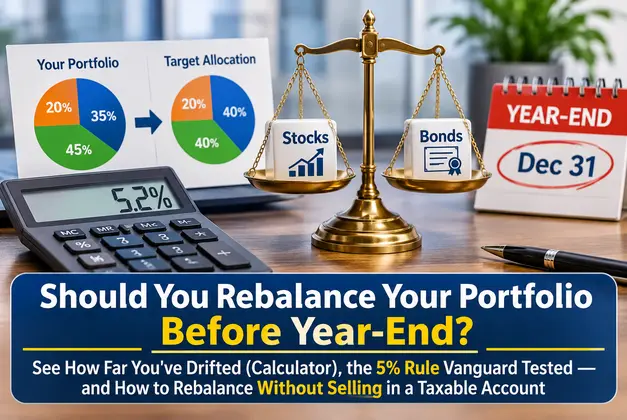
Quick answer: do you need to rebalance? Only if you’ve drifted past a band you set in advance. Vanguard’s research found that checking once or twice a year, and acting only when an asset class is 5 or more percentage points off target, balanced risk and cost for most investors. If you do need to rebalance, use new money or your 401(k)/IRA first. Selling in a taxable account is the last step, not the first.
The one number: In Vanguard’s historical test, a 60/40 portfolio that was never rebalanced averaged 84.1% stocks. That’s a very different risk than the one its owner chose.
Source: Vanguard, “Best Practices for Portfolio Rebalancing,” July 2010 edition (hypothetical portfolio, U.S. data 1926–2009, no taxes).
The 60-second example.
Target: 60% stocks / 40% bonds. Today: 67% / 33%. Stocks are 7 points over → past the 5-point band → time to act.
At 63% / 37% → inside the band → do nothing.
Verified November 14, 2026. Tax figures: see our capital gains guide.
Drift & Rebalance Calculator
Enter what you own and the target you chose, and this shows how far each asset class has drifted and whether it is outside its band.
Add up each asset class across every account you own (401(k), IRA, Roth, HSA, taxable) so you see one portfolio.
Your results
Fill in the left side, then press “Check my drift.”
Measures drift against the target you entered. It does not recommend an allocation, and it doesn’t calculate your tax. Not investment or tax advice. Nothing you enter is saved or sent.
What Drift Is, and Why It Quietly Changes Your Risk
Drift is the gap between the mix you chose and the mix you now own, and it grows on its own as prices move.
Say you start with $100,000: $60,000 in stocks and $40,000 in bonds. Stocks rise 25% and bonds stay flat. You now hold $75,000 and $40,000, which is 65.2% stocks and 34.8% bonds. You never bought or sold anything. (Illustrative numbers, not a forecast.)
Your risk moved with it. A portfolio that is 65% stocks swings more than one that is 60% stocks. Over long stretches stocks have tended to grow faster than bonds, so a mixed portfolio tends to drift toward stocks. That is a pattern in the historical record, not a promise. In a downturn the drift runs the other way.
Vanguard’s historical test shows how far it can go. Over 1926–2009, a hypothetical 60/40 portfolio that was never rebalanced averaged 84.1% in stocks (2010 edition, no taxes). That is an average across the whole period, not where it ended.
This guide picks up after your portfolio exists. If you haven’t chosen a target yet, start with How to Build an Investment Portfolio. One more limit: a band check sees asset classes, not what’s inside them. If your stock slice is concentrated in a few holdings, see our QQQ vs VOO comparison.
How Often to Rebalance: What Vanguard Actually Found
Vanguard found no single best frequency, and that is the useful part: checking once or twice a year and acting only at a 5-point band delivers most of the risk control with a fraction of the trading.
The research is “Best Practices for Portfolio Rebalancing” by Colleen Jaconetti, Francis Kinniry and Yan Zilbering (July 2010, updated November 2015). The table below is from the 2010 edition: a hypothetical 60% stock / 40% bond portfolio using U.S. data from 1926 to 2009.
| Strategy | Rebalancing events | Annual turnover | Average equity allocation |
|---|---|---|---|
| Monthly, 0% threshold | 1,008 | 2.7% | 60.1% |
| Monthly, 1% threshold | 389 | 2.3% | 60.1% |
| Quarterly, 5% threshold | 50 | 1.7% | 60.9% |
| Annually, 5% threshold | 28 | 1.6% | 60.7% |
| Annually, 10% threshold | 15 | 1.4% | 63.0% |
| Never rebalanced | 0 | 0.0% | 84.1% |
Frequency barely changed risk-adjusted results. Vanguard reported that risk-adjusted returns were not meaningfully different across monthly, quarterly and annual rebalancing. What changed was the workload: monthly rebalancing with no threshold triggered 1,008 events, while annual rebalancing with a 5% threshold triggered 28.
Doing nothing was the outlier. The never-rebalanced portfolio averaged 84.1% in stocks against a 60% target.
A wider band means fewer trades and more drift. The 10% annual threshold needed 15 events and averaged 63.0% in stocks. The 5% annual threshold needed 28 events and averaged 60.7%.
Vanguard’s conclusion for most broadly diversified stock and bond portfolios: monitor once or twice a year and rebalance at 5% thresholds, which balances risk control against cost. The 5% there means 5 percentage points. The 2015 update adds that annual rebalancing is likely the better fit when taxes or substantial time and costs are involved.
One caveat that matters for you: Vanguard’s table leaves out taxes. In a taxable account every sale can add a tax bill, which strengthens the case for fewer trades.
The 5/25 Rule, With Real Bands
The 5/25 rule says to rebalance an asset class when it drifts 5 percentage points from its target or 25% of its target weight, whichever comes first.
The rule was popularized by author and adviser Larry Swedroe. A flat 5-point band works for big holdings, but it is too loose for small ones: a 5% holding would have to double or vanish before a 5-point band caught it. The 25% test catches it at 3.75% or 6.25%.
| Target | Band used | Rebalance if at or below | Rebalance if at or above |
|---|---|---|---|
| 60% | 5 points | 55% | 65% |
| 40% | 5 points | 35% | 45% |
| 20% | 5 points | 15% | 25% |
| 10% | 2.5 points | 7.5% | 12.5% |
| 5% | 1.25 points | 3.75% | 6.25% |
For a target of 20% or more, the 5-point band is the one that triggers (at exactly 20% the two agree). Below 20%, 25% of the target is smaller, so the relative band triggers first.
Be clear about where each piece comes from. Vanguard’s research tested absolute thresholds such as 5 points. The 25% relative test is a practitioner’s rule of thumb, not a Vanguard finding. Either way, the point is to pick your bands in advance and write them down. The calculator above accepts the 5/25 rule, 5 points only, or your own number of points.
When to check. Pick one or two dates a year, and look again after any large deposit or withdrawal. The SEC’s Investor.gov notes that rebalancing tends to work best when done relatively infrequently.
Small trades. If a band-breaking trade would be a few hundred dollars and would create tax in a taxable account, sending new money to the lagging class (Rung 1 below) is another way to close the gap.
Calendar vs. Threshold vs. Hybrid vs. Cash-Flow
Four methods cover almost every approach, and the hybrid (check on a date, trade only if a class is outside its band) matches the shape of Vanguard’s conclusion.
| Method | How it works | Best for | Downside |
|---|---|---|---|
| Calendar | Pick one or two dates a year and rebalance to target every time. | People who want a fixed routine. | Trades even when drift is tiny, which adds events and cost, and tax in a taxable account. |
| Threshold | Rebalance whenever an asset class crosses a band, such as 5/25. | Investors who will monitor and want trades only when drift matters. | Needs watching, and a volatile stretch can trigger more than one trade in a year. |
| Hybrid (calendar check + band) | Check on set dates. Rebalance only if a class is outside its band. | Investors who want a routine and few trades. This is the shape of Vanguard’s conclusion. | Drift can cross the band between check dates. |
| Cash-flow (buy-only) | Send contributions, dividends and interest to the underweight class. No selling. | Anyone still adding money, especially in taxable accounts. | Slow when new money is small next to the portfolio, and it may not fix a large drift. |
These methods stack. On your check date, run the band test, and if you’re outside it, start with new money before anything else. That is the ladder below.
How to Rebalance Without Selling in a Taxable Account
Point new money at what’s underweight first, trade inside sheltered accounts next, and sell in a taxable account only when nothing else closes the gap.
That order is the Rebalancing Ladder. Start at the top rung and move down only if the gap is still outside your band.
RUNG 1: NEW MONEY (contributions, dividends, interest). No selling, so no capital gain.
RUNG 2: SHELTERED ACCOUNTS (trade inside a 401(k), IRA, Roth or HSA). Trades inside these accounts don’t create a tax bill.
RUNG 3: HARVESTED LOSSES (sell losers in taxable). Watch the wash sale rule.
RUNG 4: TAXABLE SALES (sell winners). Long-term lots first. Last resort.
Trades inside a 401(k) or IRA don’t create a tax bill. Buying and selling inside a 401(k), 403(b), traditional or Roth IRA, or HSA is not a taxable event.
Turning off dividend reinvestment doesn’t make dividends tax-free. Dividends in a taxable account are taxed whether or not they’re reinvested. Turning DRIP off only changes where the cash goes. Use that cash to buy the laggard (Rung 1).
This is the lowest-tax order, not a tax-free one. Dividends and interest in taxable accounts are taxed either way, and Rung 4 can still create gains. For harvesting losses, use our Tax-Loss Harvesting Calculator. For gains, see Capital Gains Tax for current brackets.
The Lowest-Tax Rebalancing Order: Copyable Checklist
- 1. RUNG 1: Point new money at what’s underweight. Redirect contributions and payroll deferrals. Send dividends and interest to cash and use them to buy the laggard. (Dividends in taxable accounts are still taxed.)
- 2. RUNG 2: Trade inside sheltered accounts. Do the selling and buying in your 401(k), IRA, Roth or HSA, and treat all accounts as one portfolio.
- 3. RUNG 3: Harvest losses in taxable. Sell positions below cost to fund the rebalance. Avoid buying a substantially identical security within 30 days before or after the sale, including in your IRA (wash sale rule).
- 4. Alternatives to selling winners. If you itemize, give appreciated shares held more than a year to charity. The new non-itemizer deduction covers cash gifts only, not shares. Or gift shares to family with the basis rules in mind (gifting stock; year-end tax moves).
- 5. RUNG 4: Sell winners in taxable, last. Pick long-term lots first, and among those the highest cost basis first. Check which lot method your brokerage uses by default, and see whether a gain fits a lower bracket (capital gains tax).
- 6. Before buying a mutual fund in taxable in November or December: check its distribution date (fund distributions).
- 7. Write down your target and bands, and set one or two check dates a year.
Rebalancing Across a 401(k), IRA, Roth, HSA, and Brokerage Account
Treat every account as one portfolio: add up each asset class across all of them, compare the total to one target, then make the trades where they cost the least tax.
You don’t need each account to match your target. Only the combined mix matters, so forcing every account to look alike can create trades, and tax, for no benefit. If you invest your HSA, count the invested part in your totals.
Worked example. A 401(k) of $120,000, a Roth IRA of $30,000 and a taxable account of $50,000 total $200,000. The target is 60% stocks / 40% bonds, or $120,000 / $80,000. (Round numbers for illustration. This is not a suggested allocation.)
Today: stocks $140,000 (70%), bonds $60,000 (30%). Stocks are 10 points over, outside the 5-point band.
Where the money sits: 401(k) holds $70,000 of stocks and $50,000 of bonds. Roth holds $30,000 of stocks. Taxable holds $40,000 of stocks and $10,000 of bonds.
The trade: inside the 401(k), sell $20,000 of stocks and buy $20,000 of bonds.
Result: stocks $120,000 (60%), bonds $80,000 (40%). The Roth and taxable accounts were never touched, so there was no sale in the taxable account and no capital gain. That is Rung 2 doing all the work.
If the 401(k) can’t absorb the full trade, for example because its fund menu lacks what you need or the account is too small, move down the ladder: Rung 3, then Rung 4.
| Account | Tax on trades? | Best use in rebalancing |
|---|---|---|
| 401(k) / 403(b) | No tax on trades inside. Withdrawals follow the account’s own rules. | Often the first place to do the selling and buying, limited to your plan’s fund menu. |
| Traditional IRA | No tax on trades inside. | Flexible place to trade. Remember that buying in an IRA can still trigger the wash sale rule for a loss sold in taxable. |
| Roth IRA | No tax on trades inside. | Same as a traditional IRA, including the wash sale caution. |
| HSA | No tax on trades inside. | If the invested portion is large enough to matter, trade there too. |
| Taxable brokerage | Selling at a gain creates a capital gain: short-term if held one year or less, long-term if held more than a year. | Last. Use new money first, then harvested losses, and sell long-term winners only if needed. |
December or January? Year-End Timing
Neither month is better for returns; the choice comes down to which tax year a gain lands in, plus two year-end traps.
| Factor | Rebalance in December | Rebalance in January |
|---|---|---|
| Tax year of any gain | A gain you realize counts for the tax year that is ending. | A gain counts for the new tax year and shows up on the next return. |
| Pairing with loss harvesting | Losses harvested the same year can offset that year’s gains (calculator). | Losses harvested in January belong to the new year and can’t offset the prior year’s gains. |
| Fund distribution risk | Mutual funds often distribute capital gains in December. Buying in taxable before the date can create a tax bill. | Once a fund’s year-end date has passed, buying no longer picks up that payout. Check the fund’s own schedule. |
| Wash-sale window crossing the year | A loss sold in late December keeps its wash sale window open into January. | A January purchase can land inside the wash sale window of a December loss sale. Check December first. |
| Time spent off target | You end the year on target. | You stay off target a few more weeks. That can help or hurt, and nobody can know in advance. |
The distribution trap. Many mutual funds pay out capital gains late in the year. If you buy a fund in a taxable account just before that date, you can receive a taxable distribution on gains you didn’t earn. Check the date first. Our guide to mutual fund capital gains distributions shows how.
The year-line trap. The wash sale rule covers 61 days, ignores the calendar, and applies across accounts. A loss you sell on December 20 stays in play until January 19. Buying the same fund in your IRA on January 10 would still count.
Alternatives to selling. If you itemize, giving appreciated shares held more than a year to a qualified charity generally avoids realizing the gain. The new non-itemizer deduction that starts in 2026 covers cash gifts only, so shares don’t qualify for it. See Year-End Tax Moves and Gifting Stock to Family.
Should You Turn On Automatic Rebalancing in Your 401(k)?
It depends on whether the 401(k) is your whole portfolio or only one piece of it.
Many plans let you choose a schedule and a target mix for the account, and the plan then trades the account back to that mix on each date. Features vary by plan, so check what yours offers.
It fits when the 401(k) holds most of what you own. Trades inside it don’t create tax, it takes no effort, and it keeps the account at the mix you set.
It can fight you when you also manage an IRA or taxable account. The plan only sees the 401(k), so it can pull that account toward a mix that is right for the account but off for your whole portfolio. It can also undo trades you made elsewhere on purpose. And its schedule may be more frequent than you need (Vanguard found little benefit from more frequent rebalancing) and may not use a band.
Two other ways to automate: a target-date fund rebalances inside the fund and shifts its mix over time (see our target-date fund guide), and robo-advisors build rebalancing into the service (see Are Robo-Advisors Worth It?).
Is Rebalancing Worth It? The Honest Answer
Rebalancing controls risk; it does not promise higher returns, and in a long rally it can lag a portfolio that let its winners run.
Vanguard’s 2010 edition shows both sides. For the time-only strategies over 1926–2009, the never-rebalanced portfolio averaged 9.1% a year with volatility of 14.4%. The rebalanced portfolios averaged 8.5% to 8.6% a year with volatility of about 12%. They earned a little less and swung less. (Hypothetical 60/40 portfolio, no taxes, past results.)
That fits Vanguard’s stated goal: to minimize risk relative to your target, not to maximize returns.
The other benefit is behavioral. Rebalancing means trimming what has risen and adding to what has fallen, which is hard to do on instinct. A written rule makes it routine. Nobody knows what markets do next, and rebalancing doesn’t try to predict it.
So the question is whether the risk level matters to you. If a portfolio that is 85% stocks would be a different experience than the one you planned for, rebalancing keeps you near your plan. If you would rather accept the drift, that is a choice too. Make it on purpose, not by default.
Common Rebalancing Mistakes
Most rebalancing mistakes come from doing the right thing in the wrong order or in the wrong account.
| Mistake | Why it costs you | Do this instead |
|---|---|---|
| Selling in taxable first | It realizes gains that new money or sheltered trades could have avoided. | Climb the ladder from Rung 1. |
| Rebalancing each account separately | It forces trades, and maybe tax, just to make accounts look alike, when only the combined mix matters. | Treat all accounts as one portfolio and trade where tax is lowest. |
| Buying a fund before its December distribution | In taxable, you can receive a taxable payout of gains you didn’t earn (see why). | Check the distribution date first, or buy after it or in a sheltered account. |
| Harvesting a loss, then buying it back in your IRA | The wash sale rule applies across accounts, so the loss can be disallowed. | Wait outside the 61-day window or buy something that isn’t substantially identical. |
| Rebalancing tiny drifts | It costs time, and in taxable maybe tax, for almost no change in risk. | Set the band in advance and act only when you’re outside it. |
| Thinking DRIP-off is tax-free | Dividends in a taxable account are taxed whether or not they’re reinvested. | Treat dividends as Rung 1 cash and use them to buy the laggard. |
FAQ
Short answers to the questions people ask most about rebalancing.
How often should you rebalance your portfolio?
Vanguard found no optimal frequency. Checking once or twice a year and acting only when an asset class is 5 or more points off target balanced risk and cost for most diversified stock and bond portfolios. Annual is likely the better fit when taxes are involved.
What is the 5/25 rule?
Rebalance an asset class when it drifts 5 percentage points from its target or 25% of its target weight, whichever comes first. For targets of 20% or more the 5-point band governs. Below 20%, the 25% band is tighter. See the bands table.
Is it better to rebalance on a schedule or by threshold?
Vanguard’s research found little difference in risk-adjusted results across schedules. The case for thresholds is fewer trades and lower cost, not higher returns. A hybrid of a check date plus a band is a common middle path.
Does rebalancing a 401(k) or IRA trigger taxes?
No. Trades inside a 401(k), 403(b), traditional or Roth IRA, or HSA are not taxable events. Taxes follow each account’s own rules when you withdraw money.
How do I rebalance without selling?
Point new contributions, dividends and interest at the underweight class. That is Rung 1. The calculator’s buy-only mode shows how to split new money to cut drift the most, and what drift remains.
Does turning off dividend reinvestment avoid taxes?
No. Dividends in a taxable account are taxed whether or not they’re reinvested. Turning DRIP off changes where the cash goes, which you can then use to buy the laggard.
How do I rebalance across multiple accounts?
Add up each asset class across all accounts, compare to one target, then make the trades where tax is lowest, usually inside the 401(k) or IRA first. See the worked example.
Should I rebalance in December or January?
Neither is better for returns. December puts any gain in the current tax year and lets same-year harvested losses offset it. January moves the gain to next year. Watch fund distributions and the 61-day window. See the year-end table.
Can rebalancing trigger a wash sale?
Yes, if you sell something at a loss and buy a substantially identical security within 30 days before or after, including in your IRA. Selling at a gain doesn’t trigger it. See the wash sale rule guide.
Should I turn on automatic rebalancing in my 401(k)?
It fits if the 401(k) is most of your portfolio. If you also manage an IRA or taxable account, it only sees one account and may pull it away from your whole-portfolio mix. See the trade-offs.
Do target-date funds rebalance for me?
Yes, the fund’s managers handle rebalancing inside the fund and shift the mix over time. If you hold other investments alongside it, your combined mix can still drift. See our target-date fund guide.
Does rebalancing increase returns?
Not reliably. It’s a risk-control tool. In Vanguard’s 2010 test, the never-rebalanced portfolio had the higher average return (9.1%) and the higher volatility (14.4%).
Should I rebalance after a big market drop?
Use the same band rule you set in advance. If stocks fell below their band, the rule has you add to them, which can be hard to do. Nobody can say whether prices will fall further, and the rule doesn’t try to. Buy-only mode is one way to do it with new money.
What’s a good rebalancing threshold for small holdings?
The 5/25 rule scales the band to the holding: a 5% target gets a 1.25-point band. If each trade creates tax or fees, some investors use a wider band or new money only. The calculator accepts a custom number of points.
How do I pick which shares to sell?
Sell as late on the ladder as you can. When you must sell in taxable, long-term lots with the highest cost basis come first. Check which lot method your brokerage uses by default. See Capital Gains Tax.
Do I need to rebalance if I only own one fund?
If that one fund holds both stocks and bonds in a fixed mix, the fund rebalances internally. If it holds a single asset class, there is nothing to rebalance between.
Sources
Vanguard Research, “Best Practices for Portfolio Rebalancing,” Jaconetti, Kinniry and Zilbering (July 2010; updated November 2015). Table 1 uses the 2010 edition.
IRS Publication 550 (capital gains and losses) · IRS Topic 409 · IRS Publication 526 (charitable contributions) · IRS Publication 590-A and 590-B (IRAs) · IRS Publication 969 (HSAs) · Investor.gov: Asset Allocation and Diversification
Last updated:
This article is general information, not investment or tax advice. Historical research doesn’t guarantee future results. Tax treatment depends on your accounts and situation. Based on sources verified on November 14, 2026.

Daniel Hayes is the founder and sole researcher at AdvoraHQ. He covers U.S. personal finance, insurance, and consumer law — working directly from IRS publications, federal and state statutes, court opinions, and SEC filings rather than secondary summaries. His focus is the gap between what readers think they know and what the source documents actually say. Daniel is not a licensed attorney, CPA, or financial advisor; his articles are educational and not personalized advice. Reach him at Daniel.Hayes@advorahq.com.
