
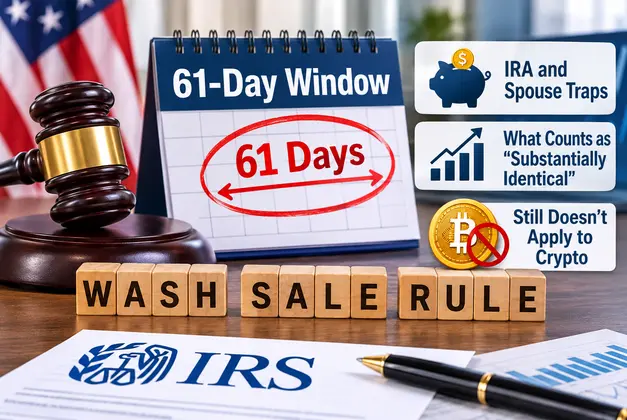
Quick answer: If you sell a stock or fund at a loss, and you, your spouse, or your IRA buys the same or a “substantially identical” one within 30 days before or after, you can’t deduct the loss now. In a regular account the loss moves into the new shares’ cost basis. In an IRA it’s lost for good.
Rebought in a regular account
LOSS DEFERRED: added to the new shares’ basis.
Rebought in an IRA or Roth IRA
LOSS LOST: no basis increase.
Crypto you hold directly
RULE DOESN’T APPLY (YET): a House bill would cover sales after Sept. 14, 2026 if enacted as drafted.
Enter your sale date to see the window, your first safe day to rebuy, and how much loss you’d lose: jump to the calculator.
Sell on December 31 and the window runs from December 1 through January 30. A purchase in early January can still cancel this year’s loss.
- How it works
- The 61 days
- What happens to the loss
- Hidden accounts
- Automatic buys
- Substantially identical
- Options
- Crypto
- Your tax forms
- How to avoid it
Rules and bill status verified November 5, 2026.
Wash Sale Window & Basis Calculator
Add a purchase (up to 3)
How the Wash Sale Rule Works
A wash sale is a disallowed loss, not a penalty and not a ban on selling.
Under IRC §1091 (see IRS Publication 550), you can’t deduct a loss on stock or securities if, within 30 days before or after the sale, you acquire substantially identical stock or securities, or a contract or option to acquire them. Three conditions: you sold at a loss, you bought (or got an option to buy) the same thing in the window, and it counts as substantially identical.
The 61-Day Window, Counted Correctly
The window is 61 calendar days: 30 before the sale, the sale date, and 30 after.
The rule looks backward too, so a purchase last week can matter. Count calendar days, not trading days; the trade date generally controls, not settlement. The first safe day to rebuy is sale date plus 31.
The December trap: a late-December sale pulls in early-January purchases, including automatic ones.
| Sale date | Window starts | Window ends | First safe day to rebuy |
|---|---|---|---|
| Nov. 28 | Oct. 29 | Dec. 28 | Dec. 29 |
| Dec. 15 | Nov. 15 | Jan. 14 | Jan. 15 |
| Dec. 31 | Dec. 1 | Jan. 30 | Jan. 31 |
What Happens to the Loss
In a taxable account the loss isn’t gone; it’s deferred into the replacement shares’ cost basis.
The replacement shares’ holding period also includes the old shares’ holding period. If you rebuy fewer shares than you sold, only the loss on the reacquired shares is disallowed (a partial wash sale).
Example (illustrative round numbers): Sam sells 100 shares at a $2,000 loss on December 15. His dividend reinvestment buys 3 shares on December 28. Disallowed loss: $2,000 ÷ 100 × 3 = $60. Sam can deduct $1,940, and the 3 new shares’ basis rises by $60. LOSS DEFERRED.
Net losses offset gains, then up to $3,000 of ordinary income ($1,500 if married filing separately), with carryforward. See Capital Gains Tax 2026.
Automatic Buys That Trigger It
A purchase you never click still counts.
Dividend reinvestment and recurring investments buy shares on a schedule, and either can land inside your window, in any account. Robo-advisor accounts can also buy without a prompt; see Are Robo-Advisors Worth It. A December mutual fund distribution is another year-end surprise: Mutual Fund Capital Gains Distributions.
“Substantially Identical”: Clear, Gray, and Generally Not
The IRS has no bright-line definition, so some swaps are clear and some are genuinely debated.
Same index, different fund company: the IRS hasn’t said. Two funds tracking the same index (for example VOO and IVV, used here only to illustrate) are a gray area, and practitioners disagree. Ask a tax professional before you trade. Funds tracking different indexes are generally treated as not identical, which isn’t the same as “safe.” See VTI vs VOO.
| Sold | Bought | Likely treatment | Why |
|---|---|---|---|
| Same stock | Same stock | Wash sale | Identical security |
| Stock | Call option on it | Wash sale | Option to acquire counts |
| One share class | Another class, same fund | Likely wash sale | Same portfolio |
| S&P 500 fund | Another company’s S&P 500 fund | Gray (IRS hasn’t ruled) | Same index, different issuers |
| S&P 500 fund | Total-market fund | Generally not | Different index |
| One company | A competitor | Generally not | Different issuer |
| Spot Bitcoin ETF | Same ETF | Wash sale | Security, same fund |
| Spot Bitcoin ETF | Another issuer’s ETF | Gray | Different issuers |
| Spot BTC | Spot BTC | Not under current law | Property, not a security |
Options and Wash Sales
Buying a call on a stock you just sold at a loss counts as acquiring an option to buy it.
Other option positions can raise harder questions; ask a tax professional. If an option expires in the money, see Option Expires In the Money.
Crypto: Not Now, But Watch H.R. 10357
Under current law the wash sale rule generally doesn’t reach crypto you hold directly; two House bills would change that, and neither is law.
Directly held digital assets are treated as property (IRS Notice 2014-21), and §1091 covers stock or securities. Spot crypto ETFs are securities, so the rule applies to them.
The crypto bill is not law, but its drafted date is September 14, 2026. H.R. 10357 would extend wash sale rules to “traded digital assets,” exclude U.S. dollar stablecoins, and treat wrapped or tokenized versions as substantially identical. As drafted, it applies to dispositions after Sept. 14, 2026. RULE DOESN’T APPLY (YET), and this could change. Re-check before you act.
| Bill | Sponsor | Introduced | Status | Drafted effective date |
|---|---|---|---|---|
| H.R. 10357, Digital Asset Tax Certainty Act | Jason Smith | Sept. 14, 2026 | Ordered reported by Ways and Means 38–5, Sept. 16, 2026; no House floor vote found as of Nov. 5, 2026; not law | Dispositions after Sept. 14, 2026 |
| H.R. 9172, Applying Existing Tax Anti-Abuse Rules to Digital Assets Act | Jodey Arrington | June 8, 2026 | Referred to Ways and Means; June 2026 wash sale proposal, since folded into the broader H.R. 10357 package; not law | Dispositions after introduction |
What the drafted date would mean. If H.R. 10357 were enacted as drafted, a loss on a traded digital asset sold after Sept. 14, 2026 would be subject to the wash sale rule if you bought the same or a substantially identical asset within 30 days before or after. That means a sale already made this fall could be affected. The bill could change before any final vote, and it might not become law at all. If you rebuy directly held crypto inside a window like that, keep your dates and ask a tax professional.
Crypto reporting is changing too: Got a 1099-DA for Crypto.
How Wash Sales Show Up on Your Tax Forms
Your broker reports the disallowed loss in Form 1099-B box 1g, and on Form 8949 you enter code W in column (f) and the disallowed loss as a positive number in column (g).
You still can’t deduct a wash sale loss that isn’t on your 1099-B. Add wash sales your broker couldn’t see, such as an IRA purchase or another firm’s. A mismatch can draw a notice: CP2000 on Your Stock Sale.
How to Harvest a Loss Without Triggering It
Wait until day 31, or stay invested in something that isn’t substantially identical.
A different-index replacement is the usual route, and the gray areas deserve a professional’s view. Some investors buy first and sell the old lot after 31 days; ask a tax professional whether that fits you. Coordinate the household. For the savings side, see Tax-Loss Harvesting and the Tax-Loss Harvesting Calculator.
| Mistake | Why it hurts | What to do instead |
|---|---|---|
| Rebuying in early January | A late-December sale’s window runs to late January | Wait until sale date + 31 |
| Forgetting dividend reinvestment | An automatic purchase counts | Turn it off in every account |
| Buying in the IRA | LOSS LOST, no basis increase | Pause IRA buys of the same fund |
| A spouse buying | Pub. 550 counts a spouse’s purchase | Coordinate the household |
| Relying on the 1099-B | It only shows what your broker can see | Keep your own records |
| Assuming same-index swaps are safe | The IRS hasn’t ruled | Use a different index, or ask a professional |
| Assuming crypto rules can’t change | H.R. 10357 is drafted to reach back to Sept. 14, 2026 | Check bill status and keep dates |
Before You Harvest
- 1. Turn off dividend reinvestment on that holding, in every account, at least until the window closes.
- 2. Pause recurring buys of the same fund, including in your IRA and your spouse’s accounts.
- 3. Check your spouse’s and your own other accounts for purchases in the last 30 days.
- 4. Pick a replacement that tracks a different index if you want to stay invested, or plan to wait 31 days.
- 5. Mark the first safe day on your calendar (sale date + 31).
- 6. Selling in late December? The window runs into late January.
- 7. Keep your own records. Your 1099-B may not catch everything.
- 8. Gray area? Ask a tax professional before you trade, not after.
FAQ
What is the wash sale rule?
It disallows a loss deduction if you buy substantially identical securities within 30 days before or after selling at a loss.
How many days do I have to wait to buy back a stock?
Wait until day 31 after the sale. Purchases within 30 days after the sale trigger the rule.
Does the 30 days include the day of the sale?
The full window is 61 days: 30 before, the sale date, and 30 after.
Does the rule apply to purchases before the sale?
Yes. A purchase within 30 days before the sale can disallow the loss.
What happens to a disallowed loss?
In a taxable account it’s added to the replacement shares’ basis. In an IRA it’s lost.
What is a partial wash sale?
If you rebuy fewer shares than you sold, only the loss on the reacquired shares is disallowed.
Does the wash sale rule apply to IRAs?
Yes. Buying in your IRA or Roth IRA triggers it (Rev. Rul. 2008-5), and basis isn’t increased.
Does it apply if my spouse buys the stock?
IRS Pub. 550 says yes. Confirm how it applies to your situation with a tax professional.
Does my broker track wash sales across accounts?
Generally only for the same security in the same account. Other accounts are on you.
Can dividend reinvestment cause a wash sale?
Yes. A reinvested dividend is a purchase, and it can land inside your window.
Are VOO and SPY substantially identical?
It’s a gray area. The IRS hasn’t ruled, and practitioners disagree. Ask a tax professional.
Is selling VOO and buying VTI a wash sale?
Generally treated as not identical because the indexes differ, but that isn’t a guarantee.
Does the wash sale rule apply to options?
Buying a call or other option to acquire the stock within the window counts.
Does the wash sale rule apply to crypto in 2026?
Not to directly held crypto under current law. Spot crypto ETFs are securities, so it applies to them.
Do Bitcoin ETFs follow the wash sale rule?
Yes. Selling and rebuying the same ETF is a wash sale; different issuers are gray.
What is H.R. 10357?
A House bill by Chairman Jason Smith that would extend wash sale rules to traded digital assets. Not law.
If I sell on December 31, when can I buy back?
January 31. The window runs December 1 through January 30.
How do I report a wash sale on my taxes?
Use Form 8949 with code W, and add adjustments your 1099-B (box 1g) missed.
Sources: IRC §1091, IRS Publication 550, Rev. Rul. 2008-5, Treas. Reg. §1.6045-1, the IRS instructions for Form 8949 (code W) and Form 1099-B (box 1g), IRS Notice 2014-21, H.R. 10357 actions on congress.gov, the Joint Committee on Taxation description (JCX-47-26), and H.R. 9172 on congress.gov.
Last updated:
This is general information, not tax advice. “Substantially identical” and several account situations have no bright-line answer, and pending legislation may change. Rules and bill status verified November 5, 2026.

Daniel Hayes is the founder and sole researcher at AdvoraHQ. He covers U.S. personal finance, insurance, and consumer law — working directly from IRS publications, federal and state statutes, court opinions, and SEC filings rather than secondary summaries. His focus is the gap between what readers think they know and what the source documents actually say. Daniel is not a licensed attorney, CPA, or financial advisor; his articles are educational and not personalized advice. Reach him at Daniel.Hayes@advorahq.com.
