See what the fee gap costs over your timeline →
Fees, holdings, and weights checked against Invesco, Vanguard, Nasdaq, S&P Dow Jones Indices, and SEC sources. Figures from other sources are labelled.
FUND COSTS — what you pay
Fee-Drag Calculator: What the Expense Ratio Gap Costs in Dollars
Enter your numbers and your own assumed return. The calculator applies each fund’s expense ratio to that same return.
INDEX RULES — what gets in. FUND COSTS — what you pay. YOUR MIX — what you hold. This guide sorts the differences into those three tiers.
INDEX RULES
What Each Fund Actually Holds
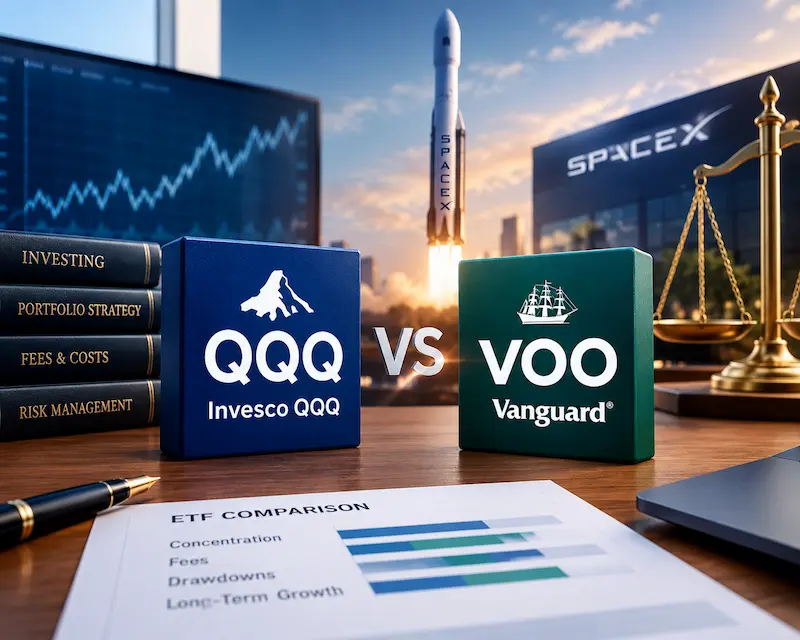
VOO holds roughly 500 large U.S. companies in every sector, while QQQ and QQQM hold the Nasdaq-100: about 100 of the largest non-financial companies listed on Nasdaq.
The Nasdaq-100 leaves out banks, insurers, and other financial companies by definition. The S&P 500 includes them. For VOO basics, see How to Invest in the S&P 500; for fund structure, see Index Funds vs ETFs.
| Fund | Tracks | Expense ratio | Holdings | Owns SpaceX? | Verified |
|---|---|---|---|---|---|
| VOO | S&P 500 | 0.03% (Vanguard, as of Apr. 28, 2026) | 505 securities (Vanguard, Sept. 30, 2026) | No — not eligible under S&P 500 rules | Oct. 28, 2026 |
| QQQ | Nasdaq-100 | 0.18% (Invesco; lowered from 0.20% on Dec. 22, 2025) | About 104 securities (Aug. 24, 2026; third-party count of Invesco's file) | Yes — 2.82% (Invesco, effective Sept. 22, 2026) | Oct. 28, 2026 |
| QQQM | Nasdaq-100 | 0.15% (Dow Jones Newswires, June 26, 2026) | Same index as QQQ | Yes — same index; weight follows the index | Oct. 28, 2026 |
VOO — Vanguard S&P 500 ETF
Tracks: S&P 500
Fee: 0.03% (as of Apr. 28, 2026)
Holdings: 505 securities (Sept. 30, 2026)
Top-10 weight: 40.6% (Sept. 30, 2026)
Owns SpaceX? No
QQQ — Invesco QQQ ETF
Tracks: Nasdaq-100
Fee: 0.18% (since Dec. 22, 2025)
Holdings: about 104 securities (Aug. 24, 2026)
Top-10 weight: about 47.7% (Q2 2026 holdings; third-party)
Owns SpaceX? Yes — 2.82% (Invesco, effective Sept. 22, 2026)
QQQM — Invesco Nasdaq 100 ETF
Tracks: Nasdaq-100
Fee: 0.15% (Dow Jones Newswires, June 26, 2026)
Holdings: same index as QQQ
Top-10 weight: same index as QQQ
Owns SpaceX? Yes — same index
INDEX RULES
The Rulebooks: How a Company Gets Into Each Index
The two indexes ask different things of a new company, and since spring 2026 those differences decide who owns SpaceX.
The S&P 500 requires seasoning and profitability. The Nasdaq-100 requires neither, and in May 2026 it added a fast lane for the largest new listings.
| Rule | S&P 500 | Nasdaq-100 |
|---|---|---|
| Profitability | Required: positive GAAP earnings in the latest quarter and over the four most recent quarters combined | Not required |
| Seasoning after IPO | 12 months | Normally three full calendar months; Fast Entry (since May 1, 2026) allows entry after 15 trading days for a company ranking in the index's top 40 by market cap |
| Minimum float | A minimum public-float (investable weight factor) screen remains | None; the former 10% minimum was removed on May 1, 2026 |
| Low-float weighting | Weighted by float-adjusted market cap | Weighted at up to 3× free-float value while float is under about 33.3% |
| Sector exclusions | None | Financial companies excluded |
| Constituent count | About 500 companies (VOO held 505 securities on Sept. 30, 2026) | 100 by design; temporarily more after Fast Entry added SpaceX with no removal |
| Rebalance schedule | Quarterly | Quarterly rebalance; annual reconstitution |
Profitability
S&P 500 — required: positive GAAP earnings in the latest quarter and over the last four combined.
Nasdaq-100 — not required.
Seasoning after IPO
S&P 500 — 12 months.
Nasdaq-100 — normally three full calendar months; Fast Entry allows 15 trading days for a top-40 company.
Minimum float
S&P 500 — a public-float screen remains.
Nasdaq-100 — none; the 10% minimum was removed May 1, 2026.
Low-float weighting
S&P 500 — float-adjusted market cap.
Nasdaq-100 — up to 3× free-float value while float is under about 33.3%.
Sector exclusions
S&P 500 — none.
Nasdaq-100 — financial companies excluded.
Constituent count
S&P 500 — about 500 companies.
Nasdaq-100 — 100 by design; temporarily more after SpaceX was added with no removal.
Rebalance schedule
S&P 500 — quarterly.
Nasdaq-100 — quarterly rebalance, annual reconstitution.
Sources: S&P DJI (June 4, 2026); Nasdaq methodology FAQ (July 2026); Callan; Schwab; Invesco. Checked Oct. 28, 2026.
INDEX RULES
The SpaceX Split: Why QQQ Owns It and VOO Doesn't
QQQ owns SpaceX because the Nasdaq-100 changed its rules in 2026 to admit it quickly; VOO doesn't because S&P Dow Jones Indices kept its rules as they were.
This is an index-composition story. Nothing here is a view on SpaceX's stock.
The timeline
- May 1, 2026 — Nasdaq's Fast Entry rule takes effect.
- June 4, 2026 — S&P Dow Jones Indices announces no changes to S&P 500 eligibility rules.
- June 12, 2026 — SpaceX (SPCX) lists on Nasdaq.
- June 18, 2026 — The CRSP US Total Market Index adds SpaceX, five trading days after listing.
- June 26, 2026 — Nasdaq announces SpaceX qualifies for the Nasdaq-100.
- July 7, 2026 — SpaceX joins the Nasdaq-100 before the open; no company is removed.
Fast Entry and the 3× float rule
Under Fast Entry, a newly listed company ranked in the Nasdaq-100's top 40 by market cap can be added after 15 trading days, instead of waiting for the normal seasoning period.
Nasdaq also removed its 10% minimum float requirement. In its place, a company's index weight is capped at three times the value of its free-floating shares. A company with a 5% float is weighted at 15% of its listed market value.
Above roughly one-third float (about 33.3%), the cap stops binding and the company is weighted at its full market cap.
The S&P 500 decision
On June 4, 2026, S&P Dow Jones Indices announced the results of its mega-cap consultation. For the S&P 500 it said "no changes will be made to the eligibility criteria," and it concluded that size alone does not justify exceptions to its financial viability, seasoning, or float requirements.
It had consulted on cutting seasoning from 12 months to 6, waiving the minimum float, and adding a financial-viability exception for mega-caps. The release reports no change on all three for the S&P 500.
SpaceX listed on June 12, 2026, so the 12-month rule means it cannot be eligible before June 2027. Eligible is not the same as selected: the index committee still chooses additions.
SpaceX's financials, plainly
In its S-1, SpaceX reported 2025 revenue of $18.67 billion and a GAAP net loss of $4.94 billion. Its Q1 2026 net loss was about $4.28 billion.
For Q2 2026 it reported a net loss of $541 million. For Q3 2026, reported October 20, 2026, it reported net income of $4.4 billion, which leaves a net loss of $413 million for the first nine months of 2026.
Its accumulated deficit was $37.45 billion at September 30, 2026 (Q3 10-Q), down from $41.85 billion at June 30.
The S&P 500 profitability screen looks at the latest quarter and at the four most recent quarters combined, so one profitable quarter does not settle it. The S&P 500's other screens also still apply.
How much of QQQ is SpaceX?
Invesco's QQQ monthly review, dated October 26, 2026, says SpaceX's weight rose from 1.28% to 2.82%, effective September 22, 2026, after the September 18 rebalance. Invesco attributes the rise to a larger free float after lock-up provisions expired.
The weight can change again as float grows and at each rebalance. Check Invesco's QQQ holdings page for the current figure and date.
INDEX RULES
Does My Fund Own SpaceX?
Pick your fund to see which index it tracks and which rule decides.
FUND COSTS
Fees: QQQ vs. QQQM vs. VOO
VOO charges 0.03% a year, QQQM 0.15%, and QQQ 0.18%, which on $10,000 is $3, $15, and $18 a year.
On $100,000, those are $30, $150, and $180 a year. The calculator above shows what the gap compounds to over your own timeline.
The December 2025 QQQ change
QQQ's expense ratio fell from 0.20% to 0.18% when Invesco converted it from a unit investment trust to an open-end ETF. Shareholders approved the change on December 19, 2025, and it took effect December 22, 2025.
Invesco said the conversion has no tax implications for QQQ investors. The new structure also lets the fund lend securities and reinvest income.
Why QQQM exists
QQQM tracks the same index at a lower fee, so it suits investors who hold for years rather than trade often. QQQ remains the larger and more heavily traded of the two; Invesco reported an average of 33.12 million QQQ shares traded a day in September 2026.
Other Nasdaq-100 funds now exist
State Street launched the SPDR Portfolio Nasdaq 100 ETF (QNDX) in June 2026 at a 0.10% expense ratio. BlackRock launched the iShares Nasdaq 100 ETF (IQQ) on July 9, 2026, with a 0.12% gross fee waived to 0.10% through July 31, 2027. Check each issuer's page for current fees.
For the wider cost picture, see Investment Fees. The expense ratio is one cost; the index you pick changes what you own, which can matter far more.
YOUR MIX
Concentration and Sector Tilt
QQQ is more concentrated than VOO: its top ten holdings carry more weight, and technology makes up a much larger share of it.
| Measure | VOO | QQQ |
|---|---|---|
| Top-10 weight | 40.6% (Vanguard, Sept. 30, 2026) | About 47.7% (Q2 2026 holdings, Helm Terminal; confirm on Invesco's holdings page) |
| Technology share (Invesco's ICB classification, Sept. 2026 average weights) | 44.77% (S&P 500, which VOO tracks) | 67.04% |
| Information technology (Vanguard's GICS classification) | 39.7% (Sept. 30, 2026) | Not reported on this basis |
| Largest holding | NVIDIA 8.4% (Vanguard, Sept. 30, 2026) | NVIDIA about 8.2% (Oct. 20, 2026; third-party fund data) |
| Holdings | 505 securities (Sept. 30, 2026) | About 104 securities (Aug. 24, 2026) |
| SpaceX weight | 0% — not a member | 2.82% (Invesco, effective Sept. 22, 2026) |
Invesco's own comparison shows the main gap: QQQ's technology holdings averaged 67.04% of the fund in September 2026, against 44.77% for the S&P 500. QQQ's consumer discretionary holdings averaged 16.05%, against 11.79%.
Health care, industrials, consumer staples, utilities, and materials carry real weight in the S&P 500 and far less in the Nasdaq-100.
YOUR MIX
Drawdowns: How Each Has Fallen Before
In the dot-com bust and in 2022, the Nasdaq-100 fell much further than the S&P 500; in 2008 the gap was smaller.
| Period | S&P 500 | Nasdaq-100 | Source |
|---|---|---|---|
| 2000–2002 (peak to trough, March 2000 to October 2002) | About -49% | Over -80% | ChartRow (S&P 500, to the Oct. 9, 2002 low); Nasdaq index research (Nasdaq-100) |
| 2008 (calendar-year total return) | -37.0% | About -42% (QQQ as proxy) | BTN Research (S&P 500); Trade That Swing -41.7% and ChartRow -41.9% (QQQ) |
| 2022 (calendar-year total return) | -18.1% | About -32.6% (QQQ as proxy) | S&P Global Market Intelligence; ChartRow |
Concentration cuts both ways. The same tilt toward fast-growing companies that can lift an index in good years has meant deeper falls when those stocks sold off. Whether that trade-off suits you depends on your timeline and how you would react to a large drop.
YOUR MIX
Holding Both: Overlap and What It Means
QQQ and VOO overlap by a little over half by weight, because the largest companies sit at the top of both indexes.
A Guardfolio comparison of full holdings dated August 24, 2026 found 53.6% overlap by weight across 87 shared securities. It also found that 94.3% of QQQ's weight sat in names VOO holds. Other trackers show 53% to 55% depending on date and method.
These figures sum the smaller of the two weights for every shared holding. SpaceX is one of the few meaningful QQQ holdings VOO lacks.
YOUR MIX
If You Own Both: A Copyable Checklist
- 1. Check your top-10 holdings across both funds — the same names appear in each.
- 2. Check your tech and communication-services share of the total.
- 3. Decide whether you want one core fund or a deliberate tilt.
- 4. If you hold QQQ long term, compare QQQM's lower fee (same index).
- 5. Check tax consequences before switching in a taxable account (see Tax-Loss Harvesting).
- 6. Rebalance on a schedule, not on headlines.
- 7. Re-check fund pages after each index rebalance (Nasdaq-100: quarterly rebalance, annual reconstitution; S&P 500: quarterly).
YOUR MIX
Which Fits Which Investor (No Verdict)
Each fund fits some goals better than others, and every choice carries a trade-off; this table lays them side by side without picking one.
| Goal | Common approach | Trade-off |
|---|---|---|
| One broad core holding | An S&P 500 fund such as VOO | Top ten holdings are about 40.6% of the fund; no SpaceX until S&P 500 eligibility rules are met (June 2027 at the earliest) |
| A growth tilt on top of a core | Add a Nasdaq-100 fund at a deliberate percentage | Technology averaged 67.04% of QQQ in September 2026; deeper past drawdowns; SpaceX held at its index weight |
| Lowest cost | VOO at 0.03%, against QQQM at 0.15% and QQQ at 0.18% | The fee gap is small next to the difference between the two indexes |
| Same index, long holding period | QQQM instead of QQQ | QQQ is the more heavily traded fund (average $23.99 billion a day in September 2026, per Invesco) |
| Both funds | Hold one as the core and the other as a sized tilt | About 53.6% overlap by weight, so the biggest names count twice |
Building a full allocation? See How to Build an Investment Portfolio. Comparing VOO with a dividend fund instead? See SCHD vs VOO.
If you landed here looking for TQQQ or another leveraged Nasdaq-100 product, those work differently: see Why Leveraged ETFs Lose Value.
Frequently Asked Questions
What's the difference between QQQ and VOO?
VOO tracks the S&P 500, about 500 large U.S. companies in every sector, for 0.03% a year. QQQ tracks the Nasdaq-100, about 100 of the largest non-financial Nasdaq-listed companies, for 0.18%.
Is QQQ riskier than VOO?
In past downturns the Nasdaq-100 has fallen further than the S&P 500 (see the drawdowns table), and QQQ is more concentrated in technology. Past results do not predict future ones.
Is QQQ or VOO better for long-term investing?
Neither is better in general; they are built differently. VOO is broader and cheaper, while QQQ is more concentrated in growth and technology.
What's the difference between QQQ and QQQM?
Both track the Nasdaq-100, so they hold the same companies at the same weights. QQQ charges 0.18% and QQQM 0.15%, and QQQ is the older, more heavily traded fund.
What is QQQ's expense ratio now?
QQQ's expense ratio is 0.18%, down from 0.20% since December 22, 2025. Invesco's October 26, 2026 review lists it at 0.18%.
Does QQQ own SpaceX?
Yes. SpaceX joined the Nasdaq-100 on July 7, 2026, and QQQ holds it at 2.82% per Invesco, effective September 22, 2026.
Does VOO own SpaceX?
No. VOO tracks the S&P 500, which does not include SpaceX and cannot before June 2027 at the earliest.
Why isn't SpaceX in the S&P 500?
The S&P 500 requires 12 months of trading after an IPO, positive GAAP earnings, and a minimum public float. On June 4, 2026, S&P Dow Jones Indices declined to waive these for mega-cap companies.
When could SpaceX join the S&P 500?
The earliest it could be eligible is June 2027, 12 months after its June 12, 2026 listing, and only if it meets the profitability screen. The index committee must still select it, and S&P has announced nothing. This is not a prediction.
What is the Nasdaq-100 fast-entry rule?
A newly listed company ranked in the index's top 40 by market cap can be added after 15 trading days, without removing another company. It took effect May 1, 2026.
What is the 3× float rule?
A company's index weight is capped at three times the value of its free-floating shares, which applies while float is under about 33.3%. A company with a 5% float is weighted at 15% of its listed market value.
How much of QQQ is SpaceX?
Invesco's October 26, 2026 review puts it at 2.82%, effective September 22, 2026, up from 1.28%. The weight changes with float and rebalances, so check Invesco's holdings page.
How much do QQQ and VOO overlap?
About 53.6% by weight across 87 shared securities in a full-holdings comparison dated August 24, 2026. Other trackers show 53% to 55%.
Should I own both QQQ and VOO?
That is your decision, and this is not a recommendation. Owning both doubles up on the largest names; some investors hold one as a core and the other as a sized tilt. The checklist above covers what to review.
Why doesn't the Nasdaq-100 include banks?
The index is defined as the largest non-financial companies listed on Nasdaq. Banks, insurers, and other financial companies are excluded by definition, even when Nasdaq-listed.
How did QQQ do in 2022 vs. VOO?
QQQ returned about -32.6% with dividends in 2022, against -18.1% for the S&P 500, which VOO tracks. Historical figures; past results do not predict future ones.
How far did the Nasdaq-100 fall in 2000–2002?
Nasdaq's index research puts the peak-to-trough decline at over 80%, from March 2000 to October 2002. The S&P 500 fell about 49% over the same stretch.
Does VTI own SpaceX?
Its index, the CRSP US Total Market Index, added SpaceX on June 18, 2026, and press reports describe VTI as holding it at a small weight. Confirm the current weight on Vanguard's holdings page.
Sources
- Invesco QQQ monthly review, dated October 26, 2026
- Invesco: QQQ shareholders approve modernization (December 19, 2025)
- Vanguard S&P 500 ETF fact sheet (September 30, 2026)
- Nasdaq-100 methodology changes FAQ (July 2026)
- Nasdaq index research on the Nasdaq-100 (2022)
- S&P Dow Jones Indices: consultation on treatment of MegaCap companies, results (June 4, 2026)
- CNBC on S&P Dow Jones Indices' June 4, 2026 decision
- Schwab: some indexes accelerate entry for massive IPOs
- SpaceX Q2 2026 results, SEC Form 8-K
- SpaceX Form 10-Q for the quarter ended September 30, 2026
- S&P Global Market Intelligence on the S&P 500's 2022 return
- Guardfolio: QQQ vs VOO overlap (holdings dated August 24, 2026)
Last updated: . Re-verify after each Nasdaq-100 rebalance and if S&P changes its rules.
This article is general information, not investment advice. Fees, holdings, and weights were verified on October 28, 2026 from issuer, index-provider, and SEC sources, with third-party figures labelled. Past performance doesn't predict future results.

Daniel Hayes is the founder and sole researcher at AdvoraHQ. He covers U.S. personal finance, insurance, and consumer law — working directly from IRS publications, federal and state statutes, court opinions, and SEC filings rather than secondary summaries. His focus is the gap between what readers think they know and what the source documents actually say. Daniel is not a licensed attorney, CPA, or financial advisor; his articles are educational and not personalized advice. Reach him at Daniel.Hayes@advorahq.com.