
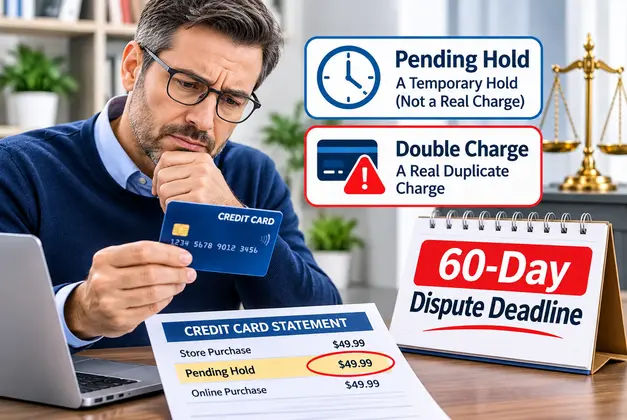
WAIT. If one of the two charges says Pending, you most likely haven’t been charged twice yet. A pending line is usually a temporary hold that drops off or turns into the single real charge. If both say Posted, that’s a possible real duplicate, and the steps below matter.
Answer a few quick questions. See whether to wait or act →
ACT NOW: Both charges posted? Go straight to what to do →
Typical hold times
- Most stores and online orders
- Usually a few days to about a week
- Gas pumps
- Often 1–3 days
- Hotels and car rentals
- Up to about 30 days
Based on card-network rules; your bank may release sooner or later.
Verified .
Was I Really Charged Twice? A 30-Second Check
Treat this as possible fraud. Lock your card and see unauthorized charges →
Your 60-day window starts from the statement that shows it. Use the deadline calculator →
Ready to dispute? See how to dispute a credit card charge →
Debit hold causing overdraft trouble? See how to get overdraft fees refunded →
Canceled but still charged? See canceled subscription still charged →
Pending vs. Posted: What You’re Actually Looking At
A pending charge is a hold your bank placed after the merchant asked for approval. A posted charge is the final one that settles. Both can show at once for the same purchase, which is why one purchase can look like two charges.
Every card purchase follows the same path. First, the merchant asks your card issuer to approve the amount and hold it. That is the authorization. Nothing has moved yet, and your app shows it as pending.
Later, the merchant sends the final charge. That is settlement, and it posts to your account. The hold should then release. During the overlap, both lines can appear. That is the most common “charged twice” moment.
On a credit card, a hold lowers your available credit, not your current balance. A big hold can leave too little room for your next purchase. If that happened, see Credit Card Declined but You Have Available Credit?
The one-minute read
Look at three things: the status word, the amounts, and the dates. The table below turns them into a verdict.
| What you see | Verdict |
|---|---|
| One pending, one posted, same amount | WAIT. Most likely the hold plus the real charge. |
| Two pending, same amount, under 7 days | WAIT. One usually drops off. |
| Two pending, past the usual window | CHECK. Ask the merchant to reverse it. |
| Both posted, same amount | ACT NOW. Possible real duplicate. |
| Different amounts at a restaurant | WAIT. Usually pre-tip and with-tip. |
| You don’t recognize either charge | ACT NOW. Possible fraud; see unauthorized charges. |
6 Reasons You See Two Charges
Six everyday situations create two lines for one purchase: gas pumps, hotels and rentals, restaurant tips, multi-item online orders, payment retries or double taps, and subscriptions or free trials. Open the one that matches yours.
Gas pump: a big hold plus the real charge
What you see: A large pending amount next to the smaller real charge.
Why: At the pump, the station can’t know your total, so it asks your bank to hold a pre-authorization first. Visa and Mastercard raised their pump limit from $125 to $175 in 2022. The station sets the actual amount.
When it clears: Often 1–3 days, once the real amount posts. Your bank decides when the hold disappears.
When to act: WAIT for a few days. CHECK with your bank if the big hold is still there after about 5 days.
Hotel or car rental: a hold bigger than the bill
What you see: A pending hold larger than your final bill, still showing after checkout or return.
Why: These merchants place an estimated authorization plus a cushion for extras. Network rules let lodging and vehicle rental merchants hold for up to about 30 days.
When it clears: Often a few days after checkout or return. It can stretch toward 30 days.
When to act: WAIT about a week. Then CHECK: ask the merchant to release the extra amount. On a debit card, ask sooner, because the hold ties up cash.
Restaurant or bar: pre-tip and with-tip
What you see: Two lines with different amounts, one lower than the other.
Why: The restaurant authorized your bill before the tip, then sent the final amount with the tip added. The pre-tip line should drop off.
When it clears: Usually within a few days.
When to act: WAIT. If both lines post, or the lower one stays past about 5 days, CHECK your receipt and ask the restaurant.
Online order with several items
What you see: Two or more charges from one order, same or different amounts.
Why: Some retailers charge per shipment. Amazon’s own help page says it charges when each part of a split order ships (Identify an Amazon Charge). Check your order emails; each shipment lists its own total.
When it clears: A leftover pending authorization usually drops within about 7–10 days.
When to act: CHECK your order emails first. If the shipment totals don’t add up to your order total, or two posted charges match one shipment, ACT NOW and contact the retailer.
Payment retry or double tap
What you see: Two identical lines after a spinner, a timeout, a “payment failed” message, or a second tap.
Why: Each attempt can create its own authorization. If the first one actually went through, the retry makes a second. One usually drops.
When it clears: In store, same day to about 5 days. Online, about 7–10 days.
When to act: CHECK whether you got two order confirmations. If you did, you may have two orders; cancel one. If you got one, WAIT, then ask the merchant to reverse the extra authorization.
Subscription or free trial
What you see: A $0 or $1 charge before a trial, or a charge on the day the trial ends that looks like a repeat.
Why: Merchants can verify a card with a small authorization that drops off. A trial-to-paid charge is different: it is a real charge, not a duplicate. A true duplicate can come from two active subscriptions.
When it clears: Verification holds drop within the online window. Real charges do not.
When to act: CHECK your account for two active plans. If you canceled and were still charged, ACT NOW: see Canceled a Subscription but Still Charged?
How Long Holds Usually Last, and Why Sources Disagree
Most holds clear within days, but the exact length depends on the merchant type and your bank, not on one rule. Card networks set maximum windows, and published summaries disagree on details, so treat every number as a range.
| Merchant type | Usual window |
|---|---|
| Most in-store (card present) | Same day to about 5 days |
| Most online (card not present) | About 7 to 10 days |
| Gas pumps | Often 1 to 3 days; pre-authorization up to $175 |
| Restaurants and bars | Same day to about 5 days |
| Hotels, car rentals, cruises | Up to about 30 to 31 days |
| Mastercard pre-authorization | Up to about 30 days |
Why the numbers don’t match
Visa’s own merchant guide lists 5 days for card-present, 10 days for card-absent, 10 days for rental categories, and 30 days for lodging, vehicle rental and cruise lines. Many processor summaries instead list same day, 7 days and 31 days.
The sources measure different things: estimated versus final authorizations, card-present versus online, and country rules. Mastercard pre-authorizations are described as valid for up to about 30 days.
The network rule is a ceiling. Your bank decides when the line leaves your app, and it may release sooner or later.
Asking for an early release
A merchant can release a hold early by sending an authorization reversal. Visa’s merchant guide expects unneeded authorization amounts to be reversed within 24 hours of finishing a transaction. Ask for a confirmation or reference number, then give your bank a day or two to show it.
Not sure which window applies? Use the 30-second check.
Credit vs. Debit: Same Problem, Different Damage
On a credit card, a hold uses up available credit and no cash leaves your bank. On a debit card, a hold freezes real money in your account. Different federal laws cover each, though both use a 60-day reporting window.
| Issue | Credit card | Debit card |
|---|---|---|
| What’s frozen | Part of your available credit. No cash leaves your bank account. | Real cash in your account, right away. |
| Governing rule | Fair Credit Billing Act / Regulation Z (12 CFR 1026.13) | Electronic Fund Transfer Act / Regulation E (12 CFR 1005.11) |
| Reporting window | Written notice must reach the issuer within 60 days after it sent the first statement showing the error. | Notice must reach the bank within 60 days after the statement showing the error. A call counts; the bank may ask for written confirmation within 10 business days. |
| Investigation timing | Acknowledged within 30 days; resolved within two billing cycles, no more than 90 days. You may withhold the disputed amount. | 10 business days to decide, or up to 45 days if the bank gives provisional credit. Up to 90 days for point-of-sale debit purchases. |
| Overdraft risk | None from the hold itself, but a big hold can leave too little available credit. | Real: less spendable cash can lead to overdraft or declined purchases. |
Credit cards
The FTC lists a company billing you twice for the same thing as a billing error (FTC: Disputing Credit Card Charges). To keep your federal rights, send written notice to the billing-error address on your statement. You can withhold the disputed amount while it’s investigated.
Debit cards
A duplicate debit is generally treated as an incorrect transfer, which Regulation E calls an error. The bank must investigate, and may owe you provisional credit while it does. See Provisional Credit Reversed? Bank Fraud Refund Rules.
A hold can also leave you short for the next purchase and trigger overdraft or insufficient-funds consequences. Bank policies vary, and federal guidance on surprise overdraft fees has been in flux (the CFPB withdrew its 2022 circular on them in May 2025). Don’t assume a refund; ask. See How to Get Overdraft Fees Refunded.
What to Do, in Order
Work in this order: wait out the usual hold window, ask the merchant, ask your bank, then send a written dispute. If both charges have posted, skip the waiting and start at the merchant step today.
- Save proof first. Screenshot both lines. Pending lines can vanish, and you may need them. Confirm the purchase is yours.
- WAIT through the usual window. Use the hold-time table. Check back daily. Pending charges generally can’t be formally disputed until they post.
- CHECK with the merchant. Ask them to reverse the duplicate authorization or refund the duplicate, and to give you a reference number. Message 1 below is ready to send. If they agree to refund a posted charge, see How Long Does a Credit Card Refund Take?
- CHECK with your bank. If a pending duplicate outlasts its window, ask the bank to release it or say when it expires. Message 2 does this.
- ACT NOW with a written dispute. If a duplicate has posted and the merchant hasn’t fixed it, send written notice. Message 3 is the short version; the full process is in How to Dispute a Credit Card Charge. Behind the scenes, card networks have a “duplicate processing” dispute category, but that is your issuer’s process, not something you file yourself.
One-Tap Messages
Fill in the brackets, then copy. Never put your full card number in a chat or email.
1. To the merchant (live chat), to reverse a duplicate hold
I was charged twice for order/receipt [#] on [date]: two charges of $[amount]. I only made one purchase. Please reverse the duplicate authorization or refund it, and send me the confirmation or reference number.
2. To your bank, for a pending charge stuck past the usual window
A pending charge from [merchant] for $[amount] dated [date] hasn't dropped off after [x] days. The merchant says [response]. Can you release the hold or tell me when it will expire?
3. Written billing-error notice (credit), short version
I am disputing a billing error on account ending [last 4]. On my statement dated [date], [merchant] charged $[amount] twice on [date]. I made one purchase. Please remove the duplicate charge of $[amount]. Copies of my receipt are enclosed.
Send this to the billing-error address on your statement, not the payment address. For the full letter, see How to Dispute a Credit Card Charge.
The 60-Day Clock
The 60-day clock starts when the statement showing the error was sent, not when you bought the item. On a credit card, your issuer must receive your written notice within those 60 days for your federal billing-error rights to apply.
- When it starts. From the first statement that shows the error. If no statement was sent, from when one should have been.
- In writing. Send it to the billing-error address on your statement. A phone call alone may not preserve your rights. If your issuer’s billing-rights notice says it accepts electronic notices, those count as written. The FTC suggests mail with a return receipt as proof of delivery.
- What the issuer must do. Acknowledge within 30 days, then resolve within two billing cycles and no more than 90 days.
- Withholding payment. You don’t have to pay the disputed amount or related finance charges while it’s investigated. Pay the rest of your bill. During the investigation, the issuer can’t collect the disputed amount or report you delinquent on it.
Dispute Deadline Calculator
Find your 60-day date
Ready to write the notice? Start with How to Dispute a Credit Card Charge.
When It’s Not a Duplicate
Two lines can both be legitimate. Before you dispute, rule out the four cases below, because a wrong dispute wastes time you may need on a real one.
- Different amounts abroad. A currency conversion or a dollars-versus-local-currency choice can make the same purchase show up with different amounts. See Pay in Dollars or Local Currency?
- A split order. Two shipments can mean two real charges, each matching its own shipment.
- A charge you don’t recognize. If it isn’t yours, it isn’t a duplicate. See Unauthorized Credit Card Charges.
- A canceled subscription. A charge after you canceled is a different problem. See Canceled Subscription Still Charged.
Holiday Shopping: How to Avoid the Double-Charge Panic
You can’t stop every hold, but a few habits prevent most scares. During holiday shopping, orders ship in pieces and checkouts get slow, so double lines are more common.
- Don’t hit “pay” twice. Wait for the confirmation page or email before you retry.
- Check order emails. Each shipment and each retry should have its own email and total.
- Think credit over debit for gas, hotels and rentals. These use holds, and a credit hold doesn’t freeze cash. This is a general point about how holds work, not a card recommendation.
- Watch your available balance. Holds change it before charges post.
- Screenshot pending lines. They can disappear, and the screenshot is your proof.
Frequently Asked Questions
Why do I have two pending charges for the same amount?
Usually the merchant asked your bank for approval twice: a retry, a double tap, a changed order, or a split shipment. One is normally reversed or becomes the real charge. A pending line can still post, so give it the usual window, then ask.
Will one of the pending charges drop off automatically?
Often, yes. Authorizations expire or are reversed when the final charge posts or the window ends. That is days for most purchases and up to about 30 days for hotels and rentals. Your issuer may release sooner or later.
How long does a duplicate pending charge take to disappear?
Plan on a few days for in-store purchases and about 7 to 10 days for most online ones. Gas pump holds are often 1 to 3 days, and hotel or rental holds can run toward 30. See the hold-time table.
Why is a pending charge still there after 7 days?
Seven days is a common summary figure, but Visa’s merchant guide lists 10 days for card-absent authorizations, and lodging or rentals can run to about 30. If you’re past the range for your merchant type, ask the merchant for a reversal, then your bank.
Can I dispute a charge while it’s still pending?
Usually not. Issuers typically wait until it posts, because a pending line may still disappear. Meanwhile, ask the merchant to reverse the authorization or ask your bank to release or explain the hold. Save screenshots in case it posts.
Should I contact the merchant or my bank first?
For a pending duplicate, start with the merchant, who can send a reversal. If that doesn’t help or the hold outlasts the usual window, ask your bank. For a posted duplicate, contact the merchant right away and watch the 60-day clock.
Why did a restaurant charge me twice with different amounts?
The first line is usually your bill before the tip, and the second is the final amount with the tip. The pre-tip hold should drop within a few days. If both post, compare against your receipt and ask the restaurant.
Why did a gas station put a large hold on my card?
At the pump, the station doesn’t know your total, so it asks your bank to hold a pre-authorization. Visa and Mastercard raised their limit for this to $175 in 2022. The hold should release after the real amount posts.
How long do hotel holds last after checkout?
Often a few days, but network rules let lodging merchants hold for up to about 30 days. If extra money is still held after about a week, ask the hotel to release it. On debit, ask sooner, because the hold ties up cash.
Why did one online order show several charges?
Some retailers charge each shipment separately. Amazon’s help page, for example, says it charges when each part of a split order ships. Check your order emails: shipment totals should add up to your order total. If they don’t, contact the retailer.
Can a merchant release a hold early?
Yes, by sending an authorization reversal. Visa’s merchant guide expects unneeded authorization amounts to be reversed within 24 hours of finishing a transaction. Your bank still has to process it, so ask for a confirmation or reference number.
What if both charges posted?
Treat it as a possible duplicate and act now. Check receipts and order emails, ask the merchant for a refund, and note the statement date. On a credit card, written notice must reach your issuer within 60 days of that statement.
When does the 60-day dispute window start?
On credit, it starts when your issuer sent the first statement showing the error, not on the purchase date. On debit, it runs from the statement showing the error. Use the calculator to find your date.
Do I have to dispute in writing?
For federal credit card billing-error rights, yes: written notice to the billing-error address. Many issuers also take phone or online disputes, but only written notice is what the law protects. For debit, a call counts, though the bank may ask you to confirm in writing within 10 business days.
Can I withhold payment on the duplicate amount?
On a credit card, once you send a valid billing-error notice, you don’t have to pay the disputed amount or related finance charges while it’s investigated. Pay the undisputed rest. Debit is different: the money already left, so ask about provisional credit.
What if a debit card hold caused an overdraft fee?
Ask your bank to review and reverse the fee, explaining that a pending hold caused it. Policies vary and federal guidance has shifted, so don’t assume a refund. See How to Get Overdraft Fees Refunded.
Sources
- CFPB: Regulation Z §1026.13, billing error resolution
- CFPB: Regulation E §1005.11, error resolution
- 15 U.S.C. §1666, Fair Credit Billing Act
- FTC: Disputing Credit Card Charges
- Visa: Authorization and Reversal Processing (2023)
- Adyen: authorisation holds, by card network
- Amazon: Identify an Amazon Charge
- ABA Banking Journal: CFPB rescinds dozens of guidance documents (May 2025)
Last updated: . Network hold windows are re-verified yearly.
This article is general information, not legal advice. Hold times come from card-network rules and vary by issuer and merchant. Federal rights are summarized as verified on November 16, 2026. Follow your card issuer's dispute instructions.

Daniel Hayes is the founder and sole researcher at AdvoraHQ. He covers U.S. personal finance, insurance, and consumer law — working directly from IRS publications, federal and state statutes, court opinions, and SEC filings rather than secondary summaries. His focus is the gap between what readers think they know and what the source documents actually say. Daniel is not a licensed attorney, CPA, or financial advisor; his articles are educational and not personalized advice. Reach him at Daniel.Hayes@advorahq.com.
