
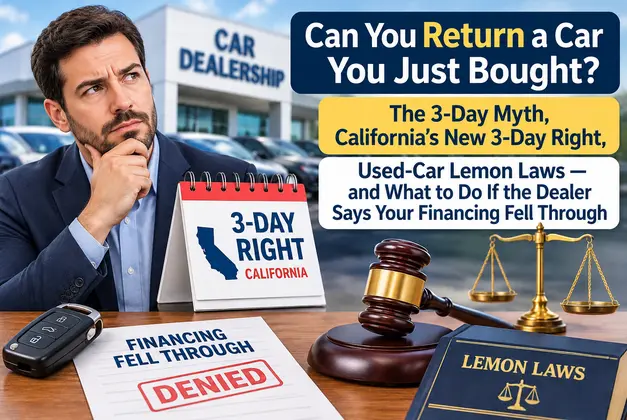
Can I Return a Car I Just Bought? The Quick Answer
YES, in one case
A used car of $50,000 or less bought from a California dealer on or after October 1, 2026. You have 3 calendar days if you’ve driven it 400 miles or fewer. The fee is up to $750.
NO automatic right everywhere else
That includes new cars in California. Your options are the contract’s return policy, a defect remedy, or a fraud claim.
DEPENDS if the dealer says “your financing fell through”
If the dealer cancels the deal, it generally must give back your down payment and trade-in. You don’t automatically have to sign a worse contract.
Don’t do these today
- Don’t sign a new contract under pressure.
- Don’t stop making payments or abandon the car.
- In California, don’t keep driving: the right ends after 400 miles.
- The 3-day myth
- California’s new right
- Financing fell through
- As is & lemon laws
- Bought online
- Private seller
- Your exit options
- Scripts
California rules verified . Other states can change; check your attorney general.
Last updated:
Can I Undo This Car Deal? A 30-Second Checker
Answer eight quick questions. Nothing is saved or sent anywhere, and there are no names, VINs or contract numbers to enter.
The 3-Day Myth: Why the Federal Rule Doesn’t Cover a Dealer’s Lot
The FTC’s 3-day Cooling-Off Rule does not apply to a car you bought at a dealership.
That rule covers sales made at your home, your workplace or a dorm, and sales at a temporary location the seller rents, such as a hotel room, convention center or restaurant. It was written for door-to-door selling.
Cars are carved out. The rule exempts vehicles sold at tent sales and other temporary events when the seller has a permanent place of business (16 CFR Part 429, section 429.3). A dealer’s lot is that permanent place of business, so it is outside the rule altogether.
There is also no general national right to return a car. Whether you can return one comes down to your contract, a state law that fits your facts, or, since October 1, 2026, California’s new used-car right.
The FTC did try to write new federal dealer rules (the CARS Rule). The Fifth Circuit vacated it on January 27, 2025, on procedural grounds, before it took effect (Fifth Circuit opinion, No. 24-60013). California answered with its own law about eight months later.
Your Situation, Your Rights
You have an automatic right to return the car in only one situation. Everything else depends on a contract, a defect or a lie.
| Situation | Automatic right to return? | What decides it | First move |
|---|---|---|---|
| California, used car of $50,000 or less, from a dealer | YES | Sale on or after October 1, 2026; 400 miles or fewer; within 3 calendar days of signing. | Take the car back in person with the dealer’s 3-Day form and an odometer photo. |
| California, new car | NO | The contract’s return policy. For defects, the new-car lemon law. | Read the contract’s return clause. If something is broken, document it. |
| Dealer in another state | NO | Your contract and your state’s law. Other states may pass similar rules. | Read the contract. Ask in writing for a voluntary unwind. Check your attorney general’s site. |
| Online retailer with delivery | DEPENDS | The retailer’s contract return window, mileage limit and fees. In California, the state right may also apply if the seller is a licensed dealer and the car is used and $50,000 or less. | Read the return terms today. If you’re inside the window, start the return in writing. |
| Private seller | NO | What you both signed. Misrepresentation and fraud are the only routes. | Gather the listing, texts and bill of sale. Put your complaint in writing. |
| Dealer event at a temporary location | NO | The FTC rule exempts vehicles sold this way by dealers with a permanent place of business. In California, run the checker: the state right may still apply. | Read the contract. In California, ask for the dealer’s 3-Day form. |
| Financing fell through | DEPENDS | Whether the dealer cancels the deal or asks for a new contract; the contract’s financing clause; your state’s spot-delivery rules. | Ask in writing for the lender’s denial. Don’t sign new terms under pressure. |
| Defect found | DEPENDS | The Buyers Guide box, your state’s implied-warranty or used-car lemon law, or the new-car lemon law for a new car. | Document it, get a written repair estimate and read the Buyers Guide. |
| Dealer misrepresented the car or terms | DEPENDS | What was said or hidden, and whether it was written down. | Gather ads, texts and the contract. Contact your attorney general or a consumer attorney. |
California, used car of $50,000 or less, from a dealer
Automatic right to return?: YES
What decides it: Sale on or after October 1, 2026; 400 miles or fewer; within 3 calendar days of signing.
First move: Take the car back in person with the dealer’s 3-Day form and an odometer photo.
California, new car
Automatic right to return?: NO
What decides it: The contract’s return policy. For defects, the new-car lemon law.
First move: Read the contract’s return clause. If something is broken, document it.
Dealer in another state
Automatic right to return?: NO
What decides it: Your contract and your state’s law. Other states may pass similar rules.
First move: Read the contract. Ask in writing for a voluntary unwind. Check your attorney general’s site.
Online retailer with delivery
Automatic right to return?: DEPENDS
What decides it: The retailer’s contract return window, mileage limit and fees. In California, the state right may also apply if the seller is a licensed dealer and the car is used and $50,000 or less.
First move: Read the return terms today. If you’re inside the window, start the return in writing.
Private seller
Automatic right to return?: NO
What decides it: What you both signed. Misrepresentation and fraud are the only routes.
First move: Gather the listing, texts and bill of sale. Put your complaint in writing.
Dealer event at a temporary location
Automatic right to return?: NO
What decides it: The FTC rule exempts vehicles sold this way by dealers with a permanent place of business. In California, run the checker: the state right may still apply.
First move: Read the contract. In California, ask for the dealer’s 3-Day form.
Financing fell through
Automatic right to return?: DEPENDS
What decides it: Whether the dealer cancels the deal or asks for a new contract; the contract’s financing clause; your state’s spot-delivery rules.
First move: Ask in writing for the lender’s denial. Don’t sign new terms under pressure.
Defect found
Automatic right to return?: DEPENDS
What decides it: The Buyers Guide box, your state’s implied-warranty or used-car lemon law, or the new-car lemon law for a new car.
First move: Document it, get a written repair estimate and read the Buyers Guide.
Dealer misrepresented the car or terms
Automatic right to return?: DEPENDS
What decides it: What was said or hidden, and whether it was written down.
First move: Gather ads, texts and the contract. Contact your attorney general or a consumer attorney.
Table 1. California rows verified November 18, 2026.
California’s New 3-Day Right to Cancel (Since October 1, 2026)
If you bought a used car of $50,000 or less from a California dealer on or after October 1, 2026, you can cancel for any reason within 3 calendar days, as long as you’ve driven 400 miles or fewer.
The law is California’s CARS Act (SB 766, Chapter 354, Statutes of 2025). It replaced the old optional, paid two-day option with an automatic right, and it covers leases too. California rules verified ; other states may follow.
Who is covered, and when the clock runs
The car must be used, sold or leased by a dealer, and priced at $50,000 or less. The 3 days are calendar days, so weekends count (California DMV).
Day 1 is the day after you sign, even if you haven’t taken delivery. You cancel by bringing the car back in person during business hours.
What it costs
The dealer can keep a restocking fee of 1.5% of the price ($200 minimum, $600 maximum). Add $1 for each mile over 250, up to $150. The most you can pay is $750.
Example: on a $20,000 car returned after 300 miles, the fee is $300 plus $50 for mileage, or $350. Use the calculator below for your own numbers.
Refund and trade-in
The dealer must cancel the contract and refund you within 48 hours, less the permitted fee. It must also return your trade-in or pay you its value.
What the dealer can’t do
It can’t stall or discourage your cancellation, overcharge the fee, hold on to your down payment or trade-in, make damage claims it can’t support, or tell you the person who handles refunds “isn’t available.”
The car must come back with reasonable wear and tear. That is normal use, not new dents or stains.
New cars are not covered
California has no cooling-off period for new vehicles. A new car’s remedies are the contract’s return policy and the new-car lemon law for defects.
| Rule | Detail | Source |
|---|---|---|
| Who is covered | Used vehicles sold or leased at retail by a California dealer for $50,000 or less. Includes rideshare workers and small businesses that buy or lease used vehicles at that price. | SB 766, Civil Code 1784.43 |
| Price cap | $50,000 or less. | SB 766, Civil Code 1784.43 |
| Window | 3 calendar days, including weekends. The clock starts the day after you sign, not the day you take delivery. It ends at close of business on day 3, or the next day the dealer is open to the public if day 3 falls on a closed day. | SB 766, Civil Code 1784.43; California DMV |
| Mileage limit | The right ends once the car has been driven more than 400 miles between signing and your attempt to cancel. Exactly 400 is still inside the right. | SB 766, Civil Code 1784.43 |
| Fee formula | Restocking fee of 1.5% of the sale price, minimum $200 and maximum $600, plus $1 for each mile over 250 (the mileage charge is capped at $150). If the dealer charged a shipping fee, it can keep its actual shipping cost instead of the basic fee, subject to the same cap. | SB 766, Civil Code 1784.43 |
| Total cap | $750 ($600 restocking fee plus $150 mileage charge). | SB 766, Civil Code 1784.43 |
| Refund timing | The dealer must cancel the contract and refund you within 48 hours. If you paid by check, it may wait 2 business days after the payment clears. | SB 766, Civil Code 1784.43 |
| Trade-in | The dealer must return your trade-in or pay you the greatest of its value in the contract, the amount the dealer sold it for, or its fair market value. | SB 766, Civil Code 1784.43 |
| New cars | Excluded. California has no cooling-off period for new vehicles. | SB 766, Civil Code 1784.43 |
| Excluded sales | Motorcycles, auction and wholesale sales, fleet sales, vehicles with a 10,000-pound or higher gross vehicle weight rating, and a few others. | SB 766, Civil Code 1784.43 |
| Dealer prohibitions | Stalling or discouraging a cancellation; overcharging the restocking fee; holding your down payment or trade-in; making damage claims without a reasonable basis; saying the person who can process the refund “isn’t available.” | SB 766, Civil Code 1784.43 |
| Required notices | A large (36-point) notice in the dealership, a clear notice on the first page of the contract and a separate form titled “3-Day Right to Cancel Used Car Purchase or Lease.” | SB 766, Civil Code 1784.43 |
| Effective date | October 1, 2026. The law replaced California’s old optional two-day cancellation agreement. | SB 766; California DMV |
- Who is covered: Used vehicles sold or leased at retail by a California dealer for $50,000 or less. Includes rideshare workers and small businesses that buy or lease used vehicles at that price.
- Price cap: $50,000 or less.
- Window: 3 calendar days, including weekends. The clock starts the day after you sign, not the day you take delivery. It ends at close of business on day 3, or the next day the dealer is open to the public if day 3 falls on a closed day.
- Mileage limit: The right ends once the car has been driven more than 400 miles between signing and your attempt to cancel. Exactly 400 is still inside the right.
- Fee formula: Restocking fee of 1.5% of the sale price, minimum $200 and maximum $600, plus $1 for each mile over 250 (the mileage charge is capped at $150). If the dealer charged a shipping fee, it can keep its actual shipping cost instead of the basic fee, subject to the same cap.
- Total cap: $750 ($600 restocking fee plus $150 mileage charge).
- Refund timing: The dealer must cancel the contract and refund you within 48 hours. If you paid by check, it may wait 2 business days after the payment clears.
- Trade-in: The dealer must return your trade-in or pay you the greatest of its value in the contract, the amount the dealer sold it for, or its fair market value.
- New cars: Excluded. California has no cooling-off period for new vehicles.
- Excluded sales: Motorcycles, auction and wholesale sales, fleet sales, vehicles with a 10,000-pound or higher gross vehicle weight rating, and a few others.
- Dealer prohibitions: Stalling or discouraging a cancellation; overcharging the restocking fee; holding your down payment or trade-in; making damage claims without a reasonable basis; saying the person who can process the refund “isn’t available.”
- Required notices: A large (36-point) notice in the dealership, a clear notice on the first page of the contract and a separate form titled “3-Day Right to Cancel Used Car Purchase or Lease.”
- Effective date: October 1, 2026. The law replaced California’s old optional two-day cancellation agreement.
California Return Cost Calculator
Estimate the most a California dealer can keep if you cancel inside the window.
“Your Financing Fell Through”: Spot Delivery and Yo-Yo Financing
A dealer saying your financing fell through does not automatically mean you must accept a worse contract.
What spot delivery is
In a spot delivery, the dealer lets you drive the car home before a lender has finally accepted your loan. Days later, you may get a call saying the deal has changed.
The FTC’s position
The FTC describes yo-yo financing like this: the dealer calls you back to say financing fell through, then falsely claims you must sign a new contract, often on worse terms (FTC guidance on yo-yo financing).
If the dealer cancels and asks for the car back, it generally has to return your down payment, your trade-in and anything else you gave it. Spot-delivery laws vary by state, so check yours.
Two things get mixed up. “Financing fell through” is one claim. “You must sign a new contract” is a separate claim, and it is not automatically true.
Check the contingency clause
Read your contract for words like “subject to financing approval” or a clause letting the dealer cancel if a lender doesn’t accept the deal. It shows whether the sale was ever final and who can cancel, and by when.
What to ask for in writing
- The lender’s written denial, or the lender’s written new terms.
- A statement of whether the dealer is cancelling the deal, in those words.
- Confirmation that your down payment and trade-in will be returned if it cancels.
- The exact terms that changed and why.
Reply by email or letter, and keep copies. Don’t sign anything new until you have read it at home, away from the finance desk.
What if the trade-in was already sold?
If the dealer cancels and has already sold your trade-in, it generally has to make you whole. Ask in writing what happened to it and what it sold for, and talk to a consumer attorney or your state attorney general.
Where to complain
- Your state attorney general’s consumer protection division.
- The CFPB, for a problem with the auto lender.
- The FTC, at ReportFraud.ftc.gov.
Threats of repossession or a stolen-car report need a consumer attorney or your attorney general right away. See our guide to Car Repossession. Don’t hand over the car or stop paying until you have a written cancellation.
California buyers: since October 1, 2026, state law also bars dealers from misrepresenting the status of a financing application.
When “As Is” Isn’t the End: Implied Warranties and Used-Car Lemon Laws
“As is” means no dealer warranty in many states, but in some states it can’t wipe out your basic rights, so the Buyers Guide box and your state both matter.
The Buyers Guide boxes
Dealers must post a Buyers Guide in every used car they sell. The FTC’s Used Car Rule applies in every state except Maine and Wisconsin, which have their own similar disclosure rules (FTC Used Car Rule guide).
The guide has two versions. One says “As Is – No Dealer Warranty.” The other says “Implied Warranties Only.” States that limit or prohibit eliminating implied warranties must use the second one. A dealer warranty is shown in a third section.
Implied warranties are unspoken promises that the car is fit for ordinary use. The guide is part of your sales contract, so photograph it and keep a copy. If a dealer gives you any written warranty, federal law generally bars it from disclaiming implied warranties.
| Pattern | What it means for you | States named by NCLC (confirm with your attorney general) |
|---|---|---|
| Used-car lemon law that generally eliminates “as is” | The state gives used cars a minimum warranty even when the dealer says “as is.” Coverage limits, such as age, mileage and price, vary. | Hawaii, Massachusetts, Minnesota, New Jersey, New York, Rhode Island (also the Virgin Islands). Source: NCLC. |
| Ban on disclaiming implied warranties | A dealer can’t use “as is” or similar language to wipe out the basic implied warranty that the car is fit for ordinary use. | California, District of Columbia, Kansas, Louisiana, Maryland, Massachusetts, Minnesota, Mississippi, Oregon, West Virginia. Source: NCLC. |
Used-car lemon law that generally eliminates “as is”
What it means for you: The state gives used cars a minimum warranty even when the dealer says “as is.” Coverage limits, such as age, mileage and price, vary.
States named by NCLC (confirm with your attorney general): Hawaii, Massachusetts, Minnesota, New Jersey, New York, Rhode Island (also the Virgin Islands). Source: NCLC.
Ban on disclaiming implied warranties
What it means for you: A dealer can’t use “as is” or similar language to wipe out the basic implied warranty that the car is fit for ordinary use.
States named by NCLC (confirm with your attorney general): California, District of Columbia, Kansas, Louisiana, Maryland, Massachusetts, Minnesota, Mississippi, Oregon, West Virginia. Source: NCLC.
Sources list different states, and an older FTC consumer guide names a different group again. Confirm with your attorney general.
“As is” also doesn’t excuse lying. If the dealer misstated the car’s history or condition, a fraud or misrepresentation claim is separate from the warranty question.
New-car lemon laws, in one paragraph
All 50 states and DC have a lemon law for new vehicles. They generally cover defects covered by the manufacturer’s warranty that survive repeated repair attempts, within time and mileage limits that vary by state. They are a defect remedy, not a change-of-mind right.
A handful of states extend lemon-law-style protection to some used cars. Check yours in the NCLC compendium of used-car laws, or ask your attorney general.
If it broke right after you bought it
- Photograph the Buyers Guide and the problem, and note the miles.
- Tell the dealer in writing and ask for a written repair estimate.
- Check your state’s pattern in Table 3, then call your attorney general’s consumer line.
- Keep making payments and keep insurance in force.
Bought It Online? Your Return Window Is a Contract Term
Many online car retailers advertise a return window, but that window is a contract term, not a legal right, so read it today.
The FTC Cooling-Off Rule is for in-person sales away from the seller’s place of business, so it doesn’t cover an online order. What you get is whatever the retailer wrote into your purchase agreement.
Find the return terms in the agreement itself, not just the ad. Check these:
- The deadline, and whether it starts at signing or at delivery.
- The mileage limit.
- Any return fee or deduction for wear.
- Who pays to send the car back.
- How fast the refund arrives, and what happens to a trade-in.
If you’re inside the window, start the return in writing before the deadline, and photograph the odometer and the car’s condition. In California, if the seller is a licensed California dealer and the car is used and $50,000 or less, the state’s 3-day right may also apply. Ask for its 3-Day Right to Cancel form.
Bought From a Private Seller? There’s Generally No Return Right
When you buy from a private seller, you generally can’t return the car unless the seller agreed to that in writing.
The FTC Buyers Guide and California’s 3-day right both apply to dealers, not to a neighbor or a classified-ad seller. A bill of sale that says “as is” protects the seller from ordinary defects.
It does not protect a seller who lied. If the seller misstated the car’s history, hid a known problem or misrepresented the title, you may have a misrepresentation or fraud claim.
- Save the listing, texts and emails before they disappear.
- Write to the seller, describing the problem and what you want.
- For smaller amounts, small claims court may be the practical route. See How to Sue in Small Claims Court.
- For serious fraud, talk to a consumer attorney or your state attorney general.
No Legal Right to Return? Your Real Exit Options
If you have no legal right to return the car, your realistic exits are asking the dealer to unwind the deal, trading in, selling privately or refinancing.
| Route | When it’s available | Typical cost | Credit impact | How fast |
|---|---|---|---|---|
| California cancellation | Used car of $50,000 or less from a dealer, sold on or after October 1, 2026, 400 miles or fewer, within 3 calendar days. | Up to $750 in fees. | Usually little, if the contract and loan are cancelled. Ask for written confirmation. | Refund due within 48 hours. |
| Dealer’s voluntary unwind | Only if the dealer agrees. Your contract may or may not allow it. | Negotiable. Expect to cover fees, mileage or lost value. | Varies. Get in writing that the loan is cancelled. | Days to weeks, at the dealer’s pace. |
| Trade-in | Any time you can get an offer. Know your loan payoff first. | Depreciation, plus any negative equity. | A new loan application. The old loan is paid off. | Same day to a few days. |
| Private sale | Any time, if your lender will release the lien at payoff. | The gap between your payoff and the sale price. | None if the loan is paid off. Missed payments hurt. | Days to weeks. |
| Refinance | If a lender approves you. Helps if the loan terms are the problem. | Loan fees; interest may rise or fall. | A hard inquiry, then a new loan replaces the old. | Days to weeks. |
California cancellation
When it’s available: Used car of $50,000 or less from a dealer, sold on or after October 1, 2026, 400 miles or fewer, within 3 calendar days.
Typical cost: Up to $750 in fees.
Credit impact: Usually little, if the contract and loan are cancelled. Ask for written confirmation.
How fast: Refund due within 48 hours.
Dealer’s voluntary unwind
When it’s available: Only if the dealer agrees. Your contract may or may not allow it.
Typical cost: Negotiable. Expect to cover fees, mileage or lost value.
Credit impact: Varies. Get in writing that the loan is cancelled.
How fast: Days to weeks, at the dealer’s pace.
Trade-in
When it’s available: Any time you can get an offer. Know your loan payoff first.
Typical cost: Depreciation, plus any negative equity.
Credit impact: A new loan application. The old loan is paid off.
How fast: Same day to a few days.
Private sale
When it’s available: Any time, if your lender will release the lien at payoff.
Typical cost: The gap between your payoff and the sale price.
Credit impact: None if the loan is paid off. Missed payments hurt.
How fast: Days to weeks.
Refinance
When it’s available: If a lender approves you. Helps if the loan terms are the problem.
Typical cost: Loan fees; interest may rise or fall.
Credit impact: A hard inquiry, then a new loan replaces the old.
How fast: Days to weeks.
Costs are typical, not guaranteed. Credit effects depend on how the lender reports.
Ask for a voluntary unwind
Some dealers will take a car back if they can resell it easily. Ask politely, in writing, offer to return the car promptly in good condition, and ask what they would need. Keep paying and keep insurance until the cancellation is confirmed in writing. There is a script below.
Trade in
Trading in is the quickest exit, but you may owe more than the car is worth. Read Trading In a Car With Negative Equity before you sign anything.
Cancel the add-ons
Service contracts, GAP and similar add-ons can often be cancelled for a prorated refund. Ask for it in writing. See Is GAP Insurance Worth It.
To avoid being here again, set your budget before you shop. See How Much Car Can You Afford.
What to Do in the Next 48 Hours
Protect your paper trail first, then decide which route fits, then put every request in writing.
- Photograph the odometer, the dashboard, the outside and the inside. Note the date and time.
- Find your paperwork: the contract, the Buyers Guide copy, any financing or return clause and, in California, the dealer’s 3-Day Right to Cancel form.
- Read the contract’s return, cancellation and financing clauses tonight.
- In California, check the date, price and miles with the checker and the calculator, and count your 3 days from the day after you signed.
- Put every request in writing, by email or letter, and keep copies of everything.
- Keep making payments and keep insurance on the car. If you need to change coverage, see New Car Insurance Grace Period.
- If the down payment went on a credit card, read Buy a Car With a Credit Card and Dispute a Credit Card Charge before disputing anything. A dispute is not a return right.
- If you see fraud, a repossession threat or a sold trade-in, call a consumer attorney or your state attorney general.
- If you have no legal right to return the car, ask for a voluntary unwind and get a trade-in offer to compare.
Copy-Ready Scripts
Three scripts you can copy into an email or letter. Fill in the brackets, send in writing and keep a copy.
1. California cancellation cover note
Subject: Exercising my 3-Day Right to Cancel

Dear [Dealer name / Finance manager],

I am exercising my 3-Day Right to Cancel under California law. Attached is the dealer's "3-Day Right to Cancel" form, signed.

Vehicle: [year, make, model]
Contract date: [signing date]
Vehicle returned on [date] at [miles] miles.

Please refund [amount] less the permitted fee and return my trade-in / down payment. Please send an itemized receipt and confirm in writing when the contract is cancelled.

[Your name]
[Your phone and email]
Bring with you:
- Odometer photo (dated)
- Condition photos, inside and outside
- All keys and every item the dealer gave you
- The dealer's 3-Day Right to Cancel form
- Your contract and ID
2. Yo-yo reply (in writing)
Please send the lender's written denial. I am not agreeing to new terms today. If you are cancelling our contract, please confirm in writing and return my down payment and trade-in.
3. Voluntary unwind request (other states)
Hello [Name],

I bought the [year, make, model] on [date]. [One sentence on the problem: for example, the payment is more than I can sustain, or the car has an issue I did not expect.]

I would like to ask whether you would be willing to unwind the sale. I can bring the car back promptly in its current condition, with [miles] miles and all keys.

What would you need from me to consider this, and what costs would apply? Please reply in writing. I will keep making payments and keep the car insured in the meantime.

Thank you,
[Your name]
[Your phone and email]
FAQ: Returning a Car You Just Bought
Can I return a car I bought yesterday if I changed my mind?
Usually not. There is no federal right to return a car. The exceptions are a used car of $50,000 or less bought from a California dealer on or after October 1, 2026 (400 miles or fewer, within 3 calendar days), a return policy written into your contract, or an online retailer's return window.
Is there a 3-day cooling-off period for cars?
Not nationally. The FTC's 3-day rule excludes dealer sales. California now has its own 3-day right for qualifying used cars.
Does the FTC Cooling-Off Rule apply to car dealers?
No. It covers door-to-door sales and sales at temporary locations like hotel rooms and convention centers. It exempts vehicles sold at tent sales and other temporary events by sellers that have a permanent place of business, and a dealer's own lot is not covered at all.
What is California's 3-day right to cancel?
Since October 1, 2026, California dealers must let buyers and lessees of used vehicles priced at $50,000 or less cancel within 3 calendar days for any reason, if the car has been driven 400 miles or fewer. The dealer may keep a limited fee. Dealers must hand you a separate "3-Day Right to Cancel" form.
Does California's law apply to new cars?
No. California has no cooling-off period for new vehicles. A new car's remedies are the contract's return policy and the new-car lemon law for defects.
How much does it cost to return a car in California?
The restocking fee is 1.5% of the price, with a $200 minimum and a $600 maximum. If you drove more than 250 miles, add $1 per mile over 250, up to $150. The total can't exceed $750. If the dealer charged a shipping fee, it can keep its actual shipping cost instead of the basic fee, subject to the same cap. Use the calculator above.
What happens to my trade-in if I cancel in California?
The dealer must return the trade-in or pay you its value. If the dealer already sold it, you are owed the greatest of its value in the contract, the amount the dealer sold it for, or its fair market value, and you can ask for a copy of the sale document with the buyer's personal details removed.
What if I've driven more than 400 miles?
The California right ends. You would then rely on your contract, a defect remedy, a voluntary unwind or the exit routes in this guide.
Can I cancel before taking delivery?
Signing a contract usually binds you, even before delivery. Ask the dealer in writing to cancel and check the contract's cancellation and deposit terms. In California, the 3-day clock starts the day after signing, not at delivery.
The dealer says my financing fell through. Do I have to sign a new contract?
Not automatically. The FTC says that if the dealer cancels and asks for the car back, it generally has to return your down payment, trade-in and other consideration. Ask for the lender's denial in writing and don't sign new terms under pressure. State spot-delivery rules vary.
What if the dealer already sold my trade-in?
If the dealer cancels the deal, it generally has to make you whole. Ask in writing what happened to the trade-in and what it sold for, then contact a consumer attorney or your state attorney general.
Can a dealer repossess the car if financing falls through?
It depends on your contract and your state's law. If the dealer has cancelled the deal and wants the car back, it generally has to return your down payment and trade-in. Reply in writing, don't ignore its letters, and call a consumer attorney or your attorney general if you are threatened with repossession or a stolen-car report. See our guide to Car Repossession.
Does "as is" mean the dealer can hide defects?
No. "As is" can limit warranty claims in many states, but it doesn't excuse fraud or misrepresentation. Some states also limit or ban "as is" sales of used cars.
Is there a lemon law for used cars?
A few states have used-car lemon laws, and others protect used-car buyers through implied-warranty rules. Which states, and how, depends on the source you read, so confirm with your attorney general. New-car lemon laws exist in every state.
Can I return a car bought online?
Only if the retailer's contract gives you a return window. That window is a contract term, not a legal right. Read the deadline, mileage limit and fees in your purchase agreement.
Can I return a car bought from a private seller?
Generally no, unless the seller agreed in writing. If the seller lied about the car, you may have a misrepresentation or fraud claim. See our guide to How to Sue in Small Claims Court.
How do I convince a dealership to take a car back?
Ask politely, in writing. Name the problem, offer to return the car promptly in its current condition, and ask what the dealer would need and what costs would apply. Be ready to pay a fee, keep making payments, and get any agreement in writing. See the script above.
Will returning a car hurt my credit?
It depends. If the contract and the loan are cancelled, the effect is usually small, though the loan application may leave a hard inquiry. Missed payments hurt your credit, so don't stop paying until the cancellation is confirmed in writing.
Sources
- California SB 766 (CARS Act), SB 766, Chapter 354, Statutes of 2025, and California DMV guidance.
- FTC Cooling-Off Rule, 16 CFR Part 429; FTC FTC Used Car Rule guide and consumer guidance on buying a used car; FTC guidance on yo-yo financing.
- Fifth Circuit opinion, No. 24-60013, vacating the FTC's CARS Rule.
- NCLC: NCLC and NCLC summaries; NCLC compendium of used-car lemon and warranty laws.
- Your state attorney general's consumer protection division; the CFPB for complaints about an auto lender.
This is general information, not legal advice. State laws vary and change. California rules verified November 18, 2026. Your contract and state law control. For disputes, consult a consumer attorney or your state attorney general.

Daniel Hayes is the founder and sole researcher at AdvoraHQ. He covers U.S. personal finance, insurance, and consumer law — working directly from IRS publications, federal and state statutes, court opinions, and SEC filings rather than secondary summaries. His focus is the gap between what readers think they know and what the source documents actually say. Daniel is not a licensed attorney, CPA, or financial advisor; his articles are educational and not personalized advice. Reach him at Daniel.Hayes@advorahq.com.
