
Quick answer
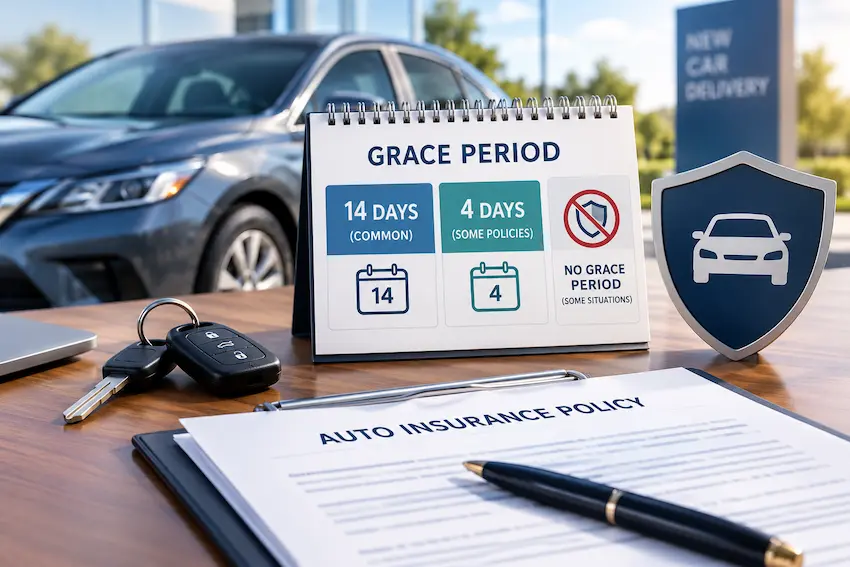
If you already have an active auto policy, it may cover a newly bought car for a short time — but how long depends on your policy’s wording and the coverage you already carry.
Under the standard policy form, you generally have 14 days to tell your insurer — but only 4 days for collision or comprehensive if your policy doesn’t already carry that coverage on another car.
If you have no active policy, there’s no grace period at all.
| Your situation | Liability | Collision | Comprehensive | What to do |
|---|---|---|---|---|
| Adding a car, and you already carry collision and comprehensive | Ask within 14 days for the broadest coverage on your policy | Ask within 14 days | Ask within 14 days | COVERED FOR NOW inside the window. Call with the VIN anyway. |
| Adding a car, no collision or comprehensive on any car | Ask within 14 days | Ask within 4 days | Ask within 4 days | ACT TODAY Four days goes fast. |
| Replacing a car | Depends on the edition: the 2005 form provides it without asking, the 2018 form requires a request within 14 days | Ask within 14 days if collision is on any car, otherwise 4 days | Ask within 14 days if comprehensive is on any car, otherwise 4 days | ACT TODAY Assume the newer rule and ask within 14 days. |
| No active policy (first car, canceled, lapsed) | No automatic coverage | No automatic coverage | No automatic coverage | NOT COVERED Buy a policy before you drive. |
Simplest move: call your insurer with the VIN before you drive away.
Get your exact deadline dates →
Is My New Car Covered Right Now?
Answer seven questions and get your deadlines as dates. The checker uses the ISO baseline and never stores or sends anything. Don’t enter a VIN, name, or policy number.
Why the Answer Is in Your Policy, Not a Rule of Thumb
The deadline is whatever your own policy says, and the standard form most policies are modeled on uses 14 days or 4 days, depending on the coverage.
That standard form is the ISO Personal Auto Policy, PP 00 01. It is filed with state regulators, and insurers may use it as written, change it with state endorsements, or file their own wording.
This guide reads two editions: the 2005 edition (PP 00 01 01 05) and the 2018 edition (PP 00 01 09 18). We checked both against copies of the form text on October 21, 2026.
The term to know is “newly acquired auto.” In both editions, a private passenger car you become the owner of during the policy period qualifies.
Pickups and vans qualify only under extra conditions, such as a weight rating of 10,000 pounds or less and no other insurance covering them.
“During the policy period” means you need an active policy on the day you become the owner.
A vehicle leased under a written agreement for a continuous period of at least six months also counts as owned.
Many insurers use their own forms, so treat everything here as the baseline. Then confirm your own wording with the steps for finding the rule in your policy.
Added or Replaced? The Distinction That Changes Everything
An added car joins your current cars and a replacement takes one’s place, and under the 2005 edition that difference decided whether you had to ask at all.
Keep your old car and buy a second one, and the new car is an addition. Sell, trade in, or scrap the old one, and the new car is a replacement.
The timing can blur the line. If the old car sits in your driveway for a week before you sell it, ask your insurer how it will treat the overlap instead of guessing.
For liability, medical payments, and uninsured motorist coverage, the 2005 edition provides coverage for a replacement without your having to ask. The 2018 edition removed that exception. See what changed in 2018.
For collision and comprehensive, neither edition treats a replacement differently from an added car. You must ask within the window either way, so don’t assume a replacement’s physical damage coverage carries over on its own.
The 14-Day Rule
Under the standard form, you have 14 days after you become the owner to ask your insurer to insure the car, and the car then gets the broadest coverage already on your policy.
“you must ask us to insure it within 14 days”
“Broadest coverage” means the most the policy now provides for any vehicle shown in the Declarations.
If one car has liability only and another has liability, collision, and comprehensive, a newly added third car gets the fuller package.
The form says you must ask your insurer. Don’t assume the dealership or the lender has done it for you.
The window is a deadline to ask, not a free pass. Inside it, coverage runs from the day you became the owner. After it, coverage begins the day you ask, and the days in between are a gap.
Count from the date you became the owner. If signing and delivery fall on different days, ask your insurer which date it uses.
State law and your lender can require proof of insurance sooner than your policy’s deadline.
Missing the window doesn’t cancel your policy or take back coverage on your other cars. It only means the new car’s coverage starts late.
Don’t cancel your old policy until the new car is on it. If you are switching insurers, see how to switch car insurance without a lapse.
The 4-Day Rule for Collision and Comprehensive
Under the standard form, if no car on your policy has collision (or comprehensive), you have only 4 days to ask for it, and each coverage is tested on its own.
For collision, the form asks one question: do your Declarations show Collision on at least one auto? If yes, you have 14 days and the new car gets the broadest collision coverage on the policy. If no, you have 4 days.
Comprehensive, which the form calls Other Than Collision, works the same way and is tested separately. A policy with comprehensive on one car but no collision has 14 days for comprehensive and 4 days for collision.
Collision and comprehensive are checked separately. Look at your Declarations for each one. Don’t assume that having one gives you the longer window for the other.
On the 4-day path there is also a deductible rule. If you meet the four-day requirement and a loss happened before you asked, the form applies a $500 deductible. It is $500 for collision losses and $500 for comprehensive losses.
The $500 deductible applies only to damage that happened before you called. It applies only on the 4-day path.
On the 14-day path the form sets no special figure, and your Declarations deductible would normally govern. After you ask, the deductible is whatever you and your insurer set.
A worked example
Maya carries liability only on her older car. She becomes the owner of a second car on day 0. Her Declarations show no collision and no comprehensive on any car.
Her liability deadline is day 14. Her collision and comprehensive deadlines are both day 4.
Hail dents the new car on day 2. She calls on day 3 and asks for comprehensive. She asked inside the 4-day window, so comprehensive may apply from day 0, with the $500 deductible on the hail loss.
If she had waited until day 6, the window would have closed. Under the form, her comprehensive coverage would begin on day 6, and the day-2 hail damage would not be covered.
Deciding what to carry on the new car? See full coverage vs. liability and how much car insurance you need.
| Coverage | If already on another car | If not on any car | If damaged before you call |
|---|---|---|---|
| Liability, medical payments, uninsured motorists | Ask within 14 days (added car) for the broadest coverage on the policy | Not a separate test: the 14-day rule applies | Ask within 14 days and coverage may reach back to the day you became the owner. Ask later and it starts the day you ask. |
| Collision | 14 days, with the broadest collision coverage on the policy | 4 days | 4-day path: $500 collision deductible. 14-day path: no special figure, your Declarations deductible would normally apply. After the window: coverage starts when you ask. |
| Other Than Collision (comprehensive) | 14 days, with the broadest comprehensive coverage on the policy | 4 days | 4-day path: $500 comprehensive deductible. 14-day path: no special figure, your Declarations deductible would normally apply. After the window: coverage starts when you ask. |
Liability, medical payments, uninsured motorists
If already on another car: ask within 14 days (added car) for the broadest coverage on the policy.
If not on any car: not a separate test. The 14-day rule applies.
If damaged before you call: ask within 14 days and coverage may reach back to the day you became the owner. Ask later and it starts the day you ask.
Collision
If already on another car: 14 days, with the broadest collision coverage on the policy.
If not on any car: 4 days.
If damaged before you call: on the 4-day path a $500 collision deductible applies. On the 14-day path the form sets no special figure. After the window, coverage starts when you ask.
Comprehensive (Other Than Collision)
If already on another car: 14 days, with the broadest comprehensive coverage on the policy.
If not on any car: 4 days.
If damaged before you call: on the 4-day path a $500 comprehensive deductible applies. On the 14-day path the form sets no special figure. After the window, coverage starts when you ask.
What Changed in the 2018 Policy Form
The 2018 edition removed the replacement-car exception: now any newly acquired auto needs a request within 14 days to have liability, medical payments, and uninsured motorist coverage from the day you got it.
Earlier editions gave a replacement car that coverage without your asking, for the rest of the policy term. A trade-in used to be easier than a second car.
An insurance trade-press explainer on ISO’s 2018 changes says ISO made the change so carriers can adjust the coverage symbol and charge the right premium. See the sources at the end.
“coverage will begin on the day you first ask us to insure”
That clause applies to every coverage in the section. The 2005 edition says much the same in its introductory paragraph. The 2018 edition makes it a paragraph of its own.
| Situation | PP 00 01 01 05 | PP 00 01 09 18 |
|---|---|---|
| Additional car: liability, medical payments, uninsured motorists | Broadest coverage on the policy if you ask within 14 days | Same: ask within 14 days |
| Replacement car: liability, medical payments, uninsured motorists | Provided without your having to ask | Ask within 14 days, like any newly acquired auto |
| Replacement car: collision and comprehensive | Ask within 14 days if the coverage is on any car, 4 days if not | Same deadlines, and a late request starts coverage the day you first ask (K.2.d) |
Why do some sources still describe the old rule? Several online study guides for insurance exams disagree with each other about replacement cars, and some predate or ignore the 2018 wording. When in doubt, the clause text settles it.
Which edition do you have? Look for the form number on your policy, such as PP 00 01 09 18. If your insurer uses its own form, there may be no ISO number at all, so search for “newly acquired auto” instead.
Where “30 Days” Comes From
The 30-day figure appears in some state endorsements and rate-bureau forms, and may appear in insurers’ own wording, but not in the standard ISO clause.
Historical filings we found include 30-day language for newly acquired autos: a Virginia amendatory endorsement (PP 01 99 07 05) and North Carolina Rate Bureau policy forms from the early 2000s.
We read only portions of these. Whether any applies to a given policy is something only that policy can tell you.
Insurers that file their own forms can set any window, longer or shorter than the ISO baseline. If someone at the dealership says 30 days, they may be thinking of one of these forms.
The fix is simple. Ask for the clause, then compare it to yours using the steps below. Until you have seen your own wording, plan around the shorter standard-form dates.
When You Have No Grace Period at All
If you don’t have an active auto policy on the day you become the owner, the newly acquired auto clause has nothing to attach to, so there is no grace period.
First car? There’s no grace period. Get a policy in place before you drive it. Many insurers can bind coverage by phone or app with the VIN. Never drive the car uninsured.
A canceled or lapsed policy can’t carry a new car either. The clause covers cars you become the owner of during the policy period. See car insurance canceled or nonrenewed for your options.
A non-owner policy doesn’t fill the gap. It is built for people who don’t own a car, and it typically doesn’t cover a car owned by a relative or household member.
If you own the car, you generally need an owner’s policy. Confirm with your insurer.
Buying privately? Don’t count on the seller’s insurance to protect you after the sale, and plate and registration rules vary by state, so check your state’s DMV.
| Situation | Why there’s no automatic coverage | What to do |
|---|---|---|
| First car, no policy | There is no policy for the clause to extend | Buy a policy before you drive |
| Policy canceled or lapsed | The clause applies to cars acquired during the policy period | Get a new policy before you drive, and ask about the lapse |
| Non-owner policy only | Built for cars you don’t own, and typically not for one you own | Ask for an owner’s policy on the new car |
| Private sale, relying on the seller’s policy | The seller’s insurance isn’t yours, and state rules vary | Insure the car in your name before you drive it away |
Financed or Leased Cars
A lender or lessor sets its own insurance requirements, often collision and comprehensive before the car leaves the lot, whatever your policy’s grace period says.
Expect the lender to ask for proof of insurance, often with a maximum deductible and the lienholder’s name and address on the policy. Have those details ready when you call your insurer.
On leases, the standard form counts a vehicle as owned only if it is leased under a written agreement for a continuous period of at least six months. A shorter lease or a rental may not qualify, so ask your insurer.
Waiting on delivery in a rental car? See do you need rental car insurance.
Financing more than the car is worth? Read is GAP insurance worth it and trading in a car with negative equity.
How to Find the Rule in Your Own Policy
Search your policy for “newly acquired auto,” then check your Declarations to see which coverages are on which cars.
- Open the Declarations page. List the coverages on each car. Collision and comprehensive on any car decide whether you get 14 days or 4 days for each.
- Open your full policy document and search for “newly acquired auto.” Also search “your covered auto.”
- Look for a state amendatory endorsement, often titled “Amendment of Policy Provisions.” It can change the number of days.
- Note the form number in the footer, such as PP 00 01 09 18, if there is one.
- Ask your agent in writing: How many days do I have to add a car? Does it differ for collision and comprehensive? Does a replacement car need a request? What deductible applies to a loss before I ask?
Before You Drive Off
Eight steps, in order, that you can finish from the dealership lot or the seller’s driveway.
- Call or use your insurer’s app and add the car by VIN.
- Have ready: VIN, purchase date, garaging address, who will drive it, and the lienholder’s name and address if the car is financed or leased.
- Ask which coverages the new car has right now, and get a new ID card.
- Keep the old car on the policy until it is sold or traded, then remove it.
- Never cancel your policy before the new car is added. If you are changing insurers, see how to switch without a lapse.
- Financed or leased? Confirm the lender’s required deductibles, and ask about GAP insurance.
- Private sale? Don’t count on the seller’s insurance after the sale, and check your state’s plate and registration rules.
- Save the confirmation email.
If You Crash Before the Car Is Added
Call your insurer right away, even if you aren’t sure the new car is covered, because the window may still help you.
Make sure everyone is safe first, then follow what to do after a car accident. The standard form also expects prompt notice of how, when, and where a loss happened.
Then the window matters. If you ask inside it, coverage may reach back to the day you became the owner. On the 4-day path, the $500 deductible applies to damage that happened before you asked.
If the window has closed, the form starts coverage the day you ask. A loss in the gap isn’t covered.
Give your insurer the real purchase date and the real date of the loss. The standard form provides no coverage for anyone who makes fraudulent statements in connection with a loss.
Don’t repair the car until your insurer has had a chance to inspect it.
Frequently Asked Questions
Is my new car covered by my old insurance?
Possibly, for a short time. Under the standard form, a newly acquired auto can get coverage if you ask your insurer within the deadline, but you must have an active policy when you become the owner. Your own policy’s wording controls.
How long do I have to add a new car to my insurance?
Under the standard form, 14 days after you become the owner, or 4 days for collision or comprehensive if your policy carries that coverage on no car. Some insurers and state endorsements use different numbers, so check yours.
What is the 4-day rule?
If your Declarations show no collision (or no comprehensive) on any car, you must ask for that coverage on the new car within 4 days. Each coverage is tested separately.
What is the 14-day rule?
You must ask your insurer to insure the new car within 14 days after you become the owner to get the broadest coverage already on your policy. It applies to liability, medical payments, and uninsured motorist coverage, and to collision and comprehensive when you already carry them.
Is there a 30-day grace period for a new car?
Not in the standard ISO clause. Some state endorsements and rate-bureau forms use 30 days, and insurer-specific forms may too. See where “30 days” comes from.
Can I drive a new car home without insurance?
Don’t. If you have an active policy, call your insurer before you drive away. If you have none, buy a policy first. State law and your lender may require proof of insurance.
What if it’s my first car?
There is no grace period. Buy a policy before you drive it.
Does my insurance transfer when I trade in my car?
The new car is a replacement. Under the 2005 edition, liability, medical payments, and uninsured motorist coverage are provided without asking. Under the 2018 edition, ask within 14 days. For collision and comprehensive, ask within 14 days (or 4 days if you carry none) in both.
Does the grace period include collision and comprehensive?
Yes, but each has its own test. Collision and comprehensive each get 14 days if on at least one car, otherwise 4 days.
What’s the $500 deductible for a newly acquired car?
On the 4-day path only, if you ask within the window and a loss happened before you asked, the standard form applies a $500 deductible to that loss.
What happens if I miss the deadline?
Coverage for the new car begins the day you ask. The days in between aren’t covered. Your policy and your other cars aren’t affected.
Can I drive a financed car off the lot with liability only?
Lenders usually require collision and comprehensive, so check your financing agreement before you sign. Ask your insurer to add those coverages when you add the car.
Do I need insurance to buy a car from a private seller?
State rules vary, so check your DMV. In practice, get a policy in your name before you drive the car away, and expect to show proof of insurance to register it.
Should I cancel my old car’s insurance first?
No. Add the new car first. Remove the old car when it’s sold or traded. If you put the new car on a separate policy, the standard form ends the old policy’s coverage for that car when the other insurance takes effect. See how to switch without a lapse.
Does a leased car count as newly acquired?
If it’s leased to you under a written agreement for a continuous period of at least six months, the standard form treats it as owned. A shorter lease may not qualify.
How do I check my own policy’s rule?
Search the policy for “newly acquired auto,” check the Declarations, and look for a state amendatory endorsement. Details are in how to find the rule in your own policy.
Sources
- ISO Personal Auto Policy PP 00 01 01 05, copy promulgated by the Virginia State Corporation Commission.
- ISO Personal Auto Policy PP 00 01 09 18, publicly hosted copy of the form text. Confirm against your state’s filing.
- IA Magazine (Big “I”): Understanding ISO’s Recent Changes to the PAP.
- FC&S (PropertyCasualty360): Personal Auto Definitions.
- Virginia Bureau of Insurance filing, including endorsement PP 01 99 07 05, for the 30-day wording.
- North Carolina Rate Bureau circular A-03-6, for the 30-day wording.
- United Policyholders: Non-Owner Car Insurance.
- Your state insurance department and DMV, for proof-of-insurance and registration rules.
This article is general information, not insurance or legal advice. It describes the ISO Personal Auto Policy standard form (2005 and 2018 editions), verified on October 21, 2026. Insurers use their own forms, your policy controls, and state insurance and registration rules vary. Last updated: .

Daniel Hayes is the founder and sole researcher at AdvoraHQ. He covers U.S. personal finance, insurance, and consumer law — working directly from IRS publications, federal and state statutes, court opinions, and SEC filings rather than secondary summaries. His focus is the gap between what readers think they know and what the source documents actually say. Daniel is not a licensed attorney, CPA, or financial advisor; his articles are educational and not personalized advice. Reach him at Daniel.Hayes@advorahq.com.