
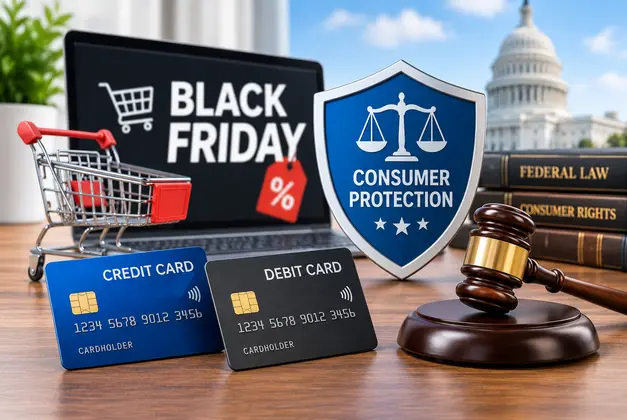
Quick answer: is it safer to use a credit or debit card online?
For online and holiday shopping, a credit card usually gives you more protection:
- The money at risk is the bank’s, not yours.
- Federal law lets you dispute an order that never arrived or arrived different from what you agreed to.
A debit card is protected against charges you didn’t make, but not against a seller who takes your money and doesn’t deliver, and your own cash is out of your account while the bank investigates.
- USE CREDIT FOR: online stores, unfamiliar sellers, preorders and delayed delivery, hotels, rental cars, gas pumps, big-ticket gifts.
- DEBIT IS FINE FOR: ATM cash, trusted in-person purchases, and when you would otherwise carry a balance at high interest.
- DEBIT ONLY? Use a phone wallet or a virtual card number if your bank offers one, keep a cash cushion for holds, and turn on transaction alerts.
The $500 myth: the “$50 / $500” debit rule you have read about applies to a lost or stolen card or code. If only your card number was stolen, different rules may apply. See why below.
- Side by side
- The $500 myth
- Never arrived
- Where your money sits
- Holds
- Black Friday scenarios
- Debit-only plan
- Letters
Rules verified November 18, 2026 from the CFPB’s Regulation E and Z text.
Which Card for This Purchase?
Answer five questions for a plain-text recommendation. Nothing you enter is stored or sent anywhere, and you should never type card numbers or names.
Credit Card vs. Debit Card, Side by Side
A credit card gives you more legal protection when an online order goes wrong, while a debit card gives you more direct control over what you spend.
Every protection below carries a label so you can tell what the law guarantees from what is only a bank or network policy.
| Protection | Credit card | Debit card |
|---|---|---|
| Charges you didn’t make (unauthorized use) | LAW PROTECTS YOULiability for unauthorized use is capped at $50 under 12 CFR 1026.12(b). The charge can also be disputed as a billing error. | LAW PROTECTS YOURegulation E limits your liability. The $50 and $500 tiers apply to a lost or stolen card or code (see Table 2). |
| Stolen card number (card still in your wallet) | LAW PROTECTS YOUUnauthorized charges can be disputed as billing errors, and unauthorized use is capped at $50. Issuers and networks often go further. | LAW PROTECTS YOUMay be $0 if reported within 60 days of the statement. Banks differ on whether a card number counts as an access device. NETWORK POLICY ONLYNetwork zero-liability policies often apply. |
| Order never arrived | LAW PROTECTS YOUA billing error under 12 CFR 1026.13(a)(3). You don’t have to contact the merchant first. | NOT COVEREDNot covered by Regulation E. NETWORK POLICY ONLYChargeback rules and your bank’s willingness, generally. |
| Order not as agreed (wrong item, wrong quantity, late, wrong address) | LAW PROTECTS YOUAlso a billing error: goods or services not delivered as agreed. | NOT COVEREDNot covered by Regulation E. NETWORK POLICY ONLYChargeback rules and your bank, generally. |
| Item accepted but defective | LAW PROTECTS YOUWith conditions. Not a billing error. Claims and defenses (12 CFR 1026.12(c)) apply if you tried in good faith to resolve it with the merchant, the purchase is over $50, and it was in your state or within 100 miles of your address (exceptions apply). | NOT COVEREDNot covered by Regulation E. NETWORK POLICY ONLYChargeback rules and your bank, generally. |
| Whose money is gone during the dispute | LAW PROTECTS YOUThe bank’s. You don’t have to pay the disputed amount while a billing error is investigated (FTC). | Yours. Your cash leaves the account at once. LAW PROTECTS YOUFor Regulation E errors, provisional credit is required if the investigation runs past 10 business days (with exceptions). NETWORK POLICY ONLYChargebacks follow bank and network rules. |
| Investigation timeline | Acknowledge within 30 days; resolve within two billing cycles, no more than 90 days (FTC). | 10 business days, or up to 45 days with provisional credit; 90 days for certain point-of-sale, not-initiated-within-a-state or new-account transfers. Chargebacks have no fixed legal clock. |
| Authorization holds | A hold reduces your available credit, not your cash. Why a card can decline under its limit. | A hold reduces the money you can spend from your own account until it is released. |
| Overdraft risk | No overdraft of a bank account. Over-limit handling depends on your card agreement. | If your account allows overdrafts, a purchase or hold can push the balance below zero. Fee policies vary. Overdraft fee refunds. |
| Surcharges | Some merchants add one where allowed; rules vary. Credit card surcharge rules. | Network rules restrict surcharging debit cards. |
| Rewards | Some cards earn rewards. Rewards are not a legal protection and don’t offset interest on a carried balance. | Usually fewer or none; varies by issuer. |
| Credit-score effect | Payment history and how much of your limit you use can affect your score. | Debit spending isn’t reported to credit bureaus, so it neither builds nor hurts your score. |
Charges you didn’t make (unauthorized use)
Credit card: LAW PROTECTS YOULiability for unauthorized use is capped at $50 under 12 CFR 1026.12(b). The charge can also be disputed as a billing error.
Debit card: LAW PROTECTS YOURegulation E limits your liability. The $50 and $500 tiers apply to a lost or stolen card or code (see Table 2).
Stolen card number (card still in your wallet)
Credit card: LAW PROTECTS YOUUnauthorized charges can be disputed as billing errors, and unauthorized use is capped at $50. Issuers and networks often go further.
Debit card: LAW PROTECTS YOUMay be $0 if reported within 60 days of the statement. Banks differ on whether a card number counts as an access device. NETWORK POLICY ONLYNetwork zero-liability policies often apply.
Order never arrived
Credit card: LAW PROTECTS YOUA billing error under 12 CFR 1026.13(a)(3). You don’t have to contact the merchant first.
Debit card: NOT COVEREDNot covered by Regulation E. NETWORK POLICY ONLYChargeback rules and your bank’s willingness, generally.
Order not as agreed (wrong item, wrong quantity, late, wrong address)
Credit card: LAW PROTECTS YOUAlso a billing error: goods or services not delivered as agreed.
Debit card: NOT COVEREDNot covered by Regulation E. NETWORK POLICY ONLYChargeback rules and your bank, generally.
Item accepted but defective
Credit card: LAW PROTECTS YOUWith conditions. Not a billing error. Claims and defenses (12 CFR 1026.12(c)) apply if you tried in good faith to resolve it with the merchant, the purchase is over $50, and it was in your state or within 100 miles of your address (exceptions apply).
Debit card: NOT COVEREDNot covered by Regulation E. NETWORK POLICY ONLYChargeback rules and your bank, generally.
Whose money is gone during the dispute
Credit card: LAW PROTECTS YOUThe bank’s. You don’t have to pay the disputed amount while a billing error is investigated (FTC).
Debit card: Yours. Your cash leaves the account at once. LAW PROTECTS YOUFor Regulation E errors, provisional credit is required if the investigation runs past 10 business days (with exceptions). NETWORK POLICY ONLYChargebacks follow bank and network rules.
Investigation timeline
Credit card: Acknowledge within 30 days; resolve within two billing cycles, no more than 90 days (FTC).
Debit card: 10 business days, or up to 45 days with provisional credit; 90 days for certain point-of-sale, not-initiated-within-a-state or new-account transfers. Chargebacks have no fixed legal clock.
Authorization holds
Credit card: A hold reduces your available credit, not your cash. Why a card can decline under its limit.
Debit card: A hold reduces the money you can spend from your own account until it is released.
Overdraft risk
Credit card: No overdraft of a bank account. Over-limit handling depends on your card agreement.
Debit card: If your account allows overdrafts, a purchase or hold can push the balance below zero. Fee policies vary. Overdraft fee refunds.
Surcharges
Credit card: Some merchants add one where allowed; rules vary. Credit card surcharge rules.
Debit card: Network rules restrict surcharging debit cards.
Rewards
Credit card: Some cards earn rewards. Rewards are not a legal protection and don’t offset interest on a carried balance.
Debit card: Usually fewer or none; varies by issuer.
Credit-score effect
Credit card: Payment history and how much of your limit you use can affect your score.
Debit card: Debit spending isn’t reported to credit bureaus, so it neither builds nor hurts your score.
Table 1. Credit card vs. debit card, protection by protection. Sources: CFPB text of 12 CFR 1005 and 1026; FTC Consumer Advice. Verified November 18, 2026.
Two Laws, Two Very Different Promises
Credit cards fall under Regulation Z and debit cards under Regulation E, and the biggest difference is whose money is at risk.
Regulation Z implements the Truth in Lending Act for credit cards. It caps your liability for unauthorized use, lets you dispute billing errors (including goods not delivered as agreed), and in limited cases lets you raise claims and defenses against the card issuer. You are disputing a bill, so the bank’s money is the money in play.
Regulation E implements the Electronic Fund Transfer Act for debit card transfers. It protects you against unauthorized transfers and listed errors. It does not give you a legal right to reverse an authorized purchase from a merchant who failed to deliver. By the time you dispute, your own money has already left your account.
For the credit side in depth, see Unauthorized Credit Card Charges and How to Dispute a Credit Card Charge.
The $500 Myth: What the Debit Rule Really Covers
The “$50 / $500 / 60 days” rule is not a universal debit fraud rule: the first two tiers are tied to a lost or stolen card or code.
The tiers for a lost or stolen card or code
Under 12 CFR 1005.6(b)(1), if you notify the bank within two business days after learning of the loss or theft, your liability is the lesser of $50 or the unauthorized transfers made before you reported. Learn on Wednesday that the card went missing Monday, and you have until the end of Friday.
If you don’t notify within two business days, 1005.6(b)(2) lets liability rise to the lesser of $500 or a sum the regulation sets out, which includes later transfers the bank shows would not have happened had you reported in time. The CFPB notes that receiving a statement can be a factor in whether you knew, but isn’t conclusive proof.
The 60-day statement rule
If an unauthorized transfer appears on a periodic statement, report it within 60 days of the bank’s transmittal of the statement to avoid liability for later transfers. If you wait longer, you can be liable for transfers made after the 60 days and before you report, if the bank shows they would not have happened with timely notice.
Promptness, not care
Liability turns on how fast you report, not how careful you were. The CFPB’s commentary says that behavior that might be negligence under state law, such as writing a PIN on your card, doesn’t change your liability. No agreement can impose more liability than Regulation E allows.
Transfers made without an access device
Regulation E has a separate rule for unauthorized transfers that don’t involve an access device. The official interpretation says the first two tiers of liability do not apply to them. Under the CFPB’s own example, a transfer reported inside the 60-day period carries no consumer liability, but a later one can be charged to you if you delay.
The stolen-number grey area
Here is what is unsettled. The CFPB’s EFT FAQs say a transfer made with a card number obtained through fraud is an unauthorized transfer. But Regulation E defines an access device as “a card, code, or other means of access,” and banks differ on whether a card number used online, with your card still in your wallet, counts as loss or theft of an access device.
So the accurate answer is not “$0, guaranteed.” It may be $0 if you report within 60 days of the statement. Banks differ, and network zero-liability policies often apply.
Network zero-liability policies
These are voluntary and have exceptions, so treat them as a layer on top of the law, not a replacement. For example, Visa’s published policy says it covers most credit and debit cards but not certain commercial card and anonymous prepaid card transactions, or transactions not processed by Visa. Your issuer’s terms decide.
Late reports don’t end protection
Even when you report more than 60 days after the statement, the bank must still evaluate your liability under 12 CFR 1005.6. It cannot simply deny the claim. Report in writing anyway.
| Situation | Report by | Maximum liability | Source |
|---|---|---|---|
| Card lost or stolen, reported within 2 business days of learning | Within two business days after you learn of the loss or theft | The lesser of $50 or the unauthorized transfers made before you reported | 12 CFR 1005.6(b)(1) |
| Card lost or stolen, reported later | After two business days | The lesser of $500 or the sum of (a) $50, or the amount taken in the first two business days if less, plus (b) later transfers the bank shows would not have happened if you had reported in time | 12 CFR 1005.6(b)(2) |
| Not reported within 60 days of the statement | More than 60 days after the bank sent the statement showing the transfer | Unauthorized transfers made after day 60 and before you report, if the bank shows a timely report would have prevented them. If an access device was involved, the first two tiers can still apply. | 12 CFR 1005.6(b)(3) |
| Transfer made without an access device | Within 60 days of the bank’s transmittal of the statement | The first two tiers do not apply. Transfers reported inside the 60-day period generally carry no consumer liability. | 12 CFR 1005.6(b)(3); official interpretation, comment 6(b)(3)-2 |
| The stolen-number grey area (card in your wallet, number used online) | As soon as you see it, and within 60 days of the statement | May be $0. Banks differ on whether a card number alone is an “access device.” Network zero-liability policies often apply. | 12 CFR 1005.2(a), 1005.6(b); CFPB EFT FAQs |
Card lost or stolen, reported within 2 business days of learning
Report by: Within two business days after you learn of the loss or theft
Maximum liability: The lesser of $50 or the unauthorized transfers made before you reported
Source: 12 CFR 1005.6(b)(1)
Card lost or stolen, reported later
Report by: After two business days
Maximum liability: The lesser of $500 or the sum of (a) $50, or the amount taken in the first two business days if less, plus (b) later transfers the bank shows would not have happened if you had reported in time
Source: 12 CFR 1005.6(b)(2)
Not reported within 60 days of the statement
Report by: More than 60 days after the bank sent the statement showing the transfer
Maximum liability: Unauthorized transfers made after day 60 and before you report, if the bank shows a timely report would have prevented them. If an access device was involved, the first two tiers can still apply.
Source: 12 CFR 1005.6(b)(3)
Transfer made without an access device
Report by: Within 60 days of the bank’s transmittal of the statement
Maximum liability: The first two tiers do not apply. Transfers reported inside the 60-day period generally carry no consumer liability.
Source: 12 CFR 1005.6(b)(3); official interpretation, comment 6(b)(3)-2
The stolen-number grey area (card in your wallet, number used online)
Report by: As soon as you see it, and within 60 days of the statement
Maximum liability: May be $0. Banks differ on whether a card number alone is an “access device.” Network zero-liability policies often apply.
Source: 12 CFR 1005.2(a), 1005.6(b); CFPB EFT FAQs
Table 2. The debit liability rule, correctly stated. Source: CFPB, 12 CFR 1005.6 and its official interpretation. Verified November 18, 2026.
What Could You Lose?
Enter what happened to see your legal maximum and your deadlines. Nothing you enter is stored or sent anywhere.
“It Never Arrived”: The Biggest Gap Between Credit and Debit
If an order never arrives, a credit card gives you a legal billing-error right, while a debit card leaves you with network chargeback rules and your bank’s willingness.
On a credit card, not delivered is a billing error
Under 12 CFR 1026.13(a)(3), a billing error includes goods or services not accepted by you, or not delivered as agreed. The CFPB’s examples include refusing delivery because the goods didn’t match the contract, receiving something different from what you agreed to, the wrong quantity, late delivery, and delivery to the wrong location.
Your written notice must reach the creditor at its billing-error address within 60 days after it sent the first statement showing the error. Send it to that address, not the payment address.
You don’t have to contact the merchant first
For a billing error, the CFPB’s commentary says you are not required to try to resolve it with the merchant before sending your notice. The FTC still suggests contacting the seller, but not waiting so long that you lose your card-dispute rights. A preorder is the trap: the 60 days run from the statement showing the charge, not from the delivery date.
On a debit card, network rules only
Regulation E protects against unauthorized transfers and errors. A purchase you made yourself from a seller who then didn’t deliver isn’t an unauthorized transfer. You rely on card-network chargeback rules and the bank’s willingness to file one, generally. The FTC’s consumer advice says debit protections are weaker and you may not get a refund for non-delivery.
Fake stores
A fake store is the worst case for debit: the money is already gone, the seller isn’t answering, and no law gives you a way to reverse the payment. Credit lets you dispute the charge as goods not delivered. With debit, call the bank right away, ask for a chargeback and a new card, and report the store at ReportFraud.ftc.gov.
The FTC’s Mail, Internet, or Telephone Order Merchandise Rule also requires sellers to ship within the time they promise, or within 30 days if no time is stated, and to offer a full refund if they can’t.
Accepted but defective goods
If you accepted the item and it is simply defective, it is not a billing error. The claims-and-defenses rule (12 CFR 1026.12(c)) applies only with conditions: a good-faith attempt to resolve it with the merchant, a purchase over $50, and a transaction in your state or within 100 miles of your address, with exceptions such as a merchant controlled by the card issuer. Online sellers elsewhere often fall outside it.
Where Your Money Sits While the Bank Investigates
With a debit card, your own cash is out of your account while the bank investigates; with a credit card, the disputed amount is a bill you don’t have to pay yet.
Debit: the Regulation E clock
Under 12 CFR 1005.11, the bank must decide whether an error occurred within 10 business days of your notice. If it needs longer, it can take up to 45 days, but only if it provisionally credits your account within those 10 business days. Certain transfers get up to 90 days: point-of-sale debit transactions, transfers not initiated within a state, and transfers within 30 days of the account’s first deposit. New accounts can also get 20 business days instead of 10.
Provisional credit can be reversed
If the bank finds no error, it can debit the provisional credit. It must tell you the date and amount, and honor certain checks and preauthorized payments for five business days after that notice without overdraft charges to you. For an unauthorized-transfer claim, the bank may withhold up to $50 of the provisional credit if it has a reasonable basis to believe the transfer was unauthorized. If you reported by phone, the bank can require written confirmation within 10 business days and skip provisional credit if you don’t send it. More in Provisional Credit.
Rent and bills
If a disputed charge drains the account before provisional credit arrives, rent, utilities and automatic payments can bounce. That is the practical cost of debit fraud, even when the law is on your side. Keep a cushion in the account, and ask in writing whether the bank will refund related fees (see the fee reversal letter).
Credit: the bill you can hold back
Per the FTC, a credit issuer must acknowledge your billing-error notice within 30 days and resolve it within two billing cycles, no more than 90 days. You don’t have to pay the disputed amount while it is investigated.
A chargeback on a debit purchase isn’t a Regulation E error, so these clocks don’t apply. Timing comes from the bank and network rules.
Holds at Hotels, Gas Pumps, and Rental Counters
A hold is a temporary authorization, not a charge, but on a debit card it ties up your own cash until it is released.
Hotels, rental counters and gas pumps authorize an estimated amount up front to make sure the funds exist. On a credit card the hold reduces your available credit. On a debit card it reduces the money you can spend from your own account, and an account with overdrafts turned on can go negative if another payment arrives meanwhile.
Ask the business how and when the hold is released, and keep a cushion in the account. Holds can also make a credit card decline while you are under your limit. See Credit Card Declined With Available Credit and Overdraft Fees Refunded.
Black Friday and Holiday Scenarios
The same holiday problem plays out very differently on credit and on debit, so find the scenario closest to yours.
| Scenario | With credit | With debit | Your first move |
|---|---|---|---|
| Fake store: you paid and nothing arrives | LAW PROTECTS YOUNot delivered as agreed is a billing error. Send written notice within 60 days of the statement. No merchant step required. | NOT COVEREDNETWORK POLICY ONLYNo Regulation E right to reverse an authorized purchase. Ask your bank to file a chargeback. | Screenshot the site and your order, call your card issuer, report it at ReportFraud.ftc.gov, and watch the account for other charges. |
| Package stolen from your porch (guide) | Depends on the facts. Delivery to the wrong location is a listed billing error; a package left at the right address and later stolen is less clear. | NOT COVEREDNETWORK POLICY ONLYNo Regulation E right. Network rules and your bank only. | Contact the seller and the carrier first; many replace or refund. Then your bank, in writing. |
| Charged twice (guide) | Check whether the second charge is only a pending hold. If it posts, ask the merchant for the refund and raise it with your issuer in writing within the 60-day window. | A duplicate may qualify as an incorrect-transfer error under Regulation E; notice is due within 60 days of the statement. Your cash is out in the meantime. | Check pending versus posted, then the merchant, then your bank in writing. |
| Defective gift you accepted | LAW PROTECTS YOUWith conditions. Claims and defenses apply if you tried in good faith, the purchase is over $50, and it was in your state or within 100 miles. Not a billing error. | NOT COVEREDNETWORK POLICY ONLYNot a Regulation E error. Chargeback rules and your bank, generally. | Contact the merchant, photograph the defect, use the return process, then ask your issuer if the conditions fit. |
| Free-trial auto-renewal (guide) | A renewal you agreed to is generally treated as authorized. A charge after a documented cancellation can be disputed; results depend on your records. | The same, and your cash is already gone. Regulation E has rules for recurring debits, including a way to stop them. Ask your bank. | Screenshot the terms and your cancellation, contact the merchant in writing, then your bank. |
| Price drops after you buy | NOT COVEREDNot a billing error or a legal protection. Check the store’s price-adjustment policy. | NOT COVEREDNot a Regulation E error either. The store’s policy decides. | Ask the store for an adjustment within its stated window. Check your card’s benefits guide for any price or return benefit. |
| Gift card scam (you bought the card yourself) | NOT COVEREDYou authorized buying the gift card, so the law is unlikely to give you a right to reverse it. | NOT COVEREDSame: an authorized purchase is not a Regulation E error. | Contact the gift card company immediately with the card numbers, report it at ReportFraud.ftc.gov, and tell your bank. |
Fake store: you paid and nothing arrives
With credit: LAW PROTECTS YOUNot delivered as agreed is a billing error. Send written notice within 60 days of the statement. No merchant step required.
With debit: NOT COVEREDNETWORK POLICY ONLYNo Regulation E right to reverse an authorized purchase. Ask your bank to file a chargeback.
Your first move: Screenshot the site and your order, call your card issuer, report it at ReportFraud.ftc.gov, and watch the account for other charges.
Package stolen from your porch (guide)
With credit: Depends on the facts. Delivery to the wrong location is a listed billing error; a package left at the right address and later stolen is less clear.
With debit: NOT COVEREDNETWORK POLICY ONLYNo Regulation E right. Network rules and your bank only.
Your first move: Contact the seller and the carrier first; many replace or refund. Then your bank, in writing.
Charged twice (guide)
With credit: Check whether the second charge is only a pending hold. If it posts, ask the merchant for the refund and raise it with your issuer in writing within the 60-day window.
With debit: A duplicate may qualify as an incorrect-transfer error under Regulation E; notice is due within 60 days of the statement. Your cash is out in the meantime.
Your first move: Check pending versus posted, then the merchant, then your bank in writing.
Defective gift you accepted
With credit: LAW PROTECTS YOUWith conditions. Claims and defenses apply if you tried in good faith, the purchase is over $50, and it was in your state or within 100 miles. Not a billing error.
With debit: NOT COVEREDNETWORK POLICY ONLYNot a Regulation E error. Chargeback rules and your bank, generally.
Your first move: Contact the merchant, photograph the defect, use the return process, then ask your issuer if the conditions fit.
Free-trial auto-renewal (guide)
With credit: A renewal you agreed to is generally treated as authorized. A charge after a documented cancellation can be disputed; results depend on your records.
With debit: The same, and your cash is already gone. Regulation E has rules for recurring debits, including a way to stop them. Ask your bank.
Your first move: Screenshot the terms and your cancellation, contact the merchant in writing, then your bank.
Price drops after you buy
With credit: NOT COVEREDNot a billing error or a legal protection. Check the store’s price-adjustment policy.
With debit: NOT COVEREDNot a Regulation E error either. The store’s policy decides.
Your first move: Ask the store for an adjustment within its stated window. Check your card’s benefits guide for any price or return benefit.
Gift card scam (you bought the card yourself)
With credit: NOT COVEREDYou authorized buying the gift card, so the law is unlikely to give you a right to reverse it.
With debit: NOT COVEREDSame: an authorized purchase is not a Regulation E error.
Your first move: Contact the gift card company immediately with the card numbers, report it at ReportFraud.ftc.gov, and tell your bank.
Table 3. Black Friday and holiday scenarios. Sources: CFPB, 12 CFR 1005 and 1026; FTC Consumer Advice. Verified November 18, 2026.
When Debit Is the Better Choice
Debit is the better choice when you would otherwise carry a balance, need cash, face a credit card surcharge, or want a hard spending limit.
If you would carry a balance, the interest can cost more than the protection is worth. See How Credit Card Interest Works. This isn’t a push toward credit for anyone who can’t pay it off.
| Situation | Why debit | Watch out for |
|---|---|---|
| You would otherwise carry a balance | Debit avoids interest. Credit protection isn’t worth paying 20%+ interest (how credit card interest works). | Weaker protection for orders that never arrive. Buy only from sellers you trust and keep a cash cushion. |
| ATM cash | Cash comes straight from your own account. Credit card cash advances typically cost more and start accruing interest right away (check your card agreement). | ATM operator fees and your bank’s limits. |
| The merchant adds a credit card surcharge | Network rules restrict surcharging debit cards (surcharge rules). | You give up credit-style protection on that purchase. For an unfamiliar seller, consider another seller, or a phone wallet or virtual card number. |
| You want a hard spending limit | You can only spend what is in the account. | Holds and overdraft settings can still surprise you. Turn on alerts. |
| A trusted in-person purchase | Low risk of a delivery problem, and no interest. | If something does go wrong, your cash is out of the account while the bank investigates. |
You would otherwise carry a balance
Why debit: Debit avoids interest. Credit protection isn’t worth paying 20%+ interest (how credit card interest works).
Watch out for: Weaker protection for orders that never arrive. Buy only from sellers you trust and keep a cash cushion.
ATM cash
Why debit: Cash comes straight from your own account. Credit card cash advances typically cost more and start accruing interest right away (check your card agreement).
Watch out for: ATM operator fees and your bank’s limits.
The merchant adds a credit card surcharge
Why debit: Network rules restrict surcharging debit cards (surcharge rules).
Watch out for: You give up credit-style protection on that purchase. For an unfamiliar seller, consider another seller, or a phone wallet or virtual card number.
You want a hard spending limit
Why debit: You can only spend what is in the account.
Watch out for: Holds and overdraft settings can still surprise you. Turn on alerts.
A trusted in-person purchase
Why debit: Low risk of a delivery problem, and no interest.
Watch out for: If something does go wrong, your cash is out of the account while the bank investigates.
Table 4. When debit makes sense. Sources: card network surcharge rules; CFPB. Verified November 18, 2026.
Shopping Online With Only a Debit Card: A Safety Plan
If debit is all you have, you can lower your exposure a lot, but nothing here gives you a legal right to reverse an order that never arrives.
- Use a phone wallet. A phone wallet usually sends a device-specific token instead of your real card number.
- Use a virtual card number if your bank offers one, so a seller never has your actual number.
- Use a separate account. Keep a low-balance account for online shopping and move in only what you plan to spend.
- Turn on alerts for every transaction, and check statements weekly through January.
- Skip unfamiliar sites. Search the seller’s name with the word “scam” or “complaint” first, and check refund and return policies.
- Never use your PIN online. A website that asks for it is a red flag.
- Keep a cash cushion for holds, and keep records: screenshots, confirmation emails, tracking numbers.
Copy-Ready Dispute Letters
Put your dispute in writing, keep a copy, and fill in the brackets with your own details, using only the last 4 digits of any account or card number.
Select a letter’s text to copy it. Send credit letters to the billing-error address, and keep proof of mailing.
1. Credit card billing-error notice (Regulation Z)
Use this for an order that never arrived or arrived different from what you agreed to, or for an unauthorized charge.
[Date]

[Card issuer name]
Billing Inquiries / Billing Errors
[Billing-error address from the back of your statement or your statement's billing rights section. Not the payment address.]

Re: Billing error notice, account ending in [last 4 digits only]
Name: [Your name]

I am writing to assert a billing error under the Fair Credit Billing Act (12 CFR 1026.13).

Charge in question:
- Merchant: [merchant name]
- Date: [charge date]
- Amount: [amount]
- First statement showing the charge: [statement date]

The error is: [choose one]
  [ ] Goods or services not delivered as agreed. I ordered [item] on [order date] and it [has not arrived / arrived late / was delivered to the wrong place / was different from what I agreed to buy].
  [ ] Unauthorized charge. I did not make or authorize this charge.

Explanation: [two or three plain sentences: what you ordered, what happened, and what you already tried]

I am withholding payment of the disputed amount while this is investigated. Please correct my account by removing the charge and any related finance charges.

Enclosed: [order confirmation, tracking or delivery records, screenshots, messages with the merchant].

Sincerely,
[Your name]
[Phone or email]
2. Debit card unauthorized-transfer claim (Regulation E)
Use this for transfers you did not make. If you reported by phone, send it promptly: the bank can require written confirmation within 10 business days.
[Date]

[Bank name]
[Address for error notices from your account agreement or online banking help]

Re: Notice of error (unauthorized transfers), account ending in [last 4 digits only]
Name: [Your name]

I am writing to confirm my notice of error under Regulation E (12 CFR 1005.11).

- Date I learned of the problem: [date]
- Date I first reported it to the bank: [date], by [phone / online / in person]
- Transactions I did not authorize:
    [date], [merchant], [amount]
    [date], [merchant], [amount]

I did not authorize these transfers, and I received no benefit from them.

Please investigate. If you cannot complete your investigation within 10 business days, please provisionally credit my account for the amount in question, and tell me the date and amount of any credit. Please report the results of your investigation to me in writing.

Sincerely,
[Your name]
[Phone or email]
3. Debit “never arrived” request
Use this when you authorized the purchase and the seller didn’t deliver.
[Date]

[Bank name]
[Disputes address or secure message center]

Re: Request for card-network chargeback, debit card ending in [last 4 digits only]
Name: [Your name]

I paid [merchant] [amount] on [date] for [item or service]. It was supposed to be delivered by [date], and it has not arrived. I understand this is a purchase I authorized, so I am not claiming an unauthorized transfer. I am asking you to file a chargeback under the card network's dispute rules.

What I have done so far:
- Contacted the merchant on [dates] by [email / phone / chat]. [Their response, or no response.]
- Tracking status: [status or none provided]

Attached: order confirmation, tracking information, screenshots of the listing, and my messages with the merchant.

Please tell me in writing whether you will file the chargeback, what deadline applies, and what else you need from me.

Sincerely,
[Your name]
[Phone or email]
4. Fee reversal request
Use this to ask the bank to reverse fees caused by a disputed or unauthorized transaction. See Overdraft Fees Refunded.
[Date]

[Bank name]
[Address or secure message center]

Re: Request to reverse fees caused by a disputed transaction, account ending in [last 4 digits only]
Name: [Your name]

On [date] I reported [an unauthorized transaction / a disputed transaction] of [amount] at [merchant] (claim reference: [number, if any]). Because of that transaction, my account was charged these fees:

- [fee type], [date]
- [fee type], [date]

These fees would not have been charged if the transaction had not occurred. The CFPB's commentary to Regulation E (12 CFR 1005.11) says correcting an error includes refunding fees the institution imposed. Please reverse these fees and confirm in writing.

Sincerely,
[Your name]
[Phone or email]
Frequently Asked Questions
Short answers to the questions shoppers ask most, with the legal limits spelled out.
Is it safer to use a credit or debit card online?
For online shopping, a credit card usually gives you more protection. If a charge isn’t yours, both card types limit your liability. If an order never arrives, a credit card gives you a legal billing-error right and a debit card does not. With credit, the disputed money is the bank’s. With debit, your own cash is out of the account while the bank investigates.
Should I use credit or debit on Black Friday?
Use credit for online stores, unfamiliar sellers, preorders and delayed delivery, but only if you pay the balance in full. If you would carry a balance, the interest can outweigh the protection, so use debit with the safeguards in this article for sellers you trust. The card picker runs through it for a specific purchase.
If someone steals my debit card number, am I liable for $50 or $500?
Possibly neither. The $50 and $500 tiers are tied to a lost or stolen card or code. If only the number was used and the card is still in your wallet, the CFPB’s commentary says the first two tiers do not apply to transfers made without an access device. Whether a card number counts as an access device is where banks differ, so the honest answer is: it may be $0 if you report within 60 days of the statement. Network zero-liability policies often apply.
What if my debit card itself was stolen?
Then the tiers apply. Report within two business days of learning it is gone and your liability is the lesser of $50 or the unauthorized transfers before you reported. Report later and it can reach $500. Wait more than 60 days after the statement showing a transfer and you can be liable for later transfers. See Table 2 and the calculator.
Do zero-liability policies cover debit cards?
Often, but they are voluntary and have exceptions. Visa’s published policy says it covers most credit and debit cards, but not certain commercial card and anonymous prepaid card transactions, or transactions not processed by Visa. Other networks publish their own versions. Your card agreement controls, and you still need to report promptly.
Can I dispute a debit card charge for an item that never arrived?
You can ask, but Regulation E doesn’t give you a legal right to reverse an authorized purchase from a merchant who didn’t deliver. You rely on card-network chargeback rules and your bank’s willingness to file one. The FTC says debit protections are weaker and you may not get a refund for non-delivery. Contact the bank quickly and use the debit letter below.
Can I get money back from a fake online store with a debit card?
Sometimes, through a chargeback, but not as a legal right. Act fast: call your bank, ask for a chargeback and a replacement card, screenshot the site and your order, and report the store at ReportFraud.ftc.gov. With a credit card, the same problem is a billing error you can dispute in writing within 60 days of the statement.
Is “item not received” a billing error on a credit card?
Yes. Under 12 CFR 1026.13(a)(3), a billing error includes goods or services not accepted or not delivered as agreed. The CFPB’s examples include delivery of the wrong quantity, late delivery, and delivery to the wrong location.
Do I have to contact the merchant before disputing?
Not for a billing error on a credit card. You don’t have to contact the merchant first. The claims-and-defenses rule for accepted-but-defective goods is different: it requires a good-faith attempt to resolve the dispute with the merchant. The FTC suggests contacting the seller but not waiting so long that you lose your dispute rights.
What if the item arrived but it’s defective?
That is a quality dispute over goods you accepted, so it is not a billing error. On a credit card, claims and defenses (12 CFR 1026.12(c)) may help if you tried in good faith to resolve it with the merchant, the purchase is over $50, and it happened in your state or within 100 miles of your address. Exceptions exist, for example when the merchant is related to the card issuer. On a debit card, you rely on chargeback rules and your bank.
How long does a debit card dispute take?
For a Regulation E error such as an unauthorized transfer, the bank must decide within 10 business days, or take up to 45 days if it gives you provisional credit within those 10 business days. Certain point-of-sale, not-initiated-within-a-state and new-account transfers can take up to 90 days. A chargeback for an order that never arrived has no fixed legal clock. More on provisional credit.
What is provisional credit, and can the bank take it back?
It is a temporary credit the bank gives you while it investigates. It can be reversed if the bank finds no error, but it must notify you of the date and amount. For unauthorized-transfer claims the bank may withhold up to $50 of the credit if it meets certain conditions. Provisional credit explained.
Will the bank refund overdraft fees caused by fraud?
The CFPB’s commentary to Regulation E says that correcting an error includes refunding fees the institution imposed. Banks apply that differently in practice, so ask in writing and keep the answer. Use the fee reversal letter below, and see overdraft fee refunds.
Why do hotels and gas stations put holds on debit cards?
They authorize an estimated amount up front to make sure funds exist before the final bill. On debit that reduces the money you can spend from your own account until the hold is released, and it can cause an overdraft if the balance runs short. On credit it reduces available credit. Ask how and when the hold is released. Why a credit card can decline with credit available.
Is a phone wallet safer than typing my card number?
Generally it reduces exposure, because a phone wallet usually sends a device-specific token instead of your real card number. It does not change the legal rules. A debit purchase through a wallet still has no Regulation E right to reverse an order that never arrives.
Can merchants charge a surcharge on debit cards?
Major network rules restrict surcharging debit cards. Credit card surcharges are allowed in some places and not others. Check the total before you pay. Credit card surcharge rules.
When should I use debit instead of credit?
Use debit for ATM cash, trusted in-person purchases, a hard spending limit, and when you would otherwise carry a credit card balance at high interest. See When Debit Is the Better Choice.
Does using a credit card for holiday shopping hurt my credit score?
It can, mainly through how much of your limit you are using when the issuer reports your balance, and through whether you pay on time. A large holiday balance can raise your reported usage for a while. Paying in full on time avoids interest. Debit spending isn’t reported to credit bureaus. How credit card interest works.
Sources
The rules in this article come from the regulation text and official guidance below.
- CFPB, Regulation E: 12 CFR 1005.6, liability for unauthorized transfers, official interpretation, 12 CFR 1005.11, error resolution.
- CFPB, Regulation Z: 12 CFR 1026.12, unauthorized use and claims and defenses, 12 CFR 1026.13, billing errors.
- FTC Consumer Advice: What To Do if You’re Billed for Things You Never Got.
- Visa: Zero Liability Policy (factual mention only).
Last updated:
General information, not legal or financial advice. Based on Regulation Z and Regulation E text verified on November 18, 2026. Card agreements and network rules also apply and may offer more protection.

Daniel Hayes is the founder and sole researcher at AdvoraHQ. He covers U.S. personal finance, insurance, and consumer law — working directly from IRS publications, federal and state statutes, court opinions, and SEC filings rather than secondary summaries. His focus is the gap between what readers think they know and what the source documents actually say. Daniel is not a licensed attorney, CPA, or financial advisor; his articles are educational and not personalized advice. Reach him at Daniel.Hayes@advorahq.com.
