
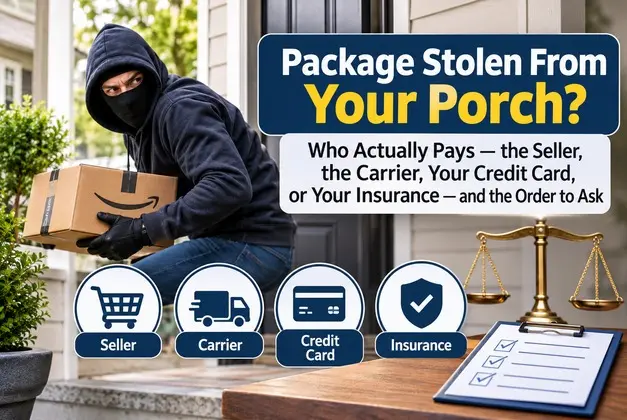
Start with the seller, not your insurer. Most big retailers replace or refund a stolen package as a matter of policy, even though the law usually puts the loss on you once a package has been properly delivered. Carriers almost never pay once a delivery scan shows your address. Your credit card may help, depending on what actually happened. Insurance covers theft, but only for the amount above your deductible — and often not even that.
- 1. The seller or marketplaceUsually your fastest refund.
- 2. The carrierTo trace it and report it — but claims usually run through the seller.
- 3. Your credit cardA dispute if it was never delivered; purchase protection if it was stolen after delivery.
- 4. Police reportOften required for card benefits and insurance.
- 5. Homeowners or renters insuranceOnly worth it if the loss is well above your deductible.
Tell us where you bought it and how it was delivered. We’ll put your steps in order — jump to the tool.
Before you report it: look at the delivery photo, check around your home and with neighbors, and give it the time your seller asks for. Deliveries are sometimes scanned before they physically arrive.
- Is it stolen?
- Who to ask
- Stolen vs. misdelivered
- The seller
- The law
- The carrier
- Your card
- Insurance
- Gifts
- Is it a crime?
Policies and laws verified November 5, 2026. Retailer and marketplace policies change often, so check the current page before you file anything.
Who Pays First?
Answer these and we’ll put your steps in order.
First 30 Minutes: Is It Really Stolen?
Check before you report. Delivery scans sometimes happen before the driver actually reaches your door, and “delivered” photos are sometimes of the wrong house entirely.
- Look at the delivery photo and the exact scan time. Does it show your door?
- Check around your home: back door, garage, mailroom, behind bushes or planters.
- Ask household members, neighbors, or a building office — a package is sometimes brought inside or held at a desk.
- Give it the time your seller asks for before reporting; check the current guidance on their page, since early scans do happen.
- Don’t confront anyone you suspect of taking it. Note what you know and report it to the police instead.
The First 48 Hours (copyable checklist)
- Look at the delivery photo and the exact scan time. Does it show your door?
- Search around: back door, garage, mailroom, bushes; ask neighbors and the building office.
- Wait the time your seller asks for before reporting — check the current guidance, since scans sometimes come early.
- Report to the seller or marketplace through the order page. Keep the case number.
- File a police report (many cities let you do this online). Note the report number.
- USPS package? Also report it to the Postal Inspection Service.
- Call your card issuer if the seller won’t help: a dispute for a misdelivered or undelivered package, or purchase protection for theft after delivery. Check the deadline.
- Save everything: screenshots of tracking and photos, receipts, emails, the police report number.
- Insurance only if the loss is well above your deductible.
Who to Ask, In Order
The seller comes first because a refund after a proper delivery is almost always their choice to make, not a legal requirement — and most big sellers would rather replace a cheap item than lose a customer over it.
| Who | When they usually pay | What you’ll need | Window | Legal duty or policy? |
|---|---|---|---|---|
| Seller or marketplace | Almost always, as goodwill | Order number, delivery photo | Check the current window | Policy |
| Carrier | Rarely, once delivery is confirmed | Tracking number | Check the carrier’s page | Neither, usually |
| Card — billing-error dispute | If it was never delivered as agreed | Order details, proof of non-delivery | Check your issuer’s deadline | Legal right (Reg Z) |
| Card — purchase protection | If stolen after a proper delivery, on some cards | Receipt, often a police report | Check your benefit guide | Card benefit, not law |
| Insurance | Only above your deductible | Police report, receipt, claim form | Check your policy | Policy, with limits |
Stolen, Misdelivered, or Never Delivered?
The remedy that actually works depends on which of these three happened — they are not the same problem.
Claiming a delivered package was stolen when it wasn’t is fraud. And you can’t be reimbursed twice for the same loss — pick one path (seller, card, or insurance) and see it through before trying another.
| What tracking shows | Who to contact first | Does a card dispute fit? | Notes |
|---|---|---|---|
| Delivered, your door | Seller, then police report | Usually not — it did arrive, legally | Purchase protection may fit instead |
| Delivered, wrong place or no photo | Seller and carrier | Often yes | Goods weren’t delivered as agreed |
| Not marked delivered / stalled | Seller | Often yes | Non-delivery is the clearest dispute case |
The Seller and the Marketplace
Most of the time, the fastest path back to your money runs through whoever sold you the item, not whoever delivered it.
- Sold and shipped by Amazon: contact Amazon support directly through the order page.
- Amazon third-party seller: message the seller first; if they don’t resolve it, Amazon’s A-to-z Guarantee covers eligible non-receipt and misdelivery claims, generally within about 90 days of the estimated delivery date, after waiting roughly 48 hours for the seller to respond. Check the current page before you file, since these windows change.
- Walmart, Target, and other major retailers: most will replace or refund a package marked stolen as a matter of customer-service policy, within whatever window their current help page states.
- eBay: the Money Back Guarantee generally covers items that never arrive; check the current filing window on eBay’s page.
- Etsy: individual sellers set their own policies; Etsy’s own purchase protection has its own eligibility rules — check the current page.
- Small independent shops: policies vary widely; ask directly, and mention the delivery photo and scan time.
What to say: state the order number, the delivery date, and what the tracking shows. Ask plainly for a replacement or refund. Don’t claim more than you know — see the note on fraud above.
What the Law Says About Who Bears the Loss
Here’s the part that surprises most people: once a package has been properly delivered, the law usually puts the loss on you, the buyer — a refund after that point is the seller’s choice, not a legal obligation.
The Uniform Commercial Code’s risk-of-loss rule (UCC §2-509) sets out three general rules for when risk passes from seller to buyer:
- Shipment contract (most common for online orders): risk passes to the buyer once the goods are properly handed to the carrier — meaning the seller’s job is largely done at that point, legally speaking.
- Destination contract: risk passes only once the goods are properly tendered at the destination.
- No carrier involved, merchant seller (e.g., the retailer’s own delivery driver): risk passes on the buyer’s receipt of the goods. This rule may matter more for store-operated delivery; treat it as the general shape of the rule rather than a settled answer for every situation.
Many retailers’ own terms of sale specify exactly when risk passes, and those terms can differ from the UCC’s default rules. The practical result for porch theft: a refund after a properly completed delivery is usually the retailer’s policy choice, not something the law requires of them.
Refunds after a proper delivery are usually policy, not a legal duty.
The Carrier: USPS, UPS, FedEx, Amazon
A consumer-protection verification by the TV station WUSA9 put this plainly: once a carrier’s indemnity rules treat a package as properly delivered, it generally won’t pay for what happens to it afterward — and a UPS spokesperson told the same reporters that the company’s responsibility ends the moment a package is scanned delivered. Carrier liability and declared-value claims generally belong to the shipper — usually the seller — not to you as the recipient.
| Carrier | Responsible after delivery? | Who can file a claim | How to report | Federal crime if stolen? |
|---|---|---|---|---|
| USPS | No, once indemnity rules treat it as delivered | Generally the sender | Seller, plus the Postal Inspection Service | Yes — 18 U.S.C. §1708 |
| UPS | No, once scanned delivered | Generally the shipper | Seller, then UPS’s claims page if needed | No — state law applies |
| FedEx | No, once scanned delivered | Generally the shipper | Seller, then FedEx’s claims page if needed | No — state law applies |
| Amazon’s own delivery | No, once scanned delivered | Handled through Amazon | Amazon customer service | No — state law applies |
USPS
Not responsible once indemnity rules treat the package as delivered. Claims for lost or damaged mail generally belong to the sender. Report theft separately to the U.S. Postal Inspection Service.
UPS
Responsibility ends once a package is scanned delivered. Claims are typically filed by the shipper, not the recipient; check UPS’s current claims page for the filing window.
FedEx
Similar pattern to UPS: liability generally ends at a confirmed delivery scan, and claims usually route through the shipper. Check FedEx’s current claims page.
Amazon’s own delivery
Handled through Amazon customer service rather than a separate carrier claims process; treat it like a seller-channel issue (see “The Seller and the Marketplace” above).
Tracing a package is still worth doing — ask the carrier whether the driver has notes on exactly where it was left — but expect the actual claim, if any, to run through the seller.
Your Credit Card: Dispute vs. Purchase Protection
These are two different tools, and using the wrong one wastes your time.
- Billing-error dispute (a legal right under the Fair Credit Billing Act and Regulation Z, §1026.13): covers goods not delivered as agreed. This fits a misdelivered or never-delivered package well; it usually doesn’t fit a package that was properly delivered and then stolen off your porch, because the merchant did deliver what you ordered.
- Purchase protection (a benefit some cards offer, not a law): can cover theft within a set window after purchase on cards that have it. Terms, dollar caps, exclusions, and required documentation — often including a police report — vary by card, so read your specific benefit guide rather than assuming.
Paid by debit card instead? The billing-error rules above are specific to credit cards. Debit and other bank-account transactions are covered by Regulation E, a different rule with its own, often shorter, error-resolution deadlines — contact your bank directly for a misdelivered or undelivered package. Paid through PayPal? Its own buyer-protection program handles non-receipt and, on eligible purchases, theft after delivery — check PayPal’s current filing window.
A card dispute fits a package that was never delivered, not one stolen after delivery.
See How to Dispute a Credit Card Charge and Hidden Credit Card Benefits for more on each.
Homeowners or Renters Insurance: The Deductible Math
Insurance covers theft of personal property in most homeowners and renters policies — but only above your deductible, and a claim can sit on your insurance history (a CLUE report) for years. For a cheap item, filing often isn’t worth it.
| Package value | $500 deductible | $1,000 deductible |
|---|---|---|
| $80 | Pays $0 | Pays $0 |
| $300 | Pays $0 | Pays $0 |
| $1,500 | Pays about $1,000, before limits | Pays about $500, before limits |
Below your deductible, an insurance claim pays nothing.
See What Does Renters Insurance Cover, Does Renters Insurance Cover Theft, Does Renters Insurance Cover Robbery, Insurance Claim or Pay Out of Pocket, and Homeowners Insurance Hidden Coverages for the fuller claim-or-pay math.
Gifts Sent to Someone Else
When a gift is stolen, the purchase relationship — not the doorstep — usually decides who files.
- If you bought and shipped the gift: you’re generally the one who files with the seller and your card, since you hold the order and the receipt.
- If someone sent you a gift that was stolen: you may need to provide the police report to the purchaser, who then handles the seller and card side of things.
Is Porch Piracy a Crime?
Yes, but which law applies depends on who delivered it.
Theft of mail handled by the U.S. Postal Service is a federal crime under 18 U.S.C. §1708, punishable by a fine, up to five years in prison, or both. Packages delivered by private carriers — UPS, FedEx, Amazon, and others — are currently covered by state law, not this federal statute.
A bipartisan bill, the Porch Pirates Act of 2025 (H.R. 6924), was introduced in the House on December 23, 2025, and would extend similar federal protection to packages left by private carriers, with penalties of up to three, five, or ten years depending on the value, method, and circumstances of the theft. As of November 5, 2026, the bill remains referred to the House Judiciary Committee and has not passed either chamber — check Congress.gov for its current status before citing it as law.
Several states have made package theft its own felony offense, separate from ordinary theft law:
Texas
Felony since 2019.
Arkansas
Felony since 2021.
Tennessee
Felony since 2021.
Georgia
Felony since 2021; the threshold turns on the number of packages and addresses involved.
Michigan
Package theft elevated to a felony offense.
Oklahoma
Package theft elevated to a felony offense.
Kentucky
Package theft elevated to a felony offense.
New Jersey
Package theft elevated to a felony offense.
Pennsylvania
Signed into law in December 2023, the ninth state to do so.
Not exhaustive; verified November 5, 2026. Other states have proposed similar bills that haven’t passed yet, and this list can change.
A police report matters even when no one is ever caught — it’s often required for a card’s purchase protection or an insurance claim, and it’s part of the record if your package theft is part of a larger pattern in your area.
See Check Stolen From the Mail for mail theft specifically.
How to Stop It Next Time
The cheapest fix is usually making it harder for a package to sit unattended in the first place.
| Option | Cost | Best for | Limits |
|---|---|---|---|
| Hold for pickup | Usually free | Anyone near a carrier location | Requires a trip to collect it |
| Pickup lockers | Usually free | Apartments, offices | Not offered everywhere |
| Signature required | Sometimes a small fee | High-value items | Missed delivery if no one’s home |
| Delivery instructions | Free | Side doors, gate codes | Driver discretion still applies |
| Deliver to work | Free | Anyone at a workplace that allows it | Not always allowed by employers |
| Lockbox | One-time cost | Frequent deliveries to one address | Size-limited |
FAQ
What should I do if my package was stolen from my porch?
Check the delivery photo and your surroundings first, then contact the seller or marketplace, file a police report, and only involve your card or insurance if the seller can’t help.
Who is responsible for a stolen package?
Legally, the loss usually falls on the buyer once delivery is complete. In practice, most sellers cover it anyway, as a policy choice.
Does the seller have to refund a stolen package?
Usually not as a legal matter, but most major sellers do it as customer-service policy.
Will Amazon refund a stolen package?
Often yes for items sold and shipped by Amazon directly; for third-party sellers, the A-to-z Guarantee is the backstop if the seller won’t help.
What if the package was sold by a third-party seller on Amazon?
Message the seller first; if that doesn’t resolve it, file an A-to-z Guarantee claim within the current filing window on Amazon’s page.
Does UPS or FedEx pay for packages stolen after delivery?
Almost never once a delivery scan confirms the correct address — responsibility ends at that scan.
What if USPS says delivered but I didn’t get it?
Check around and with neighbors first, then contact the seller, and separately report it to the U.S. Postal Inspection Service.
How long should I wait after a package is marked delivered?
Check your seller’s current guidance — scans sometimes happen before the driver physically arrives.
Can I dispute a stolen package with my credit card?
A billing-error dispute usually fits non-delivery or misdelivery better than theft after a proper delivery; purchase protection, if your card has it, is the better fit for theft.
What’s the difference between a dispute and purchase protection?
A dispute is a legal right under billing-error rules for goods not delivered as agreed; purchase protection is a card benefit, with its own terms, that can cover theft after delivery.
Do I need a police report?
Often, yes — many card purchase-protection claims and insurance claims require one.
Does homeowners insurance cover stolen packages?
Generally yes, as theft of personal property, but only above your deductible and subject to your policy’s limits.
Does renters insurance cover stolen packages?
Generally yes, under the same theft-of-personal-property coverage, with the same deductible math.
Is it worth filing an insurance claim for a stolen package?
Usually only if the item’s value is well above your deductible — otherwise a claim can pay $0 and still affect your insurance history.
Who files the claim if I sent the package as a gift?
Usually the purchaser, since they hold the order and receipt; the recipient may need to supply a police report.
Is stealing a package a federal crime?
Yes, if it was handled by USPS, under 18 U.S.C. §1708. Packages from private carriers currently fall under state law, not this federal statute.
Is package theft a felony in my state?
It is in at least nine states as of this writing — check the state list above, since this changes.
What is the Porch Pirates Act?
A bill introduced in Congress in December 2025 that would make stealing a package from a private carrier a federal crime, similar to mail theft. It had not passed either chamber as of November 5, 2026.
This article is general information, not legal advice. Retailer, marketplace, carrier, and card policies change and control your specific claim; laws were verified November 5, 2026.
Last Updated:

Daniel Hayes is the founder and sole researcher at AdvoraHQ. He covers U.S. personal finance, insurance, and consumer law — working directly from IRS publications, federal and state statutes, court opinions, and SEC filings rather than secondary summaries. His focus is the gap between what readers think they know and what the source documents actually say. Daniel is not a licensed attorney, CPA, or financial advisor; his articles are educational and not personalized advice. Reach him at Daniel.Hayes@advorahq.com.
