
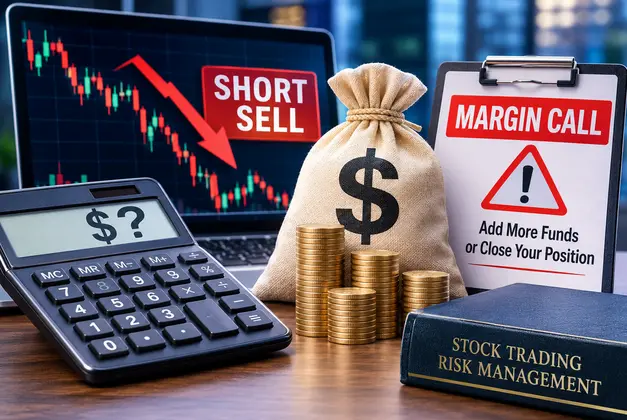
Shorting a stock costs you up to three things: a borrow fee that accrues every day (at Robinhood, for example: position value × the borrow rate ÷ 360); any dividends the stock pays while you’re short; and margin interest, but only if you’re also carrying a loan.
The bigger cost is the one you can calculate before you trade: the price at which a margin call forces you to add cash or be closed out.
Enter your trade and see your daily cost, break-even, and margin-call price →
- $2,000minimum equity for a margin account
- 150%what must be in your account to open a short (you deposit 50%)
- 30% or $5/shareFINRA’s maintenance minimum; your broker may require more
- No capon how far a stock can rise against you
Verified November 18, 2026. Broker fees and requirements change; check your broker’s disclosures before trading.
Short Trade Cost & Margin-Call Calculator
Estimate your daily cost, break-even and margin-call price for one short position of a stock priced at $5 or more. Nothing you type leaves your device.
How Short Selling Works, in Four Steps
Shorting means selling shares you borrowed, then buying them back later to return them, so you’re exposed to the price rising.
1. Borrow. Your broker lends you shares from its own inventory or from another lender.
2. Sell. The shares are sold at the current price, and the proceeds are credited to your account as collateral.
3. Buy back. Later, you buy the same number of shares at whatever the price is then.
4. Return. The bought shares go back to the lender, and the position closes.
A dollar example. You short 10 shares at $50 and receive $500. If you buy them back at $70, you pay $700 and lose $200 before costs. If you buy them back at $40, you pay $400 and keep $100 before costs.
The asymmetry. The most a short can gain is 100% of the sale value, because a stock can’t fall below $0. The loss has no ceiling, because a stock has no maximum price.
What You Need Before You Can Short in 2026
You need a margin account with at least $2,000 in equity, and that is a floor, not a trade size.
Margin account. Short sales can only be made in a margin account. Cash accounts can’t short, and IRAs generally can’t either, even where a limited form of margin is offered. At Robinhood, for example, the short-selling support page does not address retirement accounts, so check yours.
The $2,000 minimum. FINRA Rule 4210 sets $2,000 in equity as the minimum for a margin account. At Robinhood, for example, you must have margin investing enabled and at least $2,000 in portfolio value to short.
Do you need Robinhood Gold? Some third-party sites say so. Robinhood’s own short-selling page, checked November 18, 2026, lists margin and the $2,000 minimum and does not mention Gold. Confirm in your own app before you rely on either claim.
The 150% rule. Under Regulation T, a short sale needs 150% of its value in the account: the 100% in sale proceeds plus a 50% deposit from you.
Worked example. A $4,000 short needs $6,000 in the account: $4,000 of proceeds plus $2,000 of your own cash. That is why $2,000 supports a short of about $4,000 at the 50% requirement, and less if your broker’s house requirement is higher.
The day-trading rule changed. The $25,000 pattern-day-trader minimum was replaced on June 4, 2026 by intraday margin requirements (FINRA Regulatory Notice 26-10). That change does not remove the $2,000 or Regulation T requirements. See PDT Rule Replaced.
One more Robinhood detail. You can’t open a new short position during overnight hours in its 24 Hour Market.
How Much Does It Cost to Short a Stock?
A short has up to three costs: one you pay every day, a few you pay sometimes, and some risks you don’t control.
- YOU PAY EVERY DAYThe borrow fee.
- YOU PAY SOMETIMESDividends, margin interest, regulatory fees.
- YOU DON’T CONTROLRecalls, buy-ins, house-requirement changes, squeezes, Rule 201.
| Cost | How it’s calculated | When you pay it | Tier |
|---|---|---|---|
| Borrow fee | Largest short position held open that day × end-of-day price × quoted borrow rate ÷ 360 (at Robinhood, for example) | Every day the short is open, from the trade date until the closing trade settles | YOU PAY EVERY DAY |
| Payment in lieu of dividends | Dividend per share × shares short, for each ex-date while the short is open | Only when an ex-dividend date falls during your hold | YOU PAY SOMETIMES |
| Margin interest (debit balance only) | Debit (loan) balance × your broker’s margin rate ÷ 360; check your broker’s disclosure | Only if your account carries a loan, for example you also bought shares on margin | YOU PAY SOMETIMES |
| Regulatory fees | Small per-dollar fees on sales, set out in your broker’s fee schedule | When you sell, which includes opening a short | YOU PAY SOMETIMES |
The borrow fee
The borrow fee is what you pay for borrowing the shares, and it accrues every day the short is open.
At Robinhood, for example: fee per day = largest short position held open that day × end-of-day market price × quoted borrow rate ÷ 360. It starts on the trade date the short opens and runs until the closing trade settles. Robinhood’s support page says it bills monthly, and that the rate can change daily.
Worked example, easy to borrow. You short 100 shares at $50, a $5,000 position, at a 3% borrow rate. $5,000 × 0.03 ÷ 360 = $0.42 a day, about $12.50 over 30 days.
Worked example, hard to borrow. Same position at a 50% rate. $5,000 × 0.50 ÷ 360 = $6.94 a day, about $208.33 over 30 days. With a $2,500 deposit, that is 8.3% of your cash gone to fees, before the stock moves at all.
Easy vs. hard to borrow. When plenty of shares are available, rates are usually a fraction of a percent to a few percent a year. When few are available, rates can pass 100% a year. Your order screen shows the current rate. Check it every time, because it can change while you hold.
The borrow fee and margin interest are two different charges. At Robinhood, for example, the borrow fee is separate from, and in addition to, the cost of margin.
Dividends owed
If a stock goes ex-dividend while you’re short, you owe the lender the dividend. Example: a $0.50 dividend on 100 shares costs you $50. The full rules are in the dividends section.
Margin interest, only on a loan
Margin interest applies to a debit (loan) balance. Short sale proceeds are credited to your account, so a short alone does not usually create a debit. If you also bought shares on margin, or fees and dividends push your cash balance negative, interest applies to that debit. Your broker’s margin disclosure has the exact wording, so read it.
Regulatory fees
Regulators charge small fees on sales, and brokers pass them on. They apply when you open the short, and they are usually pennies on a typical retail trade. Your broker’s fee schedule lists them.
The Exact Price That Triggers a Margin Call
For a single short in a stock priced at $5 or more, the call comes at the lower of two prices, and most guides show only one of them.
Let C = your credit balance (short proceeds + your deposit − fees and dividends debited), N = number of shares, and m = the maintenance percentage as a decimal (0.30 for 30%).
Test 1, the percentage test: C ÷ (N × (1 + m))
Test 2, the $5 floor: C ÷ N − $5
Your margin-call price is the lower of the two.
FINRA Rule 4210(c) sets the minimum short maintenance requirement for stocks priced at $5 or more at the greater of $5 per share or 30% of current market value. For stocks under $5, it is the greater of $2.50 per share or 100%. These are minimums. Brokers can and do set higher house requirements. At Robinhood, for example, the maintenance ratio can range from 25% to 100% by position, and Robinhood can change it at any time.
Example A: 100 shares at $50
Value: 100 × $50 = $5,000. Deposit: $2,500. So C = $5,000 + $2,500 = $7,500.
30% test: $7,500 ÷ (100 × 1.30) = $57.69.
$5 test: $7,500 ÷ 100 − $5 = $70.00.
The call comes at $57.69, which is 15.4% above entry.
Example B: 400 shares at $12
Value: 400 × $12 = $4,800. Deposit: $2,400. So C = $4,800 + $2,400 = $7,200.
30% test: $7,200 ÷ (400 × 1.30) = $13.85.
$5 test: $7,200 ÷ 400 − $5 = $13.00.
The call comes at $13.00, only 8.3% above entry. The 30% formula alone gives the wrong answer here.
For stocks priced under about $16.67, the $5-per-share floor, not the 30% rule, sets your maintenance requirement. With only the minimum 50% deposit, the floor triggers your margin call first for entry prices under about $14.44.
Why cheap stocks hit the floor first
$5 is 30% of $16.67, so below that price the flat $5 is the bigger number. A quick check for the floor test: your cushion per share is your deposit per share minus $5.
In Example B, you deposited $6 per share, so the cushion is $1, and $12 + $1 = $13. A stock at $10 with a 50% deposit has a $5 deposit per share and a cushion of $0, so the floor test sits at your entry price. Some brokers also require at least $5 per share up front on a short, so they may refuse an order like that. Put up more cash, or use fewer shares, and the cushion grows.
What happens after a call
A margin call means your equity is below the requirement. You can add cash or close part of the position, and your broker decides whether any other deposit counts. See Margin Call Explained for how calls work in general.
Your broker can close your short without calling you first. At Robinhood, for example, the support page says it can adjust maintenance requirements and sell positions to address margin calls without notifying you first or gaining your authorization.
What Happens If the Stock Goes Up
If the stock rises, you lose the dollar amount of the rise on every share you’re short, and nothing stops that number from growing.
| Price move | New price | Loss before costs | Loss as % of deposit | Margin call? |
|---|---|---|---|---|
| +10% | $55.00 | $500 | 20% | No (call at $57.69) |
| +15.4% | $57.69 | $769 | 31% | Yes, this is the trigger |
| +25% | $62.50 | $1,250 | 50% | Yes, already past it |
| +50% | $75.00 | $2,500 | 100% | Yes, equity is zero |
| +100% | $100.00 | $5,000 | 200% | Yes, and you owe $2,500 beyond your deposit |
Why the loss has no cap. A long position can lose at most what you paid. A short’s loss is the price rise times your shares, and there is no maximum price. At +100% the loss equals the full original position value, which here is twice the cash you put up.
Short squeeze
A short squeeze happens when a rising price forces shorts to buy back shares, and that buying pushes the price up further. It tends to hit stocks where many traders are short and few shares are available. In a squeeze, the borrow rate can also jump, so your daily fee rises while your loss grows.
Overnight and after-hours gaps
Prices can jump between the close and the next open on news or earnings. Your margin-call price is a level the stock can skip past without trading there. A stop order can then fill far above your stop. See Stop-Loss Sold Below My Stop for how gaps work.
Liquidation without a call
Once your equity is below the requirement, your broker may close some or all of the position immediately. A call is not a guaranteed grace period.
When You Don’t Get to Decide: Recalls, Buy-Ins and Rule 201
Your short can be closed or restricted by events you don’t control, even if the stock hasn’t moved against you.
Locate requirement. Before a short sale, your broker must have reasonable grounds to believe the shares can be borrowed (Regulation SHO, Rule 203(b)).
Recall and buy-in. The lender of the shares can ask for them back. If your broker can’t find replacement shares, it can buy shares in the market and close your short at whatever the price is. Failures to deliver can also force close-outs (Rule 204). At Robinhood, for example, its support page says it can close a short at any time and without notice, including a buy-in when shares are no longer available to borrow. Check your own broker’s wording.
House-requirement changes. A broker can raise its maintenance percentage on a stock, sometimes after a sharp move. Your margin-call price then moves closer to the current price, with no change in the stock.
Rule 201 (the short-sale price test). If a stock falls 10% or more from the prior day’s close, new short sales in it are limited for the rest of that day and the next day. They can only be executed above the national best bid. You may not be able to open or add to a short while the restriction is on.
Dividends: The Payment You Owe
If a company pays a dividend while you’re short, you pay the lender an equal amount, called a payment in lieu of dividends.
Formula and example. Dividend per share × shares short. A $0.50 dividend on 100 shares costs $50, debited from your account.
Ex-date timing. Generally, you owe the payment if your short is open going into the ex-dividend date. The exact cutoff depends on your broker, so check it. See Ex-Dividend Date for how the dates work.
Special dividends. A one-time dividend can be large. The same rule applies, and the tax treatment differs for an extraordinary dividend (see below).
If a stock goes ex-dividend while you’re short, you pay the dividend.
How Short Sales Are Taxed
For an ordinary short closed with newly bought shares, the gain or loss is generally short-term, however long the short was open (IRC §1233). Exceptions exist: for example, if you already held substantially identical shares for more than a year when you opened the short, a loss on closing it can be treated as long-term.
Payments in lieu of dividends (IRS Pub 550; IRC §263(h)). For common stock, if you close the short by the 45th day after the short sale, you can’t deduct the payment. It is added to the basis of the stock you used to close the short. For an extraordinary dividend, the window is 1 year.
If you hold the short open longer, the payment is deductible as investment interest on Schedule A. That works only if you itemize, and it is limited to your net investment income (Form 4952).
Wash sales. The wash sale rule can apply to short sales. See Wash Sale Rule for how it works.
Loss limit. Net capital losses can offset up to $3,000 of other income a year ($1,500 if married filing separately). The rest carries forward.
One more rule. Holding a short in a stock you also own (“short against the box”) can trigger the constructive-sale rules (IRC §1259).
This is general information, not tax advice. For payments in lieu and constructive-sale questions, talk to a tax professional.
Shorting vs. Put Options vs. Inverse ETFs
These three have different worst cases: a short has no cap, a bought put loses the premium you paid, and an inverse ETF loses what you invested.
| Method | Maximum loss | Ongoing cost | Account needed | Dividends owed | Time works against you? | How it’s taxed |
|---|---|---|---|---|---|---|
| Short sale | No cap | Borrow fee every day | Margin account, $2,000 minimum | Yes | Fees accrue daily; no expiry, but you can be closed out | Generally short-term; special rules for payments in lieu |
| Buying a put option | The premium you paid | Time decay of the premium | An account approved for options | No | Yes, the option expires | Depends on how long you hold it and how it ends |
| Inverse ETF | The amount you invested | Fund expenses; daily resetting drag over long holds | A standard brokerage account | No | Often, over longer holds | Depends on fund structure and how long you hold |
For how options work, see Call vs. Put Options. For why inverse and leveraged funds drift over time, see Why Leveraged ETFs Lose Value.
Before You Tap “Short”
This checklist takes about two minutes, and each line is a check you can do before the order goes through.
- 1. Check the borrow rate on the order screen, and note that it can change daily.
- 2. Find your margin-call price with the calculator, using your broker’s actual maintenance % for this stock.
- 3. Check the calendar: an ex-dividend date or earnings date during your hold?
- 4. Decide your exit before you enter, and know that a stop order can fill far above your stop on a gap (see Stop-Loss Sold Below My Stop).
- 5. Keep spare cash in the account. A margin call can be met only with cash or by closing.
- 6. Know you can be closed out without warning: recall, buy-in, or a house-requirement change.
- 7. Track the 45-day mark if the stock pays a dividend (tax treatment changes).
- 8. Ask yourself: can I afford to lose more than I put in? If not, compare a put option (Call vs. Put Options), where the maximum loss is the premium.
FAQ
Short answers to the questions people ask most, verified November 18, 2026.
How much does it cost to short a stock?
Up to three costs: a daily borrow fee, any dividends paid while you’re short, and margin interest if you carry a loan. At a 3% borrow rate, a $5,000 short costs about $0.42 a day.
How is the borrow fee calculated?
At Robinhood, for example: largest short position held open that day × end-of-day market price × quoted borrow rate ÷ 360. Other brokers use their own methods.
Do you pay margin interest when you short a stock?
Only if your account carries a debit (loan) balance. The borrow fee is separate and always applies. Check your broker’s margin disclosure.
What is a hard-to-borrow fee?
It’s a high borrow rate charged when few shares are available to lend. Rates range from fractions of a percent to more than 100% a year, and they can change daily. Your order screen shows the current rate.
Can you short stocks on Robinhood, and what do you need?
Yes, in a margin account with margin investing enabled and at least $2,000 in portfolio value, per Robinhood’s support page. You must also meet its eligibility requirements.
Do you need Robinhood Gold to short?
Robinhood’s short-selling page doesn’t list Gold as a requirement. Some third-party sites say otherwise, so confirm in your own app.
How much money do you need to short a stock?
The account minimum is $2,000. At a 50% Reg T requirement, $2,000 supports a short of about $4,000, and less if your broker requires more.
Can you short in an IRA or a cash account?
No for a cash account. IRAs generally can’t short either. Shorting requires a margin account.
What price triggers a margin call on a short position?
The lower of C ÷ (N × (1 + m)) and C ÷ N − $5, for a stock priced at $5 or more. See the margin-call section for both tests and two worked examples.
What happens if a stock you shorted goes up 100%?
You lose an amount equal to the original position value. In Example A, that’s $5,000 on a $2,500 deposit, so you’d owe $2,500 beyond your cash, and you would have been in a margin call well before that.
What happens if a stock you shorted goes to zero?
Your gain is the sale value, less the borrow fees and dividends you paid along the way. That is the most a short can gain.
Can you lose more than you invested?
Yes. A stock has no maximum price, so a short’s loss can exceed the cash you put up, as Table 2 shows.
How long can you hold a short position?
There is generally no fixed term. You can hold while you meet margin requirements, shares stay available to borrow, and your broker doesn’t close the position. The borrow fee accrues every day you hold.
Do short sellers have to pay dividends?
Yes. You pay the lender a payment in lieu of dividends for any dividend with an ex-date while the short is open. See the dividends section.
Can my broker close my short without telling me?
Yes. At Robinhood, for example, the support page says it can close short positions at any time and without notice.
What is a short squeeze?
A rapid price rise that forces short sellers to buy back shares, which pushes the price higher still. See the section on what happens if it goes up.
How are short sales taxed?
Generally as short-term gains or losses. Payments in lieu of dividends have their own rules, including a 45-day window. See the tax section, and ask a tax professional.
Does the wash sale rule apply to short sales?
It can. See Wash Sale Rule.
Sources and Further Reading
- FINRA Rule 4210, short maintenance minimums, and Regulatory Notice 26-10, intraday margin
- Regulation T, 12 CFR 220.12, short-sale requirement
- Regulation SHO: Rule 201, Rule 203, Rule 204
- IRS Publication 550, short sales and payments in lieu of dividends; IRC §1233, §263(h), §1259; Form 4952
- Robinhood support: Short selling and Margin maintenance, named only as a factual example
Last updated: .
Disclaimer: this is general information, not investment or tax advice. Short selling can produce losses greater than the amount invested. Broker requirements, borrow rates and fees vary and change without notice. Verified November 18, 2026.

Daniel Hayes is the founder and sole researcher at AdvoraHQ. He covers U.S. personal finance, insurance, and consumer law — working directly from IRS publications, federal and state statutes, court opinions, and SEC filings rather than secondary summaries. His focus is the gap between what readers think they know and what the source documents actually say. Daniel is not a licensed attorney, CPA, or financial advisor; his articles are educational and not personalized advice. Reach him at Daniel.Hayes@advorahq.com.
