
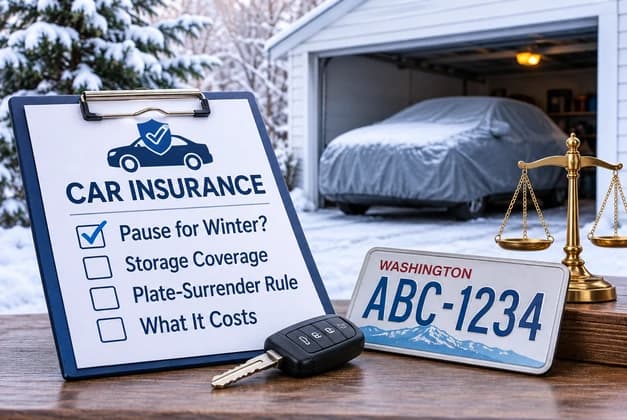
Quick answer: Usually not a true pause, but you can often drop to storage (comprehensive-only) coverage if the car won’t be driven.
The catch: in states like New York, Florida, Maryland, and North Carolina, you must keep liability insurance as long as the car is registered, or turn in your plates first.
Plates first, insurance second. If you cancel liability while the car is still registered, your insurer reports it to the state, and the fines start.
See what you’d save, and what a mistake would cost, in your state, in the calculator below.
State rules verified November 11, 2026, from DMV and state insurance sources.
Storage vs. Lapse Calculator
“Pause” Usually Means Storage Coverage
Most insurers won’t freeze a policy, but many will let you drop to storage coverage: comprehensive-only protection for a car that isn’t being driven.
Comprehensive covers theft, fire, vandalism, weather, and falling objects. It does not cover driving, and it is not the liability coverage most states require on a registered car.
In practice, insurers report what a policy covers to the state and price it by what is covered. So you’ll usually be offered less coverage, not “no coverage, restart later.” Ask your insurer whether it has a storage or suspension option, and get the terms in writing. For how comprehensive differs from the rest of a policy, see Full Coverage vs. Liability.
Three labels run through this guide:
SAFE TO DO Storage coverage with plates kept and liability-compliant under your state’s rules, or plates surrendered first.
CHECK FIRST Financed or leased cars, snowbirds, and California’s PNO.
FINE RISK Canceling liability while the plates are still active.
| Option | What’s covered | Can you drive? | Lapse on your record? | Good fit if |
|---|---|---|---|---|
| Keep full coverage | Everything on your current policy | Yes | No | You may drive the car, or you can’t confirm another option’s rules |
| Storage (comp-only) | Theft, fire, vandalism, weather, falling objects | No, not even a short trip | Depends on your state and insurer; ask whether liability ending gets reported | Your state allows it for a registered car, or the car is unregistered, and no lender objects |
| Surrender plates, then cancel | Nothing (consider comp-only for theft and fire) | No; the car can’t be on public roads without plates | Plates surrendered first means no registered-but-uninsured violation in NY, FL, MD, NC | The car will sit longer than a few weeks and no lender requires coverage |
| Cancel and keep plates FINE RISK | Nothing | No (and driving would be uninsured) | Yes in NY, FL, MD, NC; your insurer reports it | Never, in the four plate-first states |
If the real goal is a smaller bill, see How to Lower Car Insurance and How Much Is Car Insurance per Month.
The Rule That Causes the Fines: Insurance Follows the Plate
In many states the liability requirement attaches to the registration, so a parked car that still has plates still needs coverage.
When liability ends on a registered car, the insurer reports it to the state. The state then sees a registered, uninsured vehicle, and “I wasn’t driving it” is not a defense.
Florida says it directly: any vehicle with a current Florida registration needs continuous coverage even if it is not driven or is inoperable. New York says out-of-state coverage is never acceptable on a New York–registered vehicle, and that if New York coverage is ending for any reason, the plates go in before it ends.
FINE RISK Canceling liability while the plates are still active, in New York, Florida, Maryland, or North Carolina.
This guide covers the owner’s choice to reduce or end coverage. If your insurer canceled or didn’t renew you, that is a different problem: see Car Insurance Canceled or Nonrenewed.
Your State’s Rule and Penalty
In four states we checked, the answer is the same: return the plates before you cancel liability, or pay for the mistake.
| State | Plates before canceling liability? | Penalty if you don’t | Source | Verified |
|---|---|---|---|---|
| New York | Yes. Turn in plates before NY coverage ends. Out-of-state coverage is never acceptable on a NY-registered vehicle. | Civil penalty of $8/day (days 1–30), $10/day (31–60), $12/day (61–90); a 90-day lapse is $900. No civil-penalty option for 91+ days or if one was used in the past 36 months: plates surrendered and registration suspended. | NY State DMV | Nov 11, 2026 |
| Florida | Yes. Surrender the plate before canceling insurance. Continuous coverage is required on any currently registered vehicle, even if not driven or inoperable. | License and registration suspension, plus a reinstatement fee: $150 first, $250 second within 3 years, $500 subsequent. | FLHSMV; Fla. Stat. §324.0221 | Nov 11, 2026 |
| Maryland | Yes. Return tags before canceling insurance. | $200 for the first 30 days, then $7 a day, up to $3,500 per vehicle per year (in force since July 1, 2024; it was $150 and $2,500 before). | MD MVA; Md. Code, Transp. §17-106 | Nov 11, 2026 |
| North Carolina | Yes, for extended storage. Return the plate before canceling liability coverage; canceling first results in a fine. | Civil penalty of $50, $100, or $150 by number of lapses in 3 years, plus a $50 restoration fee. | NCDMV | Nov 11, 2026 |
| California (PNO, full year) | Different system. File Planned Nonoperation (REG 102) for a car kept off public roads for the entire registration year. | See the California section below. PNO is not a winter tool. | California DMV | Nov 11, 2026 |
| Other states | Check your DMV. | Check your DMV. | Your state DMV | Not covered |
Maryland’s statute says the penalty can’t be assessed if the plates were returned within 10 days of the lapse. Don’t plan around that window: return the tags before you cancel.
| State | 30 days | 60 days | 90 days | 120 days |
|---|---|---|---|---|
| New York | $240 | $540 | $900 | No civil-penalty option |
| Maryland | $200 | $410 | $620 | $830 |
| North Carolina | $50 + $50 restoration (first lapse) | |||
| Florida | $150 reinstatement (first) | |||
For any state not in the table
Ask your DMV three questions before you touch the policy: Is insurance required on a registered car that isn’t driven? Do plates have to go back before I cancel? What is the penalty, and how is it calculated?
California’s PNO: Great for a Year, Wrong for a Season
California’s Planned Nonoperation (PNO) is built for a car that stays off public roads for an entire registration year, so it doesn’t fit a three-month winter.
DMV defines PNO as the vehicle not being driven, towed, stored, or parked on public roads or highways for the entire registration year. You can file up to 60 days before your registration expires.
California DMV also lists an Affidavit of Non-Use (REG 5090) for a currently registered vehicle kept off the road “for insurance purposes.” If you keep not using the car, you must file PNO when the registration comes due.
CHECK FIRST DMV’s PNO page doesn’t spell out the insurance rule, so confirm with DMV and your insurer whether liability is required during PNO. While the car is registered, keep the insurance California requires.
Financed or Leased Car
If a lender or lessor holds the car, call them before you change anything, because they generally require physical-damage coverage the whole time.
Storage coverage is typically comprehensive-only, so it may not satisfy a contract that also calls for collision. Ask what they require while the car is stored, and get the answer in writing.
CHECK FIRST Read the loan or lease contract, then call.
Snowbirds and Two-State Owners
If you’re a nonresident, your car can trigger Florida’s insurance rule once it has been in Florida more than 90 days during the preceding 365.
Under Fla. Stat. §627.733(2) and Fla. Admin. Code 69O-176.008, a nonresident whose vehicle is physically present in Florida more than 90 days in the preceding 365 must maintain Florida PIP and property damage liability. A Florida appeals court has read the statute cumulatively, so several shorter stays add up.
Example: a car that spends January through April in Florida (about 120 days) passes 90 days around the end of March. Count your days, and count them across winters.
CHECK FIRST A car can end up needing to satisfy both its home state and Florida. Tell your insurer where the car is actually kept, and ask in writing how the policy meets both states’ rules.
Other Situations
The same plate-and-liability logic applies to every long absence; the details differ.
Military deployment
Ask your insurer about storage coverage, and check your state’s plate rule before you cancel liability. North Carolina law waives lapse penalties and restoration fees for a person who was deployed with the armed forces when notified of a lapse. Confirm other states with your DMV.
Long hospital stay or travel abroad
Set up the plate decision and the policy change before you leave. Name someone to handle the spring restore, so the car isn’t driven on lapsed coverage when you return.
A car that doesn’t run, parked in your driveway
In Florida, a registered vehicle needs continuous coverage even if it is inoperable. In the other plate-first states, registration is what creates the requirement. If the car is not coming back, surrender the plates first.
Classic and summer cars
This is the winter problem in reverse: the car sits in the cold months and the same plate rule applies. Ask about storage coverage, and confirm your state’s rule before you drop liability.
What a Lapse Costs Beyond the State Fine
Beyond the penalty, a lapse can cost you in the price of your next policy and in paperwork.
Insurers commonly price prior continuous coverage, but we have no verified figure for how much a lapse changes a quote. Ask for quotes both ways: keeping storage coverage, and starting a new policy after a gap. For how prior coverage fits into pricing, see How Car Insurance Rates Are Calculated.
Illustrative math only: at $180 a month now and a $30 storage quote, four months saves $600. In New York, canceling for those four months (about 120 days) without surrendering plates has no civil-penalty option, so you face a suspension. Even a 90-day New York lapse costs $900, more than the $450 three months of storage savings would give you.
The Day You Drive Again
Restore full coverage before the first drive, not after.
The second fatal mistake, after “one quick drive on storage coverage,” is forgetting to restore coverage in spring. Put a calendar reminder a week before you expect to need the car.
- Call your insurer and restore liability and collision, effective before the car moves. Get the new proof of insurance.
- If you surrendered plates, re-register the car first; a car without plates can’t be on public roads.
- Tell your lender if the policy changed.
- Keep every confirmation: plate receipt, policy change, effective dates.
If you’re switching insurers at the same time, see How to Switch Car Insurance Without a Lapse.
Pause It Without a Fine
This eight-step checklist puts the steps in the order that avoids the fines, and you can copy it.
- Financed or leased? Call the lender or lessor first and ask what coverage they require while the car is stored.
- Get a storage (comprehensive-only) quote from your current insurer, and ask if they offer a storage or suspension option.
- Check your state’s rule: can you keep plates with comprehensive-only, or must you surrender plates before dropping liability?
- If surrendering plates: do it first, get the receipt, then change the policy, effective that date.
- Park off the street if your state or policy requires it.
- Snowbirds: count days your car spends in Florida; past 90 in 365, Florida PIP/PDL applies.
- Set a spring reminder: restore liability and collision before the first drive, and re-register plates if you surrendered them.
- Keep every confirmation: plate receipt, policy change, effective dates.
Frequently Asked Questions
Can you pause car insurance?
Usually not as a true freeze. Most insurers offer storage (comprehensive-only) coverage instead, or you can cancel after handling your plates. What is safe depends on your state and whether the car is financed.
Can I pause car insurance for 3 months over the winter?
You can usually drop to storage coverage, but in New York, Florida, Maryland, and North Carolina a registered car still needs liability unless the plates go back first. In New York, a 90-day lapse on a registered car costs $900 under the civil-penalty option (NY DMV, November 11, 2026).
What is storage or comprehensive-only coverage?
It insures a car that isn’t being driven against theft, fire, vandalism, weather, and falling objects. It does not cover driving. See Full Coverage vs. Liability.
Can I drive a car with storage insurance?
No, not even to the mechanic. Restore full coverage before the first drive. One quick trip on storage coverage is how a stored car turns into an uninsured crash.
Do I have to turn in my plates before canceling insurance?
In New York, Florida, Maryland, and North Carolina, yes: return the plates before canceling liability. For other states, check your DMV. California uses PNO instead.
What is the penalty in New York for a lapse?
For a lapse of 90 days or less, and if you haven’t used the option in the past 36 months, you may pay $8 a day for days 1–30, $10 for days 31–60, and $12 for days 61–90. That is $240 at 30 days, $540 at 60, and $900 at 90. At 91+ days there is no civil-penalty option: plates are surrendered and the registration suspended.
What is the Maryland uninsured penalty?
$200 for the first 30 days plus $7 a day after, up to $3,500 per vehicle per year. That is $410 at 60 days, $620 at 90, and $830 at 120. These amounts took effect July 1, 2024.
What happens in Florida if I cancel while registered?
The state can suspend your license and registration, and reinstatement costs $150 (first), $250 (second within 3 years), or $500 (subsequent). Surrender the plate before you cancel.
What is North Carolina’s lapse fine?
$50 for a first lapse, $100 for a second, and $150 after that within three years, plus a $50 restoration fee. NCDMV advises returning the plate before canceling when you store a vehicle for an extended period.
What is California’s PNO, and does it need insurance?
PNO means the car won’t be driven, towed, stored, or parked on public roads for the entire registration year. DMV’s PNO page doesn’t state an insurance rule, so confirm with DMV and your insurer. It is not a winter tool.
Can I pause insurance on a financed or leased car?
Generally not without the lender’s agreement. Lenders and lessors usually require physical-damage coverage, so check the contract and get their answer in writing.
Does suspending coverage count as a lapse?
It can. If liability ends while the car is registered in a plate-first state, the state sees a lapse. If plates go back first, there is no registered-but-uninsured car. How an insurer records a gap for pricing varies, so ask.
Do I need insurance on a car that doesn’t run?
If it is registered, often yes. Florida requires continuous coverage even for an inoperable registered car, and in the other plate-first states registration creates the requirement. If it won’t return to the road, surrender the plates first.
I’m a snowbird. Which state’s insurance do I need?
Your registration state’s rules still apply. If the car is in Florida more than 90 days during the preceding 365, counting days cumulatively, Florida PIP and property damage liability also apply.
How much does storage coverage cost?
It varies by insurer, car, and state, and we have no verified average. In our illustrative example, $30 a month instead of $180 for four months saves $600. Get a quote.
How do I restore coverage in the spring?
Restore liability and collision before the first drive, and re-register the plates if you surrendered them. See How to Switch Car Insurance Without a Lapse if you’re changing insurers.
Last updated:
This guide is general information, not legal or insurance advice. State rules and penalties change; the figures here were verified on November 11, 2026. Confirm with your DMV, your insurer, and your lender before you change anything.

Daniel Hayes is the founder and sole researcher at AdvoraHQ. He covers U.S. personal finance, insurance, and consumer law — working directly from IRS publications, federal and state statutes, court opinions, and SEC filings rather than secondary summaries. His focus is the gap between what readers think they know and what the source documents actually say. Daniel is not a licensed attorney, CPA, or financial advisor; his articles are educational and not personalized advice. Reach him at Daniel.Hayes@advorahq.com.
