
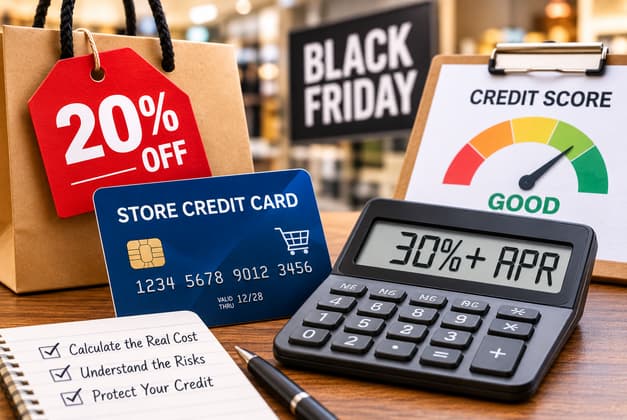
Quick answer: Only if you’ll pay the full balance by the first due date, the discount still beats the rewards your own card would earn, and you’re not applying for a mortgage or car loan soon. Store cards average over 30% APR, so carrying the balance can erase the discount in months.
The 10-Second Checkout Rule
It can make sense if ALL are true:
- You’ll pay it in full before interest.
- The discount has no cap that shrinks it, or the cap still leaves real savings.
- No mortgage, auto loan, or apartment application in the next several months.
- You’ll set up autopay today.
Say “no thanks” if ANY is true:
- You’ll pay it off over time.
- The discount is capped low.
- You’re mid–home purchase.
- You’re deciding under pressure in line.
Run your numbers in 10 seconds ↓
Store Card Break-Even Calculator
Related: deferred interest · mortgage credit scores · credit utilization
Rates and figures verified November [date], 2026. Black Friday is November 27; Cyber Monday is November 30.
What That “20% Off Today” Is Really Worth
The discount is real, but a cap, the rewards you skip, and interest can each shrink it fast.
A 20% discount “up to $100” is only 10% on a $1,000 purchase.
The rewards you give up count too: a 2% cash-back card pays $20 on $1,000, and that comes off your savings.
At 31% APR, every month you carry a balance costs about 2.6% of it. An ongoing 5% discount is gone after about two months of carrying it.
| Purchase / discount | Pay in full | 6 equal payments | 12 equal payments | $40 a month |
|---|---|---|---|---|
| $500, 20% off ($100) | +$90 | +$52.70 (interest $37.30) | +$18.99 (interest $71.01) | +$20.40 (12 months, interest $69.60) |
| $1,000, 20% off ($200) | +$180 | +$105.40 (interest $74.60) | +$37.97 (interest $142.03) | −$165.71 (29 months, interest $345.71) |
| $1,000, “20% off, up to $100” (hypothetical cap) | +$80 | −$3.92 (interest $83.92) | −$79.78 (interest $159.78) | −$393.38 (35 months, interest $473.38) |
GOOD DEAL: $1,000, 20% off, no cap, paid in full: +$180 after the 2% rewards you skip.
THIN DEAL: The same purchase on 12 equal payments: +$37.97, after $142.03 of interest.
COSTLY: The capped deal on 6 equal payments: −$3.92. On $40 a month, −$393.38.
How the labels work: COSTLY means a net result below zero. THIN DEAL means positive but under 25% of the discount. GOOD DEAL is everything else.
Why Store Card APRs Run Above 30%
Store cards typically cost more to carry than general-purpose cards, and approval is often more lenient.
The CFPB found that over 90% of retail cards had a maximum APR above 30%, vs. 38% of general-purpose cards, and the average APR on new retail cards from the 100 largest retailers was 32.66% (December 2024). Its 2025 market report put store cards at 31.3% in 2024 vs. 25.2% for general-purpose cards. The Federal Reserve’s G.19 (released Nov. 6, 2026) shows 22.36% for all card accounts assessed interest in Q3 2026.
Four large banks issue over 80% of retail cards, which had over 160 million open accounts in 2024, and late fees were about 25% of store card interest and fees vs. about 7% on general-purpose cards.
| Fact | Number | Source | Date |
|---|---|---|---|
| Average APR, new retail cards | 32.66% | CFPB | Dec. 2024 |
| Retail cards with max APR above 30% | Over 90% | CFPB | Dec. 2024 |
| Store vs. general-purpose card APR, 2024 | 31.3% vs. 25.2% | CFPB Credit Card Market Report | Dec. 30, 2025 |
| Average rate, accounts assessed interest | 22.36% | Federal Reserve G.19 | Nov. 6, 2026 (Q3 2026) |
| Hard inquiry effect | Fewer than 5 FICO points | Experian / myFICO | [date] |
| Closed account in good standing stays on report | Up to 10 years | Experian | [date] |
What Opening One Does to Your Credit
Expect a small, temporary dip from the inquiry, plus a new account and possibly a low limit.
One new hard inquiry typically lowers a FICO Score by fewer than five points. FICO counts inquiries from the past 12 months, and they stay on your report up to two years. A new account also lowers your average account age, and a low limit means even a modest purchase can raise your utilization. More in Does Applying for a Credit Card Hurt Your Credit?
Bad Timing: Don’t Open One Right Before a Mortgage or Car Loan
If a loan is coming, a new inquiry and new account are the wrong thing to add first.
If your score is near a lender’s pricing cutoff, a few points can matter. Lenders may also ask about recent inquiries and new accounts. See What Credit Score Do Mortgage Lenders Use?
Timing check — wait if any of these is true:
- You expect to apply for a mortgage in the next several months.
- You expect to apply for an auto loan or an apartment.
- Your score sits near a lender’s pricing cutoff.
COSTLY: A loan application within the next several months.
Keep It, Close It, or Sock-Drawer It?
Each option has a trade-off, and none is automatically the right one.
| What you do | Available credit and utilization | Credit age | Risk | Good fit if |
|---|---|---|---|---|
| Keep and use occasionally | Limit stays, so utilization stays lower | Keeps aging | Tempting to carry a balance at a high APR | You shop there often and pay in full |
| Keep unused (sock drawer) | Limit stays, but if the issuer closes it for inactivity, you lose that credit exactly as if you closed it | Keeps aging until closed | Possible issuer closure; missed fees or notices | You want the limit and age without spending |
| Close | Available credit drops; utilization may rise (same effect as issuer closure for inactivity) | Account stays on your report up to 10 years if in good standing | Higher utilization on other cards | You’d be tempted to overspend or the card has a fee |
See How to Cancel a Credit Card, Credit Utilization, and How Many Credit Cards Should You Have?
Store Card vs. Co-Branded vs. Store Debit vs. Your Cash-Back Card
The same checkout discount can come from very different products.
A store debit card can give the same discount with no credit check.
| Option | Where it works | Credit check | Cost if you carry a balance | Discount or rewards | Best for |
|---|---|---|---|---|---|
| Closed-loop store card | That retailer only | Yes | Often 30%+ APR | Store discount or points | Frequent shoppers paying in full |
| Co-branded store card | Anywhere (Visa/Mastercard/Amex logo) | Yes | Varies; check the terms | Store perks plus general rewards | Shoppers who want one card for everything |
| Store debit card | That retailer, linked to checking | No | No credit balance to carry | Often the same store discount | Getting the discount without credit risk |
| General cash-back card | Anywhere | Yes | Varies; averaged 25.2% for general-purpose cards in 2024 (CFPB) | Flat or category cash back | Everyday spending |
As a factual example, Target’s Circle debit version links to a checking account and needs no credit check; its credit versions are issued by TD Bank USA and require approval. All give 5% off eligible Target purchases. Check the current APR on Target’s rates page.
The Traps: Deferred Interest, Returns, and Paying at the Register
Three small things cost people the most.
You usually can’t pay a new store card at the register — set up autopay before you leave.
Deferred interest. “No interest if paid in full” can charge interest on the whole purchase if a dollar remains at the end. See Deferred Interest.
Returns. Returning a discounted item may refund less than the sticker price, and the refund may take time. See How Long Does a Credit Card Refund Take?
Interest after paying. See Charged Interest After Paying the Statement Balance.
Store Card vs. Buy Now, Pay Later This Black Friday
Both spread out a purchase, but they affect credit and cost in different ways.
A store card is a revolving account with a high APR and a hard inquiry. BNPL terms and reporting vary by provider. See BNPL and Your Credit.
When a Store Card Actually Makes Sense
It fits when the savings repeat and the balance never carries.
That is a frequent shopper with an ongoing discount who pays in full. For building credit, store cards can be easier to get approved for, but expect low limits.
Before You Leave the Register
Six steps, in order.
- Write down the APR and the first due date from the receipt or terms.
- Set up autopay for the full statement balance today, not the minimum.
- Check the discount actually applied and whether a cap reduced it.
- If it’s a “no interest if paid in full” offer: divide the balance by the months, minus one, and pay that amount every month.
- Keep the receipt. Returns of discounted items may refund less than the sticker price.
- Decide now: keep, sock-drawer, or close later and set a calendar reminder.
FAQ
Should I open a store credit card for the discount?
Run the calculator. It depends on the cap, your rewards, whether you pay in full, and your timing.
Are store credit cards worth it?
They can be if you pay in full and the discount isn’t capped low. Carrying a balance at 30%+ APR can erase it.
How much does opening a store card hurt my credit?
One inquiry typically lowers a FICO Score by fewer than five points, plus a new account lowers average age.
Does a denied store card application still hurt my credit?
The hard inquiry can still be recorded. See our guide.
Can I open a store card, get the discount, and pay it off right away?
Yes, if the terms allow it. The inquiry and new account still appear on your report, and doing this repeatedly adds both each time.
Can I pay a store card at the register?
Usually not a brand-new one. Set up autopay before you leave.
When is my first payment due?
It’s on your first statement and receipt terms. Write the date down at checkout.
Should I close a store card after using the discount?
See the keep, sock-drawer, or close table above for the trade-offs.
What happens if I never use the card?
It may stay open, but the issuer can close it for inactivity, which reduces your available credit.
Why do store credit cards have such high interest rates?
Approval is often more lenient, a few large banks issue most of them, and late fees make up about a quarter of store card interest and fees (CFPB, 2024).
What’s the difference between a store card and a co-branded card?
A closed-loop store card works only at that retailer. A co-branded card carries a Visa, Mastercard, or Amex logo and works anywhere.
Is there a store discount card with no credit check?
Some retailers offer a store debit card linked to checking, such as Target’s Circle debit version.
Is 20% off better than 2% cash back?
Paid in full and uncapped, yes. Carried or capped, it can lose. Use the calculator.
What is deferred interest on a store card?
Interest that’s waived only if you pay the full balance by the deadline; otherwise it can be charged on the whole purchase. See Deferred Interest.
Should I open a store card if I’m buying a house soon?
A new inquiry and account can matter if your score is near a lender’s cutoff. See our mortgage score guide.
What happens if I return something I bought with the sign-up discount?
The refund may be less than the sticker price. Check that retailer’s policy and keep your receipt.
Sources
CFPB, Issue Spotlight, The High Cost of Retail Credit Cards (December 2024) · CFPB, Consumer Credit Card Market Report (Dec. 30, 2025) · Federal Reserve, G.19 Consumer Credit (released Nov. 6, 2026) · Experian and myFICO, hard inquiries and closed accounts · Target, Circle Card rates and terms page · CFPB, consumer guidance on deferred-interest promotions.
Last updated:
This is general information, not financial advice. Card terms vary by issuer and offer; your cardholder agreement controls. Figures verified on [date]; calculator results are simplified estimates.

Daniel Hayes is the founder and sole researcher at AdvoraHQ. He covers U.S. personal finance, insurance, and consumer law — working directly from IRS publications, federal and state statutes, court opinions, and SEC filings rather than secondary summaries. His focus is the gap between what readers think they know and what the source documents actually say. Daniel is not a licensed attorney, CPA, or financial advisor; his articles are educational and not personalized advice. Reach him at Daniel.Hayes@advorahq.com.
