
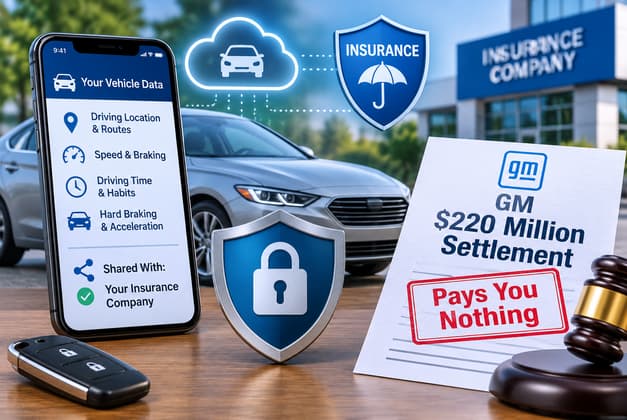
Quick answer: Possibly — even if you never knowingly opted in. Some connected cars (most notably GM vehicles through 2024) and, according to a pending Texas lawsuit, some phone apps sent trip data to data brokers, which supplied driving scores to insurers. You can check in about 10 minutes: request your free LexisNexis consumer disclosure report, look for a “driving score” or “driver feedback” feature in your car’s app, and ask your insurer in writing which data sources it used.
Get your own 10-minute action plan by car brand and state →
- 3 ways data reaches insurers
- Check your reports
- Turn it off by brand
- Did it raise my rate?
- The GM settlements
- Will I get money?
- Your state
- Letter builder
Verified . Lawsuits are still moving — dates on every claim below.
Driving Data Check — Your 10-Minute Action Plan
Answer seven quick questions and get an ordered plan. It runs in your browser, saves nothing, and never asks for a VIN, your name or a policy number.
Your action plan
Jump to: Did your car raise your rate? · Will you get any money? · Turn it off by brand · Request letters
The 3 Ways Your Driving Data Reaches an Insurer
Driving data reaches insurers through three routes: your car, an app on your phone, or a program you joined with the insurer.
Only the third route is something you always choose knowingly. The first two are what people are asking about after the $220 million headline.
| Pathway | How you got enrolled | Who collects | Who receives | How to see it | How to stop it |
|---|---|---|---|---|---|
| Connected car → broker → insurer CONFIRMED for GM (settled) | Through the car’s connected-services setup, often at purchase. Regulators say some GM enrollments were misleading or completed by dealer staff. GM admits no liability. | The automaker, through the car’s built-in modem. In the GM cases, the feature was OnStar Smart Driver. | Data brokers such as LexisNexis and Verisk, which supplied driving data and scores to insurers. | Request your LexisNexis consumer disclosure (and Verisk’s, if its form is live). Ask the automaker for a copy of your data. | Turn off driving-score and data-sharing features in the car and the app. File a privacy request. Data already shared may remain with others. |
| Phone-app software → broker → insurer PENDING (Texas lawsuit) | By installing an app and allowing location access. Texas alleges software inside the app collected driving data without users’ knowledge. Allstate denies this. | Analytics software embedded in the app (Arity, in the Texas case). | Insurers. Texas alleges Allstate used the data and sold it to other insurers. | Ask the app company, and any analytics partner it names, for your data. Read the app’s privacy page. | Set location access to Never or While Using, delete the app, or opt out in its privacy settings. |
| Insurer opt-in program CONFIRMED (how these programs work) | You enroll through the insurer’s app or a plug-in device, usually for a discount. | The insurer or its vendor. | The insurer you chose. | In the insurer’s app or portal, or by asking in writing. | Unenroll or remove the device. Check your policy terms, because a discount can end. |
Connected car → broker → insurer
- How you got enrolled
- Through the car’s connected-services setup, often at purchase. Regulators say some GM enrollments were misleading or completed by dealer staff. GM admits no liability.
- Who collects
- The automaker, through the car’s built-in modem. In the GM cases, the feature was OnStar Smart Driver.
- Who receives
- Data brokers such as LexisNexis and Verisk, which supplied driving data and scores to insurers.
- How to see it
- Request your LexisNexis consumer disclosure (and Verisk’s, if its form is live). Ask the automaker for a copy of your data.
- How to stop it
- Turn off driving-score and data-sharing features in the car and the app. File a privacy request. Data already shared may remain with others.
Phone-app software → broker → insurer
- How you got enrolled
- By installing an app and allowing location access. Texas alleges software inside the app collected driving data without users’ knowledge. Allstate denies this.
- Who collects
- Analytics software embedded in the app (Arity, in the Texas case).
- Who receives
- Insurers. Texas alleges Allstate used the data and sold it to other insurers.
- How to see it
- Ask the app company, and any analytics partner it names, for your data. Read the app’s privacy page.
- How to stop it
- Set location access to Never or While Using, delete the app, or opt out in its privacy settings.
Insurer opt-in program
- How you got enrolled
- You enroll through the insurer’s app or a plug-in device, usually for a discount.
- Who collects
- The insurer or its vendor.
- Who receives
- The insurer you chose.
- How to see it
- In the insurer’s app or portal, or by asking in writing.
- How to stop it
- Unenroll or remove the device. Check your policy terms, because a discount can end.
Three routes for driving data to reach an insurer. Sources: FTC release (Jan. 14, 2026); Washington AG (Oct. 29, 2026); Texas v. Allstate & Arity (Jan. 2025). Verified Nov. 12, 2026.
What Gets Sent — and What a “Driving Score” Measures
A driving score is built from trip records: when you drove, how fast, how hard you braked and where you were.
State filings and court papers in the GM cases describe the same list:
- Trip start and end times, and distance.
- Hard braking and hard acceleration events.
- Speeding, including time over 80 mph.
- Late-night driving.
- Seat-belt status.
- Precise location. Then-FTC Chair Lina Khan said in January 2025 that GM tracked some drivers as often as every three seconds.
The Kansas attorney general described the data the same way when announcing the $220 million settlement. These are the AGs’ descriptions, and GM admits no liability.
How a broker turns those events into a score is not public. We don’t know the formula, and we won’t guess. What you can see is the underlying file, which is why the next section matters.
The New York Times reported in 2024 that one Chevrolet Bolt owner’s LexisNexis file ran 258 pages and listed months of trips with speeding and braking events.
How to Check What Insurers May Have Seen
You can see most of what a data broker holds on you by requesting a free consumer disclosure report, and starting takes about 10 minutes.
- Request your LexisNexis consumer disclosure. Use the LexisNexis Risk Solutions consumer portal and ask for every report it holds on you, including any driving-behavior (telematics) data. You will verify your identity on the official portal. Federal law gives you a free copy at least once every 12 months.
- Request your Verisk file, if its form is still live. Verisk has a driving-behavior disclosure request form. Verisk says it stopped receiving automaker driving data in 2024, so a “no file” answer is possible. Having it in writing is still useful. UNVERIFIED that the form is live today.
- Ask your automaker for a copy of your data. Search “[your brand] privacy request” or use EFF’s list of request pages. Ask what it collects, which companies received it, and for deletion. GM owners have specific rights, covered in the GM section below.
- Ask the app companies. If you use apps like Life360, GasBuddy or Fuel Rewards, open each privacy page and ask what location and driving data it keeps and who receives it. These apps are named in Texas’s complaint against Allstate and Arity. Being named in a complaint is not a finding about the app company.
- Ask your insurer in writing. Ask which consumer reports, data brokers or telematics sources it used at your last renewal. The Request Letter Builder writes this for you.
What to look for in a report
- Lists of trips, with dates and times.
- Event counts: hard braking, hard acceleration, speeding, late-night driving.
- The source of the data: an automaker, an app or a program name.
- Inquiries: which insurers or companies pulled your report, and when.
- Errors: a trip that wasn’t yours, a car you already sold, or a vehicle you never owned.
The CFPB’s list of consumer reporting companies shows where else to request files, and its summary of your rights under the Fair Credit Reporting Act explains what you can ask for.
How to Turn Off Driving Data Sharing, by Brand
Turn off the driving-score and data-sharing features in both the car’s screen and the brand’s app, and leave crash response on if you want it.
Check both places, because the car’s screen and the brand’s app often hold separate switches.
| Brand | Feature name to look for | Where (app or screen) | Notes | Verified date |
|---|---|---|---|---|
| Chevrolet, GMC, Buick, Cadillac (GM) | OnStar Smart Driver (discontinued; GM says it ended the program in April 2024) | The OnStar app and the Chevrolet, Buick, GMC or Cadillac apps, plus the car’s connected-services or privacy screen | Under the FTC order and the Oct. 29, 2026 settlement, you can ask GM for a copy of your data and for deletion. Data already shared may remain with others until they delete it. | UNVERIFIED Nov. 12, 2026. End date per GM statements cited in AG filings. Menu path not yet checked on GM’s own page. |
| Honda and Acura | Driver Feedback | Connected-services or data-sharing settings in the car, and the HondaLink or Acura app (path varies by model year) | Press guides say the Driver Feedback privacy terms describe sharing with a data broker. Verisk said in 2024 it had received Honda driving data and stopped. | UNVERIFIED Nov. 12, 2026. Feature name from press guides. Menu path not yet checked on Honda’s own page. |
| Hyundai (and Genesis) | Drive Score (reportedly discontinued) | The Bluelink app and the car’s connected-services menu | Reported as discontinued after 2024, but the connected service itself may still collect data. Verisk said in 2024 it had received Hyundai driving data and stopped. | UNVERIFIED Nov. 12, 2026. Discontinuation reported by press only. Menu path not yet checked on Hyundai’s own page. |
| Kia | Driving Score (reportedly discontinued) | The Kia Connect app and the car’s connected-services menu | Reported as discontinued after 2024. Consumer Reports says LexisNexis has had a partnership with Kia. | UNVERIFIED Nov. 12, 2026. Discontinuation reported by press only. Menu path not yet checked on Kia’s own page. |
| Toyota and Lexus | Insure Connect, and data-sharing choices in the Data Privacy Portal | Toyota app: profile icon, then Account, then Data Privacy Portal (as Edmunds describes it) | Toyota says it does not directly sell driver data, but it has an affiliate, Connected Analytic Services, that can supply driving data to insurers (per Consumer Reports). A pending suit is in arbitration. Turning off all Connected Services can also switch off safety features, so ask what stays on. | UNVERIFIED Nov. 12, 2026. Feature name from press guides. Menu path not yet checked on Toyota’s own page. |
| Mazda | No driving-score feature name documented | The Mazda connected-services app’s privacy settings, and Mazda’s privacy request page | Texas alleges Allstate bought data from Mazda-brand vehicles (an allegation; Allstate denies wrongdoing). | UNVERIFIED Nov. 12, 2026. No feature name found. Check Mazda’s own privacy page. |
| Chrysler, Dodge, Jeep, Ram, Fiat | No driving-score feature name documented | The brand’s connected-services app and the car’s privacy screen | Texas alleges Allstate bought data from vehicles of these brands (an allegation). Montana announced an investigation of Stellantis in April 2026 (an investigation, not a finding). | UNVERIFIED Nov. 12, 2026. No feature name found. Check the brand’s own privacy page. |
| Ford and Lincoln | Driving-data consent prompt and sharing controls | In-vehicle settings and the FordPass or Lincoln app | Ford told reporters drivers can turn vehicle connectivity off entirely in vehicle settings, or use finer controls over sharing driving data. Turning connectivity off disconnects the car from the cellular network. Montana announced an investigation of Ford in April 2026 (an investigation, not a finding). | UNVERIFIED Nov. 12, 2026. Ford statement as reported. Menu path not yet checked on Ford’s own page. |
| Nissan | Driving Score (reported, not confirmed) | The NissanConnect app and the car’s privacy menu | We could not confirm an insurer-sharing feature at Nissan from a primary source. Check Nissan’s privacy page and file a data request. | UNVERIFIED Nov. 12, 2026. Not confirmed. |
| Subaru | Starlink data-sharing consent | The Starlink app and the car’s connected-services settings | Consumer Reports says LexisNexis has had a partnership with Subaru in the past. We could not confirm its current status. | UNVERIFIED Nov. 12, 2026. Menu path not yet checked on Subaru’s own page. |
| Mitsubishi | Driving Score | The brand’s app and the car’s connected-services menu | Consumer Reports says LexisNexis has a partnership with Mitsubishi. | UNVERIFIED Nov. 12, 2026. Feature name from press guides. Menu path not yet checked on Mitsubishi’s own page. |
| Volkswagen | Car-Net data-sharing consent | The Car-Net app and the car’s connected-services settings | We found no documented insurer-sharing case for Volkswagen. Request your data and check the settings anyway. | UNVERIFIED Nov. 12, 2026. Not confirmed on Volkswagen’s own page. |
Brand feature names and where to find them. Sources: Consumer Reports, EFF, press guides, state AG filings. Rows marked UNVERIFIED have a feature name from reporting but a menu path not yet checked on the brand’s own privacy page. Verified Nov. 12, 2026.
Phone settings for apps
- iPhone: Settings, then Privacy & Security, then Location Services. Pick the app and choose Never or While Using the App. Turn off Precise Location if the app doesn’t need it.
- Android: Settings, then Location, then App permissions (menu names vary by phone). Pick the app and choose Don’t allow or Allow only while using the app.
- In the app: look for toggles named Driving, Driver, Safe driving or Share data with partners.
Did Your Car Raise Your Rate? What You Can Ask and Dispute
A rate increase alone doesn’t prove your car’s data was used, but you have the right to ask your insurer which sources it relied on.
- Ask in writing. Ask which consumer reports, data brokers or telematics sources the insurer used for the increase or denial. Keep a dated copy.
- Know what federal law generally gives you. If an insurer takes adverse action based on a consumer report, it generally has to tell you and name the agency that supplied it. You can then request that agency’s file and dispute errors.
- Dispute errors with the broker. Tell the broker in writing what is wrong and ask it to correct or delete the item and notify the companies that received it. The letter builder covers this.
- Know the open question. Whether every broker driving score counts as a “consumer report” in this context is still being argued in court PENDING. That is why this page says “generally.”
- Complain to your state insurance department if the insurer won’t explain a rate change. Look yours up through the National Association of Insurance Commissioners.
Many rate changes have ordinary causes. See How Car Insurance Rates Are Calculated for the full picture, and Does Your Credit Score Affect Car Insurance? for another hidden factor. A ticket is another common cause (Speeding Ticket Insurance Increase).
If the insurer canceled or nonrenewed you, read Car Insurance Canceled or Nonrenewed. If you are ready to shop, see How to Switch Car Insurance and How to Lower Car Insurance.
The GM Cases: Every Settlement, What It Requires, and Who Gets Paid
GM has settled with the FTC, California and 35 states plus D.C., and none of those settlements pays drivers; the suits in Texas, Montana, three other states and federal court are still pending.
| Action | Date | Money | Who gets it | Can you claim? | What it requires | Tier |
|---|---|---|---|---|---|---|
| FTC order (federal) | Finalized Jan. 14, 2026 (2–0 vote) | No payment to drivers | Not applicable (a conduct order) | No | 5-year ban on GM giving geolocation and driving-behavior data to consumer reporting agencies. 20-year order requiring affirmative express consent before collecting, using or sharing covered data (narrow emergency exceptions). Copy, deletion and opt-out options. | CONFIRMED |
| California settlement | Announced May 8, 2026 | $12.75 million in civil penalties | The State of California, not drivers | No | Stop selling driving data to consumer reporting agencies for 5 years. Delete retained driving data within 180 days unless a driver gives affirmative express consent. Ask LexisNexis and Verisk to delete. Privacy program. Announced as subject to court approval. | CONFIRMED |
| Multistate settlement (35 states + D.C.) | Announced Oct. 29, 2026. Effective Nov. 30, 2026. | $220 million, due within 30 days after Nov. 30 | The participating states, divided among them | No. No claim form. | Affirmative express consent before collecting, using or sharing driving and location data. Data minimization. Deletion of pre-Jan. 16, 2025 data within 180 days unless you consent. Copy and deletion rights. Dealer training and monitoring. Privacy program with an independent assessor. Most terms run to January 2046. GM admits no liability. | CONFIRMED |
| Texas v. GM | Filed Aug. 2024 (Montgomery County) | None yet. The state seeks penalties and other relief. | Not applicable | No | Alleges data from 14 million+ vehicles and 1.8 million+ Texans, under the state’s deceptive trade practices law (Texas AG). Texas is not in the multistate settlement. | PENDING |
| Montana v. GM and OnStar | Filed Oct. 16, 2026 (Lewis and Clark County) | None yet. The state seeks civil fines, an injunction and data destruction. | Not applicable | No | Alleges driving data from 14 million+ GM vehicles (Montana complaint). Montana is not in the multistate settlement. | PENDING |
| Other state suits (Arkansas, Nebraska, Iowa) | Filed Feb. 26, 2025 (AR), July 8, 2025 (NE), March 2026 (IA) | None yet | Not applicable | No | Consumer-protection claims in each state’s own court. These states are not on the coalition list we checked, and we found no resolution as of Nov. 12, 2026 (status UNVERIFIED). | PENDING |
| MDL No. 3115 (federal class action, N.D. Ga.) | Pending since 2024. April 22, 2026 order let much of the case proceed. | None yet | Class members, only if a class is certified or the case settles | Not yet — nothing to file. | Two tracks: GM/OnStar and LexisNexis/Verisk. No settlement, no certified class, no claim form. Drivers do not need to sign up. | PENDING |
FTC order (federal)
- Date
- Finalized Jan. 14, 2026 (2–0 vote)
- Money
- No payment to drivers
- Who gets it
- Not applicable (a conduct order)
- Can you claim?
- No
- What it requires
- 5-year ban on GM giving geolocation and driving-behavior data to consumer reporting agencies. 20-year order requiring affirmative express consent before collecting, using or sharing covered data (narrow emergency exceptions). Copy, deletion and opt-out options.
- Tier
- CONFIRMED
California settlement
- Date
- Announced May 8, 2026
- Money
- $12.75 million in civil penalties
- Who gets it
- The State of California, not drivers
- Can you claim?
- No
- What it requires
- Stop selling driving data to consumer reporting agencies for 5 years. Delete retained driving data within 180 days unless a driver gives affirmative express consent. Ask LexisNexis and Verisk to delete. Privacy program. Announced as subject to court approval.
- Tier
- CONFIRMED
Multistate settlement ($220 million)
- Date
- Announced Oct. 29, 2026. Effective Nov. 30, 2026.
- Money
- $220 million, due within 30 days after Nov. 30
- Who gets it
- The participating states, divided among them
- Can you claim?
- No. No claim form.
- What it requires
- Affirmative express consent before collecting, using or sharing driving and location data. Data minimization. Deletion of pre-Jan. 16, 2025 data within 180 days unless you consent. Copy and deletion rights. Dealer training and monitoring. Privacy program with an independent assessor. Most terms run to January 2046. GM admits no liability.
- Tier
- CONFIRMED
Texas v. GM
- Date
- Filed Aug. 2024 (Montgomery County)
- Money
- None yet. The state seeks penalties and other relief.
- Who gets it
- Not applicable
- Can you claim?
- No
- What it requires
- Alleges data from 14 million+ vehicles and 1.8 million+ Texans, under the state’s deceptive trade practices law (Texas AG). Texas is not in the multistate settlement.
- Tier
- PENDING
Montana v. GM and OnStar
- Date
- Filed Oct. 16, 2026 (Lewis and Clark County)
- Money
- None yet. The state seeks civil fines, an injunction and data destruction.
- Who gets it
- Not applicable
- Can you claim?
- No
- What it requires
- Alleges driving data from 14 million+ GM vehicles (Montana complaint). Montana is not in the multistate settlement.
- Tier
- PENDING
Other state suits (Arkansas, Nebraska, Iowa)
- Date
- Filed Feb. 26, 2025 (AR), July 8, 2025 (NE), March 2026 (IA)
- Money
- None yet
- Who gets it
- Not applicable
- Can you claim?
- No
- What it requires
- Consumer-protection claims in each state’s own court. These states are not on the coalition list we checked, and we found no resolution as of Nov. 12, 2026 (status UNVERIFIED).
- Tier
- PENDING
MDL No. 3115 (federal class action)
- Date
- Pending since 2024. April 22, 2026 order let much of the case proceed.
- Money
- None yet
- Who gets it
- Class members, only if a class is certified or the case settles
- Can you claim?
- Not yet — nothing to file.
- What it requires
- Two tracks: GM/OnStar and LexisNexis/Verisk. No settlement, no certified class, no claim form. Drivers do not need to sign up.
- Tier
- PENDING
Every GM action on this topic, and whether you can claim money. Sources: FTC; California AG; Washington AG; Michigan AG; Texas AG; Montana DOJ; MDL 3115 docket. Verified Nov. 12, 2026.
What the October 29 settlement requires
- Affirmative express consent before collecting, using or sharing driving and location data. Kansas court records, as reported, say pre-checked boxes, silence and buried terms don’t count.
- Data minimization, and a privacy program with internal and independent assessments.
- Deletion of driving data GM kept from before January 16, 2025 within 180 days, unless the driver consents by email to keep it. GM must also ask the companies it gave that data to to delete it.
- The right to request a copy of your data, including the categories of companies that received it, and the right to request deletion.
- An email to people enrolled in OnStar since January 1, 2018, sent after a litigation hold on the data expires.
- Customers must enroll themselves, not at the dealer counter, plus dealer training and monitoring.
- Most obligations run to January 2046.
What the attorneys general allege (GM admits no liability)
- Smart Driver enrollment ran 2016 to 2024. GM says it ended the product in April 2024.
- Data went to Verisk (from 2015) and LexisNexis Risk Solutions (from 2019).
- More than 370,000 drivers were told in GM’s apps that they weren’t enrolled while data was still collected (Oregon’s complaint).
- Dealer staff allegedly accepted terms for customers, with sales incentives tied to enrollments.
- Connecticut’s AG says 10.28 million+ Americans were affected. New York’s AG says 700,000+ New York drivers were affected.
Every number above is an allegation, attributed to the AG who made it. PENDING in the sense that no court has made findings.
Where the money goes
Announced shares include Washington $12,311,819, New York $12,054,341, Illinois about $10.5 million, Oregon about $10.4 million, Ohio $8,076,105, Pennsylvania $8.67 million, Michigan $7,205,319, Connecticut more than $6 million and Kansas about $3.6 million. Washington’s decree lets its attorney general spend its share on investigation costs, fees and future enforcement. See the releases from Washington, New York, Michigan and Oregon, and the consent decree and complaint.
The GM email many drivers will receive
After the litigation hold expires, GM must email people enrolled in OnStar since January 1, 2018 about their copy and deletion rights. That email is a legitimate notice. It is not a payment notice, and it doesn’t lead to money.
If you aren’t sure an email is real, don’t click its links. Open GM’s site or your GM app yourself.
The deletion and copy rights, in practice
You can ask GM for a copy of your data and for deletion under the FTC order and the multistate settlement. The Request Letter Builder drafts both requests.
Will You Get Any Money?
No — not from the $220 million and not from California’s $12.75 million; the only path to money for drivers is the federal class action, and it has no settlement yet.
- The $220 million is divided among the 35 participating states and D.C. Drivers get privacy rights, not cash. CONFIRMED
- California’s $12.75 million is a civil penalty paid to the state. CONFIRMED
- MDL No. 3115 is the federal class action in Atlanta (Judge Thomas W. Thrash Jr.). On April 22, 2026 the court largely denied motions to dismiss. A September 2026 order required GM to produce named plaintiffs’ driving data. It has two tracks: GM and OnStar, and LexisNexis and Verisk. There is no settlement, no certified class and no claim form. You don’t need to sign up, and there is nothing to file today. PENDING
- Toyota: the Siefke case was stayed pending arbitration in December 2025. The allegations are unproven. PENDING
- Allstate and Arity: Texas’s case is pending, and Allstate denies the allegations. PENDING
If a real class settlement is announced, it will appear on the court’s docket and on an official administrator site. This page will be updated, and the date at the bottom shows when it last was. This page explains status. It doesn’t solicit, and it isn’t legal advice. For your own situation, talk to a licensed attorney.
Not a GM Driver? Phone Apps, Toyota, and Allstate’s Arity
Other routes exist, but each case below is an allegation, a denial or a stalled lawsuit, and none is a finding that your car or app shared your data.
Phone apps: Texas v. Allstate and Arity PENDING
Texas sued Allstate and Arity in January 2025 in Montgomery County. It alleges software embedded in apps such as Life360, GasBuddy, Fuel Rewards and Routely collected driving data on more than 45 million Americans. It also alleges Allstate bought data from Toyota, Lexus, Mazda and Stellantis-brand vehicles.
Allstate and Arity deny the allegations. Arity has said drivers consent simply and transparently and that it follows all laws. We found no resolution as of November 12, 2026 UNVERIFIED as to the current docket.
Toyota: Siefke v. Toyota, Progressive and CAS PENDING
A class action filed in the Eastern District of Texas in April 2025 alleges Toyota’s connected-car data reached Progressive through Connected Analytic Services. On December 2, 2025 the court granted motions to compel arbitration and stayed the case. Toyota says it doesn’t directly sell driver data and that it collects data from customers who consent to its connected services terms.
Other automakers: what is and isn’t documented
- Honda: a $632,500 settlement with the California Privacy Protection Agency (March 2025) concerned how Honda handled privacy requests. It was not about selling driving data. CONFIRMED
- Verisk said in 2024 that it had received driving data from GM, Honda and Hyundai vehicles and that it stopped. CONFIRMED as Verisk’s own statement.
- LexisNexis still runs a telematics exchange used by insurers, according to Consumer Reports. UNVERIFIED current product name.
- Hyundai and Kia reportedly discontinued their driving-score programs. UNVERIFIED
- Ford and Stellantis: Montana announced an investigation in April 2026. An investigation is not a finding.
Consumer Reports found that collecting driver data is widespread. Who ends up with it, and whether insurers see it, is documented only in the specific cases on this page. We don’t claim every automaker sells driving data.
Your State in 2026: Laws and Lawsuits
We found no 2026 state law that bans automakers from sharing driving data with insurers; Utah’s new law is a general car-privacy rule, and California’s AB 311 would have allowed more tracking, not less.
| Jurisdiction | Bill, law, or case | What it actually does | Status | Date | Source |
|---|---|---|---|---|---|
| Utah | HB 357 (Amendments to Motor Vehicle Data Privacy) | Adds motor-vehicle makers to the Utah Consumer Privacy Act, requires in-vehicle privacy controls for later model years, exempts certain safety and operational data from consent rules, and has the state Motor Vehicle Division publish privacy-rights information. It is not an insurer ban. | CONFIRMED Signed into law | Signed Mar. 19, 2026. Effective May 6, 2026 (reported). | Utah Legislature, enrolled text |
| California | AB 311 (Consumer Driving Data Protection Act of 2026) | Would have permitted insurers to use telematics for drivers who opt in, with written-consent and use limits, by amending Proposition 103. It is a permission bill, not a ban. | CONFIRMED Did not pass. Held under submission; Capitol Weekly reports this effectively ends it for the year. | Held Aug. 13, 2026 | CalMatters Digital Democracy; Capitol Weekly |
| Missouri | HB 2324 | Would require an owner’s written consent before an insurer buys driving data. | UNVERIFIED Not enacted. We found no record of passage; final disposition not confirmed. | Committee hearing Apr. 13, 2026 | Missouri House bill summary |
| Federal | Auto Data Privacy and Autonomy Act (H.R. 6734 / S. 3494) | Would bar automakers from accessing or selling most vehicle data without the owner’s written consent, and give owners free access and deletion rights. | PENDING Referred to committee. Has not advanced as of our check. | H.R. 6734 introduced Dec. 16, 2025 | Congress.gov |
| 35 states + D.C. | State of Washington v. General Motors LLC, No. 26-2-35496-1 SEA (King County), with parallel judgments in other state courts | Settles the states’ claims. $220 million to the states. Consent, deletion and copy rights for drivers. GM admits no liability. | CONFIRMED Settled | Announced Oct. 29, 2026. Effective Nov. 30, 2026. | Washington AG; Michigan AG |
| California | People v. General Motors LLC (separate settlement) | $12.75 million in civil penalties to the state, a 5-year ban on selling driving data to consumer reporting agencies, and deletion terms. | CONFIRMED Settled (announced as subject to court approval) | Announced May 8, 2026 | California AG |
| Texas | Texas v. GM and Texas v. Allstate & Arity | Allege GM sold driving data without clear consent, and that Allstate and Arity collected phone driving data through embedded app software. Allstate denies the allegations. | PENDING Both pending. Current docket status for the Allstate case not confirmed. | GM: filed Aug. 2024. Allstate: filed Jan. 2025. | Texas AG (GM); The Record (Allstate) |
| Montana | State of Montana v. General Motors LLC and OnStar LLC | Alleges deceptive collection and sale of driving data. Seeks an injunction, civil fines and data destruction. | PENDING Pending | Filed Oct. 16, 2026 | Montana DOJ |
| Iowa, Arkansas, Nebraska | Each state’s own suit against GM and OnStar | Consumer-protection claims over the collection and sale of driving data. | PENDING Pending. No resolution found; current status UNVERIFIED. | AR Feb. 26, 2025. NE July 8, 2025. IA March 2026. | Arkansas; Nebraska; Iowa |
Utah: HB 357
- Bill, law, or case
- HB 357 (Amendments to Motor Vehicle Data Privacy)
- What it actually does
- Adds motor-vehicle makers to the Utah Consumer Privacy Act, requires in-vehicle privacy controls for later model years, exempts certain safety and operational data from consent rules, and has the state Motor Vehicle Division publish privacy-rights information. It is not an insurer ban.
- Status
- CONFIRMED Signed into law
- Date
- Signed Mar. 19, 2026. Effective May 6, 2026 (reported).
- Source
- Utah Legislature, enrolled text
California: AB 311
- Bill, law, or case
- AB 311 (Consumer Driving Data Protection Act of 2026)
- What it actually does
- Would have permitted insurers to use telematics for drivers who opt in, with written-consent and use limits, by amending Proposition 103. It is a permission bill, not a ban.
- Status
- CONFIRMED Did not pass. Held under submission; Capitol Weekly reports this effectively ends it for the year.
- Date
- Held Aug. 13, 2026
- Source
- CalMatters Digital Democracy; Capitol Weekly
Missouri: HB 2324
- Bill, law, or case
- HB 2324
- What it actually does
- Would require an owner’s written consent before an insurer buys driving data.
- Status
- UNVERIFIED Not enacted. We found no record of passage; final disposition not confirmed.
- Date
- Committee hearing Apr. 13, 2026
- Source
- Missouri House bill summary
Federal: H.R. 6734 / S. 3494
- Bill, law, or case
- Auto Data Privacy and Autonomy Act (H.R. 6734 / S. 3494)
- What it actually does
- Would bar automakers from accessing or selling most vehicle data without the owner’s written consent, and give owners free access and deletion rights.
- Status
- PENDING Referred to committee. Has not advanced as of our check.
- Date
- H.R. 6734 introduced Dec. 16, 2025
- Source
- Congress.gov
35 states + D.C.: Washington v. GM
- Bill, law, or case
- State of Washington v. General Motors LLC, No. 26-2-35496-1 SEA (King County), with parallel judgments in other state courts
- What it actually does
- Settles the states’ claims. $220 million to the states. Consent, deletion and copy rights for drivers. GM admits no liability.
- Status
- CONFIRMED Settled
- Date
- Announced Oct. 29, 2026. Effective Nov. 30, 2026.
- Source
- Washington AG; Michigan AG
California: GM settlement
- Bill, law, or case
- People v. General Motors LLC (separate settlement)
- What it actually does
- $12.75 million in civil penalties to the state, a 5-year ban on selling driving data to consumer reporting agencies, and deletion terms.
- Status
- CONFIRMED Settled (announced as subject to court approval)
- Date
- Announced May 8, 2026
- Source
- California AG
Texas: two suits
- Bill, law, or case
- Texas v. GM and Texas v. Allstate & Arity
- What it actually does
- Allege GM sold driving data without clear consent, and that Allstate and Arity collected phone driving data through embedded app software. Allstate denies the allegations.
- Status
- PENDING Both pending. Current docket status for the Allstate case not confirmed.
- Date
- GM: filed Aug. 2024. Allstate: filed Jan. 2025.
- Source
- Texas AG (GM); The Record (Allstate)
Montana: suit against GM
- Bill, law, or case
- State of Montana v. General Motors LLC and OnStar LLC
- What it actually does
- Alleges deceptive collection and sale of driving data. Seeks an injunction, civil fines and data destruction.
- Status
- PENDING Pending
- Date
- Filed Oct. 16, 2026
- Source
- Montana DOJ
Iowa, Arkansas, Nebraska: suits against GM
- Bill, law, or case
- Each state’s own suit against GM and OnStar
- What it actually does
- Consumer-protection claims over the collection and sale of driving data.
- Status
- PENDING Pending. No resolution found; current status UNVERIFIED.
- Date
- AR Feb. 26, 2025. NE July 8, 2025. IA March 2026.
- Source
- Arkansas; Nebraska; Iowa
The 2026 state and federal picture. Sources are linked in the last column. Verified Nov. 12, 2026.
Utah HB 357, described precisely
Utah’s HB 357 adds motor-vehicle makers to the state’s Consumer Privacy Act, regardless of the usual size thresholds. It requires in-vehicle privacy controls for later model years and exempts certain safety and operational data from the consent rules. It has the state Motor Vehicle Division publish privacy-rights information. It is not an insurer ban. The governor signed it March 19, 2026, and the effective date was reported as May 6, 2026. CONFIRMED
California AB 311, explained correctly
AB 311 is often filed under “states banning car data sharing.” It would have done the opposite. The Consumer Driving Data Protection Act of 2026 would have let California insurers use telematics for drivers who opt in, with written-consent and use limits, by amending Proposition 103.
The Senate Appropriations Committee held it under submission on August 13, 2026. Capitol Weekly reports that effectively ends it for the year. The California Department of Insurance had raised concerns. CONFIRMED that it did not pass.
Proposition 103
Proposition 103 limits which factors California insurers may use to set auto rates. As of now, press and bill analyses describe California as the only state where insurers can’t rate on telematics driving data. That is a pricing rule, not a privacy shield: California’s own case was about the sale of data.
Missouri and Congress
Missouri’s HB 2324 would require written consent before an insurer buys driving data. It got a hearing on April 13, 2026, and we found no record of it becoming law. UNVERIFIED final disposition. The federal Auto Data Privacy and Autonomy Act (H.R. 6734 / S. 3494) was referred to committee and has not advanced as of our check. PENDING
Buying or Selling a Used Connected Car
A connected car’s services are tied to an account, and the account doesn’t always follow the title.
Steps vary by brand UNVERIFIED for any one brand, so use these as a checklist and confirm with the brand.
If you are buying
- Call the brand’s connected-services line. Ask it to confirm the previous owner’s account is removed and yours is set up with your own choices.
- Review every privacy and data-sharing setting in the car and the brand app. Don’t assume they start at “off.”
- Reset the infotainment system to clear paired phones, saved addresses and linked accounts.
If you are selling
- Remove the car from your app account and cancel connected services.
- Factory-reset the car’s screen.
- Ask the brand to transfer or close the connected-services account.
Should You Join an Insurer’s Tracking Program Anyway?
It is a real trade-off, because some programs raise rates as well as cut them, and the answer depends on how you drive and what the program’s terms say.
Maryland’s insurance regulator surveyed insurers in a July 2025 report. In 2023, about 31% of drivers enrolled in telematics programs saw their premiums fall, 45% saw no change and 24% saw an increase. See the Maryland Insurance Administration report. Whether a given program can raise your rate depends on that insurer’s filed terms UNVERIFIED for any one insurer, so read yours.
Questions to ask before enrolling
- What exactly is collected: phone sensors, location, a plug-in device?
- Can my rate go up at renewal, or only down?
- Is any discount guaranteed at enrollment?
- Is the data shared with, or sold to, other companies?
- How long is it kept, and can I see my score?
- What happens to my data if I leave the program?
- Does it affect my price only at renewal, or during the term?
This page doesn’t recommend any program or insurer.
Myths
Five claims go around that the record doesn’t support.
- “Turning off OnStar deleted what was shared.” No. Settings change future collection. Past copies can remain until the companies holding them delete them.
- “Every carmaker sells your data.” Not documented. Only the cases named on this page are. UNVERIFIED
- “I don’t use the car app, so I’m safe.” Phone apps are a separate route, and Texas alleges software in apps collected driving data. PENDING
- “I can file for the $220M.” No. There is no claim form.
- “The $220 million is a court verdict against GM.” No. It was a settlement. GM admits no liability, and the money goes to the states.
Claim status at a glance
Every claim on this page, with its label, source and date.
| Claim | Tier | Source | Date |
|---|---|---|---|
| FTC final order against GM and OnStar: 5-year ban on giving driving data to consumer reporting agencies; 20-year consent rules | CONFIRMED | FTC | Jan. 14, 2026 |
| California settlement: $12.75 million in penalties, paid to the state | CONFIRMED | California AG | May 8, 2026 |
| Multistate settlement: $220 million to 35 states and D.C., GM admits no liability | CONFIRMED | Washington AG; Michigan AG | Oct. 29, 2026 |
| The $220 million pays states, with no consumer restitution and no claim form | CONFIRMED | Michigan AG; Kansas coverage | Oct. 29, 2026 |
| Smart Driver ran 2016–2024; data went to Verisk (from 2015) and LexisNexis (from 2019) | PENDING | State AG complaints (allegation; GM admits nothing) | Oct. 2026 |
| 370,000+ drivers were told they were not enrolled while data was still collected | PENDING | Oregon complaint (allegation) | Oct. 2026 |
| 10.28 million+ Americans affected (Connecticut AG); 700,000+ New York drivers (New York AG) | PENDING | New York AG; Connecticut AG (allegations; not re-checked against each release) | Oct. 2026 |
| Texas v. GM: 14 million+ vehicles, 1.8 million+ Texans | PENDING | Texas AG (allegation) | Aug. 2024 |
| Montana v. GM and OnStar | PENDING | Montana DOJ (allegation) | Oct. 16, 2026 |
| Arkansas, Nebraska and Iowa suits against GM | PENDING | Arkansas; Nebraska; Iowa (allegations; current status not confirmed) | 2025–2026 |
| MDL No. 3115: claims allowed to proceed; no settlement, no certified class, no claim form | PENDING | N.D. Ga. docket | Apr. 22, 2026 order |
| Texas v. Allstate & Arity: SDK in apps collected data on 45 million+ Americans; Allstate denies | PENDING | The Record (allegation) | Jan. 2025 |
| Siefke v. Toyota, Progressive and CAS: stayed pending arbitration | PENDING | Texas Lawbook | Dec. 2025 |
| Honda: $632,500 settlement with the California Privacy Protection Agency, over privacy-request handling, not data sales | CONFIRMED | California Privacy Protection Agency | Mar. 2025 |
| Verisk stopped receiving automaker driving data in 2024 | CONFIRMED | Verisk’s own statement, as reported | 2024 |
| LexisNexis still operates a telematics exchange used by insurers | UNVERIFIED | Consumer Reports; current product name not verified | 2025 |
| Hyundai and Kia discontinued their driving-score programs | UNVERIFIED | Press reports; not verified on brand pages | 2024 |
| Utah HB 357 extends the state privacy act to automakers (not an insurer ban) | CONFIRMED | Utah Legislature | Signed Mar. 19, 2026 |
| California AB 311 would have permitted opt-in telematics rating; it did not pass | CONFIRMED | CalMatters Digital Democracy; Capitol Weekly | Held Aug. 13, 2026 |
| Missouri HB 2324 (written consent before insurers buy driving data) | UNVERIFIED | Missouri House; not enacted, final disposition not confirmed | Hearing Apr. 13, 2026 |
| Auto Data Privacy and Autonomy Act (H.R. 6734 / S. 3494) | PENDING | Congress.gov | Introduced Dec. 2025 |
| Every automaker sells driving data to insurers | UNVERIFIED | Not documented. Only the cases named on this page are. | Nov. 12, 2026 |
Questions to Ask First
Ask for a copy of your data first, then ask who received it, and only then decide whether to ask for deletion.
- To the broker: What do you hold on me, where did it come from, and which companies obtained my report?
- To the automaker: What do you collect, who received it, and will you delete it?
- To the insurer: Which consumer reports or data sources did you use at my last renewal?
- To an app company: What location and driving data do you keep, and who gets it?
Request Letter Builder
Pick who you are writing to and what you want. You get a short letter with placeholders. Nothing you pick is saved, and you type no personal data into this tool.
Your letter
Select all: long-press the letter to copy on mobile, or triple-click it on a computer. Send it through the company’s own request page or by mail, and share identity documents only through that official channel.
FAQ
Is my car sharing my driving data with my insurance company?
Possibly. Regulators say some connected cars, most notably GM vehicles through 2024, sent trip data to data brokers that supplied insurers, and a pending Texas suit says some phone apps did the same. Only your own reports can show whether it happened to you, so request your LexisNexis disclosure, ask your automaker for a copy of your data and ask your insurer in writing which sources it used.
How do I know if my car is sharing my data?
Look in the car’s connected-services or privacy menu and in the brand’s app for features called driver feedback, driving score or insurance sharing. Then file a privacy request with the automaker. No single setting shows everything.
How do I get my LexisNexis driving report?
Use the LexisNexis Risk Solutions consumer portal linked in the checking section, verify your identity and ask for every report it holds, including driving-behavior data. Federal law gives you a free copy at least once every 12 months.
Did my car raise my insurance rate?
Possibly, but a rate increase alone doesn’t prove it. Ask your insurer in writing which consumer reports or data sources it used, then compare its answer with your broker reports. Claims, tickets and statewide increases are common causes too.
Can insurers use driving data without my consent?
It depends on the source and the state. Insurers can use data from programs you join. For broker data, federal credit-reporting law generally applies, which gives you rights to see and dispute it, but whether every broker driving score counts as a consumer report is still argued in court. In California, insurers generally can’t rate on driving-behavior data at all. This is general information, not legal advice.
How do I turn off OnStar Smart Driver?
GM says it ended Smart Driver in April 2024, so there may be nothing left to switch off. Check your OnStar and brand app privacy settings, then ask GM for a copy of your data and for deletion. GM must offer both under the FTC order and the October 29 settlement.
Can I turn off data sharing and keep crash response?
Often, but it varies by brand and menu UNVERIFIED brand by brand. Turn off the driving score and data-sharing choices and leave the SOS and crash-response service on. If a menu only offers “turn off all connected services,” call the brand first. The FTC order requires GM to let owners disable precise location collection where the vehicle supports it.
Do other car brands share driving data?
The documented insurer-facing cases beyond GM are limited. Verisk said it had received data from GM, Honda and Hyundai vehicles and stopped in 2024. A Toyota case is in arbitration. Texas alleges Allstate bought data from several brands. Consumer Reports found collection is widespread, but we don’t claim every automaker sells data.
Do phone apps like Life360 share driving data?
Texas alleges that software embedded in apps, including Life360, GasBuddy and Fuel Rewards, collected driving data for Allstate and Arity. Allstate denies it. That is an allegation about Allstate and Arity, not a finding about any app company. Check each app’s location permission and privacy page.
Will I get money from GM’s $220 million settlement?
No. The $220 million goes to 35 states and D.C. There is no claim form and no restitution for drivers, according to Michigan’s attorney general. Never pay a fee or give a VIN, Social Security number or bank details to “claim” it.
Which states are in the GM settlement?
Alabama, Alaska, Arizona, Colorado, Connecticut, Delaware, Florida, Hawaii, Idaho, Illinois, Kansas, Kentucky, Maine, Maryland, Massachusetts, Michigan, Minnesota, Mississippi, Nevada, New Hampshire, New Jersey, New York, North Carolina, North Dakota, Ohio, Oklahoma, Oregon, Pennsylvania, South Carolina, South Dakota, Utah, Vermont, Virginia, Washington, Wisconsin and the District of Columbia. California settled separately. Texas and Montana have their own suits. Arkansas, Nebraska and Iowa also have their own suits.
Is there a GM OnStar class action I can join?
A federal class action, MDL No. 3115, is pending in Atlanta. No class has been certified, there is no settlement and there is no claim form, so there is nothing to file and you don’t need to sign up. This page doesn’t solicit. For questions about your own situation, talk to a licensed attorney.
What happened with the California GM settlement?
California announced a $12.75 million settlement on May 8, 2026. The money is a civil penalty paid to the state. GM also agreed to stop selling driving data to consumer reporting agencies for five years and to delete retained driving data. It was announced as subject to court approval.
Is GM still selling driving data?
GM says it ended Smart Driver in 2024 and ended data sharing with two outside companies in March 2024. The FTC order bars it from giving driving data to consumer reporting agencies for five years and requires affirmative express consent for other uses, and the October 29 settlement adds consent and deletion terms. Data already shared can remain with recipients until they delete it.
Does turning off sharing delete data that was already shared?
No. Settings change future collection. Under the October 29 settlement GM must ask the companies it gave pre-January 16, 2025 data to delete it, but you should still request your reports and ask for deletion or dispute errors yourself.
What should I do if I get an email from GM about my data?
A real notice is expected. GM must email people enrolled in OnStar since January 1, 2018 about their copy and deletion rights once a litigation hold expires. It is not a payment notice. Don’t click links that ask for payment, a VIN, a Social Security number or bank details. Open GM’s site or app yourself instead.
Does my car’s data transfer to the next owner?
It can, depending on the brand and whether the previous account was closed. Contact the brand’s connected-services team after buying, set up your own account and review every setting. See the used-car section.
Is Progressive Snapshot the same thing?
No. Snapshot and similar programs are ones you enroll in with your insurer. The GM cases involved data from the car reaching brokers without clear disclosure, according to regulators. Opt-in program data can still change your rate, so read the program’s terms before you join.
Sources
FTC: final order against GM and OnStar (Jan. 14, 2026); Washington AG: $220M settlement (Oct. 29, 2026); State of Washington v. General Motors LLC, complaint and consent decree; Oregon DOJ release; Michigan AG release (no consumer restitution); New York AG release; Kansas settlement coverage (KCTV); California AG release (May 8, 2026); Texas AG: Texas v. GM; The Record: Texas v. Allstate and Arity; Montana DOJ: Oct. 16, 2026 release; Courthouse News: Iowa suit; Hunton: Arkansas suit; Hunton: Nebraska suit; MDL No. 3115 docket, N.D. Ga.; Texas Lawbook: Siefke v. Toyota; Utah HB 357 (2026), enrolled text; California AB 311 bill history; Capitol Weekly on AB 311; Missouri HB 2324 summary; S. 3494 on Congress.gov; Maryland Insurance Administration telematics report (July 2025); Consumer Reports: stopping your car from sharing driving data; EFF: what your car knows about you; LexisNexis consumer portal; CFPB: consumer reporting companies; CFPB: summary of your FCRA rights.
Last updated: . We re-verify case and bill status monthly, and immediately if MDL 3115 settles or certifies a class, Texas or Montana resolves, or GM’s notice emails go out.
This article is general information, not legal or insurance advice. Lawsuits described here are allegations unless resolved, and no wrongdoing has been established in the pending ones. Facts were verified on November 12, 2026. Check your own policy, your state’s law and the cited sources, and talk to a licensed attorney or your state insurance department about your situation.

Daniel Hayes is the founder and sole researcher at AdvoraHQ. He covers U.S. personal finance, insurance, and consumer law — working directly from IRS publications, federal and state statutes, court opinions, and SEC filings rather than secondary summaries. His focus is the gap between what readers think they know and what the source documents actually say. Daniel is not a licensed attorney, CPA, or financial advisor; his articles are educational and not personalized advice. Reach him at Daniel.Hayes@advorahq.com.
