
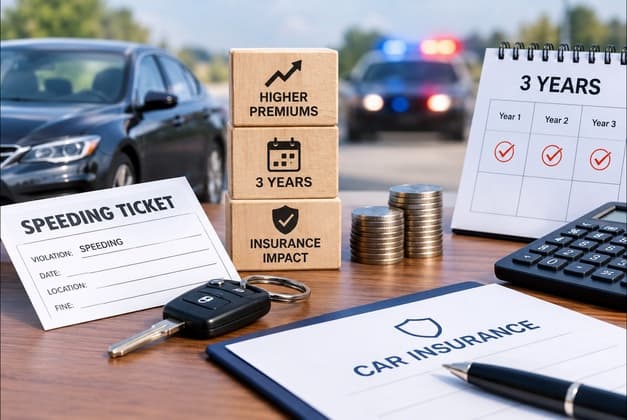
QUICK ANSWER. One speeding ticket raises car insurance about 24% on average (one 2026 analysis by ValuePenguin, updated June 30, 2026), with big differences by state and insurer. It usually doesn’t hit until your policy renews, and it typically stays for about three years. That makes the real cost of a ticket the fine plus three years of higher premiums, often far more than the fine itself.
You have time. Because the increase shows up at renewal, you usually have weeks or months to decide whether to pay, take traffic school, or contest the ticket, and to shop your insurance.
See your 3-year cost and the cheapest option →
- How much
- How long
- How insurers find out
- Pay, school, or fight?
- Camera tickets
- Out-of-state
- CDL drivers
- North Carolina
- FAQ
Figures and state rules verified November 6, 2026. Insurers and courts vary; check your state’s rules before you plead.
Speeding Ticket True Cost Calculator
Enter your numbers to compare paying, traffic school, and contesting. Nothing you type is saved or sent anywhere.
How Much Does a Speeding Ticket Raise Insurance?
One speeding ticket raises full-coverage car insurance about 24% on average, and the spread by state in the same analysis runs from 11% to 44%.
That 24% figure comes from ValuePenguin’s 2026 analysis (updated June 30, 2026). It is one industry analysis, not a law, and your own quote can land above or below it.
In that analysis, California had the largest increase at 44% after one ticket and New York the smallest at 11%. North Carolina is a special case, because the state sets the surcharge itself; see the North Carolina section.
Does going faster raise the price?
Only slightly in that analysis: the premium difference between 5–10 mph over, the common 11–15 mph band, and 21–25 mph over was small. Fines, court consequences, and in some states license points rise faster than insurance does. Very high speeds can also lead to reckless driving charges, which carry heavier consequences than an ordinary speeding ticket.
DUI is a different category with much bigger consequences; see Car Insurance After DUI.
First ticket vs. second ticket
The same analysis found that two tickets raise rates about 45% compared with a clean record, and three tickets about 60%. Those multiple-ticket figures were based on quotes from one state’s ZIP codes (Pennsylvania), so treat them as a rough guide. Teen and young drivers often see larger increases; see Add Teen to Car Insurance.
For everything else insurers weigh, see How Car Insurance Rates Are Calculated.
| State | Avg. increase after 1 ticket |
|---|---|
| California | 44% |
| North Carolina* | 39% |
| Delaware | 35% |
| Iowa | 35% |
| Texas | 20% |
| Florida | 13% |
| New York | 11% |
| National average | 24% |
How Long Does It Affect Your Rates?
A speeding ticket typically raises your rates for about three years, starting at your next renewal rather than on the day you were cited.
The increase usually starts at renewal, not the day you get the ticket.
After a ticket, the court notifies the DMV, which updates your driving record. Insurers typically pull that record (your motor vehicle record, or MVR) when you apply or renew. That is why ValuePenguin says a ticket won’t affect your rates until the policy renews.
Most drivers can expect higher rates for three to four years. Rates usually start dropping in the third year and are usually back to normal by the fourth. In the same analysis, some insurers kept the increase for about two years and then eased it by about 8% in year three, while others lowered it a little each year. Which pattern applies to you depends on your insurer and state.
How long the ticket stays on your state record is a separate question. In that analysis, California keeps a ticket on the record for three or 10 years depending on severity, and Virginia keeps one for five. Insurers set their own look-back window, so ask yours how far back it checks.
How Your Insurer Finds Out
Insurers mostly find out by pulling your motor vehicle record when you apply for coverage or renew it.
Once a conviction is on your record, the insurer sees it when it prices your next policy period. You don’t have to mail anything for that to happen.
Do you have to tell them? Check your policy for any duty to report violations. Either way, answer application and renewal questions about tickets truthfully. Never hide a ticket or give a false answer: insurers usually see the record anyway, and a false answer can put your coverage at risk.
Telematics can see speeding even without a ticket. Usage-based programs may track how fast you drive, and some insurers raise rates for unsafe habits. See Your Car May Be Reporting You.
Pay, Traffic School, or Fight? The 3-Year Math
For most drivers the cheapest outcome is a ticket that never becomes a conviction on your record, because the fine is usually the smallest part of the cost.
The fine is often the smallest part of the cost.
The examples below use a $2,400 annual premium, a $200 fine, and the 24% average increase held for three years. Run your own numbers in the calculator.
Option 1: Pay it
3-YEAR COST (example): $1,928. That is $200 for the fine plus $1,728 in higher premiums (24% of $2,400 is $576 a year, for three years).
Paying usually means pleading guilty, which puts a conviction on your record. That conviction is what the insurer sees.
Option 2: Traffic school, in some states, for eligible drivers
3-YEAR COST (example): $300, if it keeps the ticket off your record. That is the $200 fine plus about $100 for the course and fees (illustrative).
In some states, eligible drivers can complete a course so the ticket is dismissed or not reported as a conviction. Eligibility depends on your court, your state, how fast you were going, how recently you last took a course, and your license type. You may still owe the fine and fees.
Check with the court first. ValuePenguin notes that insurers can set rates from your driving record rather than license points, so a course that reduces points may not keep your premium down. A defensive driving course discount, where offered, is a separate thing from keeping the ticket off your record. CDL holders cannot use traffic school to keep a conviction off their record (see the CDL section).
Option 3: Plead to a non-moving violation
Some courts let drivers plead to a non-moving violation, which usually doesn’t carry the moving-violation surcharge. This is up to the prosecutor and judge, and not every court offers it. CDL holders face special limits.
Option 4: Hire a lawyer
3-YEAR COST (example): $300–$500, if the ticket is dismissed or reduced to a non-moving violation. That is $0–$200 in fines plus about $300 for the lawyer (illustrative).
A lawyer costing $300 is cheaper than paying only when the ticket would otherwise cost you more than $300 over three years and the case ends in a dismissal or a violation insurers don’t count. If it doesn’t, you still owe the ticket plus the lawyer. Nobody can promise an outcome, so ask the lawyer what typically happens in your court.
| Option | Fine | Fees | Insurance increase (24% × 3 yrs) | 3-year total |
|---|---|---|---|---|
| Pay it | $200 | $0 | $1,728 | $1,928 |
| Traffic school (if it keeps it off) | $200 | $100 (illustrative) | $0 | $300 |
| Lawyer (if dismissed or reduced to non-moving) | $0–$200 | $300 (illustrative) | $0 | $300–$500 |
Whatever you choose, deal with the ticket before its deadline. Ignoring a ticket can add penalties and even a license suspension, which can cost far more than any option above. This is general information, not legal advice; your court and state decide what’s available.
Will Your Insurer See It? Camera, Out-of-State, and Other Tickets
Most tickets written by an officer reach your record and your insurer, while camera tickets and some other outcomes usually don’t.
| Ticket type | Goes on your driving record? | Will they see it? |
|---|---|---|
| Police speeding ticket, paid | Yes | USUALLY |
| Ticket dismissed after traffic school (where allowed) | Often not reported as a conviction (varies by state) | USUALLY NOT |
| Plea to a non-moving violation | No moving violation (varies by court and state) | USUALLY NOT |
| Speed or red-light camera ticket (owner liability) | Usually no points; check your state | USUALLY NOT |
| Out-of-state ticket, home state in the Driver License Compact | Usually reported to your home state | USUALLY |
| Out-of-state ticket, Georgia, Michigan, or Wisconsin (not compact members) | May still be shared | SOMETIMES |
| Any ticket, CDL holder | No masking allowed | USUALLY |
Police speeding ticket, paid: USUALLY
WILL THEY SEE IT? USUALLY
Goes on your driving record: yes.
Dismissed after traffic school: USUALLY NOT
WILL THEY SEE IT? USUALLY NOT
Where allowed, often not reported as a conviction. Varies by state.
Plea to a non-moving violation: USUALLY NOT
WILL THEY SEE IT? USUALLY NOT
No moving violation on the record. Varies by court and state.
Speed or red-light camera ticket: USUALLY NOT
WILL THEY SEE IT? USUALLY NOT
Owner liability, usually no points. Check your state.
Out-of-state ticket, compact state: USUALLY
WILL THEY SEE IT? USUALLY
Usually reported to your home state.
Out-of-state ticket, GA, MI, or WI: SOMETIMES
WILL THEY SEE IT? SOMETIMES
Those states aren’t Driver License Compact members, but data may still be shared.
Any ticket, CDL holder: USUALLY
WILL THEY SEE IT? USUALLY
Federal rules bar masking a CDL holder’s conviction.
Table 3. General guide; rules differ by state, court, and insurer.
Camera tickets
Camera tickets are usually owner-liability notices rather than moving violations, so they usually don’t add points or reach insurers. New York City is a clear example.
NYC’s cameras don’t identify individual drivers. The registered owner receives a Notice of Liability, and the penalty is $50. The city’s speed camera FAQ says the violation isn’t part of your DMV operating record, “nor is it used for insurance purposes.”
Elsewhere, in most places camera tickets are owner-liability and don’t add points; check your state, because rules vary. A ticket handed to you by an officer, even one based on radar, is a regular ticket.
Out-of-state tickets
An out-of-state ticket usually follows you home, because almost every state shares convictions through the Driver License Compact.
According to the American Association of Motor Vehicle Administrators (AAMVA, list revised April 2026), 47 states plus D.C. belong to the Driver License Compact. Georgia, Michigan, and Wisconsin are the states outside it. Older lists show five non-members, but Massachusetts and Tennessee have since joined. Even non-member states can share data informally, so don’t count on a ticket staying out of sight.
Separately, the Non-Resident Violator Compact lets member states suspend the license of a driver who ignores a ticket from another member state. AAMVA’s April 2026 list shows 44 member jurisdictions.
Ignoring an out-of-state ticket can get your home license suspended.
CDL Holders: Why Traffic School Won’t Save You
If you hold a commercial driver’s license (CDL) or commercial learner’s permit, a traffic school or deferral deal cannot keep a conviction off your record.
CDL holders: traffic school and deferral can’t keep a conviction off your record.
Under federal rule 49 CFR § 384.226, states must not mask a conviction, defer judgment, or allow a diversion program that would keep a CDL or CLP holder’s conviction from appearing on the record. It applies to any traffic violation, in any vehicle, including your own car, except parking, weight, and defect violations. Courts list traffic school among the prohibited diversion options.
That is why the calculator swaps the traffic school card for a warning when you answer yes to the CDL question. Certain violations, including speeding 15 mph or more over the limit, are classed as serious under federal CDL rules, and repeat serious violations can lead to disqualification. Details depend on your license and vehicle, so check the FMCSA CDL guidance and your state, and consider talking to an attorney who handles CDL cases.
North Carolina: The State That Sets the Surcharge
In North Carolina, the state sets how much a conviction raises your premium through the Safe Driver Incentive Plan (SDIP), so the percentage depends on your points rather than on your insurer’s pricing.
The plan comes from state law (N.C.G.S. § 58-36-65 and § 58-36-75), and the table below is the official one from the NC Department of Insurance (DOI), verified November 6, 2026.
License points are not insurance points. The DMV assigns license points, which relate to license suspension. SDIP points drive the insurance surcharge. They are separate systems, so check the NC DOI and NC DMV pages for the current wording on each.
North Carolina drivers: your official surcharge table
| Points | Example conviction | Rate increase |
|---|---|---|
| 1 | Speeding 10 mph or less over a limit under 55 mph (or other moving violation) | 40% |
| 2 | Speeding 10 mph or less over in a 55+ zone, or more than 10 over at a total speed of 56–75 mph | 55% |
| 3 | At-fault accident tiers (no speeding conviction at this level) | 70% |
| 4 | Over 75 mph in a zone under 70, or over 80 mph in a zone of 70 or higher | 90% |
| 10 | Speeding to elude arrest | 260% |
| Points | Example speeding conviction | Rate increase |
|---|---|---|
| 1 | Speeding 10 mph or less over a limit under 55 mph (or other moving violation) | 40% |
| 2 | Speeding 10 mph or less over in a 55+ zone, or more than 10 over at a total speed of 56–75 mph | 55% |
| 3 | At-fault accident tiers (no speeding conviction at this level) | 70% |
| 4 | Over 75 mph in a zone under 70, or over 80 mph in a zone of 70 or higher | 90% |
| 10 | Speeding to elude arrest | 260% |
The 10 mph waiver
No SDIP points are charged for speeding 10 mph or less over the posted limit if the violation was outside a school zone and the driver has no other moving violation conviction in the five years before the application or renewal. The five-year look-back applies to convictions on or after July 1, 2025; for earlier convictions it was three years.
Prayer for judgment continued (PJC) and the July 1, 2025 change
A PJC for a moving violation carries no premium surcharge and no points unless the owner, principal operator, or another licensed driver in the household has another PJC within five years. The five-year window applies to PJCs granted on or after July 1, 2025; for PJCs granted before that date it is three years.
Whether a judge grants a PJC is up to the court. For CDL holders, a prayer for judgment counts as a conviction under the federal masking rules, according to the UNC School of Government.
How long the surcharge lasts
The July 2025 change lengthened the look-back and surcharge period to five years for some convictions worth four or more points, but the DOI’s wording excludes speeding in excess of the posted limit. Speeding convictions keep a three-year surcharge period. Check the DOI page for the exact rule on your conviction.
What to Do Before Your Renewal
The best use of the gap between the ticket and your renewal is to fix the ticket’s outcome first and shop your coverage second.
Before Your Renewal: 7 Steps
- 1. Find your renewal date. That’s usually when the ticket shows up.
- 2. Check the court’s options before paying: traffic school, deferral, or a plea to a non-moving violation. Paying usually means pleading guilty.
- 3. Ask your insurer whether it has a first-ticket or minor-violation forgiveness program, and whether you lose a safe-driver discount.
- 4. Get 3+ quotes 30–45 days before renewal. Insurers weigh tickets very differently. See How to Switch Car Insurance.
- 5. Look for discounts you can add now: a defensive driving course discount (where offered), bundling, a higher deductible. See How to Lower Car Insurance.
- 6. Never leave an out-of-state ticket unpaid.
- 7. Keep your proof: course certificate, court disposition, and payment receipt.
FAQ
How much does insurance go up after one speeding ticket?
About 24% on average in one 2026 analysis (ValuePenguin, updated June 30, 2026), ranging from 11% in New York to 44% in California. Your insurer, state, and record change that. In North Carolina the state’s table sets it: 40% for one point (NC DOI, verified November 6, 2026).
Does a speeding ticket affect insurance immediately?
Typically not. The increase usually starts at your next renewal, when the insurer pulls your motor vehicle record.
How long does a speeding ticket affect insurance?
About three years for most drivers. Rates usually start dropping in the third year and are usually back to normal by the fourth, though this depends on the insurer and state.
Will my insurance go up for 5 or 10 mph over?
It can, if the ticket becomes a conviction. In the ValuePenguin analysis, the premium difference between speed bands was small. Ask your insurer about a first-ticket forgiveness program. In North Carolina, a 10 mph-or-less ticket may carry no points under the waiver described above.
Do I have to tell my insurance company about a ticket?
Check your policy for a reporting requirement, and answer application and renewal questions truthfully. Insurers usually see your record at renewal anyway, and a false answer can put your coverage at risk.
Can I keep a speeding ticket off my insurance?
Only through lawful outcomes: a dismissal, traffic school where your court allows it, or a plea to a non-moving violation. Camera tickets are usually owner-liability notices. Hiding a ticket is never an option, and none of these routes work for a CDL holder’s conviction.
Does traffic school keep a ticket off my record?
In some states, for eligible drivers, yes. It depends on your court, how fast you were going, and how recently you last took a course. Insurers can rate on your driving record rather than license points, so confirm with the court how the ticket will be reported. It never works for CDL holders.
Is it worth fighting a speeding ticket?
It depends on the fine, your premium, a lawyer’s fee, and the facts of your case. Use the calculator’s break-even line to compare costs. Nobody can promise an outcome, and this isn’t legal advice.
Do speed camera tickets affect insurance?
Usually not. In NYC, the city’s FAQ says the violation isn’t used for insurance purposes, because cameras identify the vehicle rather than the driver. Check your state, since rules vary.
Do red light camera tickets affect insurance?
Usually handled the same way: an owner-liability civil penalty (in NYC, $50) with no points. Check your state and city, and note that a red-light ticket from an officer is a regular moving violation.
Does an out-of-state ticket affect my insurance?
Often yes. Most states share convictions through the Driver License Compact, so your home state usually receives it and your insurer can see it on your record.
What states don’t share ticket information?
Georgia, Michigan, and Wisconsin aren’t Driver License Compact members (AAMVA, revised April 2026), but they may still share data. Many older lists also name Massachusetts and Tennessee, which have since joined. Don’t rely on a state’s non-membership to avoid a ticket.
Can CDL holders take traffic school?
Not to keep a conviction off the record. Federal rules (49 CFR § 384.226) bar masking, deferral, and diversion for CDL and CLP holders, for any traffic violation in any vehicle.
How many insurance points is a speeding ticket in NC?
One, two, or four points, depending on speed and zone: 1 point (40%) for 10 mph or less over a limit under 55; 2 points (55%) for 10 or less over in a 55+ zone or more than 10 over at a total of 56–75 mph; 4 points (90%) for over 75 in a zone under 70 or over 80 in a zone of 70 or higher (NC DOI, verified November 6, 2026).
How often can you use a PJC in NC?
For insurance purposes, a PJC carries no surcharge unless another PJC was granted to someone in your household within five years (PJCs granted on or after July 1, 2025; three years before that date). Whether a judge grants one is up to the court.
Can my insurer drop me for speeding tickets?
It can happen, especially with several tickets, and rules differ by state. See Car Insurance Canceled or Nonrenewed.
Sources
ValuePenguin: Car Insurance Rate Increases with a Speeding Ticket in 2026 (updated June 30, 2026) · NC Department of Insurance: Safe Driver Incentive Plan · N.C.G.S. § 58-36-65 · N.C.G.S. § 58-36-75 · 49 CFR § 384.226 (eCFR) · FMCSA CDL guidance · NYC DOT speed camera FAQ · AAMVA Driver License Compact and Non-Resident Violator Compact joinder dates (revised April 2026) · UNC School of Government on CDL masking
Last updated:
This article is general information, not legal advice. Insurers set surcharges within state rules, and court options vary by state and county. Figures and North Carolina rules were verified on November 6, 2026.

Daniel Hayes is the founder and sole researcher at AdvoraHQ. He covers U.S. personal finance, insurance, and consumer law — working directly from IRS publications, federal and state statutes, court opinions, and SEC filings rather than secondary summaries. His focus is the gap between what readers think they know and what the source documents actually say. Daniel is not a licensed attorney, CPA, or financial advisor; his articles are educational and not personalized advice. Reach him at Daniel.Hayes@advorahq.com.
