
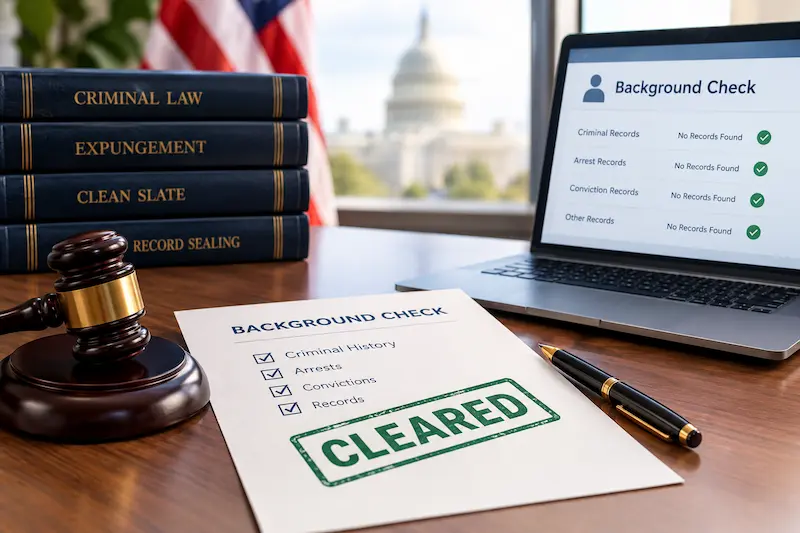
In a growing number of states, an eligible record is now cleared on a schedule — no petition, no filing fee, no lawyer. Many people who qualify have never been told. And some whose records were cleared still get turned down, because the court record and the background-check database are two different things.
See what your state’s framework provides →
State Path Finder
Answer a few questions about your record. This tool returns what your state’s framework generally provides and what to verify next — never a verdict on whether you personally qualify.
Nothing you enter here is saved, transmitted, or sent anywhere — this tool runs only in your browser, collects no name, date of birth, case number or offense description, and makes no network calls.
Nothing here tells you whether you are eligible. That is a legal determination, and free help exists — legal aid offices and law school clinics handle this work at no cost.
- Automatic states
- The four words
- Who still sees it
- Your background check
- The 7-year myth
- If it still shows
- Free help
- FAQ
State status verified October 16, 2026 against statutory text. Several of these programs have been delayed after taking effect — confirm with your state before relying on this.
Records That Clear Themselves
A Clean Slate law lets a state seal or expunge an eligible record automatically, on a schedule, with no petition and no fee. Pennsylvania ran the first fully automatic program in the country, under 42 Pa. Cons. Stat. §9122.2, which began sealing records in mid-2019.
The mechanics are almost always the same shape: a state agency — usually the state police, a bureau of investigation, or the courts’ own administrative office — runs eligible conviction and non-conviction records against the statute’s waiting periods and exclusion list on a recurring basis, usually monthly or quarterly. If a record matches, it is CLEARED AUTOMATICALLY — the person does nothing, is not interviewed, and in most states is not even sent a notice.
That is different from CLEARED BY PETITION, which still exists in every state and remains the only option for people whose record falls outside a Clean Slate program’s scope — more serious offenses, a waiting period not yet met, or a state that has not enacted automatic clearing at all.
A law taking effect and a record actually being cleared are not the same thing. The next section is about that gap.
Enacted Is Not the Same as Working
A dozen states plus Washington, D.C. have enacted some form of automatic record clearing — but “enacted” only means the legislature passed it. Building the matching system, testing it against millions of records, and actually running it on schedule is a separate, slower process, and several of these programs have slipped their own deadlines.
Three examples current as of this page’s verification date:
- Minnesota’s Clean Slate Act took effect January 1, 2025, but the state’s Bureau of Criminal Apprehension found data-accuracy problems during testing and could not meet that date. Automatic expungements began running in mid-2025 instead, after the delay.
- Oklahoma enacted its automatic expungement law in 2022, with the automatic system originally expected to be running by 2026. Technical delays pushed that back: under a 2026 revision (SB 2030), the state must launch a free online expungement-request portal by November 1, 2026, and is not required to have automatic monthly processing running until November 1, 2027.
- Washington, D.C.’s Second Chance Amendment Act began automatically expunging certain decriminalized and unconstitutional offenses on January 1, 2026. Its broader automatic sealing provisions follow a longer rollout: older qualifying cases must be processed by October 2027, while new ones are handled within 90 days of eligibility.
Virginia’s program is the one to watch most closely, because it is new: the state’s Clean Slate framework was originally scheduled for July 2025, was pushed back, and took effect July 1, 2026 — automatic sealing of eligible misdemeanor convictions and many non-conviction records, run monthly by the Virginia State Police. As of this page’s verification date, Virginia’s program has launched on schedule.
No competitor table draws this distinction. The column that matters is not whether a law exists — it’s whether a state’s system is actually clearing records today.
The full 50-state comparison below is easiest to read on a larger screen. On your phone, use the State Path Finder near the top of this page instead — it returns one state’s status at a time.
| State | Term used | Automatic program? | Effective date | Actually running? | Statute | Verified |
|---|
Four Words, Four Outcomes
Expungement, sealing, set-aside and dismissal are not interchangeable — each state picks one word and defines what it actually does to a record, and the definitions do not match across state lines. A specialist resource on record relief puts it plainly: expungement does not mean the same thing in every state.
Expungement
In states that use this word for true expungement, the record is destroyed or treated as if it never existed for most purposes. Many states that call their process “expungement” actually mean sealing — check the statute, not the label.
Sealing
The record still exists but is removed from public view. Courts, law enforcement, and specific licensing or background-check purposes named in the statute can often still see it. Colorado, New York and Pennsylvania all use “sealing.”
Set-aside
Michigan’s term. The conviction is treated as if it did not occur for most employment and housing purposes, but it is not destroyed and remains visible to courts, law enforcement and certain licensing bodies.
Dismissal
California’s PC §1203.4 term for its petition-based relief. A dismissal does not erase the record, has offense-specific exclusions, does not restore firearm rights, and stays visible to professional licensing boards and some government employers.
California is the clearest case of why the word matters: a Penal Code §1203.4 dismissal is real relief, but it is not expungement. The underlying arrest and conviction record still exists, certain offenses are excluded from eligibility entirely, firearm rights are not restored by it, and professional licensing boards and some government employers can still see the dismissed conviction. Never treat a California dismissal as if it made the record disappear.
Michigan’s set-aside works similarly — the record is treated as nonexistent for most employers and landlords, but it is not destroyed, and it remains visible to courts, law enforcement and some licensing agencies.
New York is a state with no true expungement at all. New York relief is sealing, under its Clean Slate Act (N.Y. Crim. Proc. Law §160.57) and its older petition-based sealing statute (CPL §160.59) — the word “expungement” does not appear in New York’s record-relief framework in the way people expect.
| Term | What happens to the record | Who can still see it | States that use this word |
|---|---|---|---|
| Expungement | Varies: in some states the record is destroyed; in many “expungement” states it is actually sealed, not destroyed — the statute controls, not the label. | Depends on the state; often law enforcement and courts even where “expunged” | Delaware, Utah, Oklahoma, New Jersey, Minnesota (statutory name; effect varies) |
| Sealing | Record remains on file but is hidden from public and most background-check view | Courts, law enforcement, and purposes named by statute (licensing, firearms checks, etc.) | Colorado, New York, Pennsylvania, Virginia |
| Set-aside | Treated as if it did not occur for most employment/housing purposes; record not destroyed | Courts, law enforcement, some licensing bodies | Michigan |
| Dismissal | Conviction is dismissed/withdrawn but the arrest and case record remain; has offense exclusions | Licensing boards, certain government employers, firearms eligibility unaffected | California (Penal Code §1203.4) |
Who Can Still See It
Even a successfully cleared record usually stays visible to specific categories of viewers — which categories, and for which purposes, is set state by state, so treat every line below as “check your state,” not as a universal rule.
- Law enforcement and courts. Nearly every state’s sealing and expungement statutes keep records available to police, prosecutors and judges for future cases, even after clearing.
- Professional and occupational licensing boards. Many states carve out an exception for boards that license nurses, teachers, attorneys, real estate agents and similar professions.
- Firearms eligibility. Clearing a state record does not automatically restore gun rights, which are often governed by a separate statute — and, for some convictions, by federal law that a state cannot clear at all.
- Government and sensitive roles. Positions involving law enforcement, the judiciary, child care, elder care, education and some other licensed caregiving roles frequently retain access by statute.
- Immigration. If you are not a U.S. citizen, speak to an immigration attorney before filing anything — a cleared state record can still carry immigration consequences, because immigration law looks at what happened, not just how the state currently labels it.
Sealed is not erased, and the words differ by state.
Federal Records Are a Different System
Clean Slate laws are state laws, and they do not reach federal records. A federal arrest, charge or conviction is not touched by any state’s automatic sealing or expungement program.
Federal relief exists, but it is narrow and separate: a presidential pardon, a small number of statutory federal expungement provisions (mostly limited to certain low-level drug offenses under specific circumstances), and, for some federal cases, a motion addressed to the sentencing court. None of this runs on autopilot the way a state Clean Slate program does, and none of it is triggered by a state clearing its own record for the same conduct.
Federal records are not covered by state Clean Slate laws.
The Seven-Year Rule Doesn’t Say What You Think
The seven-year rule most people have heard of limits how long non-conviction information can be reported — not how long a conviction can follow you.
Under the federal Fair Credit Reporting Act, §605 (15 U.S.C. §1681c), a consumer reporting agency generally cannot report civil suits, civil judgments, arrest records, and other adverse non-conviction information more than seven years old. Records of conviction have no federal time limit at all — a 1998 amendment to the FCRA removed the age restriction on reporting convictions, so a background-check company can lawfully report a decades-old conviction under federal law.
The salary exception. The FCRA’s seven-year limits on non-conviction information do not apply at all to positions with an annual salary reasonably expected to be $75,000 or more (15 U.S.C. §1681c(b)(3)) — at that income level, older arrest and non-conviction information can be reported without any federal age limit. Separately, many screening companies apply a seven-year cutoff as their own internal policy regardless of salary or record type, which is stricter than what federal law actually requires.
Some states go further than the FCRA. A number of states — including California, Kansas, Maryland, Massachusetts, Montana, New Hampshire, New Mexico, New York and Washington — limit how far back a conviction itself can be reported, overriding the federal no-limit rule for convictions (some of these apply a salary threshold of their own). Nevada moved in the opposite direction: it repealed its own seven-year limit on conviction reporting in 2015, so Nevada convictions can be reported indefinitely under state law, matching the uncapped federal rule.
When the clock starts, for non-convictions, is also not what most people assume. In Moran v. The Screening Pros (9th Cir. 2019), the Ninth Circuit held that the seven-year period for a non-conviction record runs from the date the charge was entered — not from the date it was later dismissed. That holding is binding only within the Ninth Circuit (Alaska, Arizona, California, Hawaii, Idaho, Montana, Nevada, Oregon and Washington); it is not a nationwide rule, and other circuits have not all addressed the question the same way.
The seven-year rule limits arrests, not convictions.
| Record type | Federal FCRA limit | Common state limits | Notes |
|---|---|---|---|
| Convictions | No time limit | Some states cap reporting at 7 years regardless of salary; a few use a salary threshold of their own | A conviction being old does not make it unreportable under federal law |
| Arrests and non-convictions | 7 years (no limit if salary ≥ $75,000) | Some states apply a flat 7-year limit with no salary exception | Clock generally starts at date of entry, not date of disposition (9th Cir.) |
| Dismissed or deferred cases | Treated as non-conviction information; 7-year limit applies | Varies | A later dismissal does not restart its own 7-year window under the Ninth Circuit’s reading |
| Sealed and expunged records | Should not be reported at all once legally restricted | State sealing/expungement statutes generally prohibit disclosure outright | CFPB guidance treats reporting these as a compliance problem, not just an age issue |
| Pending cases | No federal age limit (case has not concluded) | Varies; some states require the current status be shown | Verify the outcome against the current docket, not an old snapshot |
Why a Cleared Record Still Appears
Clearing a court record and purging a private database are two different events, and the second one does not happen automatically when the first one does.
Courts and state record-keeping agencies seal or expunge the official record. But background-check and tenant-screening companies maintain their own separate databases, often built by scraping or purchasing bulk data from courts on their own schedule — and those copies do not automatically update when the original court record is sealed. The federal Consumer Financial Protection Bureau has issued formal guidance stating that background-screening agencies should not include expunged, sealed, or otherwise legally restricted criminal or eviction records in a report — and that when they do, it is a Fair Credit Reporting Act compliance problem, not just an inconvenience.
Tenant screening is consistently the worst offender. Consumer-law research into the tenant-screening industry has specifically documented that screening companies commonly report records that have already been sealed, expunged, or otherwise legally cleared — a pattern significant enough that it has its own name in consumer-advocacy literature (“zombie records”).
This is the practical catch behind the hook at the top of this page: your record can be CLEARED AUTOMATICALLY by the state and still show up as STILL VISIBLE on a background check, because the company running that check is working from its own copy, not the court’s current record.
Clearing a court record does not purge private databases.
| Question | The court | The screening company |
|---|---|---|
| Who holds it | The state court system and the state’s criminal-history repository | A private database built from bulk data purchases, scraping, or vendor feeds |
| Who updates it | The clerk’s office and the state records agency, per the sealing or expungement order | The company itself, on its own refresh schedule |
| How fast | Updates when the sealing/expungement order is entered or processed | Can lag months or longer behind the court record |
| How you correct it | Confirm your record directly with the state agency that holds your criminal history | File a written dispute with the specific company that produced the report |
| What proves it | Your official state criminal history record and the certified court order | Your copy of their file, compared line by line against the court record |
A background check is not the same product as a credit report, even though both are governed by the same federal statute — if you’re also dealing with credit-report errors, our credit score guide covers that separately.
Verify Yours, and Fix the Report
Here is the order that actually resolves this, start to finish.
- Get your own state criminal history record from the state agency that maintains it — usually the state police or a bureau of identification. This is what shows whether a clearing has actually posted on the state’s own system.
- Pull the court docket for each case and read the disposition line. The docket and the state record can disagree with each other, and that disagreement is worth fixing before you go further.
- Run a background check on yourself. Several national screening companies will provide you a copy of your own file on request.
- If you were denied a job or an apartment, the law requires you be told which company produced the report. Request your file from that company specifically — the one named in the adverse-action notice, not a company you found online.
- Read the report against your court record. Look for a sealed or dismissed case reported as open, a charge listed as a conviction, a case that is not yours, or non-conviction information older than seven years.
- Dispute it in writing with the screening company, and keep a copy of everything you send. A dispute letter should include: your identifying details, the exact entry you’re disputing, what is wrong with it, what the correct information is, and copies of the court order or docket showing the actual disposition. The CFPB publishes a sample dispute letter — use its structure.
- Dispute with the source too, if the underlying court record itself is wrong.
- Keep the certified order. A certified copy of the sealing, expungement or set-aside order is the single document that resolves most of these disputes fastest.
- Re-check in a few months. Databases refresh on their own schedules, and a cleared record can reappear in a later report.
- Don’t pay a service that promises to erase your record from the internet, and don’t answer an application question dishonestly — ask a lawyer or a legal aid clinic what your state actually permits you to say.
If the dispute mechanics here feel familiar, they overlap substantially with correcting any other consumer report error — see our guide on fixing fraudulent accounts for the shared process. And because tenant screening is where sealed records resurface most often, our eviction notice guide covers the housing side of this in more depth.
Getting Help Without Paying
Most of this can be done without a paid lawyer, and much of this audience cannot pay one — so here is where free help actually exists, by category rather than by name, since the right office depends on where you live.
- Legal aid offices. Most counties and states have a civil legal aid organization that handles record-clearing cases, usually income-qualified and free.
- Law school clinics. Many law schools run expungement or record-sealing clinics staffed by supervised students, often free to the public.
- Public defender reentry programs. In states where the public defender’s office has a reentry or “clean slate” unit, this work is often handled regardless of ability to pay.
- State and county expungement clinics. Many prosecutors’ offices, courts, or nonprofit partners run periodic free clinics, sometimes tied to a specific filing deadline or event.
- State court self-help centers. Most state court systems maintain a self-help center with free forms and instructions for petition-based relief.
If an employer unlawfully used a record against you in hiring, that’s a separate issue from clearing the record itself — see employment discrimination or wrongful termination for that situation.
Frequently Asked Questions
Does my record clear automatically?
Only if your state has an operating Clean Slate program and your record matches its eligible offenses, waiting period and exclusion list. Use the State Path Finder near the top of this page to see your state’s framework, and confirm with your state’s own records agency.
Which states clear records automatically?
As of this page’s verification date, Pennsylvania, Utah, Michigan, Connecticut, Delaware, Oklahoma, California, Minnesota, New York, New Jersey, Colorado, Virginia and Washington, D.C. have enacted automatic clearing, though “enacted” and “actually running” are not the same thing — see the implementation table above.
Is Virginia’s Clean Slate law in effect yet?
As of this page’s verification date, yes — Virginia’s automatic sealing program took effect July 1, 2026. Confirm the current status before relying on this, since implementation dates have slipped before in other states.
How do I check whether my record was sealed?
Request your own state criminal history record from the state agency that maintains it. That is the authoritative source for whether a clearing has actually posted — not a background-check company’s file.
What’s the difference between expungement and sealing?
Sealing hides a record from public view while it still exists. Expungement, where it means true destruction, removes it. Many states that use the word “expungement” actually mean sealing in practice — check your state’s statute rather than assuming from the label.
Does California’s dismissal mean my record is expunged?
No. A California Penal Code §1203.4 dismissal is real relief, but the underlying record is not destroyed, certain offenses are excluded, it does not restore firearm rights, and it remains visible to professional licensing boards and some government employers.
What does a set-aside do in Michigan?
It treats the conviction as if it did not occur for most employment and housing purposes, but the record is not destroyed and stays visible to courts, law enforcement and some licensing agencies.
Does New York expunge records?
No — New York has no true expungement. Its relief is sealing, under the Clean Slate Act (CPL §160.57) and the older petition-based sealing statute (CPL §160.59).
Does Clean Slate apply to federal charges?
No. Clean Slate laws are state laws and do not reach federal arrests, charges or convictions. Federal relief is separate and much more limited.
Can an employer see a sealed record?
It depends on your state and the type of employer — some categories of employer retain access by statute even after sealing. Check your state’s framework rather than assuming either way.
Do I have to disclose a sealed record on a job application?
This depends on your state’s law and exactly how the application question is worded. Don’t guess, and don’t omit a record without checking — a lawyer or legal aid clinic can tell you what your state actually permits you to say.
Can a licensing board see it?
In many states, yes — professional and occupational licensing boards are a common statutory exception to sealing and expungement. This varies by state and by board, so verify directly.
Does expungement restore gun rights?
Not automatically. Firearm rights are often governed by a separate statute from the one that clears your record, and some firearm restrictions come from federal law that a state clearing cannot reach at all.
Why is my expunged record still on my background check?
Because the court’s record and the screening company’s database are two different systems. Clearing the court record does not automatically purge copies already held by private background-check or tenant-screening companies — you generally have to find and dispute it yourself.
How long can a conviction be reported?
Under federal law, indefinitely — the FCRA’s seven-year limit does not apply to convictions, only to non-conviction information like arrests and dismissed charges. Some states impose their own stricter limits on reporting convictions.
Does the seven-year rule cover convictions?
No. The FCRA’s seven-year rule under §605 limits non-conviction information — arrests, dismissed or deferred charges, civil judgments. Convictions can be reported with no federal time limit.
How do I dispute a background check?
Request your file from the specific company named in any adverse-action notice, compare it against your court record and your state criminal history record, and dispute any sealed, expunged, inaccurate or outdated entry in writing, including supporting documents. The full sequence is in the “Verify Yours, and Fix the Report” section above.
Can I get this done without paying a lawyer?
Often, yes. Legal aid offices, law school clinics, public defender reentry programs, and state or county expungement clinics handle this work at no cost in many areas — see “Getting Help Without Paying” above.
This article provides general information, not legal advice. Record relief is governed by state law, and the specific terms and effects described here differ by state. Eligibility for any form of record relief is a legal determination, and nothing on this page makes one. A cleared state record may still carry consequences for immigration, professional licensing, and firearms eligibility. State status on this page was verified on . Consult a licensed attorney or a legal aid office in your state before relying on anything here.
Last updated:

Daniel Hayes is the founder and sole researcher at AdvoraHQ. He covers U.S. personal finance, insurance, and consumer law — working directly from IRS publications, federal and state statutes, court opinions, and SEC filings rather than secondary summaries. His focus is the gap between what readers think they know and what the source documents actually say. Daniel is not a licensed attorney, CPA, or financial advisor; his articles are educational and not personalized advice. Reach him at Daniel.Hayes@advorahq.com.