
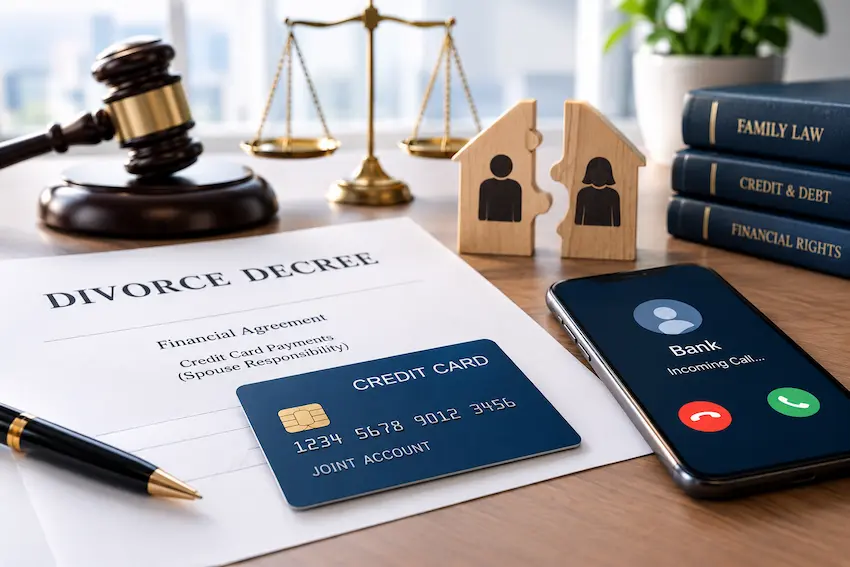
Quick answer: A divorce decree divides debts between you and your ex — but your card company isn’t part of that decree. If your name is on a joint card, the bank can still collect from you, even if the judge ordered your ex to pay. If you’re only an authorized user on your ex’s card, you’re generally not responsible.
- Joint holder — liable. Both holders are responsible for the balance. The bank can collect from either one.
- Authorized user — generally not liable. You can use the card, but the balance generally isn’t yours.
- Co-signer — liable. You promised to repay if the main borrower doesn’t.
- Card only in your ex’s name — usually not liable, except possibly in community property states. Check your state.
| Question | The decree | The card contract |
|---|---|---|
| Who it binds | You and your ex | Everyone named on the account, and the bank |
| Who enforces it | The family court | The card company |
| What it decides | Who pays whom between you and your ex | Who the bank can collect from |
Check each card in two minutes →
Rules verified October 19, 2026. Not legal advice.
Who Can Collect From Me? Card Checker
Pick your role on each card, and the checker shows who the bank can generally collect from, what your decree means, and your next steps.
Nothing you choose leaves this page. There is no field for names, card numbers, or balances.
Your results
Why the Bank Can Still Call You
Who is responsible for credit card debt after divorce is set by two separate documents, your card contract and your divorce decree, and the bank only signed one of them.
THE BANK SEES
A contract. Everyone named as a borrower on the account agreed to repay it. A change in marital status doesn’t change that agreement.
THE COURT SEES
A decree. The judge can decide which of you pays which debt, but only between you and your ex.
YOU CONTROL
The steps. Remove your name, freeze or close the account, move the balance, and ask for protective language in the decree.
The CFPB says a decree may allocate debts to one spouse, but that doesn’t change a creditor’s right to collect from anyone named as a borrower.
It also says that sending the creditor a copy of your decree doesn’t end your responsibility on a joint account.
The bank isn’t a party to your divorce.
That, not any federal rule about decrees, is why the decree doesn’t bind it.
A real-world example
University of Delaware Cooperative Extension describes a case where a decree assigned three joint cards to one spouse. The creditors told the other spouse they weren’t parties to the decree, and that spouse remained liable.
What stays true about joint accounts
As long as a balance remains, both joint holders are responsible for it.
An open joint card can collect your ex’s new charges.
If your name stays on an open joint account, charges your ex makes after the divorce can become yours too.
A card company can close a joint account at either spouse’s request. It doesn’t have to convert a joint account into an individual one.
Under 12 CFR 1002.10, a creditor that reports on an account both spouses can use or are liable on must report it so each spouse’s credit file can show it.
For an older account, either spouse can ask for that in writing, and the creditor has 90 days.
| A divorce decree can | A divorce decree can’t |
|---|---|
| Allocate debts between you and your ex. | Bind the card company, which isn’t a party to the divorce. |
| Order your ex to refinance or move a balance by a deadline. | Remove your name from the card contract. |
| Include an indemnification (hold-harmless) clause, so your ex must cover you if the bank collects from you. | Stop the bank from collecting from you if your ex doesn’t pay. |
| Give you a way to enforce the order in family court. | Force the bank to turn a joint account into an individual one. |
Death works differently. If you’re dealing with a cardholder who died rather than a divorce, see Credit Card Debt After Death.
Your Role on the Card Decides Everything
Your role on the card, not your marital status, decides whether the bank can collect from you.
| Role | Liable to the bank? | How to exit | Watch out for |
|---|---|---|---|
| Sole owner (card only in your name) | Yes. You’re responsible for the balance, including charges by anyone you authorized. | Pay it down or off. Remove your ex as an authorized user. Close the card if you choose. | In community property states, a balance from during the marriage may be treated as shared between you and your ex in the divorce. |
| Joint holder | Yes. Each holder is responsible for the full balance while any balance remains. | Freeze or close the account, then pay, transfer, or refinance the balance. Check with your attorney first if your case is pending. | New charges by your ex on an open account can become yours. The decree doesn’t bind the bank. |
| Authorized user | Generally no. You can use the card, but the balance generally belongs to the primary holder. | Ask the card company to remove you, or have the primary holder ask. Get it in writing. | The account may keep showing on your credit reports until it’s removed. |
| Co-signer | Yes. You promised to repay if the main borrower doesn’t. | Ask the lender whether the main borrower can refinance or qualify alone. Release is at the lender’s discretion. | A decree doesn’t release you. Late payments can hit your credit. |
| Not on the account | Generally no under the card contract. | Nothing to remove. Check your credit reports to confirm you aren’t listed. | Community property rules may matter. An account opened in your name without permission may be identity theft. |
Joint holders
You and your ex each signed. The bank can pursue either of you for the whole balance, whatever the decree says.
Authorized users
You never signed the credit agreement. The CFPB says an authorized user on an ex’s account is generally not responsible for the amount owed.
Ask to be removed anyway. It keeps future late payments off your reports and ends any question about who can use the card.
We cover what authorized-user status does for credit in Authorized User on a Credit Card.
Co-signers
A co-signer made a separate promise to pay if the main borrower doesn’t. That promise survives your divorce.
Sole owners
A card in only your name is yours, and so are charges by anyone you let use it. Remove your ex as an authorized user, and change autopay and online access.
Community Property States
In community property states, debt taken on during a marriage may be treated as shared even when the card is only in one name.
Nine states use a community property system. Three more let spouses opt into one.
| State | Type |
|---|---|
| Arizona | Community property state |
| California | Community property state |
| Idaho | Community property state |
| Louisiana | Community property state |
| Nevada | Community property state |
| New Mexico | Community property state |
| Texas | Community property state |
| Washington | Community property state |
| Wisconsin | Community property state |
| Alaska | Elective: applies only if spouses opt in |
| Tennessee | Elective: applies only if spouses opt in |
| South Dakota | Elective: applies only if spouses opt in |
What “shared” means varies a lot. Three questions are worth asking an attorney in your state.
First, when does community debt stop building up? Depending on the state, that may be the date of separation, a filing date, or the final decree.
Second, how are debts divided in the divorce? That differs from state to state.
Third, what can a creditor reach? Who is liable to the bank and what a court assigns between spouses are separate questions.
If you live in a community property state, a card only in your ex’s name may still matter. If you live elsewhere, a card only in your ex’s name is generally theirs. Either way, check your state’s rules.
Can the Bank Close or Change Your Account Because You Divorced?
Generally no: Regulation B bars a card company from closing or changing your open account just because your marital status changed.
Divorce alone isn’t a reason for your card company to close your account.
Under 12 CFR 1002.7(c), absent evidence that you can’t or won’t repay, a creditor may not require you to reapply, change the terms, or terminate an open-end account because of a change in marital status.
This protects any account holder who is contractually liable on the account, not just the spouse who first applied.
The spouse-income exception
If the credit was based in whole or in part on your spouse’s income, and your income alone may not support the current limit, the creditor may ask you to reapply.
While you reapply, you keep full access to the account under its existing terms.
Closing a joint account is different
That protection is about the company acting on its own. A card company can still close a joint account when either spouse asks. It doesn’t have to convert the account into an individual one.
If you get a notice that points to your divorce, save it and ask for the reason in writing. You can also file a complaint with the CFPB.
How to Cut the Cord, Card by Card
You cut the cord by taking your name off every account you shouldn’t be tied to, and by moving each shared balance to whoever is responsible for it.
If your divorce is pending, check with your attorney first.
Court orders, including automatic restraining orders in some states, may limit closing or changing joint accounts. Don’t run up new balances or move money out of sight before or during a divorce; courts take that seriously.
The Cut-the-Cord Checklist
- Step 1. Pull all three credit reports and list every card with your role on it. Get them free at AnnualCreditReport.com; our guide to checking your credit score free shows how.
- Step 2. Remove yourself as an authorized user on your ex’s cards, and remove your ex from yours.
- Step 3. For joint cards with no balance: ask to close them, and get written confirmation.
- Step 4. For joint cards with a balance: ask to freeze new charges. Then pay it off, transfer it to the responsible spouse’s individual card, or refinance it, and close the account.
- Step 5. Open at least one card in your own name if you don’t have one.
- Step 6. Ask your attorney for decree language: a deadline to refinance or transfer each balance, an indemnification (hold-harmless) clause, and attorney’s fees if it’s breached.
- Step 7. Update autopays and online access.
- Step 8. Monitor monthly for late payments on any account still tied to you.
- Step 9. If your ex misses a payment: pay to protect your credit if you can, document it, and raise it in family court.
Authorized-user accounts
Call the card company and ask to be removed, or have the primary holder do it. Then confirm on your credit reports that the account is gone.
Joint cards with no balance
Ask to close the account and get written confirmation. A zero balance is the easiest place to cut the cord.
Joint cards with a balance
Freeze new charges first. Then pick one path: pay it off, move it to an individual card of whoever is responsible, or refinance it.
Close the joint account only once the balance is gone, and keep proof of every payment.
Closed accounts that still carry a balance
Closing a card doesn’t erase what’s owed on it. Monitor it monthly, keep proof of payments, and make sure your decree covers who pays it.
Co-signed accounts
Ask the lender whether the main borrower can refinance or qualify alone so you can be released. The lender decides, so also ask your attorney for a deadline and hold-harmless language in the decree.
Your ex’s individual cards
If you aren’t on the account, there’s nothing to cut. Check your credit reports to confirm nothing appears under your name.
This guide covers credit cards only. Deposit accounts follow different rules.
If Your Ex Doesn’t Pay
If your ex stops paying a card you’re still on, protect your credit first, then pursue your ex in family court rather than going after the bank.
Protect your credit first
Late payments on a joint account are generally reported on each borrower’s credit file. If you can, pay at least what keeps the account current while you sort out who pays whom.
Ask the card company to freeze new charges so the balance stops growing.
Document everything
Keep statements, payment confirmations, dates of missed payments, and any messages about who was supposed to pay.
Use family court
Your remedy for an ex who ignores an assigned debt generally lies in family court, usually through an enforcement motion or civil contempt. The terms vary by state.
A hold-harmless clause and an attorney’s-fees clause in your decree make that path stronger. Ask a family-law attorney what your state allows.
If Your Ex Files Bankruptcy
If your ex files bankruptcy, the bank’s claim against your ex may be wiped out while its claim against you on a joint card is not.
If your ex files Chapter 7, the bank may come to you.
A discharge protects the person who filed. A joint holder or co-signer who didn’t file can still be pursued.
| Item | Chapter 7 | Chapter 13 |
|---|---|---|
| Ex’s debt to the bank | Can generally be discharged for the person who filed. | Handled through a repayment plan; remaining qualifying debt may be discharged when the plan is completed. |
| Ex’s obligation to you under a property settlement (for example, a hold-harmless clause) | Generally not dischargeable under 11 U.S.C. § 523(a)(15). | A full-compliance discharge under 11 U.S.C. § 1328(a) can discharge § 523(a)(15) property-settlement debts. |
| Support obligations (alimony, child support) | Domestic support obligations are treated differently and are generally not discharged. | Domestic support obligations are treated differently from property-settlement debts. |
| What you do next | Expect the bank to pursue you on joint cards. Ask a bankruptcy attorney about your claim against your ex. | Ask a bankruptcy attorney whether your claim is handled in the plan and whether any deadlines apply to you. |
Chapter 7
Ex’s debt to the bank. Can generally be discharged for the person who filed.
Ex’s obligation to you under a property settlement (for example, a hold-harmless clause). Generally not dischargeable under 11 U.S.C. § 523(a)(15).
Support obligations. Domestic support obligations are treated differently and are generally not discharged.
What you do next. Expect the bank to pursue you on joint cards. Ask a bankruptcy attorney about your claim against your ex.
Chapter 13
Ex’s debt to the bank. Handled through a repayment plan; remaining qualifying debt may be discharged when the plan is completed.
Ex’s obligation to you under a property settlement (for example, a hold-harmless clause). A full-compliance discharge under 11 U.S.C. § 1328(a) can discharge § 523(a)(15) property-settlement debts.
Support obligations. Domestic support obligations are treated differently from property-settlement debts.
What you do next. Ask a bankruptcy attorney whether your claim is handled in the plan and whether any deadlines apply to you.
Sources: 11 U.S.C. § 523; 11 U.S.C. § 1328. General rules only. Verified October 19, 2026.
These are general rules. Outcomes depend on the facts, your state, and the court. Talk to a bankruptcy attorney before you act, and see our guide to Chapter 7 vs. Chapter 13 there.
When It’s Not Just Debt: Fraud and Financial Abuse
If your ex opened a card in your name without your permission, that may be identity theft, which is a different problem from shared debt.
If you find an account you didn’t open, our guide to what to do when someone opens a credit card in your name gives the order of steps.
Debt can also be a tool of control: being forced to take on cards, being cut off from accounts, or being kept in the dark about money.
Safety note. If financial abuse or domestic violence is part of your situation, the National Domestic Violence Hotline is free, confidential, and open around the clock: call 1-800-799-7233 or text START to 88788. Chat is available at thehotline.org.
Rebuilding Your Credit After Divorce
You rebuild after divorce by getting accounts in your own name, paying them on time, and keeping balances low.
Accounts in your own name
If every card you had was joint or an authorized-user card, open at least one in your own name. A secured card or credit-builder loan is an option if approval is hard.
Payment history and balances
On-time payments are one of the biggest factors in a credit score. Lower balances compared with your limits generally help too.
Monitoring
Check your reports regularly for accounts still tied to you, late payments, and anything you don’t recognize. Our guide to fixing your credit score covers the next steps.
FAQ
Am I responsible for credit card debt after divorce?
It depends on your role on each account. A joint holder or co-signer can be pursued by the bank whatever the decree says. An authorized user, or someone not on the account, is generally not responsible to the bank, though community property rules may matter.
My decree says my ex pays — why is the bank calling me?
The bank isn’t a party to your divorce, so the decree doesn’t bind it. If your name is on the account, it can still collect from you. Your remedy against your ex is generally in family court.
Am I responsible for my spouse’s card if I’m not on it?
Generally not under the card contract. In community property states, debt from during the marriage may be treated as shared, so check your state’s rules.
Am I liable as an authorized user?
Generally no. The CFPB says an authorized user on an ex’s account is generally not responsible for the balance. Ask to be removed so the account stops appearing on your reports.
Can I remove my name from a joint credit card?
Usually not just by asking while a balance remains. Card companies don’t have to convert a joint account to an individual one.
The usual paths are to pay it off and close it, move the balance to the responsible person’s individual account, or refinance.
Can my ex run up charges on our joint card after we separate?
On an open joint account, yes, and those charges can become yours too. Ask to freeze or close the account, and check with your attorney first if your case is pending.
Can I close a joint card while the divorce is pending?
A card company can close a joint account at either spouse’s request, but court orders, such as automatic restraining orders in some states, may limit changes. Check with your attorney first.
Can the bank close my card because I got divorced?
Generally not on that basis. Under 12 CFR 1002.7(c), a creditor may not require reapplication, change terms, or terminate an open account because of a change in marital status.
An exception applies if the credit relied on your spouse’s income and yours may not support the limit.
What are the community property states?
Arizona, California, Idaho, Louisiana, Nevada, New Mexico, Texas, Washington, and Wisconsin. Alaska, Tennessee, and South Dakota allow an elective arrangement if spouses opt in.
What is a hold-harmless clause?
A decree provision, also called indemnification, where one spouse agrees to cover a debt and protect the other if a creditor pursues them. It’s a promise between you and your ex and doesn’t bind the bank, but it supports your claim for reimbursement.
Can I sue my ex for not paying?
Your remedy is generally in family court, usually an enforcement motion or civil contempt. The terms vary by state, so ask a family-law attorney.
What happens if my ex files Chapter 7?
Your ex’s debt to the bank can generally be discharged, but the bank can still pursue you on a joint card. Your ex’s property-settlement obligation to you is generally not dischargeable under 11 U.S.C. § 523(a)(15). Talk to a bankruptcy attorney.
What happens if my ex files Chapter 13?
A full-compliance discharge under 11 U.S.C. § 1328(a) can discharge property-settlement debts, while domestic support obligations are treated differently. Ask a bankruptcy attorney how it affects your joint cards and your claim.
Will my ex’s late payments hurt my credit?
If you’re a joint holder or co-signer, yes, late payments can appear on your credit reports too. Authorized users may also see an account on their reports until it’s removed.
Should I pay a joint card my ex was ordered to pay?
If you can, paying at least enough to keep it current protects your credit. Keep proof, document the missed payments, and ask your attorney about reimbursement.
What if my ex opened a card in my name?
That may be identity theft. See our guide to what to do when someone opens a credit card in your name.
Does removing an authorized user hurt my score?
It can, depending on the account. Removing a long, well-paid account may shorten your credit history, while removing one with high balances or late payments may help. The effect varies.
How do I rebuild credit after divorce?
Open an account in your own name, pay on time, keep balances low, and monitor your reports. See our guide to fixing your credit score.
Last updated:
This article is general information, not legal advice. Liability for a credit card debt depends on your card agreement, state law, and court orders, and family law and bankruptcy rules vary by state. Rules verified on October 19, 2026. Consult a family-law or bankruptcy attorney about your situation.

Daniel Hayes is the founder and sole researcher at AdvoraHQ. He covers U.S. personal finance, insurance, and consumer law — working directly from IRS publications, federal and state statutes, court opinions, and SEC filings rather than secondary summaries. His focus is the gap between what readers think they know and what the source documents actually say. Daniel is not a licensed attorney, CPA, or financial advisor; his articles are educational and not personalized advice. Reach him at Daniel.Hayes@advorahq.com.