
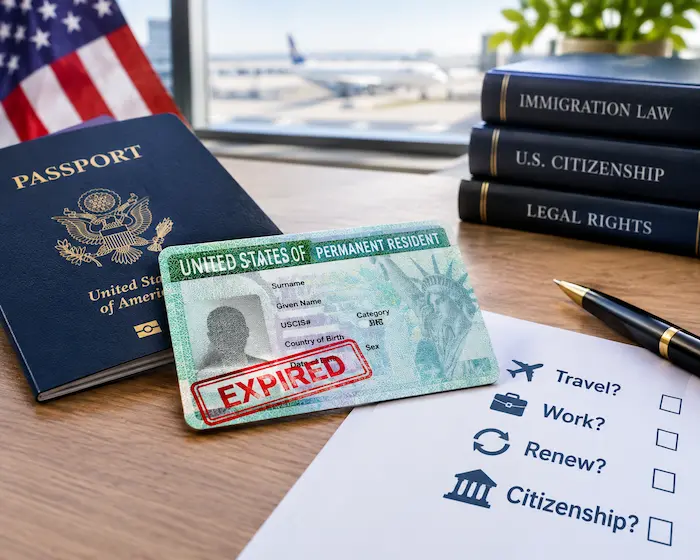
Your green card expired — your permanent residency didn’t.
An expired 10-year green card doesn’t end your status, but it makes proving it harder. File Form I-90 (up to 6 months before expiration, or anytime after) and your receipt notice extends the card for 36 months for work and travel. Airlines are generally allowed to board permanent residents returning with an expired 10-year card after less than a year abroad — but confirm with your airline. If you’re already eligible for citizenship, compare filing N-400 before paying for another 10-year card.
TRAVEL PREP
Travel
Expired 10-year card plus under 1 year abroad: boarding is generally allowed. Bring the I-90 receipt if you have it.
WORK
An expired card plus an I-90 receipt is valid for Form I-9 for 36 months. Current employers generally shouldn’t reverify.
FILE I-90
Renew
Form I-90 costs $415 online. The receipt is your 36-month bridge.
CONSIDER CITIZENSHIP
Citizenship
Eligible? Form N-400 ($710 online) ends the renewal cycle, and its receipt extends your card up to 24 months.
→ Use the “What Should I Do?” tool.
In this guide: when you can travel and work, what to file first, and the airline rule most green card holders never hear about.
What Should I Do With My Green Card?
Answer seven quick questions and get your tier, your key dates, and a cost comparison. Nothing you enter leaves your device, and the tool never asks for an A-Number, Social Security number, or passport number.
The four tiers
FILE I-90
Your 10-year card is expired or expiring. Form I-90 is the renewal.
CONSIDER CITIZENSHIP
You meet, or are within 90 days of meeting, the residence-time requirement. Compare N-400 first.
WRONG FORM
You have a 2-year conditional card. Form I-90 is not your form.
TRAVEL PREP / ABROAD
You’re abroad, or leaving soon. Your plan depends on how long you’ve been away.
Your Card Expired — Are You Still a Permanent Resident?
Yes: an expired 10-year green card does not end your permanent resident status, because the card is only the document that proves it, and the document is what expires.
The card expires — your status doesn’t
Your status can end for other reasons, such as a final removal order or a finding that you gave up your residence. A date printed on a plastic card is not one of them.
So why does it feel urgent? Because the card is how you prove status to airlines, employers, and sometimes banks or motor vehicle offices. Once it’s expired, some of them may hesitate. That is a paperwork problem, and paperwork problems have fixes. The rest of this guide walks through them in the order most people need them.
Two quick checks before anything else:
- Look at your card type. A 10-year card follows the steps in this guide. A card valid for only two years is a conditional card, and it follows different rules (see the two-year card section).
- Look at the “Card Expires” date. Every date in this guide, including the 36-month and 24-month extensions, counts from that printed date, not from the day you file.
If you’re still sorting out how you got your card, our guides to the marriage green card process and the marriage green card timeline explain the steps behind it. If you’re wondering how an expired card affects everyday ID needs, our guide to building U.S. credit as an immigrant covers ID and Real ID context.
Can You Travel With an Expired Green Card?
Often yes — if you hold an expired 10-year card and have been outside the U.S. for less than one year — but the airline decides whether to board you and Customs and Border Protection (CBP) decides admission at arrival, so prepare before you go.
The official boarding policy most people never hear about
The USCIS Form I-131A page describes a CBP policy for airlines and other carriers. In plain terms, a carrier may board these two groups of permanent residents without asking for “carrier documentation” (a special travel document):
- A permanent resident with an expired 10-year card who has been outside the U.S. for less than one year.
- A permanent resident with an expired 2-year card who also has a Form I-797 receipt for an I-751 or I-829 petition, and who has been outside the U.S. for less than one year.
USCIS notes that the regulations generally require a permanent resident to travel with a valid card; the CBP policy above is an exception that lets carriers board you anyway. Notice what this does not say: it doesn’t say you must have an I-90 receipt to fly home with an expired 10-year card. The receipt helps, and we recommend carrying it, but the policy is broader than many airline agents (and many websites) realize.
Check with your airline before you fly
USCIS advises checking with the airline first. In practice, an agent may still ask questions, and a policy that lets a carrier board you is not a promise that you’ll be boarded or admitted. Call, write down the date, the agent’s name, and what they told you, and keep it in your travel folder.
Boarding is not admission
Two different decisions happen on a trip home. First the airline decides whether to let you on the plane. Then CBP decides whether to admit you when you arrive. Nobody can promise how any single border inspection will go. What you can do is arrive with clear proof.
Travel scenarios at a glance
| Situation | Can you board? | What to carry |
|---|---|---|
| Expired 10-year card, no receipt, abroad under 1 year | Carriers may board you under CBP policy on the USCIS I-131A page. An agent may still ask questions. | Passport, expired card, proof of U.S. ties, notes from your airline check |
| Expired 10-year card plus I-90 receipt | Same boarding policy. The receipt, shown with the card, extends validity 36 months from the printed expiration date. | Passport, expired card, original receipt notice (I-797C) |
| Expired 10-year card plus N-400 receipt | Same boarding policy. The receipt, shown with the card, extends validity up to 24 months from the printed expiration date. | Passport, expired card, original N-400 receipt notice |
| Expired 2-year conditional card plus Form I-797 for I-751 or I-829, abroad under 1 year | Carriers may board you under the same CBP policy. | Passport, expired card, original I-797 receipt |
| Card lost, stolen, or destroyed, abroad under 1 year | Ask USCIS for carrier documentation on Form I-131A (see the abroad section). | Passport, any copy of your card, I-131A documentation if USCIS issues it |
| Abroad 1 year or more | Don’t assume the boarding policy applies. You may need a Returning Resident (SB-1) visa. | Talk to an immigration attorney before you book |
Should you file I-90 before you travel?
If you’re inside the 6-month window or already past expiration, and you won’t be away close to a year, filing first is usually worth it. The receipt gives you a second piece of paper that supports the card. And remember: you can’t file Form I-90 from abroad. If your card expires while you’re away, you’ll have to wait until you’re back.
Your printable travel folder
Open each item below to copy it or print it. Fill in the blanks by hand or after pasting.
Travel folder checklist and airline note
TRAVEL FOLDER: EXPIRED GREEN CARD
Name: ______________________   Trip dates: ______________________
Airline / flight: ______________________

[ ] Passport (valid for the whole trip)
[ ] Expired Permanent Resident Card
[ ] Original I-90 or N-400 receipt notice (Form I-797C), if I have one. Bring the paper original.
[ ] Proof of U.S. ties: lease or mortgage, recent pay stubs, most recent tax return
[ ] Airline check done: date ________ time ________
    Agent name or reference number: ______________________
    What they told me: ____________________________________
[ ] This page

PLAIN-ENGLISH NOTE FOR AIRLINE STAFF OR A BORDER OFFICER
I am a lawful permanent resident of the United States. My Permanent Resident Card has expired, but my status has not ended. USCIS's Form I-131A page describes a CBP policy under which a carrier may board, without carrier documentation, (1) a permanent resident with an expired 10-year card who has been outside the United States for less than one year, and (2) a permanent resident with an expired 2-year card who also has a Form I-797 for an I-751 or I-829 and has been outside the United States for less than one year. USCIS advises checking with the airline first, which is why I am carrying notes from my check. I understand that admission is decided by CBP when I arrive.

My situation (circle one): expired 10-year card, under 1 year abroad / expired 2-year card with I-797 receipt, under 1 year abroad

Source: https://www.uscis.gov/i-131a
Your Card Expired While You Were Abroad
Your status doesn’t end because the card expired while you were away, but you can’t file Form I-90 from outside the U.S., so what you do next depends on how long you’ve been gone and whether the card is expired or lost.
Abroad for under 1 year, card expired
If you have an expired 10-year card and have been outside the U.S. for less than a year, the carrier boarding policy described above applies. Check with the airline, carry your passport, expired card, and proof of ties, and file Form I-90 once you’re back in the U.S.
Abroad for under 1 year, card lost, stolen, or destroyed
This is what Form I-131A is for. It’s a request for carrier documentation for permanent residents who are abroad for less than a year and whose card was lost, stolen, or destroyed (and certain other documents). Two limits matter:
- It is not for routine expirations. If your card simply expired, see the boarding policy above instead.
- It doesn’t replace your card, and it doesn’t guarantee admission. After you return, you’ll still file Form I-90 for a replacement card.
Check the USCIS I-131A page and the fee schedule (G-1055) for the current fee and filing instructions.
Abroad for 1 year or more
A permanent resident who has been outside the U.S. for more than a year, or longer than a reentry permit allows, may need a Returning Resident (SB-1) visa from a U.S. embassy or consulate. The State Department explains the standards on its Returning Resident Visas page. These cases turn on facts, such as why you stayed away and what ties you kept, so talk to an immigration attorney before you book anything.
The abroad checklist
- Count the days you’ve been outside the U.S. Under one year, or over?
- Is the card expired, or lost, stolen, or destroyed? The path is different.
- Contact your airline and write down what they tell you.
- Gather your passport, expired card (or a copy), and proof of U.S. ties.
- Once you’re back in the U.S., file Form I-90, or compare it with an N-400 if you’re eligible.
Can You Work With an Expired Green Card?
Yes: your work authorization as a permanent resident continues, an expired card plus a qualifying I-90 receipt is an acceptable List A document for Form I-9 for 36 months, and current employers generally don’t reverify a Permanent Resident Card.
Current employee versus new hire
If you already work there, your employer completed your Form I-9 when you were hired. Under USCIS and E-Verify guidance, employers generally don’t need to reverify a Permanent Resident Card as it approaches its printed expiration date. If HR emails you asking for a new card, that’s usually a misunderstanding of the rule, not a problem with your status.
If you’re starting a new job, you choose which acceptable documents to show. An expired card on its own isn’t acceptable, but an expired card plus a qualifying I-90 receipt is a List A document for 36 months from the printed expiration date. An N-400 receipt shown with the expired card works the same way for up to 24 months. You can also choose a different combination of acceptable documents (another List A document, or a List B plus a List C document).
| Situation | Acceptable proof | Valid until |
|---|---|---|
| Current employee, card expired | Already on your Form I-9. Employers generally don’t reverify a Permanent Resident Card. | No reverification generally needed |
| New hire, expired 10-year card plus qualifying I-90 receipt | List A document | 36 months from the card’s printed expiration date |
| New hire, expired card plus N-400 receipt | List A document | Up to 24 months from the card’s printed expiration date |
| New hire, expired card, nothing filed | The expired card alone isn’t acceptable. Use other acceptable documents, or file I-90 to get a receipt. | Per the documents you choose |
| Expired 2-year conditional card plus I-751 or I-829 receipt | Follow the E-Verify / USCIS guidance for the receipt notice | As stated on your receipt notice |
If your employer asks for more
Employers may not ask you for more or different documents than the I-9 requires, and they may not insist on a specific document, such as a new green card. Doing so can be an unfair documentary practice. Complaints go to the Department of Justice’s Immigrant and Employee Rights Section (IER), which lists its worker hotline on its website.
Most of the time a polite note solves it. The letters below point your employer to the official guidance without making it a fight.
Letter for a current employee
Subject: Permanent Resident Card expiration and my Form I-9

Hello [HR contact name],

I'm writing about my Form I-9. The Permanent Resident Card I presented when I was hired shows an expiration date of [date]. My permanent resident status has not changed; the card is the document that expires, not my status.

As I understand USCIS and E-Verify guidance, Permanent Resident Cards generally are not reverified for current employees. The guidance I found is here: [link to the USCIS I-9 Central or E-Verify page on Permanent Resident Cards].

I am renewing my card with USCIS. I'm happy to share a copy of my receipt notice if that is helpful.

Could you please check this against your company's I-9 guidance and let me know if anything else is needed? I also understand that I choose which acceptable documents to present.

Thank you,
[Your name]
Letter for a new hire
Subject: Form I-9 documents for my start date

Hello [HR contact name],

For my Form I-9, I plan to present my expired Permanent Resident Card together with my Form I-90 receipt notice (Form I-797C). My understanding is that, under USCIS guidance, an expired card plus a qualifying I-90 receipt is an acceptable List A document for 36 months from the card's printed expiration date.

My card expired on [date] and my receipt notice is dated [date]. I will bring both originals on my first day.

Could you please check this against your company's I-9 guidance, and let me know if you have any questions before my start date? Here is the USCIS / E-Verify page I'm relying on: [link].

Thank you,
[Your name]
How to Renew: Form I-90 Step by Step
File Form I-90 online through a USCIS account, up to 6 months before your card expires or any time after, then keep the receipt notice with your card.
FILE I-90
This is the right form for a 10-year card that is expired, expiring within 6 months, lost, stolen, or damaged. It is not the form for a 2-year conditional card.
- Confirm it’s a 10-year card. If it’s a conditional card, stop and read the two-year card section.
- Decide whether to renew or apply for citizenship. If you’re eligible, compare the two options first.
- File online if you can. The fee is $415 online or $465 on paper (fees as of October 6, 2026, per the USCIS fee schedule, G-1055). Confirm the amount on USCIS.gov on the day you file. Fee waivers and exemptions exist in limited situations; see the Form I-90 page.
- Attend biometrics if USCIS schedules it. That’s a short appointment for fingerprints and a photo. Check the fee schedule and your notice for any separate charge.
- Save the receipt notice. USCIS sends a Form I-797C receipt. That notice, shown with your expired card, is the 36-month bridge. Keep the original with the card.
- Track your case. Use the receipt number on the USCIS case status page or in your USCIS online account.
Processing times vary and change. Check the USCIS processing-times page on the day you file, and don’t plan a trip around a guess.
Lost your I-90 receipt?
First check your USCIS online account, where copies of notices are often available. If you can’t find it, you can contact USCIS. An ADIT stamp is temporary proof of permanent resident status that USCIS may give through an in-person appointment in limited situations. It isn’t an automatic fix for a lost receipt: USCIS may decline an appointment when your receipt and expired card already serve as proof.
Before-you-call checklist for USCIS
BEFORE YOU CALL USCIS (lost receipt, ADIT stamp questions)

[ ] Receipt number, if I have it (usually three letters followed by ten digits)
[ ] Checked my USCIS online account for copies of notices
[ ] Expired card and passport in hand
[ ] My full name and date of birth. I will give my A-Number only to a USCIS representative I reached through the official contact information on uscis.gov.
[ ] Why I need proof, and by when (travel date, new job, I-9 deadline)
[ ] My question, in one sentence: ____________________________________
[ ] If asking about an ADIT stamp: ADIT is temporary evidence of permanent resident status. USCIS may grant an appointment in limited situations, and may decline if my receipt plus expired card already suffice. I'll ask whether my situation qualifies.
[ ] Write down: date ________ time ________ representative name or ID ________ reference number ________
The 36-Month Receipt Extension, Explained
A qualifying I-90 renewal receipt (Form I-797C), presented together with your expired card, extends the card’s validity for 36 months from the expiration date printed on the card, and you can use it as proof for work and travel.
USCIS made this change effective September 10, 2024. Before then, I-90 receipt notices carried a 24-month extension, which is why older articles and some HR departments may still quote 24 months. If you filed before that date, USCIS has been sending amended receipt notices with the 36-month language. To use the extension you need the notice that states it, plus the expired card.
How the date math works
The 36 months count from the printed expiration date, not the filing date. If your card expired on March 1, 2026, the extension runs through March 1, 2029, whether you filed in April 2026 or in October 2026. Use the tool above to calculate yours.
Three things to remember:
- Show both items together. The receipt alone isn’t enough. It works with the expired card.
- It’s a bridge, not the new card. Your new card still arrives after approval. The extension just keeps your proof valid while you wait.
- Check your notice. Read it for the extension wording. If it still says 24 months, or you’re unsure it qualifies, ask USCIS or an attorney before relying on it for a trip.
- It applies to renewals of an expiring or expired card. If your card is lost, you have no card to show with the receipt, so ask USCIS about an ADIT stamp.
Renew or Apply for Citizenship?
If you already meet the citizenship requirements, or will within 90 days, compare Form N-400 before paying for another 10-year card: Form I-90 buys you another card, while an approved N-400 ends the renewal cycle altogether.
CONSIDER CITIZENSHIP
This tier is for permanent residents who already meet the residence-time requirement, or will within 90 days.
FILE I-90
$415 online / $465 paper. Another 10-year card. A qualifying receipt extends your card 36 months.
CONSIDER CITIZENSHIP
$710 online / $760 paper ($380 reduced fee if you qualify). If approved and you take the oath, no more renewals. Your receipt extends your card up to 24 months.
| Point | Form I-90 | Form N-400 |
|---|---|---|
| Cost | $415 online / $465 paper | $710 online / $760 paper; $380 reduced fee for eligible applicants |
| Outcome | A new 10-year card. Your status doesn’t change. | U.S. citizenship, if approved and you take the oath |
| Test | None | English and civics tests, unless an exception applies |
| Extension | 36 months from the printed expiration date, with a qualifying receipt | Up to 24 months from the printed expiration date (for N-400s filed on or after December 12, 2022) |
| Ends renewals? | No. You’ll renew again in 10 years. | Yes, if approved |
How early can you apply for citizenship?
You may file Form N-400 up to 90 days before you meet the 5-year residence requirement, or the 3-year requirement if you’re married to a U.S. citizen, as long as you meet the other requirements. The earliest date is your “Resident Since” date plus 5 years (or 3 years), minus 90 days. The tool at the top of this page does this math for you. The N-400 page and instructions list the other requirements, such as physical presence in the U.S. and good moral character.
Does the N-400 receipt extend your card?
Under a USCIS Policy Manual update effective December 12, 2022, a qualifying N-400 receipt shown with your expired card can extend its validity up to 24 months from the printed expiration date, including as a List A document for Form I-9. If your card is lost or damaged, you generally still need Form I-90 even if you’ve filed an N-400. Because policy wording can change, check the USCIS Policy Manual before relying on it.
Criminal history? Talk to a lawyer before N-400.
Any arrest or conviction, long trips abroad, or a past immigration problem can affect a citizenship application in ways that aren’t obvious. A short consultation before you file can prevent a costly mistake. See when to get legal help.
A simple way to decide
- Not yet eligible, or unsure: file Form I-90 now. It’s the straightforward path.
- Eligible, clean record, no long absences: compare costs and timing. N-400 costs more up front but ends renewals if approved.
- Eligible, but any red flag: talk to an immigration attorney or DOJ-accredited representative first.
Two-Year Conditional Card? Don’t File I-90
If your card is a 2-year conditional card, Form I-90 is the wrong form: you file Form I-751 (marriage-based) or Form I-829 (investor) to remove the conditions.
WRONG FORM
Don’t use Form I-90 if your conditional residence has expired or will expire within 90 days.
Two-year card? Don’t file I-90
Filing the wrong form can waste time and fees. If you’re not sure which card you have, compare your “Resident Since” and “Card Expires” dates (a conditional card is usually about two years apart), or ask an attorney.
| Card type | Situation | Form |
|---|---|---|
| 10-year card | Expired, or expiring within 6 months | Form I-90 |
| 10-year card | Lost, stolen, or damaged | Form I-90 (and Form I-131A if you’re abroad for under 1 year) |
| 10-year card | Already meet citizenship requirements | Compare Form N-400 with Form I-90 |
| 2-year conditional card (marriage) | Conditional residence expired or expires within 90 days | Form I-751 |
| 2-year conditional card (investor) | Conditional residence expired or expires within 90 days | Form I-829 |
A receipt notice (Form I-797) for a pending I-751 or I-829 is the key paper to keep with your expired conditional card, and it’s the document the airline boarding policy refers to. Our guide to divorcing a U.S. citizen spouse and the I-751 waiver covers the conditional card in depth, including what to do when the marriage has ended. If your green card came through family sponsorship, the sponsor’s Form I-864 commitment is a separate topic; see our I-864 joint sponsor guide.
When to Get Legal Help — and How to Avoid Scams
Most straightforward renewals can be filed without a lawyer, but you should talk to an immigration attorney or a DOJ-accredited representative before filing N-400 or traveling if you have any criminal history, long absences, or prior immigration problems.
Good reasons to get help:
- An arrest, charge, or conviction, anywhere, at any time
- A long stay abroad, or any absence close to a year
- A past denial, removal proceeding, or other immigration problem
- A card that’s lost or stolen while you’re abroad
- Any situation where you’re not sure which form applies
Our guide to immigration lawyer fees explains typical costs so you know what to expect. Accredited representatives work for DOJ-recognized organizations and often charge less; the Department of Justice keeps a recognition and accreditation program with a roster.
Beware of “notario” scams
In some countries a “notario público” is a lawyer. In the United States, a notary public is not an attorney and cannot give immigration advice. Avoid anyone who guarantees results, asks you to sign blank forms, or charges for forms that are free on USCIS.gov. USCIS explains how to spot and report fraud on its Avoid Scams page.
Frequently Asked Questions
These are short answers to the questions people ask most about an expired green card; the sections above have the detail.
Does an expired green card mean I lost my status?
No. A 10-year card expiring ends the document’s validity, not your permanent resident status.
Can I travel with an expired green card?
Often yes, especially with an expired 10-year card and under a year abroad. USCIS says carriers may board you under CBP policy, but check with your airline first and carry supporting papers.
Can I board a flight back to the U.S. with an expired card and no receipt?
The policy on the USCIS I-131A page says carriers may board a permanent resident with an expired 10-year card who has been outside the U.S. for less than one year, without carrier documentation. An agent may still ask questions, so confirm with the airline and carry the travel folder.
What if my card expired while I was abroad?
Your status continues. If you’ve been abroad for under a year with an expired 10-year card, the boarding policy applies. You can’t file Form I-90 from abroad, so file it after you return.
Can I renew my green card from outside the U.S.?
No. You can’t file Form I-90 from abroad.
What if I lose my green card abroad?
If you’ve been abroad for under a year, you can ask USCIS for carrier documentation on Form I-131A. It doesn’t replace your card or guarantee admission, and you’ll still file Form I-90 after you return.
Can I work with an expired green card?
Yes. Your work authorization as a permanent resident continues. For a new Form I-9, an expired card plus a qualifying I-90 receipt is a List A document for 36 months.
Can my employer ask for my new card?
Employers generally don’t reverify a Permanent Resident Card for current employees. Asking for more or different documents than required can be an unfair documentary practice, and complaints go to the DOJ’s Immigrant and Employee Rights Section.
What documents work for Form I-9?
You choose from the lists of acceptable documents. An expired card with a qualifying I-90 receipt (36 months) or N-400 receipt (up to 24 months) works as a List A document. Other List A documents, or a List B plus a List C document, also work.
How does the 36-month I-90 extension work?
A qualifying I-90 receipt (Form I-797C), shown with your expired card, extends validity 36 months from the printed expiration date. USCIS made this effective September 10, 2024.
How much does Form I-90 cost?
$415 online or $465 on paper, as of October 6, 2026, per the USCIS fee schedule. Confirm on USCIS.gov before filing, since fees can change.
How long does I-90 take?
It varies by case and over time. Check the USCIS processing-times page on the day you file. Treat any number you read online as an estimate, not a promise.
What if I lose my I-90 receipt?
Check your USCIS online account for a copy of the notice, then contact USCIS if you can’t find it. An ADIT stamp is available only in limited situations, and USCIS may decline an appointment if your receipt and expired card already serve as proof.
Should I renew or apply for citizenship?
If you already meet the requirements (or will within 90 days) and have no red flags, compare N-400 with I-90. N-400 costs more but ends renewals if approved. If you’re not eligible yet, file Form I-90.
Can I apply for citizenship with an expired card?
Yes. An expired card doesn’t stop you from applying. Your status is what counts, and the N-400 receipt extends the card up to 24 months from its printed expiration date.
Does an N-400 receipt extend my card?
Under USCIS policy for N-400s filed on or after December 12, 2022, the receipt shown with your expired card extends it up to 24 months from the printed expiration date. Check the current Policy Manual before you rely on it.
How early can I apply for citizenship?
Up to 90 days before you meet the 5-year residence requirement (or the 3-year requirement if married to a U.S. citizen), if you meet the other requirements.
Can I file I-90 for a 2-year green card?
No. If conditional residence has expired or expires within 90 days, file Form I-751 (marriage) or Form I-829 (investor) instead.
What happens if I stay abroad more than a year?
You may need a Returning Resident (SB-1) visa to come back, and the question of whether you kept your residence can come up. Talk to an immigration attorney before you travel or while planning your return.
Do I need a lawyer?
Not always. A simple I-90 renewal is something many people file themselves. Get help if you have any criminal history, long absences, or a prior immigration problem, especially before an N-400.
Last updated:
This article is general information, not legal advice, and it doesn’t create an attorney-client relationship. Immigration rules and fees change. Fees and policies were verified as of October 6, 2026; confirm them on USCIS.gov before you file or travel.

Daniel Hayes is the founder and sole researcher at AdvoraHQ. He covers U.S. personal finance, insurance, and consumer law — working directly from IRS publications, federal and state statutes, court opinions, and SEC filings rather than secondary summaries. His focus is the gap between what readers think they know and what the source documents actually say. Daniel is not a licensed attorney, CPA, or financial advisor; his articles are educational and not personalized advice. Reach him at Daniel.Hayes@advorahq.com.