
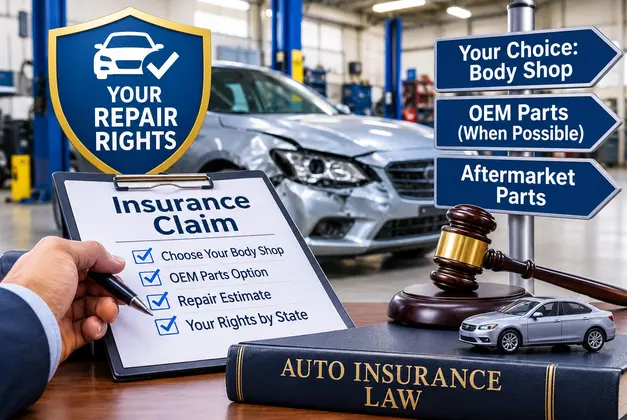
Shop: You can usually take your car to the shop you choose. Many states ban insurers from steering you, but in some the insurer may only pay up to its own estimate.
Parts: Insurers often write estimates with aftermarket or used parts. Some states limit that for newer cars or require your consent; an OEM endorsement can change it on your own policy.
Low estimate: Don’t sign a final release. Let your shop submit a supplement, ask for a reinspection, and know your appraisal-clause and complaint options.
See your rights in your state →
What Are Your Repair Rights in Your State?
Enter your state, whose insurance is paying and a few facts about your car, and the Checker lists who decides, what your state’s verified rules say, what you can ask for, where money may come out of your pocket, and where to escalate.
The build month is usually on the label inside the driver’s door.
- Your claim or theirs
- Choosing your shop
- OEM vs. aftermarket
- State laws
- OEM endorsement
- Warranty & ADAS
- Low estimate
- Cashing the check
State laws verified . Rules change; check your state’s statute and your policy.
Is It Your Claim or Theirs? Why It Changes Everything
If your own insurer pays under your collision or comprehensive coverage, your policy and state law decide what you can demand; if the at-fault driver’s insurer pays, you are making a liability claim, and state law on restoring your car to pre-loss condition decides instead.
Your claim and the other driver’s claim follow different rules
Before you argue about parts or shops, find out whose coverage is paying. Ask the adjuster: "Is this a claim under my own policy, or a liability claim under another driver’s policy?" Write down the answer and the adjuster’s name.
YOUR POLICY DECIDES On a first-party claim, your own collision or comprehensive coverage, you have an insurance contract. Its wording controls what the insurer must pay, whether an appraisal clause exists and whether you bought an OEM endorsement. State law adds floors on top, such as shop choice, parts disclosure and sometimes your consent.
STATE LAW DECIDES On a third-party claim, you are asking the at-fault driver’s insurer to pay what its customer legally owes you. You are not its customer, so your own endorsement and your own appraisal clause don’t travel with you. The question is what state law requires to restore your car to its pre-loss condition, and that answer is more negotiable than a contract term.
NEGOTIATE OR ESCALATE You can often choose the route. If the other driver was at fault, you can usually ask their insurer to pay, or use your own coverage and let your insurer recover from theirs. That recovery is called subrogation: your insurer pays for the repair, then seeks reimbursement from the at-fault driver’s insurer, and you may get your deductible back if it recovers. Our guide to filing a claim or paying out of pocket walks through the choice, and our rear-ended guide covers who pays when someone hits you. If you talk to the other driver’s insurer, read what to do if you already gave a recorded statement first.
| Question | Your policy (first-party) | Other driver’s insurer (third-party) |
|---|---|---|
| What controls | Your policy language plus state law. | State law on the at-fault driver’s liability to restore your car to pre-loss condition. Their policy isn’t your contract. |
| Shop choice | Your choice. State anti-steering rules may apply, and in some places the insurer may limit payment to its own estimate or a prevailing labor rate. | Your choice. The insurer may still pay on its own estimate. Some states add protections for third-party claimants; California, Colorado and Texas each have a provision. |
| OEM request | Under a state rule or your OEM endorsement; otherwise subject to your policy’s like-kind-and-quality language. | You can ask, but you have no endorsement. It is a negotiation over what restoring your car requires, and state rules may or may not reach you. |
| Endorsement applies? | Yes, if you bought one on your own policy. | No. Your endorsement works only on your own policy. |
| Appraisal clause | Usually, if your policy includes one. | No. It is a policy provision, and you aren’t a party to the at-fault driver’s policy. |
| Deductible | You pay it. You may get it back if your insurer recovers from the at-fault driver’s insurer. | None on their liability payment. |
| Escalation path | Reinspection, appraisal clause, state insurance department complaint. | Written demand, state insurance department complaint, then small claims or a lawsuit against the at-fault driver. |
Can Your Insurer Make You Use Its Body Shop?
Usually not: you can choose your own body shop, and many states bar insurers from steering you, but choosing a shop doesn’t guarantee the insurer pays that shop’s prices, and about 17 states had no anti-steering law as of a July 2025 report.
What a preferred shop is
Many insurers keep a network of shops, often called direct repair program (DRP) shops, that agree to the insurer’s pricing and procedures. Using one can be convenient: the shop and the adjuster work from the same estimate, and the insurer may stand behind the repair. Using one is your choice, not a requirement.
What steering looks like
- Telling you the claim will be slower, or that payment is at risk, if you use another shop.
- Saying only the insurer’s shop can honor a repair guarantee, when the shop you picked has its own written warranty.
- Declining to inspect at your shop, or quoting only the preferred shop’s price as the amount owed.
- Offering an incentive for using the insurer’s shop, or a penalty for not using it.
Not every mention of a shop is steering. California, for example, lets an insurer give truthful, non-deceptive information about a shop’s warranty, repair time or workmanship. The line is between information and pressure.
How four states handle it
STATE LAW DECIDES New York (Insurance Law § 2610): on a collision or comprehensive loss, the insurer can’t require repairs at a particular shop and can’t recommend or suggest one unless you expressly ask. Glass-only claims are excepted. The insurer must give you its estimate with a printed notice that you may use the shop of your choice. Source: N.Y. Ins. Law § 2610.
California (Insurance Code § 758.5): the insurer can’t require a particular shop. It may suggest one only if you expressly ask or it has told you in writing that you can choose, and once you choose a shop it can’t suggest a different one. The protection covers third-party claimants too. Source: Cal. Ins. Code § 758.5.
Colorado (C.R.S. § 10-4-120(2)): the insurer can’t direct that repairs be made, or not made, by a specified repair business. It can’t represent that using or not using one may result in nonpayment or delayed payment of a claim, and it can’t use coercion, incentives or disincentives. It also can’t require a third-party claimant in a liability settlement to use a particular repair business. Source: C.R.S. § 10-4-120.
Texas (Insurance Code § 1952.302): an insurer or its adjuster can’t tell you, orally or in writing, that you must use a specific shop, or one on its preferred list, for the repair to be covered. Source: Tex. Ins. Code § 1952.302.
Choosing your shop is one question; what the insurer pays is another
Even where you can choose freely, the insurer’s payment may follow its own estimate or a prevailing labor rate. If your shop charges more, the difference can be yours unless a state law, your policy or a successful supplement covers it.
California addresses one version: if the policy itself recommends a shop and you use another, the insurer can’t limit or discount reasonable repair costs by what its recommended shop would have charged. Texas’s notice rule, as described in a 2010 Texas Department of Insurance bulletin, tells claimants an insurer need not pay more than a reasonable amount for repairs and parts.
The 17 states reported without an anti-steering law
STATE LAW DECIDES PropertyCasualty360 reported in July 2025, in coverage of North Carolina Insurance Commissioner Mike Causey’s push to raise awareness of repair rights, that 17 states were still without anti-steering laws: Alabama, Alaska, Florida, Hawaii, Idaho, Indiana, Iowa, Massachusetts, Missouri, Nebraska, Nevada, New Mexico, Tennessee, Utah, Vermont, Virginia and Wyoming. Source: PropertyCasualty360, July 28, 2025.
Treat that as a trade-press count, not a statute. Lists differ, laws change, and some of these states regulate other parts of the process. Indiana, Massachusetts and Virginia appear in Table 3 for their parts or estimate rules. In a state on the list you will usually still be free to choose your shop, but you have fewer statutory tools if an insurer pushes back, so ask for its position in writing and keep a record.
How to report steering
- Write it down. Note the date, the person’s name and what was said.
- Ask in writing. Use script 1 in the low-estimate section to name your shop and ask the insurer to confirm that payment doesn’t depend on it.
- Complain. File a complaint with your state insurance department using script 5 as an outline. Use your state’s .gov site.
OEM, Aftermarket, Used or Reconditioned: Which Parts Are on Your Estimate?
OEM parts come from the carmaker, aftermarket parts come from another manufacturer, used or LKQ parts are recycled from other vehicles, and reconditioned parts are repaired originals; your estimate should show which is which, and you can ask the adjuster to spell out every line in writing.
| Type | What it is | Typical estimate notation | What to ask |
|---|---|---|---|
| OEM | A new part made by or for the carmaker. | Often "OEM" or "New." | Is it new? What is the part number? Will the insurer pay its full price? |
| Aftermarket | A new part made by a company other than the carmaker. It is not a used part. | Often "Aftermarket" or "A/M." | Who made it? Is it certified? Is every line identified? |
| Certified aftermarket | An aftermarket part tested by an independent program such as CAPA. Certification is voluntary. | Often a note naming the certifier. | Which program, and which part number? Can the shop show the seal? |
| Used, LKQ or recycled | An original part taken from another vehicle. LKQ stands for like kind and quality. | Often "LKQ," "Recycled" or "Used." | What is the source vehicle’s mileage and condition? Is it equal or better than my pre-accident part? |
| Reconditioned or remanufactured | A used or damaged original that has been repaired, refinished or rebuilt. | Often "Reman," "Recond" or "Rebuilt." | What was done to it, and who warrants it? |
What certification means, and what is disputed
CAPA, which runs a voluntary certification program, says its certified parts are independently tested to be comparable to automaker-branded parts in fit, function and quality (CAPA). Carmakers and many repairers dispute that any aftermarket copy equals the original, and some shops report fit and finish problems. Insurers and certifiers disagree with that view. This guide doesn’t settle the dispute, and it doesn’t say aftermarket parts are unsafe. Certification tells you a part passed one program’s tests; it does not make the part an OEM part.
How to read your estimate
- Ask for the full itemized estimate in writing, not only the total.
- For each replaced part, find the part type and the part number. If a code is unclear, ask the adjuster to spell it out.
- Some states require the estimate to say so. Virginia requires written notice when an estimate is based on aftermarket parts, and California repair invoices must state whether each part is new, used, reconditioned, rebuilt, OEM or non-OEM aftermarket.
- Compare the insurer’s estimate with your shop’s line by line, and note every part type that differs.
What Do State Laws Say About Aftermarket and Used Parts?
A few states limit aftermarket or used parts by vehicle age or mileage, many require a written disclosure on the estimate, and a handful require your consent; one national survey updated in August 2024 counted 31 disclosure states and 6 consent states, so your state’s text matters.
State snapshot
| State | Anti-steering law | Parts rule (age or mileage) | Consent or disclosure | Statute | Verified |
|---|
The same data powers the Checker above. A state that isn’t in Table 3 hasn’t been verified here, which is different from having no rule. Use your state’s insurance code and your state insurance department.
Rhode Island: 48 and 72 months
STATE LAW DECIDES Rhode Island’s rule is in R.I. Gen. Laws § 27-10.2-2, as amended in 2024. An insurer that intends to specify aftermarket parts must notify the owner in writing, and a shop needs your express written consent to install aftermarket parts. For a car less than 48 months from its date of manufacture, an insurer may not require aftermarket parts when negotiating with a repairer unless the repairer has your written consent. For a car more than 48 and less than 72 months from manufacture, an insurer may not refuse OEM parts if the repairer has your written consent to install them.
Example: a car built 40 months ago is in the under-48 window, so the insurer can’t make you take aftermarket parts without your written consent. A car built 60 months ago is in the 48-to-72 window, so you can ask for OEM parts, sign your repairer’s OEM consent, and the insurer may not refuse their use. Older versions of the statute used a 30-month window, so don’t rely on older articles.
Massachusetts: 20,000 miles
STATE LAW DECIDES Under 211 CMR 133.04, when a part must be replaced, the appraisal must use a rebuilt, aftermarket or used part of like kind and quality unless an exception applies. The exceptions include safety, a diligent but unsuccessful search for such a part, a new OEM part giving the lowest overall repair cost and, for policies written or renewed on or after January 1, 2004, a vehicle that has been used no more than 20,000 miles, unless its pre-accident condition warrants otherwise.
The regulation defines like kind and quality as equal or better condition than the pre-accident part. When an insurer specifies used, rebuilt or aftermarket parts, the appraisal must name the source and the specific part. A violation is treated as an unfair or deceptive practice under M.G.L. c. 176D. Example: an appraisal for a car with 12,000 miles should not specify used, rebuilt or aftermarket parts, so expect new carmaker parts; a car with 45,000 miles can be written with such parts, but each must be identified.
Indiana: five years after the model year
STATE LAW DECIDES Under IC 27-4-1.5-8, before an insurer that pays at least part of the cost directs a body shop to start repairs, it must give you written notice that you have the right to approve the type of body parts, and a chance to choose among three types: new parts made by or for the carmaker, new parts not made by or for the carmaker, or used parts. The section applies only in the five years after the vehicle’s model year, which Indiana trade press has described as the model year plus five. An insurer that skips the notice or overrides your choice commits an unfair claim settlement practice. Indiana DOI Bulletin 71 explains the notice process.
The statute refers to "the insured." A 2018 bill, HB 1189, would have added third-party claimants; it did not advance. Example: for a car in its model year or within five years of it, expect the insurer’s written notice and choose the part type in writing before repairs start.
The national pattern
The law firm Matthiesen, Wickert & Lehrer, in a survey last updated August 29, 2024, counted 35 states with statutes or regulations on a first-party insurer’s use of non-OEM crash parts. Of those, 31 require a disclosure statement with the repair estimate, 20 require the part’s manufacturer to be identified, 13 require non-OEM parts to be of "like kind and quality," and 6 require the insured’s consent before non-OEM parts are used. Read the survey at Matthiesen, Wickert & Lehrer. The NAIC also keeps a state page for its After Market Parts Model Regulation (#891) showing which states adopted parts of its model regulation.
Is an OEM Endorsement Worth Asking About?
An OEM endorsement is an optional add-on to your own policy that can require new carmaker parts on a covered claim; it isn’t available everywhere or from every insurer, it never applies to the other driver’s insurance, and you should get its price and wording in writing.
An OEM endorsement only works on your own policy
It changes what your own insurer pays on your own collision or comprehensive claim. It does nothing against the at-fault driver’s insurer, and an endorsement added after a loss won’t cover that loss.
YOUR POLICY DECIDES Terms differ by insurer, and some limit the endorsement by vehicle age or mileage, so ask for the actual wording. Availability varies too. Progressive’s own consumer page, checked on November 24, 2026, says many insurers don’t offer OEM parts coverage for cars and that Progressive offers it for motorcycles but not for cars. The same page says that if you or your shop use OEM parts when aftermarket parts could return the car to its pre-loss condition, you may have to pay the price difference (Progressive).
What to ask your insurer or agent: Do you offer an OEM parts endorsement for my vehicle? What does it cost per year? What are the age or mileage limits? Does it apply to every part? This guide doesn’t print endorsement prices, because they differ by insurer, state and vehicle.
Pay-the-Difference Calculator
Enter up to five parts, and an optional labor-rate gap and endorsement quote, to see what the gap between OEM and aftermarket or used parts could cost you.
Does a Leased or Financed Car Change Anything? Two Extra Checks
Yes: a lender or lessor may be named on the repair check and may control when funds are released, and a lease may set parts and condition standards at return, so read your finance or lease paperwork before you approve any repair that uses non-OEM or used parts.
Check 1, the lease. The lessor owns the car, and your lease decides what condition you must return it in. Some leases define excess damage or require repairs to a particular standard. Before you agree to aftermarket or used parts on a leased car, read the return-condition terms, or ask the lessor in writing whether those parts are acceptable.
Check 2, the lienholder. Many lenders and lessors are listed as loss payees, so they may appear on the repair check, and they may require the repair to be completed before funds are released. Ask the insurer who will be on the check and how the shop will be paid. Don’t endorse a check over to a shop before you are satisfied with the estimate and the parts list.
If the car is later declared a total loss while you owe more than it is worth, the repair-versus-payout question changes. Our guide to GAP insurance explains the gap, and our totaled car guide explains the total-loss process.
Will Repairs Affect Your Warranty, ADAS Calibration or Resale Value?
A carmaker can’t void your warranty just because aftermarket parts were used, but it can deny a repair it shows the part caused; after a crash, ask whether sensors need calibration, and expect resale value questions that the diminished value process addresses separately.
Warranty
The FTC says the Magnuson-Moss Warranty Act makes it illegal for a manufacturer or dealer to deny your warranty coverage just because you used an aftermarket or recycled part, and that your warranty stays in effect. If the part you installed damages another part, the manufacturer or dealer can deny coverage for the damaged part, but it must prove the part caused the damage (FTC consumer page). A new-car warranty covers defects, not collision damage, so the practical question is usually who stands behind the repair. Ask your shop for its written repair warranty, what it covers and for how long.
ADAS calibration
Ask whether your car needs ADAS calibration after the repair
Bumpers, mirrors, grilles and windshields can hold cameras, radar or other sensors for driver-assistance systems. After a repair, those sensors may need scanning and calibration. Ask the insurer and your shop, in writing, whether the estimate includes pre-repair and post-repair scans and any calibration, and ask the shop to follow the carmaker’s repair procedures. If an item is missing, it belongs in a supplement.
Our windshield replacement guide covers calibration after glass work in more detail.
Resale value
A repaired crash can show up on vehicle history reports and may lower resale value even when the repair is done well. That loss is called diminished value. Whether and how you can claim it differs between your own claim and a claim against the other driver, and it varies by state. See our diminished value claim guide.
What If the Estimate Is Lower Than the Shop’s Quote?
An insurer’s estimate is a starting point, not a final price: have your shop submit a supplement for hidden damage, ask for a reinspection, avoid signing a final release while repairs are open, and know the appraisal clause and complaint routes if the gap stays.
Why the first estimate is often low
The adjuster usually sees the visible damage. Hidden damage, such as bent brackets or cracked supports, often appears only after the shop takes the car apart. That is why supplements are normal and not a sign that anyone is padding the bill. A gap can also come from part types, labor rate, or items the insurer left off, such as scans or calibration.
What to do, in order
- Step 1. Get the insurer’s itemized estimate and your shop’s written estimate, and compare them line by line.
- Step 2. Ask your shop to submit a supplement with photos and the carmaker’s repair procedures. The shop usually files it; ask for a copy.
- Step 3. Ask the insurer for a reinspection and a written explanation of any item it won’t pay (script 3).
- Step 4. If the gap is parts or labor rate, decide whether to pay the difference or push back. Use the Pay-the-Difference Calculator.
- Step 5. On your own policy, consider the appraisal clause.
- Step 6. File a complaint with your state insurance department if the insurer isn’t following the rules or your policy.
- Step 7. On a claim against the other driver’s insurer, send a written demand, then use small claims if needed.
Don’t sign a final release while repairs are still open
Read exactly what any release or "final payment" paper covers before you sign it or cash a check that carries that language. A signed release can end your right to ask for more. If repairs aren’t finished, ask the adjuster in writing to keep the claim open for supplements.
| Step | Who does it | What it costs | When to use it |
|---|---|---|---|
| Supplement | Your shop, to the insurer | Usually no fee to you. It can add days while the insurer reviews. | When the shop finds damage the estimate missed. |
| Reinspection | The insurer’s adjuster, at your shop | Usually no fee. | When you and the insurer disagree about damage or procedures. |
| Pay the difference | You | The gap itself. Use the calculator. | When the gap is parts type or labor rate and you decide the repair is worth it. |
| Appraisal clause | You and the insurer, each with an appraiser | Typically your own appraiser’s fee plus half the umpire’s. | On your own policy, when you disagree on the amount of loss and negotiation has stalled. |
| Insurance department complaint | You | Free to file at most departments; check yours. | When you believe the insurer isn’t following the rules or its policy. |
| Small claims (third-party) | You, against the at-fault driver | A court filing fee set by your court, plus your time. | When the other driver’s insurer refuses a fair demand, within your court’s limit. |
The appraisal clause (your own policy only)
YOUR POLICY DECIDES The appraisal clause is a provision in many auto policies. It lets you and the insurer each choose an appraiser to decide the amount of a loss when you disagree. The two appraisers pick an umpire, and agreement by two of the three sets the amount. Each side typically pays its own appraiser and shares the umpire’s cost, as in Washington’s codified clause (RCW 48.18.620). Appraisal decides the amount of loss, not whether the loss is covered. Your policy’s wording, steps and deadlines control, so read it first. Because it is a policy provision, it applies to your own claim and not to the other driver’s insurer.
Complaint to your state insurance department
NEGOTIATE OR ESCALATE Use your state’s .gov site and file the consumer complaint form. Include the date of loss, the claim number, what you asked for, the insurer’s response and your documents. Script 5 gives you an outline. The department reviews claim handling; it doesn’t act as your lawyer.
If the other driver’s insurer is paying
NEGOTIATE OR ESCALATE Send a written demand letter that lists your repair estimate, your documents and what you want paid, and set a reasonable deadline. If the insurer refuses a fair demand and the amount fits your court’s limit, small claims is the next step: see how to sue in small claims court. If the at-fault driver’s coverage is too low for the damage, see what to do when the at-fault driver’s insurance isn’t enough.
What to say: copyable scripts
1. Declining a shop referral
I’ve chosen [shop name]. Please send the estimate and any supplement approvals there. Please confirm in writing that payment won’t depend on using a particular shop.
2. Requesting OEM parts
My vehicle is [age in months and mileage]. Under [state law or statute section] / my OEM endorsement, I’m requesting OEM parts. If you’re specifying non-OEM or used parts, please identify each part in writing and explain how it meets like kind and quality.
3. Low estimate or supplement
My shop found additional damage and will submit a supplement. Please schedule a reinspection and explain in writing any items you won’t pay.
4. Invoking the appraisal clause (your own policy only)
[Date]
[Insurer name], Attn: [adjuster name]
Re: Claim [claim number], policy [policy number], date of loss [date]
Under the appraisal provision of my policy, I am demanding an appraisal of the amount of loss. We disagree on the amount: your estimate is $[amount] and my shop’s estimate is $[amount].
I have selected [appraiser name and contact details] as my appraiser. Please identify your appraiser within the time stated in the policy, and tell me in writing the next steps and any deadlines.
Please also confirm in writing that the claim stays open while the appraisal is pending.
[Your name, phone, email]
Policy wording and deadlines vary. Have a licensed attorney or your state insurance department review this before you send it.
5. Complaint outline for your state insurance department
Date of loss: [date]. Insurer: [name]. Claim number: [number]. Policy number: [number, if it is your own policy].
What happened: [one or two sentences about the loss and the repair].
What I asked for: [for example, OEM parts, a reinspection, a supplement, payment of my shop’s labor rate], and the date I asked.
The insurer’s response: [what it said or did, with dates and the name of the person].
Documents attached: [insurer’s estimate, my shop’s estimate, supplement, emails or letters, photos].
What I’m asking the department to do: [review the insurer’s handling of my claim and help resolve the dispute].
Can You Cash the Check and Skip or Cheapen the Repair?
Often yes if you own the car outright, because the payment is yours, but a lender or lessor may need to approve it, unrepaired damage can reduce what you recover on a later claim or total loss, and safety systems may not work properly if the car isn’t repaired.
Own it outright. The payment compensates you for a covered loss. Many policies don’t require you to repair the car, but yours might, so read it. Photograph the damage and keep the estimate.
Financed or leased. The check may be made out to you and the lienholder, and your loan or lease may require repairs to be completed. If a lienholder is named on the check, you can’t cash it alone, so ask the lender how it releases repair payments.
Prior damage on a future claim. If you leave damage unrepaired, a later insurer may treat it as pre-existing, which can reduce what you recover for new damage. It can also lower the valuation if the car is later declared a total loss; see our totaled car guide.
Safety. Structural damage and sensor misalignment aren’t always visible. If the car has driver-assistance features, ask whether the repair includes calibration before you decide to skip anything.
What About Glass, Deer, Hit-and-Run, Rentals and Winter Crashes?
Glass, deer strikes, hit-and-runs, rentals and winter crashes each follow a slightly different claim path, so use this section to jump to the right guide and to see which repair-rights questions about shops, parts and supplements still apply to your situation.
- Glass. Glass-only claims are carved out of some shop-choice statutes (New York’s § 2610 excepts them), and camera calibration often follows a windshield replacement. See our windshield replacement guide.
- Deer and comprehensive claims. A deer strike is usually a comprehensive claim under your own policy, so your policy, endorsement and appraisal clause can apply. See our hit-a-deer guide.
- Hit-and-run. With no at-fault insurer to pay, your options depend on your own coverages. See our hit-and-run guide.
- Rental during repairs. A supplement can extend repair time, so check your rental limits early. See our guide to how much car insurance you need for how rental coverage fits into your policy.
- Winter crashes. Shops are often booked after storms, and tow and storage fees can add up. Ask the insurer who pays for towing and storage and how long it will cover them. For fault questions on ice, see our slid-on-ice guide.
Repair Rights FAQ: What Else Do Drivers Ask?
These are the questions drivers most often ask about repair rights after a claim, and each answer is brief and carries the same caution used throughout this guide: your policy, your state’s current law and your state insurance department control the outcome.
Does insurance have to pay for OEM parts?
Not always. On your own claim, your policy and state law decide. Most policies pay for parts of like kind and quality, which an insurer may read as aftermarket or used. Some states limit that for newer cars or require your consent, and an OEM endorsement can require OEM parts. Without one of those, you may pay the difference.
Can I refuse aftermarket parts?
You can ask, and in some states the law gives you a say. Rhode Island requires your written consent before a shop installs aftermarket parts, and Indiana lets you approve the type of body parts in the five years after the model year. Elsewhere, refusing may mean paying the price difference. Check your state card in the Checker.
Can insurance use used parts on a new car?
It depends on the state. Massachusetts bars appraisers from specifying used, rebuilt or aftermarket parts on vehicles used 20,000 miles or less, unless pre-accident condition warrants otherwise. Rhode Island’s age rule covers aftermarket parts on cars under 48 months old. Many states have no such rule, so ask for the parts list in writing.
What is an LKQ part?
LKQ stands for like kind and quality. On an estimate it usually marks a used or recycled part taken from another vehicle. Some states define the standard: Massachusetts says a part is of like kind and quality when it is of equal or better condition than the pre-accident part. Ask for the part’s source, mileage and condition.
Can my insurer make me use its body shop?
Usually not. Many states bar insurers from requiring a particular shop; New York, California, Colorado and Texas are examples. But about 17 states had no anti-steering law as of a July 2025 report, and in some states the insurer may pay only up to its own estimate. Using a preferred shop is your choice.
What happens if I don’t use the insurer’s preferred shop?
Your claim is still handled under your policy and state law. You may lose conveniences, such as the insurer working directly with the shop, and any repair guarantee offered through the insurer’s network typically applies only to network shops. Your shop’s own warranty applies instead. Ask in writing that payment doesn’t depend on your shop choice.
Which states don’t have anti-steering laws?
PropertyCasualty360 reported in July 2025 that 17 states had none: Alabama, Alaska, Florida, Hawaii, Idaho, Indiana, Iowa, Massachusetts, Missouri, Nebraska, Nevada, New Mexico, Tennessee, Utah, Vermont, Virginia and Wyoming. This is a trade-press count, so check your state’s statute and your state insurance department.
Does the other driver’s insurance have to pay for OEM parts?
Not automatically. You have no contract with the other driver’s insurer. Its job is to pay what its customer legally owes to restore your car to pre-loss condition under state law. Whether that requires OEM parts is negotiable and varies by state. Ask in writing, explain why OEM is needed, and use a demand letter and small claims if refused.
Is an OEM endorsement worth it?
It depends on your car, your insurer’s offer and its price. It applies only to your own policy, may have age or mileage limits, and some insurers don’t sell it for cars. Ask for the price and wording in writing, then use the Pay-the-Difference Calculator to compare a typical OEM gap with the premium.
Do aftermarket parts void my warranty?
No. Under the Magnuson-Moss Warranty Act, according to the FTC, a manufacturer or dealer can’t void your warranty or deny coverage just because an aftermarket or recycled part was used. It can deny coverage for a repair it shows that part caused. Collision damage itself is usually not a warranty matter.
Who files a supplement, me or the shop?
Usually the shop. It finds hidden damage after teardown, documents it with photos and repair procedures, and sends the supplement to the adjuster. You can ask the shop for a copy and ask the insurer for a reinspection. Don’t sign a final release until the supplement is settled.
What if the insurer won’t pay my shop’s labor rate?
Ask the insurer in writing which rate it used and why. Some states or policies address the gap. California, for example, limits discounting repair costs by an insurer-recommended shop’s prices when the policy itself recommends a shop. Otherwise the gap may be yours to pay or negotiate. Estimate it with the Pay-the-Difference Calculator.
How do I invoke the appraisal clause?
Read your policy’s appraisal provision first, because steps and deadlines vary. Typically you send a written demand, name your own appraiser, the two appraisers choose an umpire, and agreement by two of the three sets the amount of loss. Each side usually pays its own appraiser and shares the umpire’s cost. A template appears in the low-estimate section.
Does the appraisal clause apply to the other driver’s insurer?
No. The appraisal clause is a provision of an insurance policy, so it applies to claims under your own policy. You aren’t a party to the at-fault driver’s policy. For a claim against the other driver’s insurer, use a written demand, a state insurance department complaint, and small claims or a lawsuit.
Can I cash the check and not fix my car?
Often, if you own the car outright, but check your policy and your loan first. A lienholder or lessor may be on the check or may require repairs. Unrepaired damage can reduce what you recover on a later claim or in a total loss, and safety systems may not work properly. Keep the estimate and photos.
How do I complain to my state’s insurance department?
Search for your state’s department of insurance on its .gov site and find the consumer complaint form. Include the date of loss, the claim number, what you asked for, the insurer’s response and dates, and your documents. The department reviews insurers’ claim practices, but it can’t act as your lawyer.
Where Can You Check These Rules Yourself?
Every state rule in this guide comes from the statutes, regulations and agency pages listed here, read on November 24, 2026, so you can open the source, confirm the current wording and see whether your state has changed it since.
- Rhode Island: R.I. Gen. Laws § 27-10.2-2 (P.L. 2024, chs. 416 and 438)
- Massachusetts: 211 CMR 133.00, Standards for the Repair of Damaged Motor Vehicles
- Indiana: IC 27-4-1.5-8 and Indiana DOI Bulletin 71
- New York: Insurance Law § 2610
- California: Insurance Code § 758.5 and 16 CCR § 3356
- Colorado: C.R.S. § 10-4-120
- Texas: Insurance Code § 1952.302, § 1952.301 and the Texas Department of Insurance bulletin
- Virginia: Code § 38.2-510
- PropertyCasualty360: the 17 states without anti-steering laws (July 28, 2025)
- Matthiesen, Wickert & Lehrer: OEM parts in vehicle repairs survey (updated August 29, 2024)
- NAIC: After Market Parts Model Regulation (#891) state page
- FTC: auto warranties and aftermarket parts (Magnuson-Moss)
- Your state department of insurance complaint page, on your state’s .gov site
General information, not legal advice. State laws and policy terms vary and change. State rules in this guide were verified on against the sources named above; check your policy, your state's current law and your state insurance department. Last updated: .

Daniel Hayes is the founder and sole researcher at AdvoraHQ. He covers U.S. personal finance, insurance, and consumer law — working directly from IRS publications, federal and state statutes, court opinions, and SEC filings rather than secondary summaries. His focus is the gap between what readers think they know and what the source documents actually say. Daniel is not a licensed attorney, CPA, or financial advisor; his articles are educational and not personalized advice. Reach him at Daniel.Hayes@advorahq.com.
