
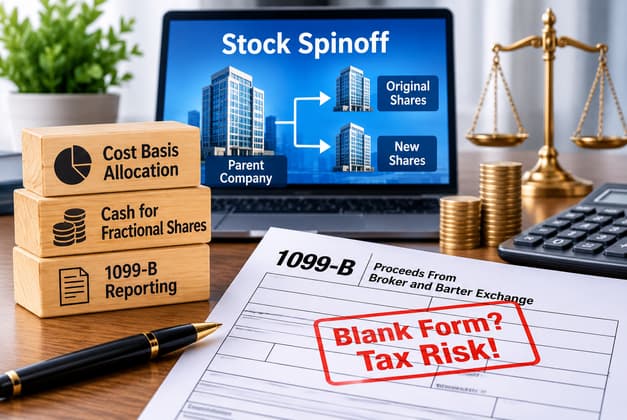
- Receiving spinoff shares is usually not taxable.
- Your original cost basis is split between the old and new shares by their market values, not by share count. The total doesn’t change.
- The small cash payment for fractional shares is taxable, as a tiny sale.
- Your holding period carries over, so the new shares aren’t automatically short-term.
If your 1099-B shows a blank or $0 cost basis for spinoff shares, do not just accept it. You could pay tax on money that was never a gain.
Verified . Ratios and dates from company filings; basis percentages only from each company’s Form 8937.
Receiving the new shares. Splitting your basis.
Cash paid in lieu of a fractional share.
The basis you assign today decides that bill.
Spinoff Cost Basis Calculator
Enter each lot of parent shares you held on the record date. Use the parent percentage from the company’s Form 8937 if you have it; otherwise use first-day prices.
Lot 2 (optional)
Lot 3 (optional)
“1 for X” means divide 1 by X: 1 for 2 = 0.5; 1 for 25 = 0.04; 1 for 3 = 0.3333. You can also type “1 for 25”.
Your results
What Actually Happened to Your Shares
A company you owned split off one of its businesses into a new public company and handed you shares of it, so you now hold two stocks where you had one.
Record date, distribution date, and the two ways to trade
The record date decides who gets the new shares. The distribution date is when they land in accounts.
Between those dates the parent often trades two ways. Comcast’s notice explained that selling CMCSA “regular-way” after the record date also sold your right to the Versant shares. Selling in the separate “ex-distribution” market kept that right.
The new stock may also trade early on a “when-issued” basis (Versant traded as VSNTV). Real trading under the permanent ticker is “regular-way” trading, and it usually starts the next business day. Not every spinoff has a when-issued market: Corteva said there would be none for Vylor.
Why the parent’s price dropped the same day
Part of the parent’s value walked out the door with the new company. A lower parent price on spinoff day is expected and is not a loss. Add the two stocks together to see what you really own.
Why a new ticker appeared, often with no basis
Your broker created a new position for the spinco shares. Many brokers show it with a blank or $0 basis until they apply the company’s numbers. That placeholder is the start of the problem this guide fixes.
If the parent was bought out instead of split up, see What happens when a company you own is bought out.
Is a Spinoff Taxable?
Usually not: most spinoffs are designed to be tax-free to shareholders under IRC §355, except for any cash paid instead of fractional shares.
Every 2025–2026 spinoff in our table was described by the company as intended to be tax-free for U.S. federal income tax purposes. FedEx, for example, said it received a private letter ruling from the IRS, and Comcast said it expected an opinion from its tax advisor.
The exception: a taxable spinoff
If a spinoff doesn’t qualify under §355, it’s treated as a distribution. You’d typically see it on a Form 1099-DIV, the new shares’ basis would generally be their fair market value when received, and their holding period would start fresh. That’s rare for large U.S. spinoffs, and it calls for a CPA.
| Question | Tax-free (§355), the usual case | Taxable spinoff, the exception |
|---|---|---|
| Tax on receipt | None, except cash for a fractional share | Value of shares is a distribution (dividend to the extent of earnings and profits) |
| Basis of new shares | A slice of your old basis, by relative market value | Generally the shares’ fair market value when received |
| Parent basis | Reduced by the slice moved to the spinco | Unchanged, unless part of the distribution is a return of capital (a CPA should confirm) |
| Form you get | Company posts a Form 8937; sales show on 1099-B | Form 1099-DIV, plus the company’s statement |
| Holding period | Carries over from the parent shares | Starts on the distribution date |
How to Split Your Cost Basis
Your total basis stays the same; you divide it between the parent and spinco shares in proportion to their market values on the spinoff date, lot by lot.
Relative market value, not share count
The rule comes from IRC §358 and Treas. Reg. §1.358-2. FedEx’s information statement puts it plainly: you allocate your old basis between the two stocks “in proportion to their relative fair market values” on the spinoff date.
Share count is irrelevant. In the S&P Global spinoff you got one Mobility Global share per S&P share, yet only 4.84% of your basis moved to Mobility Global, because it was worth far less per share.
The math, if you have prices:
Parent % = parent price ÷ (parent price + ratio × spinco price)
Spinco % = 100% − parent %
Form 8937 — and why the price method matters
After a spinoff, the parent company reports the basis effect on IRS Form 8937, usually posted on its investor-relations site with a percentage and a worked example. Companies generally must file or post it within 45 days of the action.
U.S. tax law doesn’t say exactly which price to use. Companies pick one: Comcast used closing prices on Versant’s first trading day; Aptiv used the average of the high and low on April 1, 2026; FedEx, Honeywell and S&P Global used volume-weighted average prices.
Neither you nor your broker is strictly bound by the company’s method. S&P Global’s form says so directly. In practice, though, brokers usually apply the Form 8937 figure, and it’s the sensible default unless your tax adviser has a reason to use another reasonable method.
The worked example (we’ll use it all the way through)
You own 101 shares of ParentCo in three lots. ParentCo spins off SpinCo at 1 for 2 (ratio 0.5) on June 1, 2026. Its Form 8937 says the parent keeps 80% of basis. (Hypothetical companies and numbers.)
| Lot | Shares and cost | Parent basis after (80%) | SpinCo shares due | SpinCo basis (20%) |
|---|---|---|---|---|
| 1 — bought Mar 10, 2019 | 40 shares, $2,000 | $1,600 ($40.00/share) | 20 | $400 ($20.00/share) |
| 2 — bought Aug 22, 2022 | 36 shares, $2,880 | $2,304 ($64.00/share) | 18 | $576 ($32.00/share) |
| 3 — bought Feb 3, 2026 | 25 shares, $2,500 | $2,000 ($80.00/share) | 12.5 (12 whole + 0.5 cash) | $500 ($40.00/share) |
| Total | 101 shares, $7,380 | $5,904 | 50 whole + 0.5 cash | $1,476 |
Lot by lot, never one average
Each lot gets the same percentage, but you apply it to that lot’s own cost. Each lot’s spinco shares keep that lot’s purchase date. Comcast’s form tells holders of multiple blocks to do the allocation “separately with respect to each such block,” and Honeywell’s says the same.
Averaging the three lots into one blended basis would mix long-term and short-term shares and give you wrong gains on every later sale.
Starting basis isn’t always what you paid. If the parent shares were inherited, start from the stepped-up basis (see Inherited stock cost basis). If they were a gift, the donor’s basis generally carries into both stocks (see Gifting stock to family).
Cash in Lieu of Fractional Shares
The small cash payment for a fractional share is taxable: you’re treated as if you received the fraction and sold it right away, so you report a tiny gain or loss.
The “deemed sale” math
Companies don’t issue fractional shares. The distribution agent bundles everyone’s fractions, sells them, and pays out the cash. IRS Publication 550 treats that cash as the amount realized on a sale of the fractional share.
The fraction carries basis like any other spinco share. DuPont’s Form 8937 shows it: a holder due 252.5 Qnity shares got 252 shares plus $48.89 for the half share, whose basis was $17.89, for a long-term gain of $30.99.
Our example
Lot 3’s SpinCo basis is $500 across 12.5 shares, or $40.00 per share. The half share’s basis is $20.00. You receive $14.00 cash.
Result: a $6.00 loss, short-term, because Lot 3 was bought February 3, 2026, less than a year before the June 1 spinoff. The 12 whole shares from Lot 3 keep $480 of basis.
If you’d entered $0 as the basis, you’d have reported a $14.00 gain instead of a $6.00 loss. Small, but it’s the same mistake that gets expensive on the whole position.
Why it shows up as a separate sale
Brokers usually report the cash as its own line on the 1099-B, often in the following weeks. Brokers generally aren’t required to file a 1099-B when a fractional-share sale brings in less than $20; the gain or loss is still reportable. If you held shares directly with the transfer agent, the form may come from the agent instead.
Your 1099-B: Blank, $0, or Wrong
A blank basis means “not reported,” not “zero”; you enter your correct basis on Form 8949 yourself.
Covered vs. non-covered shares
Brokers must report basis to the IRS only for “covered” shares. For stock, that generally means shares acquired after 2010 (after 2011 for mutual funds and dividend-reinvestment plans). Spinco shares that came from older, non-covered parent shares are generally non-covered too.
On the 1099-B, box 5 checked means non-covered. Box 12 checked means basis was reported to the IRS. Box 1e is the cost basis itself.
Why “$0” overstates your gain
Online threads sometimes suggest entering $0 when the basis box is blank. It’s an understandable shortcut, but it isn’t the rule. Gain is sale price minus basis; with $0, the entire sale price becomes gain.
If you already filed with $0, an amended return can usually fix it within the refund deadline. If the IRS sends a notice because the basis was missing, see CP2000 for missing cost basis.
Form 8949 boxes and codes
Per the IRS’s 2025 Form 8949 instructions (the latest final version when we checked; confirm against the 2026 revision before filing):
- Box A / D: basis shown and reported to the IRS (short-term / long-term).
- Box B / E: basis not shown or not reported to the IRS. Enter your correct basis in column (e).
- Box C / F: no 1099-B at all (for example, a cash-in-lieu sale under $20 that wasn’t reported).
- Wrong basis that was reported: enter the reported basis in column (e), code B in column (f), and the correction in column (g).
- Boxes G–L are for digital assets and don’t apply to spinoff stock.
| 1099-B shows | What it means | What to enter | Form 8949 box |
|---|---|---|---|
| Basis reported and correct (box 12 checked) | Broker applied the allocation | The amounts as shown; no adjustment | A (short) / D (long); may qualify to go straight to Schedule D |
| Basis reported but wrong | Wrong allocation, or $0 placeholder sent to the IRS | Reported basis in (e), code B in (f), correction in (g) | A / D |
| Basis not reported / blank (box 5 may be checked) | Non-covered shares, or records didn’t transfer | Your correct basis in (e) | B / E |
| Cash-in-lieu line | The deemed sale of your fractional share | The fraction’s basis (never $0); same term as the original lot | A/D if basis reported; B/E if blank; C/F if no 1099-B |
Your Holding Period Carries Over
Spinco shares inherit the holding period of the parent shares they came from, so they can be long-term on day one.
This is called “tacking.” Under IRC §1223(1), a §355 distribution is treated as an exchange, and the regulations say the holding period of the parent stock is included (Treas. Reg. §1.1223-1).
In the example, SpinCo shares from Lots 1 and 2 are long-term immediately. The 12 shares from Lot 3 are short-term until they’ve been held more than a year from February 3, 2026, so they turn long-term if sold on or after February 4, 2027.
Check that your broker shows the original purchase dates on the spinco shares, not the spinoff date. A reset date can turn a long-term gain into a short-term one. For rates, see Capital gains tax.
Spinoff + Reverse Split on the Same Day: The Honeywell Case
Do the spinoff allocation first, then apply the reverse split: the split halves your HON share count and doubles the per-share basis, but the total doesn’t move.
On June 29, 2026, Honeywell distributed one Honeywell Aerospace (HONA) share for every two HON shares held on the June 15 record date. The same day it completed a 1-for-2 reverse split of HON, which now operates as Honeywell Technologies, under a new CUSIP (438516205).
Honeywell’s Form 8937 allocates 51.2909% of basis to HON and 48.7091% to HONA, using June 29 volume-weighted prices of $234.21 (HON, split-adjusted) and $222.42 (HONA).
The company’s own example, step by step
- Start: 100 HON shares bought at $100, total basis $10,000.
- Spinoff: you receive 50 HONA shares. HONA basis = $4,870.91 (about $97.42 per share). HON basis = $5,129.09.
- Reverse split: 100 HON shares become 50. HON basis stays $5,129.09, now about $102.58 per share instead of $51.29.
Fractional HON shares from the split were also sold for cash, so some holders got two tiny cash sales: one for HONA, one for HON. Each needs its own basis. The calculator above handles both if you choose the 1-for-2 option.
For how reverse splits work in general, see Reverse stock split.
The 2025–2026 Spinoffs
Here are the ratios, dates and Form 8937 basis percentages for the major recent spinoffs, copied from each company’s own documents.
| Parent → Spinco (ticker) | Ratio | Record date | Distribution date | % basis kept by parent (Form 8937) | Where to find the 8937 |
|---|---|---|---|---|---|
| Honeywell → Solstice Advanced Materials (SOLS) | 1 for 4 (0.25) | Oct 17, 2025 | Oct 30, 2025 | 94.1874% (SOLS 5.8126%) | Honeywell Form 8937 attachment |
| DuPont → Qnity Electronics (Q) | 1 for 2 (0.5) | Oct 22, 2025 | Nov 1, 2025 | 41.11% (Qnity 58.89%) | DuPont Form 8937 |
| Comcast → Versant Media Group (VSNT) | 1 for 25 (0.04) | Dec 16, 2025 | Jan 2, 2026, after the close (regular-way Jan 5) | 94.55% (Versant 5.45%) | Comcast Form 8937 |
| Aptiv → Versigent (VGNT) | 1 for 3 (0.3333) | Mar 17, 2026 | Apr 1, 2026 | 86.55% (Versigent 13.32% + fractional share 0.13%) | Aptiv Form 8937 (signed Apr 23, 2026) |
| FedEx → FedEx Freight (FDXF) | 1 for 2 (0.5) | May 15, 2026 | Jun 1, 2026 | 81.55% (FedEx Freight 18.45%); FedEx kept 19.9% of FDXF | FedEx Form 8937 |
| Honeywell → Honeywell Aerospace (HONA) | 1 for 2 pre-split HON (0.5) | Jun 15, 2026 | Jun 29, 2026, then HON 1-for-2 reverse split | 51.2909% (HONA 48.7091%) | Honeywell Form 8937 attachment |
| S&P Global → Mobility Global (MBGL) | 1 for 1 (1) | Jun 15, 2026 | Jul 1, 2026 | 95.16% (Mobility Global 4.84%) | S&P Global Form 8937 |
| Resideo → ADI Global Distribution (ADIG) | 1 for 2 (0.5) | Jul 20, 2026 | Aug 3, 2026 (regular-way Aug 4) | Form 8937 not yet posted — check IR page | Resideo investor relations |
| Corteva → Vylor (VYLR) | 1 for 1 (1) | Sep 24, 2026 | Oct 1, 2026 | Form 8937 not yet posted — check IR page | Corteva investor relations |
Enter the ratio in decimal form in the calculator, and use the parent percentage from this table as method (a). For Aptiv, enter 86.55.
Sell or Keep? What the Data Can and Can’t Tell You
No rule says spinco shares should be sold or kept; that depends on the business and your situation, and this guide doesn’t make that call.
Commonly cited reasons new spinco shares are volatile early
- Index changes. A commonly cited reason is that some index funds must sell a spinco that doesn’t fit their index, while others must buy. This is a tendency, not a rule.
- Mismatched shareholders. Investors who chose the parent didn’t choose the spinco, and some sell it.
- Small positions. A 1-for-25 ratio can leave a holder with a few shares that are easier to sell than to track.
Questions worth asking yourself
- Would I buy this business today at this price if I didn’t already own it?
- How large is the new position compared with the rest of my portfolio?
- Which of my spinco shares are long-term and which are short-term?
- Is my basis correct at the broker before I sell anything?
Tax angles
Selling a lot at a loss and buying the same stock back within 30 days can trigger the wash sale rule. To see what a loss sale would save, try the Tax-loss harvesting calculator.
Spinoffs Still Coming
Of the separations announced for 2026, two finished, one is paused, and one changed shape. Status as of November 14, 2026; no predictions.
- Corteva → Vylor: completed October 1, 2026 (now in the table).
- Resideo → ADI Global Distribution: completed August 3, 2026 (now in the table).
- Kraft Heinz: on February 11, 2026, the company paused its planned split into two companies and gave no end date for the pause.
- Eaton (Mobility business): first announced as a spin-off. Eaton’s latest quarterly report describes a plan to combine Mobility with Dana through an exchange offer, which is a voluntary split-off, not a pro rata spinoff. Eaton says it would do a spin-off if that deal doesn’t close. An exchange offer has its own basis rules; read the offer documents when they arrive.
Before You File: Spinoff 1099-B Checklist
Run these seven steps for every spinoff in your account before you file.
- Find the spinco and the parent on your 1099-B. Note whether basis is marked reported or not reported to the IRS.
- Download the company’s Form 8937 from its investor-relations page. Save it with your tax records.
- Check your broker’s spinco basis against the calculator. Small differences from price methods are normal; a $0 or blank is not.
- Find the cash-in-lieu line (often a separate tiny sale). Give it a basis.
- Confirm the acquisition date shown for the spinco shares matches your original parent lot.
- If the basis is blank or wrong, report the correct basis on Form 8949: Box B/E when basis wasn’t reported; Box A/D with code B and an adjustment when a wrong basis was reported.
- Keep everything: trade confirmations, the Form 8937, your calculation. If the IRS sends a CP2000, these are your proof (CP2000 guide).
Large holders only: shareholders who owned at least 5% of a public parent (or certain other “significant distributees”) must attach a statement under Treas. Reg. §1.355-5. This does not apply to most individual investors.
| Mistake | What it costs | What to do instead |
|---|---|---|
| Entering $0 basis | The whole sale price is taxed as gain | Use the Form 8937 allocation; report it in column (e) |
| Splitting by share count | Wrong basis in both stocks (a 1-for-1 spin isn’t 50/50) | Split by relative market value |
| One average instead of lot by lot | Wrong gains and mixed-up holding periods | Apply the percentage to each lot separately |
| Resetting the purchase date | Long-term gains taxed as short-term | Carry each lot’s original date to its spinco shares |
| Ignoring cash in lieu | An unreported sale the IRS may match | Report it with the fraction’s basis |
| Using “when-issued” prices | A percentage that doesn’t match the company’s or your broker’s | Use the Form 8937, or regular-way prices from the date it names |
FAQ
Do I pay taxes when I receive spinoff shares?
Usually not. Most spinoffs are designed to be tax-free under IRC §355, so receiving the new shares isn’t income. The exception is any cash paid for a fractional share, which is treated as a small sale. The company’s Form 8937 confirms how it treated the spinoff.
How do I calculate cost basis after a spinoff?
Multiply each lot’s original basis by the parent percentage on the company’s Form 8937; the rest goes to the new shares. Without a percentage, use first-day prices: parent price ÷ (parent price + ratio × spinco price). Do it separately for every lot.
Where do I find Form 8937?
On the parent company’s investor-relations website, usually under a tax information, cost basis or spin-off page. Companies generally post it within 45 days of the spinoff. Search the site for “8937” plus the spinoff’s name. Our table links every one we found.
Do I attach Form 8937 to my tax return?
No. Form 8937 is the company’s report, not yours. Download it, keep it with your tax records, and use its numbers to check your broker. A separate statement is required only from very large holders, such as owners of 5% or more of a public parent.
Is cash in lieu of fractional shares taxable?
Yes. It’s treated as if you received the fractional share and sold it immediately. Your gain or loss is the cash minus the basis allocated to that fraction, usually a few dollars either way. It’s short- or long-term based on your original purchase date.
What basis do I use for the fractional share?
Its share of the spinco basis. Divide the lot’s spinco basis by all the spinco shares that lot was entitled to, including the fraction, then multiply by the fraction. In our example: $500 ÷ 12.5 = $40 per share, so the half share’s basis is $20. Never zero.
Why does my 1099-B show no cost basis for my spinoff shares?
Usually because the parent shares were non-covered (generally bought before 2011), so the broker doesn’t have to report basis, or because records didn’t transfer between brokers. Sometimes the broker simply hasn’t applied the Form 8937 yet. Blank means unknown, not zero.
What happens if I report $0 cost basis?
You report the whole sale price as gain and overpay. Selling 50 shares for $1,500 with a real basis of $1,456 is a $44 gain; at $0 it’s a $1,500 gain. An amended return can usually fix it within the refund deadline. See our CP2000 guide.
Which Form 8949 box do I use?
Basis reported to the IRS: Box A (short-term) or D (long-term). Basis not reported or blank: Box B or E. No 1099-B at all, like a tiny unreported cash-in-lieu payment: Box C or F. These come from the 2025 instructions; confirm them in the 2026 revision.
Does my holding period carry over?
Yes. Spinco shares take the holding period of the parent shares they came from, so shares from a lot bought years ago are long-term immediately. Shares from a lot bought within the past year stay short-term until that lot has been held more than one year.
I bought the parent at different times — how do I split each lot?
Apply the same percentage to each lot’s own basis, and give each lot’s spinco shares that lot’s purchase date. Don’t blend your lots into one average. Comcast’s and Honeywell’s own Forms 8937 tell holders of multiple blocks to allocate block by block.
Why is my broker’s number slightly different from Form 8937?
Brokers may use a different price (closing price versus volume-weighted average), round differently, or apply the Form 8937 a little later. A difference of a few cents per share is normal. A blank, a $0, or a basis far from the calculator’s result is not.
What if I inherited the parent shares?
Start with your inherited basis, usually the fair market value on the date of death (the step-up), not the original owner’s cost. Then split it by the Form 8937 percentage as usual. Inherited stock is generally treated as long-term. See our inherited stock cost basis guide.
How did the Honeywell reverse split affect my basis?
It didn’t change your total. First the spinoff moved 48.7091% of your HON basis to HONA. Then every two HON shares became one, so the remaining HON basis covers half as many shares. In Honeywell’s example, per-share basis went from about $51.29 to $102.58.
What was the Versant distribution ratio?
One Versant (VSNT) share for every 25 Comcast shares held on the December 16, 2025 record date, or 0.04 per share. The distribution happened after the close on January 2, 2026. Comcast’s Form 8937 allocates 94.55% of basis to Comcast and 5.45% to Versant.
What was the FedEx Freight ratio?
One FedEx Freight (FDXF) share for every two FedEx shares held on the May 15, 2026 record date. The spinoff took effect June 1, 2026. FedEx’s Form 8937 allocates 81.55% of basis to FedEx and 18.45% to FedEx Freight. FedEx itself kept 19.9% of FDXF.
Does selling the parent right after the spinoff trigger a wash sale?
Not just because you received spinco shares; the spinco is a different company, not substantially identical stock. But if you sell the parent at a loss and buy parent shares back within 30 days before or after, the wash sale rule can apply. See our wash sale guide.
Is a spinoff the same as a stock split?
No. A split gives you more, or fewer, shares of the same company. A spinoff gives you shares of a different company, and your basis is divided between two stocks by market value. Honeywell did both on June 29, 2026, which is why that case needs two steps.
Sources
- IRS: Instructions for Form 8949 (2025); Publication 550 (2025), “Fractional shares”; Instructions for Form 8937.
- Regulations: Treas. Reg. §1.1223-1 (holding period in §355 distributions); Treas. Reg. §1.355-5 (significant distributees).
- Issuer documents: Forms 8937 linked in the table; Comcast cost basis guide; FedEx Freight information statement (SEC EDGAR); Honeywell Technologies release of June 29, 2026; Resideo release of August 4, 2026; Corteva Form 8-K of September 29, 2026; Eaton Form 10-Q for the quarter ended September 30, 2026.
Last updated: . We’ll re-check in late January 2027, when brokers issue 1099-Bs, and add each new Form 8937 as it posts.
Disclaimer: This article is general information, not tax or investment advice, and it does not recommend buying, selling or holding any security. Issuer ratios, dates and Form 8937 percentages were verified on November 14, 2026. Your broker’s reported figures and your own records govern your return. Consult a CPA for non-covered lots, taxable spinoffs, inherited or gifted positions, and holdings of 5% or more.

Daniel Hayes is the founder and sole researcher at AdvoraHQ. He covers U.S. personal finance, insurance, and consumer law — working directly from IRS publications, federal and state statutes, court opinions, and SEC filings rather than secondary summaries. His focus is the gap between what readers think they know and what the source documents actually say. Daniel is not a licensed attorney, CPA, or financial advisor; his articles are educational and not personalized advice. Reach him at Daniel.Hayes@advorahq.com.
