
Likely fine to file now if:
- You’re within 90 days of your 3- or 5-year date.
- You meet physical presence.
- No trip abroad over 6 months.
- No arrests.
- Taxes filed every year.
Talk to a lawyer first if:
- Any arrest or citation (even expunged).
- A trip of 6+ months.
- Unfiled or unpaid taxes.
- You ever voted or claimed citizenship.
- A pending I-751.
- A Selective Service gap.
Check your earliest filing date, your fee, and your risk flags →
- The fee
- Earliest date
- The new test
- Senior exceptions
- Wait times
- Why denials rose
- Documents
- Delayed after interview
- FAQ
Fees and rules verified . Check uscis.gov/g-1055 before you file.
Citizenship Readiness & Cost Check
This free check estimates your earliest filing date, your fee, your test, and which risk flags apply. Answers stay on this page. Nothing is saved or sent. Do not enter your A-number, Social Security number, or name.
The Fee: What You Pay Now and What’s Proposed
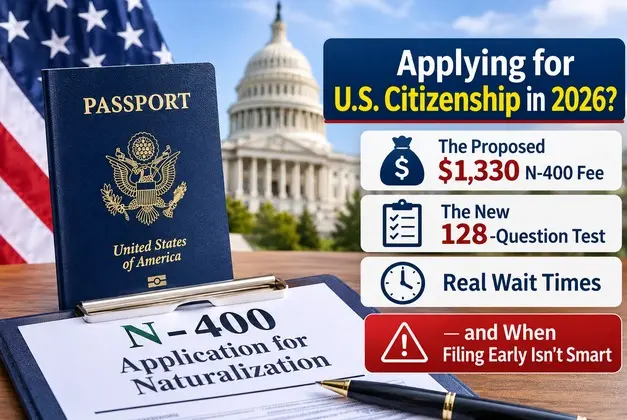
Today the N-400 costs $710 online or $760 on paper, and the higher fee DHS proposed in June 2026 is not in effect.
Those fees include biometrics (since April 2024). Two lower options exist today, and both require a paper filing.
- Reduced fee, $380: household income above 150% and up to 400% of the Federal Poverty Guidelines.
- Fee waiver, $0: Form I-912, if you get a means-tested benefit, earn at or below 150% of the guidelines, or face a financial hardship.
- Military applicants, $0: filing under INA §328 or §329.
| Filing type | Now | Proposed |
|---|---|---|
| Online | $710 | $1,280 |
| Paper | $760 | $1,330 |
| Reduced fee | $380 | Eliminated |
| Fee waiver | $0 | Eliminated |
| Military | $0 | $0 (exemption stays; required by statute) |
The proposal, in dates
- June 23, 2026: DHS published “Naturalization Application Fee Adjustments” in the Federal Register (91 FR 37500; docket USCIS-2026-0265; RIN 1615-AD08). A correction followed on July 8, 2026 (91 FR 42144).
- August 24, 2026: the public comment period closed.
- November 1, 2026: we found no final rule and no announced effective date.
What would change
The N-400 fee would rise by $570. The $380 reduced fee would end. Fee waivers would end for the N-400 and for the N-336, the form used to ask for a hearing after a denial. The proposal would also raise the N-336 fee to $1,425 online or $1,475 on paper.
Military fee exemptions would stay, because the law requires them.
Why “proposed” matters
After reading comments, DHS can change the amounts, keep parts of the current system, or issue the rule as written. No one outside DHS can say which, or when.
Under earlier fee rules, USCIS charged the fee in effect on the day it received a filing. A final rule would say whether that holds, so read its transition language when it is issued.
That is why the honest advice is not “file now.” It is: file when your own dates and record are ready. If they already are, today’s fee is a fact. A higher fee is only a possibility.
Your move: find your category in the check above, then confirm your fee on the USCIS fee schedule on the day you file.
Are You Eligible — and When Can You File?
Most green card holders can apply after 5 years, or after 3 years if married to and living with a U.S. citizen, and you may file up to 90 days early.
| Path | Years as resident | Physical presence | Early filing | Key extra rule |
|---|---|---|---|---|
| 5-year (INA §316) | 5 years | 30 months (913 days) | Up to 90 days before the 5-year date | Continuous residence; 3 months in your state or USCIS district. |
| 3-year (INA §319) | 3 years | 18 months (548 days) | Up to 90 days before the 3-year date | Married to and living with your U.S. citizen spouse for those 3 years, and your spouse a citizen for those 3 years. |
| Military (INA §328, §329) | Different rules | Different rules | Different rules | No filing fee. Ask a military legal office. |
You must also be 18 or older, show good moral character, pass the English and civics tests, and be attached to the principles of the Constitution.
On the 3-year path, both clocks must run: your time as a resident and your spouse’s time as a citizen. Read the marriage green card timeline if you are still planning your dates.
Physical presence vs. continuous residence
These are two different tests, and people mix them up.
- Physical presence counts days you were actually inside the U.S.: 913 days on the 5-year path, 548 on the 3-year path.
- Continuous residence asks whether you kept your life here. A trip under 6 months generally does not break it. A trip of 6 to 12 months creates a presumption that it broke, which you can try to rebut with proof (job, home, taxes, family). A trip of 1 year or more generally breaks it.
You also need 3 months of residence in your state or USCIS district before you file.
The 90-day early rule, with a worked example
Say your green card shows “Resident Since” February 10, 2022. Your 5-year date is February 10, 2027. Subtract 90 days, and your earliest filing date is November 12, 2026.
Filing before that date can lead to rejection or denial. Do not file ahead of the window.
For physical presence, a 5-year period is about 1,826 days. If you were abroad 400 days in total, you were here about 1,426 days. That is well above 913.
A pending I-751
If you are a conditional resident with an I-751 pending, talk to a lawyer before you file an N-400. USCIS generally has to resolve the I-751 first. See I-751 waiver after divorce and divorce and deportation risk.
Your move: write down your “Resident Since” date, then run the check above. Pull your passport stamps before you trust any day count.
File Now or Wait? The Honest Answer
If your record is clean and your dates work, filing within the 90-day window at today’s fee is reasonable. If any risk flag applies, get legal advice before you pay.
When filing early is smart
- You are within 90 days of your 3- or 5-year date, or past it.
- Your day count clears 913 (or 548) with room to spare.
- You have no arrest, citation, long trip, or tax problem.
- You can document every trip and every tax year.
When it is risky
- You have a flag from the list at the top of this article.
- You are guessing at trip dates or tax years.
- You are filing only to beat a possible fee change, with no clean record behind you.
- You are more than 90 days from your date. The application can be rejected or denied.
What a denial costs
USCIS fees are generally not refunded. After a denial, you can ask for a hearing with an N-336 (proposed to rise to $1,425 online or $1,475 on paper), or you can refile and pay the fee in effect then.
An N-400 also asks USCIS to look at your whole record. If something in it could affect your green card itself, such as certain convictions or long absences, a lawyer should review it before you file.
A one-time consult usually costs less than a lost filing fee. See what immigration lawyers charge.
Your move: if no flag applies, set your filing date. If one does, book a consult first and file after.
The 2025 Civics Test
If you filed on or after October 20, 2025, you take the 2025 test: an officer asks up to 20 of 128 questions, and you need 12 right.
2008 test (filed before Oct. 20, 2025)
- Bank of 100 questions.
- Up to 10 asked.
- 6 correct to pass.
- 65/20: 10 of 20 starred, 6 to pass.
2025 test (filed on or after Oct. 20, 2025)
- Bank of 128 questions.
- Up to 20 asked.
- 12 correct to pass.
- 65/20: 10 of 20 starred, 6 to pass.
| Feature | 2008 test | 2025 test |
|---|---|---|
| Question bank | 100 | 128 |
| Questions asked | Up to 10 | Up to 20 |
| Correct to pass | 6 | 12 |
| 65/20 | 10 of 20 starred, 6 to pass | 10 of 20 starred, 6 to pass |
| Who takes it | N-400 filed before October 20, 2025 | N-400 filed on or after October 20, 2025 |
How the officer scores it
The test is oral. The officer stops as soon as you reach 12 correct answers (pass) or 9 wrong answers (fail).
You will also read and write a short sentence in English, and the officer judges your speaking during the interview. Study with the official USCIS study materials.
If you fail
You get one retest of the part you failed, at a second interview about 60 to 90 days later. If you fail again, USCIS denies the application. You can refile and pay a new fee.
Your move: practice out loud, not only by reading. Time yourself on 20 questions at a stretch.
Exceptions for Older Applicants and Disabilities
Three age-and-residence exceptions can excuse the English test or shorten the civics test, and a medical form can excuse both for a disability.
- 65/20: age 65 or older and 20 years or more as a permanent resident. You study the 20 starred questions. The officer asks 10, and you need 6. You may take the test in your language. English is excused.
- 50/20: age 50 or older and 20 years or more as a resident. English is excused. You take the civics test in your language.
- 55/15: age 55 or older and 15 years or more as a resident. English is excused. You take the civics test in your language.
For 50/20 and 55/15, the civics test is the regular 2025 test (up to 20 questions, 12 to pass), not the shorter one. You generally bring your own interpreter.
Your age and years as a resident are measured on the day you file.
Disability exception
If a medical condition keeps you from learning English or civics, a licensed medical professional can complete Form N-648. Officers read it closely, so ask your doctor to be specific about how the condition limits you.
Your move: count your years from your “Resident Since” date, not from your first visit to the U.S.
How Long It Takes in 2026
USCIS reports a national median of 9.5 months for regular N-400 cases decided from April to June 2026, and some field offices take longer.
| Measure | Figure | Period | Source |
|---|---|---|---|
| Applications received (regular N-400) | 140,179 | Apr–Jun 2026 (FY2026 Q3) | USCIS quarterly N-400 data |
| Approvals | 54,974 | Apr–Jun 2026 | USCIS quarterly N-400 data |
| Approvals, same quarter a year earlier | 236,924 | Apr–Jun 2025 | USCIS quarterly N-400 data |
| Denials | 12,591 | Apr–Jun 2026 | USCIS quarterly N-400 data |
| Pending at quarter end | 727,371 | June 30, 2026 | USCIS quarterly N-400 data |
| Median time to a decision | 9.5 months | Cases decided Apr–Jun 2026 | USCIS quarterly N-400 data |
| Median time, military cases | 2.6 months | Cases decided Apr–Jun 2026 | USCIS quarterly N-400 data |
| Average processing time reported | 12.7 months | August 2026 | USCIS monthly data, as reported |
USCIS decided far fewer cases in that quarter than a year earlier, while new filings kept arriving. The data do not say why.
Wait times and outcomes differ a lot by field office. Check yours instead of relying on the national number.
The usual stages
- Receipt notice after you file.
- Biometrics appointment (fingerprints and photo).
- Interview notice.
- Interview, English test, and civics test.
- Decision: approved, more evidence requested, or denied.
- Oath ceremony. You become a citizen when you take the oath.
If your case is past the processing time posted for your field office, you can submit a case inquiry through your USCIS online account.
Your move: look up your field office’s time today and save a screenshot with the date.
Why More Applications Are Denied
Denials come from problems in your whole record, not only from missed test questions, so most of the work happens before you file.
In April to June 2026, USCIS denied 12,591 regular N-400 applications and approved 54,974. That is about 19 of every 100 decisions (12,591 of 67,565). Published analyses of the same quarterly data report that approvals made up a smaller share of decisions than a year earlier.
Good moral character is judged as a whole
A USCIS memo of August 15, 2025 (PM-602-0188) tells officers to weigh the totality of your circumstances, not just a checklist. Your statutory period is 5 years (3 on the marriage path), but older conduct can still be considered.
Neighborhood and workplace checks
USCIS resumed neighborhood investigations in August 2025 (PM-602-0189) and wrote them into the Policy Manual on August 25, 2026 (Policy Alert PA-2026-10, Volume 12, Part B, Chapter 2). Officers may contact neighbors, employers, and others to check what you wrote on your N-400.
USCIS can waive the check in a case. Character letters you submit with your application are one thing it may weigh. Submit evidence because it helps your case, not out of worry.
Travel, taxes, voting, and Selective Service
- Travel: long trips can break continuous residence. Keep a trip list with exact dates.
- Taxes: file every required return. If you owe, be on a payment plan and keep proof. Get free IRS transcripts. To build a clean money record, see how to build U.S. credit as an immigrant.
- Voting and false claims: unlawful voting and false claims to U.S. citizenship are serious bars. Even a mistaken voter registration needs a lawyer’s review before you file.
- Selective Service: men who lived in the U.S. between ages 18 and 26 had to register. If you did not, ask for a status information letter. Between ages 26 and 31, USCIS may ask for the letter and a statement that the failure was not knowing and willful. At 31 or older, failure to register is generally not a bar. Disclose it anyway.
| Issue | Why it matters | What to do before filing |
|---|---|---|
| Arrest, charge, or citation (even expunged) | Officers review the full record and your honesty about it. | Get certified court dispositions. See a lawyer. |
| Trip of 6+ months | May break continuous residence. | List dates. Gather proof you kept your home, job, and taxes here. |
| Unfiled or unpaid taxes | Can count against good moral character. | File missing returns. Set up a payment plan. Keep IRS transcripts. |
| Voting or claiming citizenship | A serious bar in many cases. | See a lawyer before filing. |
| Selective Service gap | Matters if the failure was knowing and willful. | Request a status information letter. Prepare a statement. |
| Failing English or civics | Two tries, then denial. | Practice out loud. Know your exception, if any. |
| Answers that do not match your forms | Raises doubt about your honesty. | Re-read your N-400 line by line before the interview. |
Your move: pull your tax transcripts, your trip dates, and any court records now. Do it before you fill out the form.
Your Interview, Step by Step
At the interview, an officer goes through your N-400 with you under oath, tests your English and civics, and tells you what happens next.
- Arrive early with your notice, photo ID, green card, and passport.
- Swear to tell the truth.
- The officer reviews your N-400 answers, line by line. Your spoken answers must match the form.
- You take the English and civics tests.
- The officer decides, asks for more evidence, or sets a retest.
- If approved, you take the oath on the same day or at a later ceremony.
N-400 Document Checklist
Bring originals and one set of copies of everything below that applies to you.
- Green card (front and back); passport(s) and any travel documents.
- Trip list for the statutory period: dates out and back. Check your passport stamps, and request your travel history if you are unsure.
- Tax transcripts for the statutory period (IRS, free), and proof of any payment plan.
- Marriage certificate, proof of your spouse’s citizenship and the date, and joint-life evidence (3-year path).
- Certified court dispositions for any arrest or citation, even if dismissed or expunged.
- Selective Service status, or a status information letter.
- Fee-waiver or reduced-fee proof (benefit letter, tax return).
- The 2025 list of 128 questions (or the 20 starred questions for 65/20). Practice speaking and writing.
- Copies of everything you submit, plus your receipt notice.
Your move: start the document folder today, even if your filing date is months away.
Still No Decision After Your Interview?
If USCIS has not decided your case more than 120 days after your interview, you may be able to ask a federal court to act.
- Check the processing time for your field office, then submit a case inquiry through your USCIS online account.
- Ask your U.S. representative’s or senator’s office to send a casework inquiry to USCIS.
- After 120 days, talk to an immigration attorney about a lawsuit under 8 U.S.C. §1447(b).
Under that law, a federal district court can decide the application itself or send it back to USCIS with instructions.
The 120 days run from the examination, which is your interview. Courts have differed on when the examination is finished, with some treating it as open until background checks are done. That timing is a legal question, so use an attorney.
Your move: write down your interview date and the date 120 days later, and keep every notice.
Special Situations
A few common situations change the steps, even though the main rules stay the same.
- Expired green card while you wait: naturalizing and renewing can overlap. See expired green card.
- Conditional residents: check your I-751 first. See I-751 waiver after divorce.
- Public benefits: a benefit you qualified for does not by itself block naturalization, and a means-tested benefit can support a fee waiver today. Giving false information to get one can cause serious problems. See public charge in 2026.
- Military service: special rules under INA §328 and §329 apply, with no filing fee. USCIS reported a 2.6-month median for military cases in April to June 2026.
- Children: many children under 18 with a green card, living with a citizen parent, become citizens automatically. Check USCIS guidance on Form N-600 for your child’s case.
Your move: if your situation is on this list, read that article before you file.
FAQ
How much does U.S. citizenship cost in 2026?
The N-400 costs $710 online or $760 on paper. A $380 reduced fee and a $0 fee waiver exist for qualifying applicants who file on paper. Military applicants pay nothing. DHS has proposed higher fees, but the proposal is not final.
When will the N-400 fee increase take effect?
There is no effective date. DHS proposed the rule on June 23, 2026, and comments closed August 24, 2026. As of November 1, 2026, we found no final rule. A higher fee applies only after a final rule is published and takes effect.
Can I still get a fee waiver?
Yes, today. File Form I-912 with a paper N-400 if you get a means-tested benefit, earn at or below 150% of the poverty guidelines, or face a hardship. The proposal would end waivers for the N-400 and N-336, but it is not final.
When can I apply for citizenship?
Usually after 5 years as a permanent resident, or 3 years if you are married to and living with a U.S. citizen who has been a citizen for those 3 years. You must also be 18 or older and have lived 3 months in your state or district.
What is the 90-day early filing rule?
You may file up to 90 days before you complete the 5-year or 3-year requirement. Filing earlier than that can lead to rejection or denial.
What’s the difference between continuous residence and physical presence?
Physical presence is the number of days you were inside the U.S.: 913 on the 5-year path, 548 on the 3-year path. Continuous residence asks whether long trips broke your ties here. Trips of 6 to 12 months raise a presumption of a break. Trips of 1 year or more generally break it.
How many questions are on the new citizenship test?
The 2025 test has a bank of 128 questions. The officer asks up to 20, out loud. It applies if you filed your N-400 on or after October 20, 2025.
How many do I need to get right?
You need 12 correct. The officer stops when you reach 12 right answers or 9 wrong ones.
What is the 65/20 exception?
If you are 65 or older and have been a permanent resident for 20 years or more, you study 20 starred questions. The officer asks 10, and you need 6 right. English is excused.
Can I take the test in my language?
If you qualify for 65/20, 50/20, or 55/15, yes. You take the civics test in your language and skip the English test. Everyone else takes the tests in English.
What happens if I fail?
You get one retest of the part you failed, at a second interview about 60 to 90 days later. If you fail again, USCIS denies the application. You can refile with a new fee.
How long does citizenship take in 2026?
The national median for regular cases decided in April to June 2026 was 9.5 months. USCIS reported an average of 12.7 months in August 2026. Some field offices take 15 months or more. Check the processing times tool for your office.
Why is my N-400 taking so long?
USCIS had 727,371 regular N-400 cases pending on June 30, 2026, and it decided fewer cases than a year earlier. Extra review, such as a neighborhood investigation, can add time in some cases. If you are past the posted time, submit a case inquiry. If it has been more than 120 days since your interview, see the section above.
Why are citizenship applications being denied?
The main causes are issues in the full record: arrests or citations, long trips, tax problems, voting or false claims, Selective Service gaps, and answers that do not match. Failing the tests twice also leads to denial.
Does an expunged record show up?
Often, yes. The N-400 asks about arrests “ever,” and fingerprint checks can surface sealed or expunged records. Disclose it and bring certified court records.
Does USCIS check social media?
USCIS can consider publicly available information, including social media, when it reviews an application. It issued a policy alert on social media vetting in August 2025 (PA-2025-16). Assume anything public may be seen, and ask a lawyer if a post worries you.
Can I travel while my N-400 is pending?
Generally yes, but trips matter. A long trip can break continuous residence, and you must be here for your biometrics and interview. Talk to a lawyer before any trip of 6 months or more.
What if there’s no decision 120 days after my interview?
You may be able to ask a federal district court to decide your case or send it back to USCIS under 8 U.S.C. §1447(b). Use an immigration attorney for this step.
Last updated: . We will update this page the day a final fee rule is published.
This article is general information, not legal advice. Fees, rules, and processing data were verified on November 1, 2026 and are subject to change, including a pending fee rule. Consult an immigration attorney or a DOJ-accredited representative about your case.

Daniel Hayes is the founder and sole researcher at AdvoraHQ. He covers U.S. personal finance, insurance, and consumer law — working directly from IRS publications, federal and state statutes, court opinions, and SEC filings rather than secondary summaries. His focus is the gap between what readers think they know and what the source documents actually say. Daniel is not a licensed attorney, CPA, or financial advisor; his articles are educational and not personalized advice. Reach him at Daniel.Hayes@advorahq.com.