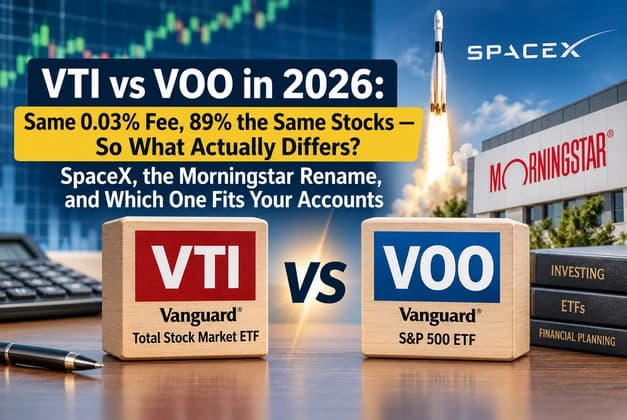
For most long-term investors, either is a reasonable core holding. The real question is which fits the accounts you already have.
See exactly what $1 of each buys →
Data checked November 3, 2026 from Vanguard fund documents (fact sheets dated September 30, 2026). Holdings and weights change daily.
What You Actually Own: A Dollar-by-Dollar Look
Enter an amount and pick a fund to see where the money goes. Every weight comes from the dated data note below the result.
What’s the Same: Issuer, Fee, and Most of the Stocks
VTI and VOO are both market-value-weighted Vanguard index ETFs with the same 0.03% fee, and about 89% of VTI’s weight sits in companies VOO also holds.
- SAME Issuer. Both are run by Vanguard and are the ETF share classes of larger Vanguard index funds.
- SAME Fee. Both charge 0.03% a year, about $3 on every $10,000 (Vanguard fact sheets, September 30, 2026). Our investment fees guide shows how small fees compound.
- SAME Biggest holdings. NVIDIA, Apple and Microsoft lead both funds, and the top ten names are nearly the same (Vanguard, September 30, 2026).
- SAME Weighting. Both give bigger companies bigger slices, based on the shares that actually trade. A small company gets a small slice in either fund.
- SAME Dividends. Both pay quarterly (Vanguard fact sheets).
- SAME Tax efficiency. Both are ETFs, a structure generally associated with low taxable distributions. Actual distributions vary by year, so check each fund’s history.
New to VOO? Start with how to invest in the S&P 500.
What’s Different: Mid- and Small-Cap Stocks
VTI holds about 3,000 more companies than VOO, but together they make up only about 11%–12% of the fund.
VTI
Vanguard Morningstar Total Stock Market ETF
- Index
- Morningstar US Total Market Index (formerly CRSP US Total Market)
- Fee
- 0.03%
- Holdings
- 3,519 stocks (index: 3,478)
- Outside the S&P 500
- About 11%–12% of the fund
- New big IPOs
- Fast: added after the 5th trading day
- Top-10 weight
- 36.1%
VOO
Vanguard S&P 500 ETF
- Index
- S&P 500 Index
- Fee
- 0.03%
- Holdings
- 505 securities (index: 503)
- Outside the S&P 500
- None, by design
- New big IPOs
- Slow: about 12 months, plus a profitability test
- Top-10 weight
- 40.6%
Holdings, fee and top-10 weight: Vanguard fact sheets, September 30, 2026. Outside-the-S&P share: estimate from SEC filings, March 31, 2026.
| Feature | VTI | VOO |
|---|---|---|
| Index | Morningstar US Total Market Index (formerly CRSP US Total Market) | S&P 500 Index |
| Official name | Vanguard Morningstar Total Stock Market ETF (formerly Vanguard Total Stock Market ETF) | Vanguard S&P 500 ETF |
| Fee | 0.03% | 0.03% |
| Holdings | 3,519 stocks (index: 3,478) | 505 securities (index: 503) |
| Mid-and-small-cap share outside the S&P 500 | About 11%–12% of the fund | None, by design |
| IPO inclusion | Fast: after the 5th trading day | Slow: about 12 months, plus a profitability test |
| Top-10 weight | 36.1% | 40.6% |
| Dividend schedule | Quarterly | Quarterly |
On September 30, 2026, VTI held 3,519 stocks and VOO held 505. The roughly 3,000 extra companies are mostly mid- and small-cap stocks outside the S&P 500.
They move the needle little because both funds weight by size. The ten largest holdings alone are 36.1% of VTI, so the other 3,500 or so companies share what is left.
The 11%–12% figure comes from an overlap analysis of the two funds’ SEC filings as of March 31, 2026 (ChartRow), which put the overlap near 89% by weight. Other trackers report anywhere from roughly 85% to 89%, depending on the date and method. For today’s figure, compare the two funds’ holdings files on Vanguard’s site.
SMALL DIFFERENCE It rarely changes results much in a single year. It matters mainly if you want mid- and small-cap exposure on purpose, or want to leave it out on purpose.
The 2026 Difference: SpaceX and Fast IPO Inclusion
VTI added SpaceX within days of its June 2026 IPO because its index fast-tracks big new listings, while VOO can’t add it until the S&P 500’s 12-month and profitability rules are met, which means mid-2027 at the earliest.
How it played out
- June 4, 2026. S&P Dow Jones Indices said it would keep the S&P 500’s eligibility rules, including the 12-month seasoning period and the profitability requirement, after a consultation on mega-cap IPOs. Nasdaq and FTSE Russell had moved the other way (Bloomberg).
- June 10. Vanguard said VTI, VXF and VT were expected to add SpaceX after the close of the fifth trading day after the IPO, with initial weights of 1% or less (as reported by Sapling).
- June 11–12. SpaceX priced its IPO at $135 and began trading on Nasdaq on June 12 under the ticker SPCX.
- June 18–23. The total market index added SpaceX. Reports put the index change on June 18, and Morningstar describes the fund’s first holding on June 23, so check Vanguard’s holdings history for the exact day.
- June 30. VTI held 18,738,438 SpaceX shares, worth about $3.2 billion and about 0.14% of the fund (Vanguard holdings, as reported by Morningstar and The Motley Fool).
- July 7. The Nasdaq-100 added SpaceX under its own 15-trading-day rule, at about a 1.3% weight (Morningstar). That index is covered in QQQ vs VOO.
Why such a small slice
VTI weights companies by the shares that can actually trade (the float). Only about 5% of SpaceX’s shares were available to the public at the IPO, so its index weight was a small fraction of its headline size.
That weight can grow as insiders’ shares are unlocked and sold, which Vanguard has said can raise the float over time. The 0.14% above is the latest dated figure I could confirm, so check Vanguard’s holdings page for today’s number.
The point here is index rules, not stock-picking. Whether the stock goes up or down, the weight in a total market fund stays modest.
How fast each index adds a big IPO
| Fund | Index | Inclusion timing | Profitability required? | Source |
|---|---|---|---|---|
| VTI | Morningstar US Total Market (formerly CRSP) | After the close of the 5th trading day after the IPO; float or liquidity screens apply | No profitability screen | Vanguard, June 10, 2026; Morningstar |
| VXF | S&P Completion Index | After the 5th trading day | Not stated in Vanguard’s summary | Vanguard, June 10, 2026 |
| VT | FTSE Global All Cap | After the 5th trading day | Not stated in Vanguard’s summary | Vanguard, June 10, 2026 |
| VOO | S&P 500 | About 12 months of seasoning, then committee selection | Yes: GAAP profitability test | S&P DJI, June 4, 2026 (via Bloomberg) |
| QQQ | Nasdaq-100 | After 15 trading days (Fast Entry) | Size-based test; no profitability test cited | Morningstar |
Two philosophies
CRSP’s fast-track rule has existed since 2017, and in late April 2026 CRSP added an alternative liquidity test so very large IPOs with low float can qualify. A new listing now needs either at least a 10% float or a float-adjusted value above a size threshold (about $3.3 billion as of March 2026, per Morningstar).
The S&P 500 works differently. It keeps its 12-month seasoning, its GAAP profitability test and its float minimum, and a committee still picks which eligible companies join. SpaceX has reported net losses, so even after June 2027 it would need to pass the profitability test.
Neither design is wrong. Fast inclusion keeps an index closer to the whole market sooner. Slow inclusion gives new companies a track record before index funds must hold them.
If other very large companies list in the future, the same rules would apply. OpenAI and Anthropic are often named in press coverage, but this article assumes no listing. Our guide to IPO shares covers the direct route; your index fund may already own the stock.
REAL DIFFERENCE This is the one structural change that can affect your choice, for those who care about how soon new listings enter their fund.
VTI’s New Name: What Changed (Nothing That Affects You)
Since July 29, 2026 the fund’s official name is Vanguard Morningstar Total Stock Market ETF, and the ticker, objective and holdings approach are unchanged.
- SAME Ticker and objective. The ticker is still VTI. Vanguard describes this as purely a name change, with no change to the investment objective, strategies or policies.
- SAME Method. Morningstar said the rebrand affects naming only and that index methodologies remain unchanged.
Here is the chain of events. Morningstar completed its acquisition of CRSP, the index provider behind VTI’s benchmark, in February 2026. On July 28, Morningstar finished rebranding the CRSP indexes as Morningstar Market Indexes.
On July 29, Vanguard added “Morningstar” to the names of several of its index funds. The benchmark, the CRSP US Total Market Index, became the Morningstar US Total Market Index. The mutual fund siblings were renamed too, so VTSAX is now Vanguard Morningstar Total Stock Market Index Fund Admiral Shares.
You don’t need to do anything. Your account statements and 1099s may show the new name. VOO was not renamed, because it tracks the S&P 500, which S&P Dow Jones Indices owns.
Older articles will still say CRSP. They’re describing the same index.
Concentration: How Much Rides on the Biggest Companies
The ten largest holdings are 36.1% of VTI and 40.6% of VOO, so both lean heavily on the same big companies.
| Company | VTI | VOO |
|---|---|---|
| NVIDIA | 7.1% | 8.4% |
| Apple | 6.6% | 7.4% |
| Microsoft | 5.2% | 5.8% |
| Alphabet (both share classes) | 4.9% | 5.5% |
| Amazon | 3.3% | 3.7% |
| Broadcom | 2.3% | 2.5% |
| Meta Platforms | 2.2% | 2.4% |
| Micron Technology | 1.6% | 1.8% |
| Tesla | 1.4% | 1.5% |
| Advanced Micro Devices | 1.4% | 1.5% |
| Top ten total | 36.1% | 40.6% |
VTI is only slightly less concentrated. Its mid- and small-cap slice is real but small, so it trims each top name’s weight by roughly 10%–15%. Technology also leads: VOO’s information technology sector was 39.7% of the fund on that date.
SMALL DIFFERENCE If top-heavy funds worry you, VTI trims the problem a little. It doesn’t remove it.
Performance, Without Chasing It
Through September 30, 2026, Vanguard reports VOO’s average annual returns a little ahead of VTI’s over one, five and ten years, but past performance doesn’t predict future results.
| Fund (inception) | 1-year | 5-year | 10-year | Since inception |
|---|---|---|---|---|
| VTI (May 24, 2001) | 15.33% | 12.56% | 14.70% | 9.44% |
| VOO (September 7, 2010) | 15.70% | 13.75% | 15.29% | 14.94% |
The gap ran from about 0.4 to 1.2 percentage points a year across those three periods. Don’t compare the “since inception” column directly. VTI’s starts in 2001 and includes the 2000s, while VOO’s starts in 2010.
Why did VOO lead? Large companies have driven much of the market’s gains in recent years, and VOO holds a larger share of them. VTI’s extra mid- and small-cap slice has lagged in that stretch. For example, an extended-market fund returned about 25% over five years against about 78% for VOO in one March 2026 comparison (24/7 Wall St).
That can reverse. Leadership has rotated before, and no one can say when it will again. A 5-year gap is a snapshot of one stretch, so don’t pick a fund based on last year’s return.
Which Fits Your Accounts
The right fit usually depends on what your 401(k) already holds, because that decides how much of the market you already cover.
Which Fits Your Accounts? A Quick Checker
Answer five questions to see options to consider. This isn’t advice.
401(k) and 403(b) limits
Most plans offer a short menu. Many include an S&P 500 fund, some include a total market fund, and many people hold only a target-date fund.
If your plan has a total market fund, you already own the whole U.S. market there. If it has only an S&P 500 fund, you cover large companies but not the roughly 11%–12% outside the index.
Many target-date funds, including Vanguard’s index-based ones, hold a total U.S. stock index fund inside them. Check yours. Our target-date funds guide explains what’s inside.
Combining VOO and VXF
If you want the full market and your 401(k) only has an S&P 500 fund, one option is VOO-like exposure in the 401(k) plus VXF in an IRA or taxable account. VXF tracks the S&P Completion Index, which holds U.S. stocks that are not in the S&P 500, and its fee is listed at 0.05%.
The mix that roughly matches the whole market is about 88.5% S&P 500 and 11.5% extended market, based on the SEC-filing overlap estimate above. Estimates run from roughly 85% to 89%, so treat it as a starting point.
At that mix the blended fee is about 0.03%. The two funds drift apart over time, so you would need to rebalance. VXF also adds big new IPOs after the fifth trading day, in line with VTI’s rule.
For help planning the pieces, see how to build an investment portfolio.
Roth IRA and traditional IRA
Inside an IRA, trades and fund distributions aren’t taxed in the year they happen, so the choice between VTI and VOO is about what you want to own. A Roth IRA’s tax-free growth is the same whichever fund you hold.
Because a Roth IRA often has a long horizon, mid- and small-cap exposure and IPO timing are the two things that differ. Our Roth vs. traditional IRA guide covers the account choice itself.
Taxable brokerage
In a taxable account, both funds are generally considered tax-efficient, and the difference between them is small. What can matter more is whether you may sell at a loss to harvest it. That brings in the wash-sale rules.
Can You Use VTI and VOO for Tax-Loss Harvesting?
The IRS hasn’t said whether VTI and VOO are “substantially identical,” so using one to harvest a loss on the other is an open question, not a settled yes or no.
A wash sale happens when you sell at a loss and buy a “substantially identical” security within 30 days before or after the sale (IRC §1091; IRS Publication 550). The disallowed loss is generally added to the cost basis of the new shares in a taxable account.
Publication 550 doesn’t define “substantially identical” for funds that track different indexes. It says stock of one corporation is ordinarily not substantially identical to stock of another. It doesn’t give a rule for two funds with different indexes and heavy overlap.
Both views exist among tax practitioners. Here they are, and this article recommends neither.
- View one: not substantially identical. The funds track different indexes, hold about 3,500 versus about 500 stocks, and follow different rules for adding companies. Some practitioners treat that as enough.
- View two: caution. About 89% of VTI’s weight is in the same companies as VOO, and the two move closely together. Others advise caution for that reason.
Watch the IRA. Under Revenue Ruling 2008-5, buying a substantially identical fund in your IRA within 30 days of a loss sale can disallow the loss, and the IRA’s basis doesn’t increase. Reinvested dividends, automatic purchases and a spouse’s accounts can matter too.
Rules and facts change, and your situation is your own. Talk to a tax professional. For the mechanics, use our tax-loss harvesting calculator.
Owning Both: Diversification or Duplication?
Owning both mostly duplicates the same companies, because about 89% of VTI’s weight is already in S&P 500 names that VOO holds.
Here is the math in plain terms. Put $10,000 in each fund, for $20,000 total. VTI holds about $8,850 in S&P 500 companies and about $1,150 outside it. VOO holds all $10,000 in S&P 500 companies.
You’d have about $18,850 in S&P 500 companies and about $1,150 in everything else. That’s roughly 94% and 6%, a bit more tilted toward large companies than VTI alone (about 88.5% and 11.5%).
So owning both doesn’t add many new companies. It shifts weight toward the S&P 500’s biggest names. Some investors want that tilt, and some pair the two funds for tax-loss harvesting (see the wash-sale section). It’s your call.
The calculator at the top shows your own numbers.
Equivalents at Fidelity, Schwab, and iShares
Each major provider offers near-equivalents, but funds in the same category can track different indexes, which matters for exact holdings and for tax-loss harvesting.
Vanguard
- Total market
- VTI, ETF, 0.03%. VTSAX, mutual fund, 0.04%.
- S&P 500
- VOO, ETF, 0.03%. VFIAX, mutual fund, 0.04%.
Fidelity
- Total market
- FSKAX, mutual fund, 0.015%, tracks the Dow Jones U.S. Total Stock Market Index. FZROX, mutual fund, 0.00%, tracks Fidelity’s own index and is generally held only at Fidelity.
- S&P 500
- FXAIX, mutual fund, 0.015%.
Schwab
- Total market
- SWTSX, mutual fund, 0.03%. SCHB, ETF, 0.03%.
- S&P 500
- SWPPX, mutual fund, 0.02%. SCHX, ETF, 0.03%, holds large companies but tracks a different index than the S&P 500.
iShares
- Total market
- ITOT, ETF, 0.03%, tracks the S&P Total Market Index.
- S&P 500
- IVV, ETF, 0.03%.
SPDR
- S&P 500
- SPY, ETF, 0.0945%.
Fees as published by the providers and fund-data sites in October 2026. Confirm each on the issuer’s site before you act.
| Broker | Total-market fund (ticker, fee) | S&P 500 fund (ticker, fee) | Mutual fund or ETF |
|---|---|---|---|
| Vanguard | VTI 0.03%; VTSAX 0.04% | VOO 0.03%; VFIAX 0.04% | VTI and VOO are ETFs; VTSAX and VFIAX are mutual funds |
| Fidelity | FSKAX 0.015% (Dow Jones U.S. Total Stock Market Index); FZROX 0.00% (Fidelity’s own index, generally held only at Fidelity) | FXAIX 0.015% | All mutual funds |
| Schwab | SWTSX 0.03%; SCHB 0.03% | SWPPX 0.02%; SCHX 0.03% (large companies, but a different index than the S&P 500) | SWTSX and SWPPX are mutual funds; SCHB and SCHX are ETFs |
| iShares | ITOT 0.03% (S&P Total Market Index) | IVV 0.03% | ETFs |
| SPDR | None listed | SPY 0.0945% | ETF |
The structure matters. Mutual funds price once a day and some have minimums, while ETFs trade all day. Our index funds vs. ETFs guide explains the trade-offs. Moving brokers? See how to transfer stocks without selling.
Comparing other S&P 500 funds with a different goal? See SCHD vs VOO and QQQ vs VOO.
Frequently Asked Questions
Is VTI or VOO better?
Neither is better for everyone. They share a fee and about 89% of their weight. VTI adds mid- and small-cap stocks and fast IPO inclusion, and VOO sticks to the S&P 500’s rules. The right fit depends on your accounts, so use the checker above.
What’s the difference between VTI and VOO?
VTI tracks the Morningstar US Total Market Index (about 3,500 stocks) and VOO tracks the S&P 500 (about 500). The extra stocks are roughly 11%–12% of VTI. VTI also adds big IPOs after five trading days, while VOO waits about 12 months and applies a profitability test.
Did VTI change its name?
Yes. Since July 29, 2026 it is the Vanguard Morningstar Total Stock Market ETF. The ticker is still VTI. Morningstar acquired CRSP, the index provider, in February 2026 and rebranded its indexes.
Did VTI’s strategy change after the Morningstar rename?
No. Vanguard describes it as purely a name change, and Morningstar says the rebrand affects naming only and methodologies stay the same. You don’t need to do anything.
Does VTI own SpaceX?
Yes, at a small weight. VTI held about $3.2 billion of SpaceX, or about 0.14% of the fund, on June 30, 2026 (Vanguard holdings, per Morningstar). VOO does not own it.
When will VOO own SpaceX?
Not before mid-2027 at the earliest. The S&P 500 requires about 12 months of trading and positive profitability, and a committee still has to select the company. If it doesn’t meet the tests, it won’t be added.
How much SpaceX is in VTI?
About 0.14% as of June 30, 2026, which is roughly $14 per $10,000 invested. The weight can rise as more shares become tradable, so check Vanguard’s current holdings.
Should I buy both VTI and VOO?
This is your call. Owning both mostly duplicates the same companies and tilts you toward the S&P 500’s largest names. Some investors accept that tilt, and some pair the funds for tax-loss harvesting, which is an unsettled question (see the wash-sale section).
Which is better for a Roth IRA?
The account type doesn’t favor either fund. Inside a Roth IRA, trades and distributions aren’t taxed, so the choice comes down to what you want to own: the whole market (VTI) or the S&P 500 (VOO).
My 401(k) only has an S&P 500 fund. What can I do?
Options include keeping it as is, or adding an extended-market fund such as VXF in an IRA or taxable account to cover the stocks outside the index. A target-date fund in the plan may already include the total market. Try the checker above.
What’s the right VOO and VXF mix?
There isn’t one exact answer. A mix near 88.5% S&P 500 and 11.5% extended market roughly matches the whole market, based on the March 31, 2026 SEC-filing estimate. Estimates run from about 85% to 89%, and the mix drifts, so you would need to rebalance.
Is switching VTI to VOO a wash sale?
The IRS hasn’t said. Some practitioners treat funds that track different indexes as not substantially identical, and others caution because of the high overlap. See the wash-sale section and ask a tax professional.
VTI vs VTSAX: what’s the difference?
VTI is the ETF and VTSAX is the Admiral Shares mutual fund of the same Vanguard fund. The ETF is listed at 0.03% and trades all day. VTSAX is listed at 0.04%, prices once a day, and has carried a minimum investment, so confirm the current figure with Vanguard. Both were renamed on July 29, 2026. See index funds vs. ETFs.
VOO vs SPY vs IVV?
All three track the S&P 500. VOO and IVV charge 0.03% and SPY charges 0.0945%. SPY has a different legal structure from the other two, so check that if it matters for your account.
Which has performed better?
Through September 30, 2026, Vanguard shows VOO ahead over one, five and ten years by about 0.4 to 1.2 percentage points a year. That reflects a stretch when large companies led. It doesn’t predict the future.
Do VTI and VOO pay the same dividends?
Both pay quarterly, and their yields have been close, around 1%, but not identical. The exact amounts depend on each fund’s holdings, so check each fund’s page.
Sources
- Vanguard, Morningstar Total Stock Market ETF fact sheet (September 30, 2026)
- Vanguard, S&P 500 ETF fact sheet (September 30, 2026)
- Vanguard, name-change supplement (July 29, 2026)
- Vanguard, name changes for equity index funds and CRSP/Morningstar benchmarks
- Vanguard press release on the name changes (April 29, 2026)
- Morningstar, Completes Rebrand of CRSP Market Indexes (July 28, 2026)
- Morningstar, Completes Acquisition of CRSP (February 2026)
- Morningstar, How Index Funds Are Adapting to Mega-IPOs
- Morningstar, The 179 ETFs That Own SpaceX
- Bloomberg, S&P Dow Jones keeps mega-cap IPO rules (June 4, 2026)
- The Motley Fool, Vanguard ETFs buying SpaceX (July 24, 2026)
- Sapling, Vanguard ETFs that could buy SpaceX (reporting Vanguard’s June 10, 2026 statement)
- ChartRow, VTI vs VOO overlap (from SEC Form N-PORT filings, March 31, 2026)
- IRS Publication 550; IRC §1091; Revenue Ruling 2008-5
Last updated:
This article is general information, not investment or tax advice, and it recommends no fund. Fund data comes from Vanguard documents as of September 30, 2026, except where another date is stated; holdings, weights and expenses change. Past performance does not predict future results. Talk to a licensed professional about your own situation.

Daniel Hayes is the founder and sole researcher at AdvoraHQ. He covers U.S. personal finance, insurance, and consumer law — working directly from IRS publications, federal and state statutes, court opinions, and SEC filings rather than secondary summaries. His focus is the gap between what readers think they know and what the source documents actually say. Daniel is not a licensed attorney, CPA, or financial advisor; his articles are educational and not personalized advice. Reach him at Daniel.Hayes@advorahq.com.