Quick answer
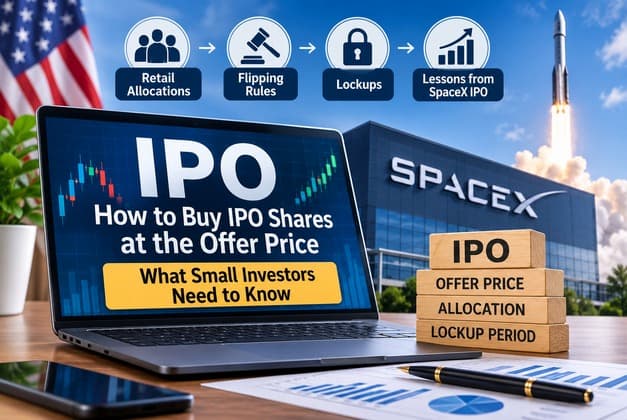
To buy IPO shares, request them through a broker in the deal. Requesting isn’t receiving.
Popular IPOs are oversubscribed, so brokers may use lotteries or limits.
If you get shares and sell inside the broker’s window (often weeks), you may lose access to future IPOs.
Missed the allocation? Anyone can buy once trading starts, usually at a different price.
Three routes to an IPO stock
IPO PRICE
Route 1: IPO allocation
MARKET PRICE
Route 2: Day-one market order
MARKET PRICE
Route 3: Wait, including past lockups
Compare buying at the IPO price vs. on day one, after tax →
SpaceX figures and broker rules verified on November 2, 2026.
IPO Price vs. Day-One Price Calculator
See what a buy at the IPO price and a buy on day one each turn into, before and after tax.
Three Price Tiers: Which One Are You Looking At?
Every way of owning an IPO stock fits one of three tiers, and only the first two are open to most people.
IPO PRICE
If you are allocated shares. Broker rules apply.
MARKET PRICE
Once trading begins. Anyone with a brokerage account.
NOT AVAILABLE TO YOU
Pre-IPO shares, unless you are accredited or use a registered vehicle.
Anything unsolicited is a red flag.
How an IPO Reaches Retail Investors
An IPO reaches individual investors through a short chain of steps, and you can lose your place at several of them.
Knowing the chain is the first step in how to get IPO shares at the offer price.
The company registers the offering with the SEC. Underwriters market the deal and set a price range.
Brokers in the deal collect indications of interest (IOIs). An IOI is a request, not a promise.
After pricing, you usually must reconfirm.
You may need to confirm again if the price or terms change materially.
Then the broker allocates shares.
Trading starts with an opening auction, and the first price is often not the IPO price.
| Step | What happens | What you do |
|---|---|---|
| 1. Registration | The company files an S-1 with the SEC. Many first file a confidential draft. OpenAI announced one on June 8, 2026. | Read the risk factors in the prospectus. |
| 2. Price range and roadshow | Underwriters pitch the deal to investors and set a range. | Check whether your broker is part of the deal. |
| 3. Indication of interest | Brokers collect non-binding requests. Some call them conditional offers to buy. | Submit one if you are eligible. Cash may be held. |
| 4. Pricing | Underwriters set the final offer price, usually after the close the day before trading. | Watch for your broker’s notice. |
| 5. Reconfirmation | Brokers may ask you to confirm after pricing, and again if the price or terms change materially. | Confirm before the deadline. Miss it and you may get nothing. |
| 6. Allocation | The broker fills requests by lottery, tiers, pro rata or another method. | Wait. A fill can be partial or zero. |
| 7. Opening auction | The exchange sets the opening price and trading begins. Robinhood notes this may be midday. | If you trade, consider a limit order. |
New to buying stock at all? Start with how to buy your first stock.
Why You Got Fewer Shares (or None)
Brokers get only a slice of each deal, and hot IPOs draw far more requests than shares.
Retail investors typically get about 5% to 10% of a large IPO.
For SpaceX, about 30% (roughly $22.5 billion) was reportedly earmarked.
One report later put the final share in the low 20s. (Traders Post)
Even so, brokers warned of partial fills.
Fidelity told customers they could get some, none or all of what they requested. (Fortune)
Methods differ. Robinhood randomly selects from all requests.
Fidelity said it would use a lottery if it could not fill everyone.
Bloomberg: every eligible requester at the five brokers got at least one share. (Bloomberg Government)
Other reasons you may get nothing
Not eligible. Brokers set minimums, account-type limits and questionnaires.
Robinhood excludes retirement, joint and managed accounts from IPO Access.
You did not reconfirm. Many brokers require a confirmation after pricing.
Schwab’s SpaceX deadline was reported as 7:00 a.m. ET the morning after pricing.
Restricted person. FINRA Rule 5130 generally bars sales of new issues to broker-dealer staff and some fund managers.
Deal advisers and certain family members are covered too.
Funds not in place. Robinhood holds cash for a request until allocation is final.
E*TRADE expects the account to be funded.
Flipping history. A broker can restrict you after earlier flips. See the flipping section.
Broker IPO Rules Compared
Each broker sets its own IPO rules, so the same IPO can mean different things depending on where your account sits.
SpaceX named five retail distributors in its prospectus.
We list them because they were named, not to rank them.
For full broker reviews, see our best online stock brokers guide.
Broker IPO Rules Finder
Show the full broker rules table
| Broker | Eligibility | Allocation method | Reconfirmation | Flipping window and consequence | Source and date |
|---|---|---|---|---|---|
| Fidelity | SpaceX deal: $2,000 in a retail account (lower than its usual IPO thresholds). | Tries to fill some shares for every confirmed customer; lottery if it cannot. | Reported: confirm after pricing to make the request binding. | 15 calendar days. Per Fidelity: 6 months (first), 1 year (second). Other outlets differ. | Fidelity learning center (broker page); Fortune; reviewed Nov 2, 2026 |
| Charles Schwab | Reported: $100,000 minimum for SpaceX plus a questionnaire and opt-in. | Not published in sources reviewed. | Reported: affirm by 7:00 a.m. ET after pricing. | Reports differ: none unless the issuer requires one, or set per deal. Confirm with Schwab. | Press reports (Fortune, WSJ, Yahoo Finance); not confirmed on Schwab’s page; reviewed Nov 2, 2026 |
| Robinhood | No minimum reported. Retirement, joint and managed accounts excluded. | Random selection from all requests; request size does not change your odds. | Indication of interest, then a conditional offer to buy; cash held. No separate reconfirmation described. | Sell within 30 days: may be barred from IPO Access for 60 days. | Robinhood IPO Access page (broker page); reviewed Nov 2, 2026 |
| SoFi | No minimum reported. Active Investing account and eligibility questions (reported). | Not stated in sources reviewed. | Reported: non-binding indication of interest, then confirm after SoFi’s notice. | 30 days. Future IPO access may be limited 180 days (first) and 365 days (second). Reports add a permanent ban after a third and a possible $50 fee. | SoFi Help Center (broker page); Motley Fool; reviewed Nov 2, 2026 |
| E*TRADE | Investor Profile and prospectus acknowledgment; funded account. Morgan Stanley employee accounts excluded. | Many valid offers may get nothing; method not stated in excerpts. | Conditional offer to buy (shares and max price). No reconfirmation step described. | Prefers 30 days. Selling or transferring out sooner may affect eligibility; no fixed penalty published. | E*TRADE pages dated 06/05/26 and 08/24/26 (broker pages); reviewed Nov 2, 2026 |
Broker pages: Robinhood IPO Access, Fidelity, SoFi flipping policy, E*TRADE SpaceX page.
The Flipping Rule: What Happens If You Sell Fast
Flipping means selling IPO shares soon after you get them, and a broker may respond by limiting your access to future IPOs.
FINRA Rule 5131 defines a flipped sale as an initial sale within 30 days of the offering.
That rule governs firms, not you.
Brokers write their own penalties.
Windows reported for SpaceX ran from 15 days (Fidelity) to 30 days (Robinhood, SoFi, E*TRADE).
Penalties vary too. Robinhood: 60 days. SoFi: 180 days, then 365. Fidelity: 6 months, then 1 year.
Check each broker’s current terms.
The brokers whose pages we read say you can still sell. The cost is access, not permission.
Shares you buy on the open market after trading starts are not allocated IPO shares.
These policies generally do not apply to them. Confirm with your broker.
Reuters reported that at least one large asset manager said its allocation came with no flipping limits.
Retail rules can be tighter. (BNN Bloomberg)
SoFi was reported to reserve a $50 fee on sales before day 120. (Motley Fool)
Day One: Buying When Trading Opens
On day one the market, not the underwriter, sets your price, and it is usually different from the IPO price.
The IPO price comes from roadshow demand.
The opening price comes from an auction of live buy and sell orders.
Strong demand can lift the open well above the offer.
SpaceX priced at $135 and, as reported, closed its first session at $160.95, about 19% higher. (Traders Union)
It can run the other way.
SpaceX was reported to close below $135 on every trading day from July 16 through August 5. (Sovereign Magazine)
How to place an order more safely
Use a limit order. It caps the price you will pay, so a fast open cannot fill you far above it.
Be wary of market orders. In a fast, thin open they can fill at prices you did not expect.
Check when trading starts. Robinhood notes it may not begin until midday on IPO day.
Size the position first. Allocated shares and open-market shares have different costs.
Treat them as separate positions.
Order types are covered in stop-loss, limit and market orders.
Extended hours carry extra risk, covered in trading after hours.
How brokers route your order is covered in commission-free trading and PFOF.
Lockups Explained
A lockup is a contract that stops insiders from selling shares for a set time after the IPO.
Employees, executives and early investors agree not to sell.
The terms sit in the prospectus (the 424(b) filing on EDGAR).
Typical lockups run 90 to 180 days. Many deals now stagger releases or add early-release triggers.
When a lockup ends, more shares can trade. That adds supply, but price also depends on demand.
Eligible to sell is not sold. Holders may wait, sell in pieces or hold.
Affiliates also face SEC Rule 144 limits.
To check a schedule, read the prospectus sections on shares eligible for future sale and on underwriting.
Index funds are another source of demand. They buy only when a stock meets an index’s rules.
See QQQ vs VOO for how those funds work.
The SpaceX IPO, by the Numbers
SpaceX shows how one IPO can open high, slide below its offer price, and still rise on an unlock day.
This is a case study, not advice. We make no forecast and no call on SpaceX stock.
Jun 11, 2026
IPO prices and shares are allotted.
About 30% (roughly $22.5 billion) was reportedly earmarked for retail, against a typical 5% to 10%.
One report later put the final retail share in the low 20s.
$135 per share. Deal reported at $86.2 billion.
Jun 12, 2026
Trading begins on Nasdaq as SPCX. The first session closes well above the offer price.
Close $160.95, about 19% higher. Up as much as 30% intraday.
Source: Traders Union, citing Reuters
Jun 16, 2026
Bloomberg reports that eligible requesters at all five brokers received at least one share.
At least 1 share each.
Source: Bloomberg Government
Week after the IPO (reported)
Reported peak. The 52-week high shown in market data is the same figure.
Intraday high $225.64.
Jul 16 to Aug 5, 2026
Shares close below the IPO price on every trading day in this stretch (reported).
Below $135.
Source: Sovereign Magazine
Aug 5, 2026
Day before the first unlock. All-time-low close.
$108.27, down about 14% on the day.
Source: Sovereign Magazine; Kyunghyang Shinmun
Aug 6, 2026
First lockup release: up to 911.5 million Class A shares, about 7% of roughly 13.2 billion outstanding.
A further 455.8 million would have unlocked at a $175.50 close (30% above the IPO price).
It did not.
Stock rose about 6% to roughly $114 to $115 (reports vary).
Source: Motley Fool; CryptoBriefing; INDmoney
Aug 20 to Oct 9, 2026
Five more releases (reported dates include Aug 20, Sep 9 to 10, Sep 24 and Oct 9).
With Aug 6, almost 2.3 billion shares came out of lockup. Sizes vary by outlet.
Stock fell on 3 of the first 6 release days. The last three moves were under 1.5%.
Source: Motley Fool, Oct 13
Oct 20 to 22, 2026
Third-quarter results on Oct 20.
Up to about 1.3 billion shares became eligible on Oct 22, the second full trading day after results.
Stock rose about 8% on Oct 21.
Source: Yahoo Finance; Quantral
Oct 24, 2026
Up to 328.4 million more shares (a Saturday; first trading day Oct 26).
Up to 328.4 million shares.
Source: Motley Fool, Oct 13
Dec 8, 2026 (scheduled)
End of the 180-day group’s lockup (reported). Confirm in the 424(b) prospectus.
Up to 797.6 million shares.
Source: Motley Fool, Oct 13; Sovereign Magazine
2027 (scheduled)
Extended-lockup holders other than Musk unlock in stages after later earnings reports.
First stage reported at about 352 million shares.
Source: Webull, citing Reuters
Jun 12, 2027 (scheduled)
Musk’s shares: a 366-day lockup with no early release (reported).
About 6.4 billion Class A-equivalent shares.
Source: Webull, citing Reuters; Yahoo Finance
| Date | Event | Price or shares | Source |
|---|---|---|---|
| Jun 11, 2026 | IPO prices and shares are allotted. About 30% (roughly $22.5 billion) was reportedly earmarked for retail, against a typical 5% to 10%. One report later put the final retail share in the low 20s. | $135 per share. Deal reported at $86.2 billion. | Bloomberg Government; Traders Post, citing CNBC |
| Jun 12, 2026 | Trading begins on Nasdaq as SPCX. The first session closes well above the offer price. | Close $160.95, about 19% higher. Up as much as 30% intraday. | Traders Union, citing Reuters |
| Jun 16, 2026 | Bloomberg reports that eligible requesters at all five brokers received at least one share. | At least 1 share each. | Bloomberg Government |
| Week after the IPO (reported) | Reported peak. The 52-week high shown in market data is the same figure. | Intraday high $225.64. | Wikipedia (timing); Kyunghyang Shinmun (price) |
| Jul 16 to Aug 5, 2026 | Shares close below the IPO price on every trading day in this stretch (reported). | Below $135. | Sovereign Magazine |
| Aug 5, 2026 | Day before the first unlock. All-time-low close. | $108.27, down about 14% on the day. | Sovereign Magazine; Kyunghyang Shinmun |
| Aug 6, 2026 | First lockup release: up to 911.5 million Class A shares, about 7% of roughly 13.2 billion outstanding. A further 455.8 million would have unlocked at a $175.50 close (30% above the IPO price). It did not. | Stock rose about 6% to roughly $114 to $115 (reports vary). | Motley Fool; CryptoBriefing; INDmoney |
| Aug 20 to Oct 9, 2026 | Five more releases (reported dates include Aug 20, Sep 9 to 10, Sep 24 and Oct 9). With Aug 6, almost 2.3 billion shares came out of lockup. Sizes vary by outlet. | Stock fell on 3 of the first 6 release days. The last three moves were under 1.5%. | Motley Fool, Oct 13 |
| Oct 20 to 22, 2026 | Third-quarter results on Oct 20. Up to about 1.3 billion shares became eligible on Oct 22, the second full trading day after results. | Stock rose about 8% on Oct 21. | Yahoo Finance; Quantral |
| Oct 24, 2026 | Up to 328.4 million more shares (a Saturday; first trading day Oct 26). | Up to 328.4 million shares. | Motley Fool, Oct 13 |
| Dec 8, 2026 (scheduled) | End of the 180-day group’s lockup (reported). Confirm in the 424(b) prospectus. | Up to 797.6 million shares. | Motley Fool, Oct 13; Sovereign Magazine |
| 2027 (scheduled) | Extended-lockup holders other than Musk unlock in stages after later earnings reports. | First stage reported at about 352 million shares. | Webull, citing Reuters |
| Jun 12, 2027 (scheduled) | Musk’s shares: a 366-day lockup with no early release (reported). | About 6.4 billion Class A-equivalent shares. | Webull, citing Reuters; Yahoo Finance |
What the case shows
Allocation was small but real. Eligible requesters at all five brokers reportedly got at least one share.
The first-day gain went to holders. Buyers at the open paid more than allocated buyers.
A slide can follow a pop. The stock closed below its IPO price in the weeks after it peaked.
Unlocks are a calendar, not one date. The Motley Fool counted declines on three of the first six release days. (Motley Fool)
Two dates can both be true. December 8 ends the main 180-day group’s lockup (reported).
Musk’s shares stay locked until June 2027 (reported).
Pre-IPO Shares: What’s Real and What’s a Trap
You generally can’t buy a private company’s shares at the IPO price before it lists, and unsolicited offers to do so are a red flag.
Legitimate routes exist, but they are narrow and carry real risk.
We do not recommend or rank any pre-IPO product.
What is real
Accredited-only deals. Private placements sell to investors who meet income or asset tests.
Many need the company’s approval to transfer shares.
Pre-IPO funds and SPVs. They pool money to hold private shares.
FINRA warns you may sit several layers from the stock, and may not own it directly. (FINRA)
Listed funds with private stakes. Some exchange-listed funds hold private companies.
Their price can sit above or below the value of their holdings, and fees vary.
Read the fund’s filings.
Tokens and derivatives
Some platforms sell tokens or derivatives said to track a private company.
You usually hold a claim on the platform, not company shares.
Anthropic said in May 2026 that unapproved transfers of its stock, or interests in it, are void.
Coverage reported a similar warning from OpenAI. (CoinDesk)
OpenAI: status as of November 2, 2026
OpenAI announced a confidential draft S-1 on June 8, 2026. (Built In)
No IPO date has been set, and no public ticker exists.
CEO Sam Altman told Fortune in September, “I would say not 2026.” (Arabian Post)
Both the SEC and FINRA warn about pre-IPO schemes.
Pre-IPO Offer Red-Flag Check
Tick everything that applies to the offer you received. Nothing you tick leaves this page.
Lost money to a pre-IPO scheme? See our securities fraud attorney guide.
| Route | Who can use it | Main risks | Regulator status |
|---|---|---|---|
| Unsolicited offer (DM, call, ad, email) | Anyone can be targeted. NOT AVAILABLE TO YOU in any legitimate form. | Shares that don’t exist, lost money, identity theft. | SEC and FINRA warn to treat as a red flag. Report it. |
| Private shares and secondary platforms | Usually accredited investors only. | Company approval to transfer, illiquid, hard to value, fees. A transfer without approval may be void. | Private placements under exemptions, not SEC-registered offerings. Sellers should be registered. Check BrokerCheck. |
| Pre-IPO funds and SPVs | Often accredited investors. | Layers between you and the stock, fees, no certainty the company will IPO, hard to value. | Depends on structure. Read the offering documents. |
| Listed funds with private stakes | Anyone with a brokerage account. | Premium or discount to holdings, fees, concentration, private holdings valued by the fund. | Depends on structure. Check the fund’s SEC filings. |
| Tokens and derivatives tracking a private company | Anyone on the platform, depending on its rules. | A claim on the platform, not shares. Companies have said unapproved interests are void. Thin liquidity. | Status varies and is evolving. Confirm the platform’s registration and the legal terms. |
How IPO Gains Are Taxed
A gain on IPO shares is short-term if you hold one year or less and long-term if you hold more than one year.
Short-term gains are taxed at your ordinary federal rate, 10% to 37%.
Long-term gains are taxed at 0%, 15% or 20%, depending on income.
Some high earners also owe the 3.8% net investment income tax. States may tax gains too.
The holding period generally starts the day after you acquire the shares.
Illustration: on a $1,000 gain, 24% short-term tax is $240 and 15% long-term tax is $150.
Details are in our capital gains tax guide and tax-loss harvesting calculator.
See also IRS Topic 409.
Long-run results matter too.
Jay Ritter’s University of Florida IPO data include a long-run returns file.
Historically, IPOs have on average trailed comparable companies over several years.
We quote no figure here. Open the current file for the latest numbers.
The Three Routes, Compared
The three routes differ in price, odds and rules, and none removes the risk that the stock falls.
| Route | Price you pay | Chance of getting shares | Rules | Main risk |
|---|---|---|---|---|
| IPO allocation IPO PRICE | The IPO price ($135 for SpaceX). | Not guaranteed. Partial or zero fills are common. | Eligibility, reconfirmation, broker flipping window. | The stock can trade below the IPO price. SpaceX did for weeks. |
| Day-one market order MARKET PRICE | Whatever the market sets at the open. SpaceX’s first close was $160.95 (reported). | High. Any funded brokerage account can buy once trading starts. | Opening auction. Limit orders recommended. IPO flipping policies generally don’t apply. | Paying a premium in a volatile open. |
| Wait, including past lockups MARKET PRICE | The market price on the day you buy. | High, subject to liquidity. | None. Check the lockup calendar. | Supply events and sentiment. SpaceX rose on its first unlock day but fell on some later ones. |
For upcoming IPOs, check each broker’s IPO calendar and the company’s public filings on EDGAR.
Frequently Asked Questions
Can regular investors buy IPO shares at the offer price?
Sometimes.
If your broker is part of the deal and you are eligible, you can request shares at the offer price.
Allocation is not guaranteed.
How do I request IPO shares?
Find the offering in your broker’s IPO section, read the prospectus and submit an indication of interest or conditional offer.
Reconfirm after pricing if your broker requires it.
Why didn’t I get any IPO shares?
Popular deals are oversubscribed.
You may also have been excluded for eligibility, an unconfirmed request, restricted-person status or earlier flipping.
Do brokers use a lottery for IPO shares?
Some do. Robinhood randomly selects from all requests.
Fidelity said it would use a lottery for SpaceX if it could not fill everyone.
What is an indication of interest?
A non-binding request for shares made before the price is set.
It tells the broker how much you want. It does not guarantee shares.
What happens if I sell IPO shares right away?
You can generally sell. Selling inside the broker’s window may limit access to future IPOs.
Windows reported for SpaceX ran 15 to 30 days, and Schwab’s policy was reported differently.
Can I be banned from future IPOs?
A broker can restrict your access to its IPO program, for a set period or in some cases permanently.
That is the broker’s policy, not a law.
Should I buy an IPO on the first day?
That depends on your goals and risk tolerance, and this guide makes no recommendation.
If you do, decide your price first and use a limit order.
Why does an IPO open above the IPO price?
The IPO price is set before trading from roadshow demand.
The opening price comes from an auction of live orders, so strong demand can lift it.
It can also open lower.
What is an IPO lockup period?
A contract that bars insiders from selling for a set time after the IPO, often 90 to 180 days.
Some deals release shares in stages.
Does a stock always drop when the lockup expires?
No. SpaceX rose about 6% on its first unlock day, though it fell on some later release days.
Unlocks add supply, but demand matters too.
When does SpaceX’s lockup end?
It is staggered. The main 180-day group’s last release was reported for December 8, 2026.
Musk’s shares are reported locked until June 12, 2027. Confirm in the 424(b) prospectus.
Can I buy OpenAI stock?
Not on a public exchange.
OpenAI announced a confidential draft S-1 on June 8, 2026, but no IPO date or ticker exists as of November 2, 2026.
Is buying pre-IPO stock legal?
It can be for eligible investors through registered channels.
The SEC warns that many pre-IPO offers aimed at the general public may be illegal.
How do I spot a pre-IPO scam?
Look for unsolicited contact, guaranteed returns, pressure, unregistered sellers and missing documents.
Use the red-flag check above and verify on BrokerCheck.
How are IPO profits taxed?
Gains on shares held one year or less are taxed as ordinary income.
Gains on shares held more than one year get long-term rates of 0%, 15% or 20%.
Sources and Where to Verify
- SEC EDGAR: SpaceX S-1 and final prospectus (424(b)), especially the shares eligible for future sale and lockup sections.
- SEC Investor.gov: Investor alert on pre-IPO investment scams.
- FINRA: Investor insights on pre-IPO risks; Rules 5130 and 5131; BrokerCheck.
- Jay R. Ritter, University of Florida: IPO data, including long-run returns.
- IRS Topic 409: Capital gains and losses.
- Broker pages: Robinhood IPO Access, Fidelity, SoFi Help Center, E*TRADE New Issue Center.
SpaceX price and lockup figures come from the press reports named in Table 3.
Read the prospectus before you rely on any date.
Last updated:
Disclaimer: general information, not investment, tax or legal advice. SpaceX data and broker policies are as reported or published on November 2, 2026. IPOs are high-risk; allocations are not guaranteed.

Daniel Hayes is the founder and sole researcher at AdvoraHQ. He covers U.S. personal finance, insurance, and consumer law — working directly from IRS publications, federal and state statutes, court opinions, and SEC filings rather than secondary summaries. His focus is the gap between what readers think they know and what the source documents actually say. Daniel is not a licensed attorney, CPA, or financial advisor; his articles are educational and not personalized advice. Reach him at Daniel.Hayes@advorahq.com.