
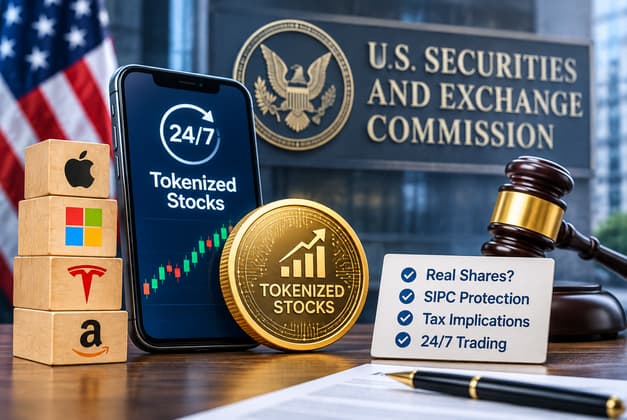
Check what you’d actually own in 3 taps ↓
Updated November 11, 2026 — after the SEC Innovation Exemption. Venue status changes weekly.
What Do You Actually Own?
Answer three questions. The result shows the ownership label, whether U.S. residents can buy it, and the protection and tax points that follow.
Your result
What’s live right now (snapshot, Nov. 11, 2026)
LIVE: TSV LLC, one issuer-sponsored stock, first trades Nov. 4. Access is limited to eligible investors who pass identity and wallet checks.
FILED, NOT TRADING: Formation Securities (expected early 2027) and OKXICE (no launch date; 67 issuers had objected as of its Nov. 5 notice).
OFFSHORE, NOT FOR U.S. RESIDENTS: the stock-token products from Coinbase, Robinhood, Gemini and Kraken. See the full tracker.
What a Tokenized Stock Is
A tokenized stock is a blockchain token linked to a share of a listed company, and what that link means is the whole question.
In the strongest version, the share itself is recorded on a blockchain. A registered transfer agent keeps the official record, and the token is how that record moves. You own the stock, and the blockchain is the bookkeeping.
In the weakest version, the token is a separate product built to follow the stock’s price. Nothing in it has to be a share, and you may have no claim on one.
Both get called “tokenized stocks.” SEC staff sorted them in a Jan. 28, 2026 statement into issuer-sponsored, third-party (backed by real shares) and synthetic, and said blockchain use doesn’t change what a security legally is.
For the wider picture on digital assets, see our guide to crypto in 2026.
The Three Kinds — and What You Own in Each
There are three kinds: in one you own the share, in another a claim, and in the third a price bet.
Three questions sort any token. Who created it? What rights come with it? Who holds the underlying asset? The tool above runs those questions for you.
YOU OWN THE SHARE
Types: issuer-tokenized, or third-party with the same rights as the listed share.
Who creates it: the company, or an outside firm holding the real shares.
Dividends and vote: YES.
U.S. residents: YES on a qualifying TSV, after eligibility checks. For third-party tokens, only where the issuer did not object.
Main risk: thin liquidity, few venues, issuer objection.
YOU OWN A CLAIM
Types: certificate or wrapper backed by shares, such as xStocks (Kraken/Backed).
Who creates it: a third party.
Dividends and vote: NO vote. Dividends depend on the terms.
U.S. residents: NO. Offshore only, and may not qualify under the exemption in current form.
Main risk: your claim is against the wrapper’s issuer, and your rights are whatever its terms say.
YOU OWN A PRICE BET
Types: synthetic tokens that follow the price with no shares behind them.
Who creates it: a third party or the platform.
Dividends and vote: NO.
U.S. residents: NO. Excluded from the exemption.
Main risk: no shareholder rights, and you depend on the product’s issuer.
| Type | Who creates it | What you own | Dividends & vote | Available to U.S. residents | Main risk |
|---|---|---|---|---|---|
| Issuer-tokenized YOU OWN THE SHARE | The company, or someone acting for it; a transfer agent keeps the record | The share, recorded on a blockchain | YES / YES | YES, on a qualifying TSV, after identity and sanctions checks | Thin liquidity; few venues |
| Third-party with full rights (exemption-eligible) YOU OWN THE SHARE | An unaffiliated firm that holds the real shares and issues tokens | The share, if the token carries the same rights | YES / YES, required by the exemption | DEPENDS: only on a venue where the issuer did not object within 30 days | Issuer can object venue by venue; rights depend on the token’s terms |
| Certificate or wrapper (for example, offshore products such as xStocks) YOU OWN A CLAIM | A third party that issues certificates or notes backed by shares | A claim on the wrapper’s issuer, backed by shares | NO vote; dividends depend on the terms | NO: offshore only; may not qualify in current form | Platform and issuer risk; rights come only from the terms |
| Synthetic YOU OWN A PRICE BET | A third party or the platform | Exposure to the price; no share and no claim on one | NO / NO | NO: excluded from the exemption | No shareholder rights; counterparty risk |
One point trips people up: backed by real shares is not the same as carrying the rights of a share. xStocks are backed by shares, yet they are certificates without voting rights. Backing alone doesn’t qualify a token under the exemption.
What the SEC Allowed on September 17, 2026
The SEC gave venues five years of conditional relief to trade tokenized stocks on-chain without registering as exchanges, and it did not make every stock token legal for everyone.
The relief. Release No. 34-106402 runs from Sept. 17, 2026 to Sept. 17, 2031. It lets Tokenized Securities Venues (TSVs) trade tokenized NMS stock, meaning stock listed on a national exchange, through permissioned automated market maker (AMM) liquidity pools. Details are in the Mayer Brown and Jones Day summaries.
Who can run a venue. A TSV must be a U.S. person and publish a plain-English notice at least 30 days before it operates. The order also sets caps on the number of symbols and the volume traded. A venue’s notice is not an SEC approval of its product.
The rights requirement. An eligible token must carry the same economic and governance rights as the listed share: dividends, residual assets and the vote. Synthetic tokens that only track price are excluded.
The issuer notice. When an unaffiliated third party tokenizes a stock, the venue must give the issuer written notice at least 30 calendar days before trading. The issuer can object. The next section covers that fight.
No leverage on a TSV. Participants may not borrow against or hypothecate securities or crypto assets through the venue, and a TSV may not extend credit.
What it didn’t do. It is not a new crypto law. The CLARITY Act failed to advance in the Senate on Sept. 15, two days earlier. The order also gives no relief to whoever does the tokenizing, and no broad relief to the people trading on a venue.
What U.S. Investors Can Buy Right Now
Very little: as of November 11, 2026, one venue has completed trades, in one stock, and the first reported trades were between an existing shareholder and an institutional buyer.
On Nov. 4, 2026, TSV LLC, which runs on the Canton Network, supported four purchases of Canton Strategic Holdings (CNTN) totaling $30,296. The issuer called them the first issuer-sponsored tokenized U.S. equity trades under the exemption.
Access is limited to eligible investors who pass identity and wallet sanctions checks. Nothing else has started trading yet under the exemption, as far as public notices show.
TSV LLC (Canton Network) · Live: first trades · Nov. 4, 2026
Model: issuer-sponsored token in a permissioned pool; a transfer agent keeps the ownership record.
Source: TSV LLC announcement.
Formation Securities (Solana) · Notice filed; trading expected early 2027 · Nov. 9, 2026
Model: permissioned pools on a public blockchain; verified investors. Access is expected through Alpaca, CoinList’s Passage and custodians.
Source: Formation Securities notice.
OKXICE (OKX–ICE) · Filed; 67 objections; no launch date · Notice of Nov. 5, 2026
Model: third-party tokens in permissioned pools.
Source: OKXICE TSV public notices; CoinDesk.
Nasdaq (exchange-based) · SEC-approved rule change · Mar. 18, 2026
Model: tokenized settlement of listed trades on the same order book as regular shares, under a DTC pilot. It runs inside a registered exchange, unlike a TSV. Approval is not a product launch.
Source: The Block; SEC Release No. 34-105047.
Coinbase / Robinhood / Kraken / Gemini · Offshore, not for U.S. residents · Reported Sept. 2026
Model: tokenized equities offered outside the U.S., not to U.S. customers.
Source: Cointelegraph; The Block.
| Venue | Model | Status | Date | Source |
|---|---|---|---|---|
| TSV LLC (Canton Network) | Issuer-sponsored token in a permissioned pool; a transfer agent keeps the record | Live: first trades | Nov. 4, 2026 | TSV LLC announcement |
| Formation Securities (Solana) | Permissioned pools on a public blockchain; verified investors | Notice filed; trading expected early 2027. Access expected via Alpaca, CoinList’s Passage and custodians | Nov. 9, 2026 | Formation notice |
| OKXICE (OKX–ICE) | Third-party tokens in permissioned pools | Filed; 67 issuers have objected; no launch date | Notice of Nov. 5, 2026 | OKXICE TSV notices; CoinDesk |
| Nasdaq | Exchange-based: tokenized settlement on the same order book, under a DTC pilot | SEC approved the rule change; approval is not a launch | Mar. 18, 2026 | The Block; SEC Release No. 34-105047 |
| Coinbase / Robinhood / Kraken / Gemini | Offshore offerings | Offered outside the U.S., not to U.S. customers | Reported Sept. 2026 | Cointelegraph |
Robinhood describes its Stock Tokens as debt securities issued by a Jersey entity, offered outside the U.S. Kraken’s xStocks are certificate-backed instruments without voting rights, and Binance’s bStocks sit in the same offshore market. Reports say xStocks and bStocks may not qualify under the exemption in their current form.
Don’t use a VPN or an offshore account to reach products that aren’t offered to U.S. residents. You could lose access to your funds with no U.S. recourse.
Why Companies Are Saying No
Companies are objecting because the exemption lets an outside firm tokenize their shares unless they say no within 30 days, and an objection blocks only that one venue, only for third-party tokens.
How it works. Before a venue trades a stock tokenized by an unaffiliated third party, it sends the issuer written notice. The issuer has 30 calendar days from receipt to object in writing. A timely objection stops that venue from trading that stock’s third-party token.
What an objection doesn’t block. It is venue by venue, so a different venue starts its own notice process. It covers third-party tokenization only, so an issuer-sponsored token isn’t affected. It also doesn’t reach synthetic products or offshore products.
The numbers. OKXICE’s first list named 62 companies. Objections grew from 33 in late October to 67 on its Nov. 5 notice, and a venue has up to five business days to publish objections, so the public list can lag.
| Venue | Objections reported | As of | Source |
|---|---|---|---|
| OKXICE | 33 | Oct. 24–25, 2026 | Press reports of OKXICE’s public notice |
| OKXICE | 59 | Nov. 3, 2026 notice | TokenPost |
| OKXICE | 67 (56 of the 62 on its first list, plus 11 others) | Nov. 5, 2026 notice | OKXICE TSV notice; CoinDesk tally |
OKXICE’s notices don’t give reasons, and the companies haven’t published theirs. Press reports say at least one large objector supports tokenization in general but opted out of this plan for now. An objection to one venue is not a ban on tokenization.
For you, the practical point is simple. A stock missing from OKXICE’s pools may be missing because its issuer objected. The route that avoids the objection process, as TSV LLC’s first trades show, is a token the issuer sponsors itself.
Are Tokenized Stocks Safe? SIPC, Custody, and Wallets
Safety depends on who holds the asset: SIPC may protect tokens held at a member broker-dealer, but not tokens in your own wallet or on an offshore platform.
SIPC protects customers of SIPC-member broker-dealers, up to $500,000 including $250,000 cash, when a firm fails and securities are missing. It does not cover losses from price moves. Our SIPC coverage limits guide has the details, and SIPC explains it directly.
Whether a given venue’s tokens sit at a member broker depends on how that venue is built. Read the custody arrangement for each one.
Self-custody adds its own risk. Lost keys mean lost assets. On a permissioned venue, tokens may also move only between approved wallets, so you may not be free to send them anywhere.
Other risks are practical. Pools can be thin, venues are new, and eligibility checks can change who may trade. Offshore platforms operate outside U.S. investor protections.
How Tokenized Stocks Are Taxed
Gains and losses are generally taxed like stock sales, but the form you receive is generally Form 1099-DA, not Form 1099-B.
The form. Under the final broker regulations (T.D. 10000), sales of tokenized securities are generally reported on Form 1099-DA. The exception: tokenized securities settled or cleared on a limited-access regulated network (LARN) go on Form 1099-B. See the IRS Form 1099-DA page and EY’s summary of the final instructions.
The transition rule. For 2025 cash sales, brokers could use either form. Check with your broker whether any similar relief applies to your 2026 forms.
Offshore and self-custody. You may get no form at all. You still owe tax on gains, so keep your own cost-basis records. Our 1099-DA cost basis guide covers the common reporting problems.
Wash sales. The wash sale rule applies to stock or securities and uses a 61-day window: 30 days before and after a loss sale. A tokenized share that is the stock is likely covered. Whether a token and the conventional share count as substantially identical has no specific IRS guidance. Treat it as likely, and ask a CPA. Our wash sale rule guide owns the mechanics.
The 24/7 Price Gap
A token that trades around the clock keeps trading when the stock exchange is closed, so its price can drift from the stock on thinner liquidity.
With the exchange closed, there is no live exchange quote to anchor the price. An AMM pool prices from its own balance of assets, so in a thin pool a single trade can move the price more than it would on an exchange.
The exemption adds limits: caps on symbols and volume, and trading must stop when the stock is halted on its primary market. Check how a venue prices tokens when exchanges are closed, and what its caps are.
The gap shows up when markets reopen. A token can trade away from where the stock then opens. Our guide on trading stocks after hours covers the ordinary version of this risk, and execution quality matters on any venue.
| Feature | Tokenized stock on a qualifying TSV | Regular share in a brokerage account |
|---|---|---|
| Trading hours | Set by the venue; may run past exchange hours, with caps and pauses when the stock is halted | Exchange hours, plus the broker’s extended-hours sessions |
| Custody | Transfer agent record held through the venue, a custodian or your wallet, depending on setup | Broker-dealer or transfer agent, in book entry |
| SIPC | DEPENDS: only at a SIPC-member broker; NO in self-custody | YES at a SIPC-member broker-dealer |
| Tax form | Generally 1099-DA; 1099-B if on a LARN | 1099-B |
| Shareholder rights | Same as the listed share, as the exemption requires | Full |
| Liquidity | Thin, capped, permissioned pools | Deep, national market |
Before You Buy
Seven checks before you buy any tokenized stock will catch most of the problems in this guide.
- Is the venue a U.S. TSV with a published notice? Find its notice page.
- Who tokenized it, the company or a third party? If a third party, did the issuer object on this venue?
- What rights does the token carry? Dividends, vote, liquidation, and can you redeem it for the conventional share?
- Who holds the asset, a broker, a custodian or you? What happens if that party fails?
- What tax form will you get, 1099-DA or 1099-B? Keep your own cost-basis records.
- Trading outside market hours? Check how the venue prices tokens when the exchange is closed, and its trading caps.
- Never use a VPN or offshore account to reach products not offered to U.S. residents.
FAQ
Are tokenized stocks real shares?
Some are. An issuer-tokenized token, or a third-party token with the same rights as the listed share, is the share. A certificate backed by shares is a claim, and a synthetic token is a price bet. The tool above sorts them.
Can U.S. citizens buy tokenized stocks in 2026?
Only narrowly. Under the exemption, trading happens on TSVs that limit access to eligible investors who pass identity and wallet sanctions checks. The first trades were on Nov. 4, 2026. Most advertised stock tokens are offshore products not offered to U.S. residents.
Where can I buy SEC-compliant tokenized stocks?
We don’t recommend platforms. As of Nov. 11, 2026, one venue has completed trades and others have filed notices. A venue must publish a plain-English notice at least 30 days before it operates, so start there.
Why can’t I buy Robinhood or Kraken stock tokens in the U.S.?
They are offered outside the U.S., not to U.S. customers. Robinhood describes its tokens as debt securities issued by a Jersey entity, and Kraken’s xStocks are certificates without voting rights. The exemption requires the same rights as the listed share and excludes price-only tokens.
Are xStocks real shares?
No. xStocks are certificate-backed instruments without voting rights, so you hold a claim backed by shares, not the shares. They are not offered to U.S. residents and may not qualify under the exemption in their current form.
Do tokenized stocks pay dividends?
A token that is the share carries dividend rights, and the exemption requires that for eligible tokens. For a certificate or wrapper, it depends on the terms. A synthetic token has no right to dividends.
Do tokenized stocks give voting rights?
Qualifying tokens do. Certificates such as xStocks don’t, and synthetic tokens don’t. Read the token’s terms before you buy.
Can a company stop its stock from being tokenized?
Partly. For third-party tokenization on a given venue, the issuer can object within 30 calendar days of notice. That doesn’t stop other venues, tokens the issuer sponsors itself, or offshore products.
Which companies objected?
OKXICE’s Nov. 5, 2026 notice listed 67 objecting issuers, and the list may have grown since. We don’t reprint names because the list changes. The venue’s public notice is the source.
Are tokenized stocks SIPC-insured?
It depends. SIPC covers missing securities when a SIPC-member broker-dealer fails, up to $500,000 including $250,000 cash. Tokens in your own wallet or on an offshore platform aren’t covered.
What happens if the platform fails?
That depends on who holds the asset. At a member broker, SIPC may apply. In self-custody, no one holds it for you. On an offshore platform, you would deal with a foreign firm. Read the custody arrangement first.
How are tokenized stocks taxed?
Gains and losses are generally taxed like stock sales. If you hold offshore or in self-custody, you still owe tax even if no form arrives. Keep your own cost-basis records and ask a CPA.
Will I get a 1099-DA or a 1099-B?
Generally Form 1099-DA. If the token settles or clears on a limited-access regulated network (LARN), you get Form 1099-B instead.
Does the wash sale rule apply?
Likely, if the token is the stock itself. Whether a token and a conventional share are substantially identical has no specific IRS guidance, so ask a CPA.
Can I trade tokenized stocks 24/7?
Some venues plan continuous trading, within the exemption’s caps and halts. Liquidity is thinner when exchanges are closed, so prices can drift from the stock.
Are tokenized stocks better than regular stocks?
Different, not clearly better. Tokens offer longer trading hours and on-chain settlement. Regular shares offer deeper liquidity, SIPC protection at a member broker and familiar reporting. See Table 4.
Last updated:
This article is general information, not investment, legal, or tax advice. This market is new and changing weekly. Facts verified November 11, 2026. Check the venue’s notice and consult a professional.

Daniel Hayes is the founder and sole researcher at AdvoraHQ. He covers U.S. personal finance, insurance, and consumer law — working directly from IRS publications, federal and state statutes, court opinions, and SEC filings rather than secondary summaries. His focus is the gap between what readers think they know and what the source documents actually say. Daniel is not a licensed attorney, CPA, or financial advisor; his articles are educational and not personalized advice. Reach him at Daniel.Hayes@advorahq.com.
