
Quick answer
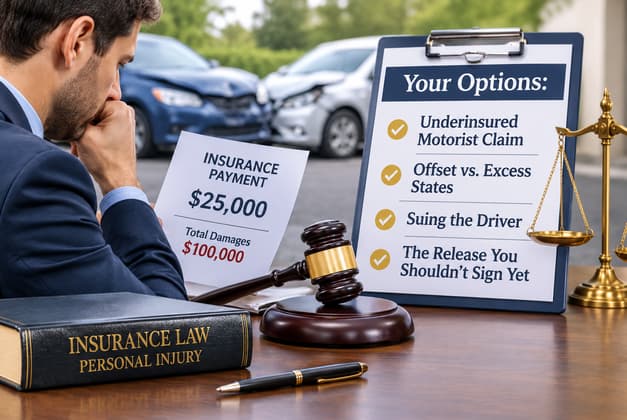
If your damages are bigger than the at-fault driver’s policy, money usually comes in layers: their liability limit first, then your own underinsured motorist (UIM) coverage, then anyone else legally responsible.
How much your UIM adds depends on whether your state and policy treat it as offset or excess. The same crash can leave a $50,000 gap in one state and $20,000 in another.
LAYER 1: THEIR POLICY
The at-fault driver’s bodily injury liability limit, per person and per accident. It comes first, and it is capped.
LAYER 2: YOUR UIM
Your own underinsured motorist coverage, if you have it. Whether it fills a difference or adds on top depends on your state and your policy wording.
LAYER 3: EVERYONE ELSE
Other liable parties, umbrella policies, and the driver personally. Less certain, but worth checking in order.
See who may pay what on your numbers →
- Don’t sign yet
- Offset vs. excess
- Find their limits
- Other sources
- Suing the driver
- Letters to send
- Deadlines
- FAQ
State rules verified . Rules vary by state and by policy — not legal advice.
Who Pays the Rest? Calculator
Enter your numbers to see how much each layer may cover and what may be left over.
Pain and suffering is hard to value. See how pain and suffering is calculated before you add a number.
If you’re not sure, the results use $25,000, $30,000 and $50,000 as examples only. Your state’s minimum may differ.
The Order Money Comes From
Money usually comes from three places in a fixed order: their policy, then your UIM, then everyone else.
LAYER 1: THEIR POLICY. The at-fault driver’s bodily injury (BI) liability coverage pays for injuries they legally caused, up to its limit. Limits are written as two numbers, such as 25/50: $25,000 per person and $50,000 per accident.
Per person vs. per accident. If several people were hurt, the per-accident limit is shared among them. Your share can end up below the per-person number, so ask the insurer what has already been paid or reserved.
LAYER 2: YOUR UIM. If you bought underinsured motorist coverage, it may pay after their limit is used. Buying decisions are covered in Is Uninsured Motorist Coverage Worth It?; this guide is about the claim.
LAYER 3: EVERYONE ELSE. Other liable parties, umbrella policies, and the driver personally. Each is covered below.
Your own first-party coverage works separately. PIP in no-fault states, MedPay, and health insurance can pay medical bills early. They may also claim repayment from your settlement. See Who Pays Medical Bills After a Car Accident and How Much of Your Settlement Will You Keep?.
Two edge cases change the order. If the driver left the scene, you are in uninsured-motorist territory; see Hit and Run: Who Pays. If you share fault, every layer can shrink; see Partially at Fault.
Stop: The Release You Shouldn’t Sign Yet
Before you accept a policy-limits offer and sign a release, check whether your own policy requires your UIM insurer to agree first.
Tell your own insurer before you accept their limit
A release ends your claim against the at-fault driver. Signing it before your UIM insurer has had a chance to respond may put your UIM claim at risk.
What the clause says. Many UIM policies require you to notify your insurer before accepting the at-fault driver’s limits and signing a release. Some require its written consent.
Why it exists: subrogation in plain words. If your insurer pays you UIM money, it may have the right to step into your shoes and try to recover that money from the at-fault driver. A release you sign can end that right. The clause protects it.
The substitution procedure. Some states set a procedure instead of leaving it to the policy. You give your insurer notice of the offer. It gets a set period to either agree or pay you the same amount itself, which keeps its subrogation right alive.
Minnesota is the best-known example. Its supreme court set out a notice-and-substitute procedure in Schmidt v. Clothier, 338 N.W.2d 256 (Minn. 1983). The legislature later modified parts of it by statute (Minn. Stat. §65B.49, subd. 4a), so the current rule is not identical to the 1983 opinion. Source: Minnesota Court of Appeals, No. A16-1149 (2017), reviewed Nov. 17, 2026.
What happens if you skip it. Breaching the clause may cost you the UIM claim, depending on your policy wording and your state’s law. Some states require the insurer to show it was actually harmed by the missing notice. Others read the clause more strictly. A signed release does not settle that question for you; the answer is state-specific.
What to do:
- Do not sign the release or deposit a check marked as full settlement yet.
- Get the offer in writing, with the amount and any deadline.
- Read the consent-to-settle language in your UIM section.
- Send your insurer written notice (Letter B in the UIM claim section).
- If you have already signed, read Settlement Check After Signing the Release and talk to an attorney promptly.
Whether the offer itself is fair is a separate question. See Should You Accept the First Settlement Offer?.
Offset vs. Excess: Why the Same Crash Pays Differently
Offset UIM subtracts the at-fault driver’s payment from your UIM limit, while excess UIM pays on top of it, up to your actual damages.
Offset (difference in limits). UIM pays your UIM limit minus the at-fault driver’s liability limit (or minus the amount they paid; states differ), up to your actual damages.
Excess (add-on, sometimes called a floating layer). UIM pays in addition to the at-fault payment, up to your UIM limit and your actual damages.
The three examples below use the formulas in the calculator.
| Case | Offset state | Excess state |
|---|---|---|
| A: $150,000 damages. Their limit $30,000. Your UIM $100,000. | $30,000 + $70,000 UIM = $100,000. Gap: $50,000. | $30,000 + $100,000 UIM = $130,000. Gap: $20,000. |
| B: $60,000 damages. Their limit $25,000. Your UIM $25,000. | $25,000 + $0 UIM. In many offset states their car is not “underinsured” here. Gap: $35,000. | $25,000 + $25,000 UIM = $50,000. Gap: $10,000. |
| C: $40,000 damages. Their limit $50,000. Any UIM. | Their policy can cover it. UIM not needed. | Their policy can cover it. UIM not needed. |
Case A: $150k injuries
Their limit $30,000. Your UIM $100,000.
Offset state: $30,000 + $70,000 UIM = $100,000. Gap: $50,000.
Excess state: $30,000 + $100,000 UIM = $130,000. Gap: $20,000.
Case B: both limits $25k
Damages $60,000. Their limit $25,000. Your UIM $25,000.
Offset state: $25,000 + $0 UIM. In many offset states their car is not “underinsured” here. Gap: $35,000.
Excess state: $25,000 + $25,000 UIM = $50,000. Gap: $10,000.
Case C: their policy is enough
Damages $40,000. Their limit $50,000.
Their policy can cover it in either kind of state, so UIM is not needed.
Calculated Nov. 17, 2026. Illustrative only; before liens, fees and fault.
Offset or excess can change your recovery by tens of thousands
In Case A, the same $150,000 crash leaves a $50,000 gap under offset and a $20,000 gap under excess.
| Item | Offset | Excess |
|---|---|---|
| How UIM is figured | Your UIM limit minus their limit (or minus what they paid) | Your UIM limit, added on top of what they paid |
| When it’s triggered | Often only when your UIM limit is higher than their limit | Generally when your damages exceed what they can pay |
| Example result (Case A) | UIM adds $70,000; total $100,000; gap $50,000 | UIM adds $100,000; total $130,000; gap $20,000 |
The offset trigger trap. In many offset states, if your UIM limit is equal to or lower than the at-fault driver’s limit, their car may not count as “underinsured” at all, and UIM may pay nothing. That is Case B. Check your policy’s definition of an underinsured vehicle. Idaho’s supreme court decided a dispute over offset wording where a $25,000 recovery met a $25,000 UIM limit in Pena v. Viking Insurance Co. (Idaho, Feb. 1, 2022) (opinion).
Your policy wording can matter as much as your state. Idaho insurers offer both types of UIM, and the state’s insurance rules include a disclosure form that records which type your policy has (IDAPA 18.02.02, reviewed Nov. 17, 2026). Read your declarations page and UIM endorsement.
State examples, sourced only. Washington is an excess state. Its statute defines an underinsured vehicle by comparing the total liability limits with the damages you are legally entitled to recover (RCW 48.22.030(1), reviewed Nov. 17, 2026). This guide does not list every state, because each entry would need its own statute or policy form.
The fastest way to find out is to ask your insurer in writing: “Does my UIM coverage work as offset or excess?” Keep the answer.
How to Find Out the Other Driver’s Policy Limits
Ask the at-fault driver’s insurer in writing for every applicable policy limit; some states require a response and many do not require one before a lawsuit.
Start with a written request. Send it to the insurer named in the police report or on the claim. Ask for the limits of every policy that may cover the driver and the vehicle, and for any umbrella or excess coverage the insurer knows about.
Some states require disclosure after a written request.
- Florida. Under Fla. Stat. §627.4137 (2024 text), a liability insurer must give a sworn statement within 30 days of a claimant’s written request. It covers the insurer’s name, each insured, the limits of coverage and a copy of the policy. The insured and their agent must also disclose known insurers.
- Georgia. O.C.G.A. §33-3-28 requires liability insurers to provide the insurer’s name, each insured and the limits of coverage after a written request. The statute sets conditions on how the request must be made, and it has been amended, so read the current text before you send one.
Many states do not require disclosure before a lawsuit is filed. If yours does not, an insurer that declines is following the law as written; the request is still worth making.
After a lawsuit is filed. Insurance is generally discoverable. In federal court, Rule 26(a)(1)(A)(iv) requires a party to make available any insurance agreement that may cover a judgment. Most state courts have comparable rules; check yours.
Letter A: Request for liability limits
Send by a method that gives you proof of delivery. Keep copies. Fill in the brackets. Do not put anything in the letter you would not want the other side to read.
[Date]

[Insurance company name]
[Claims address or email]

Re: Request for bodily injury liability coverage information
Claim number: [claim number]
Your insured: [driver's name as shown on the crash report]
Date of loss: [date of crash]
Location: [city, state]

To the claims department:

I was injured in the crash described above and am making a claim against your insured. I am asking you to provide the following in writing:

1. The bodily injury liability limits, per person and per accident, of every policy issued by your company that may cover the driver or the vehicle involved.
2. The name of each insured under those policies.
3. A statement of any other coverage you know of, including any umbrella or excess policy, that may apply to this crash.
4. A copy of the declarations page for each policy, if you can provide it.

[Optional: keep this line only if your state has a disclosure law. I make this request under [citation to your state's disclosure statute]. Delete this line if you are not sure.]

Please respond in writing by [date, or within the period your state's law allows].

Thank you.

Sincerely,

[Signature]
[Printed name]
[Mailing address]
[Phone and email]
Date signed: [date]
Filing Your Underinsured Motorist Claim
You file a UIM claim with your own insurer by giving written notice, documenting your losses, and following your policy’s deadlines.
Notice. Tell your insurer promptly and in writing, using the policy number and claim number if one exists. Include the offer you received and its amount. Letter B does that.
Proof. Expect to provide the at-fault driver’s confirmed limits, medical records and bills, proof of lost income, and the settlement offer.
Timeline. There is no single timeline. Insurer response times are set by your policy and by your state’s insurance rules. Ask your insurer for its expected timing in writing, and check your state insurance department’s consumer guidance (NAIC links to each department).
Will it raise your rate? It varies by state, and there is no blanket answer. Ask your insurer in writing how a UIM claim is treated, and ask your state insurance department what the rules allow.
Stacking. Some policies and states let you combine UIM limits across vehicles or policies; others do not. Washington, for example, lets a policy limit stacking, so the combined limit does not exceed the highest single applicable limit (RCW 48.22.030(6)). Ask your insurer which policies could apply to you.
Letter B: Notice of UIM claim and request for consent
Send by a method that gives you proof of delivery. Keep copies.
[Date]

[Your insurance company name]
[Claims address or email]

Re: Notice of possible underinsured motorist (UIM) claim and request for consent to settle
Policy number: [policy number]
Claim number: [claim number, if one has been assigned]
Date of loss: [date of crash]
Other driver's insurer: [company name]

To the claims department:

I was injured in the crash described above. The other driver's bodily injury limits may not cover my losses, and I am giving notice that I may make a UIM claim under my policy.

The other driver's insurer has offered $[amount offered] to settle my claim against its insured. [Say whether this is the full per-person limit, if you know. If the offer has a deadline, state it here.] I am sending this notice before accepting the offer or signing any release.

Please respond in writing by [date, or within the period my policy or state law allows]:

1. Confirm that you have opened a UIM claim.
2. Tell me whether you consent to my accepting this offer and signing a release of the other driver, or state your position on the offer, including whether you intend to preserve any right to recover from the other driver.
3. Send me a copy of my policy's UIM coverage and any endorsements, if I do not already have them.
4. Tell me what documents you need from me.

Sincerely,

[Signature]
[Printed name]
[Mailing address]
[Phone and email]
Date signed: [date]
Other People Who May Have to Pay
Beyond insurance policies, check whether someone else shares legal responsibility for the crash.
| Source | When it applies | What to ask |
|---|---|---|
| Employer | The driver was working at the time (respondeat superior) | Was the driver on a work task? Which business or commercial policy covers it? |
| Vehicle owner | The owner lent the vehicle, in states with owner-liability statutes | Who owns the vehicle, and what policy covers it? |
| Umbrella | The driver or their household carries extra liability coverage | Does any umbrella or excess policy exist? Put the question in Letter A. |
| Stacking | Your policy or state allows UIM limits to combine | Which of my vehicles or policies could add UIM? |
| Other drivers | Another driver also caused or contributed to the crash | What does the crash report say about every vehicle involved? |
| Dram shop | In some states, a bar or seller that served a visibly intoxicated driver can be liable | Where was the driver drinking? Does your state allow this claim, and on what terms? |
| Government | A road defect or a government vehicle contributed | What is the notice-of-claim deadline for that agency? |
Employer. If the driver was on the job, the employer may be responsible. See Employee Crashed on a Work Errand.
Vehicle owner. Some states make an owner responsible for a driver they permitted to use the vehicle. New York is one example (N.Y. Vehicle and Traffic Law §388), and federal law (49 U.S.C. §30106) shields most rental companies from this kind of liability. See My Friend Crashed My Car.
Umbrella. Umbrella policies add liability coverage above a driver’s auto policy; see Umbrella Insurance. A driver working for a rideshare app may have different coverage; see Rideshare Insurance Gap.
Claims against a city or state can have deadlines measured in months
Many governments require a written notice of claim long before the ordinary injury deadline. If a road defect or government vehicle may be involved, find the agency’s rule now.
Suing the Driver Personally: Is It Worth It?
You can sue for more than the policy limit, but a judgment is only worth what you can actually collect.
No ceiling on damages, a real ceiling on collection. Nothing in the law caps what a court can award at the other driver’s policy limit. The problem comes afterward. Many individual drivers have few assets, and a judgment against someone with nothing can sit unpaid for years.
A judgment against a driver with no assets may be hard to collect
A court order is not a payment. Ask an attorney what the driver may own or earn before deciding whether the cost of suing makes sense.
Wage garnishment has limits. If the driver works, the law limits how much of each paycheck can be taken. See How Much of Your Paycheck Can Be Garnished.
License suspension. Some states suspend a driver’s license until an unpaid auto-accident judgment is satisfied. Ask your state motor vehicle agency or an attorney whether yours does.
Drunk or drugged driving. Federal bankruptcy law generally does not allow discharge of a debt for death or injury caused by operating a vehicle while unlawfully intoxicated (11 U.S.C. §523(a)(9), reviewed Nov. 17, 2026). That protects the judgment from being erased, but it does not create assets to collect from.
Questions to raise with an attorney:
- What are the likely costs of suing, compared with what is realistically collectible?
- Does the driver have other coverage, an employer, or an owner who may also be responsible?
- How would filing a lawsuit interact with my UIM claim and my policy’s deadlines?
- What is the lawful way to find out about the driver’s assets in my state?
Often the personal-collection layer is the least certain of the three. A lawsuit can still matter because it opens discovery of insurance and may bring in other responsible parties.
Policy-Limits Demands and Bad Faith
If you offer to settle within the policy limit and the insurer unreasonably refuses, many states can hold the insurer responsible for a later judgment above the limit.
What a within-limits demand is. It is a written offer to settle the claim against the at-fault driver for no more than their policy limit, usually with a deadline. It gives the insurer a clear chance to protect its own insured.
Excess judgment exposure. As a general principle, an insurer that unreasonably turns down a reasonable within-limits offer may be liable if a judgment later exceeds the limit. How that works, and what counts as unreasonable, differs by state.
Some states regulate time-limited demands by statute.
- Georgia. O.C.G.A. §9-11-67.1 sets requirements for pre-suit settlement offers in motor vehicle injury cases, including required terms and minimum response time. The legislature amended it in 2024 (Senate Bill 83), so read the current text.
- Florida. A 2023 reform added a 90-day window in Fla. Stat. §624.155. An insurer that tenders the lesser of the policy limit or the amount demanded within 90 days after actual notice of a claim with sufficient evidence is protected from a bad-faith action.
This section explains the idea only. These offers have technical rules, and an error can cost you rights, so they are something to discuss with a personal-injury attorney.
Deadlines That Can End Your Claim
Four different deadlines can apply, and the earliest one is not always the one you expect.
| Deadline | Applies to | Where to check |
|---|---|---|
| Injury statute of limitations | A lawsuit against the at-fault driver or other responsible party | Your state’s statute; see Statute of Limitations by State |
| UIM contractual deadline | A claim under your own policy; it can differ from the statute of limitations | The UIM section of your policy and endorsements |
| Consent-to-settle notice | Settling with the at-fault driver before the UIM claim is resolved | The conditions section of your policy; your state’s notice procedure, if any |
| Government notice of claim | Claims against a city, county, state, or agency | That agency’s claim rules; deadlines can be measured in months |
Before You Accept the Policy Limits
Work through these seven steps in order before you accept an offer or sign anything.
- Confirm the limit in writing (Letter A).
- Check every policy that might apply: the driver’s, the vehicle owner’s, the employer’s, and any umbrella.
- Read your own UIM section: consent to settle, notice deadlines, and offset or excess wording.
- Notify your UIM insurer in writing (Letter B) and wait for its answer.
- Know your liens: health insurer, Medicare or Medicaid, hospital (how much you keep).
- Check your deadlines: the injury statute of limitations, any UIM contractual deadline, and any government notice-of-claim deadline.
- Talk to a personal-injury attorney if your damages clearly exceed the offer.
FAQ
What happens if my medical bills exceed the at-fault driver’s insurance?
Their policy pays up to its limit. Your own UIM coverage may pay next, then other liable parties, umbrella policies, or the driver personally. Your health insurance, MedPay or PIP can cover bills along the way and may seek repayment from your settlement.
Can I sue for more than the policy limits?
Yes. Nothing caps a court’s award at the policy limit. The practical limit is collection: see the section on suing the driver.
Should I accept the policy limits?
That depends on your damages, your UIM, liens and any other sources of money. Do not decide until you have notified your UIM insurer and checked the other sources. If your damages clearly exceed the offer, talk to a personal-injury attorney first.
Do I need my insurer’s permission to settle?
Many policies require you to notify your UIM insurer before settling, and some require its consent. Some states set a notice procedure. Read the conditions section of your policy.
What happens if I sign the release without telling my insurer?
It may cost you your UIM claim, depending on your policy wording and your state’s law. Some states require the insurer to show it was harmed by the missing notice. An attorney can read your policy and tell you where you stand.
How do I find out the other driver’s policy limits?
Send a written request to the insurer asking for every applicable policy (Letter A). Use your state’s disclosure statute if it has one. After a lawsuit is filed, insurance is generally discoverable.
Do insurers have to tell me the limits?
It depends on the state. Florida and Georgia have statutes that require disclosure after a written request, with conditions. Many states do not require it before a lawsuit is filed.
What’s the difference between offset and excess UIM?
Offset UIM subtracts the at-fault driver’s payment from your UIM limit. Excess UIM pays on top of it, up to your limit and your damages. See Table 1 for the same crash under both.
Is my state offset or excess?
There is no safe one-line answer. Washington is an excess state, and Idaho insurers offer both types, so your policy wording can matter as much as your state. Ask your insurer in writing and check your UIM endorsement.
What if my UIM limit is the same as their liability limit?
In many offset states, their car may not count as underinsured, and UIM may pay nothing. In an excess state, UIM may still pay on top. That is Case B.
Can I stack UIM coverage?
Sometimes. Some policies and states allow UIM limits from more than one vehicle or policy to combine, and others limit or prohibit it. Ask your insurer which of your policies could apply.
Will a UIM claim raise my rates?
It varies by state, and there is no blanket answer. Ask your insurer in writing and ask your state insurance department what the rules allow.
Can I use my health insurance?
Yes, health insurance can pay medical bills while your claim is open. It may also claim repayment from your settlement, so ask for the lien amount early.
Is the driver’s employer responsible?
Possibly, if the driver was working at the time of the crash. Ask whether the trip was a work task and which business policy covers it.
Is the car’s owner responsible if someone else was driving?
In some states, yes. New York, for example, has an owner-liability statute for permitted drivers. Others do not. Ask who owns the vehicle and what policy covers it.
Is it worth suing a driver with no assets?
Often the money is hard to collect, so the cost of suing matters. A lawsuit can still open discovery of insurance and bring in other responsible parties. An attorney can weigh those against the cost.
Can a drunk driver discharge my judgment in bankruptcy?
Generally no. Federal law does not allow discharge of a debt for injury caused by operating a vehicle while unlawfully intoxicated (11 U.S.C. §523(a)(9)). You still need assets or income to collect from.
How long do I have to file a UIM claim?
Your policy may set its own deadline, separate from the injury statute of limitations, and it can be shorter. Check the UIM section and ask your insurer in writing. See Statute of Limitations by State for the lawsuit deadline.
Sources
All reviewed November 17, 2026. Statutes change; check the current text for your state.
- Florida Statutes §627.4137 (limit disclosure)
- Florida Statutes §624.155 (civil remedy; 2023 changes)
- O.C.G.A. §33-3-28 (limit disclosure)
- O.C.G.A. §9-11-67.1 (time-limited demands)
- N.Y. Vehicle and Traffic Law §388 (owner liability)
- RCW 48.22.030 (Washington UIM)
- IDAPA 18.02.02 (Idaho UIM types and disclosure)
- Pena v. Viking Insurance Co. (Idaho 2022)
- Minnesota Court of Appeals, No. A16-1149, discussing Schmidt v. Clothier, 338 N.W.2d 256 (Minn. 1983), and Minn. Stat. §65B.49, subd. 4a
- 11 U.S.C. §523(a)(9) (bankruptcy)
- Fed. R. Civ. P. 26(a)(1)(A)(iv) (insurance disclosure)
- NAIC and your state insurance department (consumer guides)
Last updated:
This article is general information, not legal advice. Recovery depends on your policy wording, your state’s law, fault, and liens. State rules were verified on November 17, 2026 and can change. Consult a licensed attorney in your state before accepting a policy-limits offer.

Daniel Hayes is the founder and sole researcher at AdvoraHQ. He covers U.S. personal finance, insurance, and consumer law — working directly from IRS publications, federal and state statutes, court opinions, and SEC filings rather than secondary summaries. His focus is the gap between what readers think they know and what the source documents actually say. Daniel is not a licensed attorney, CPA, or financial advisor; his articles are educational and not personalized advice. Reach him at Daniel.Hayes@advorahq.com.
