
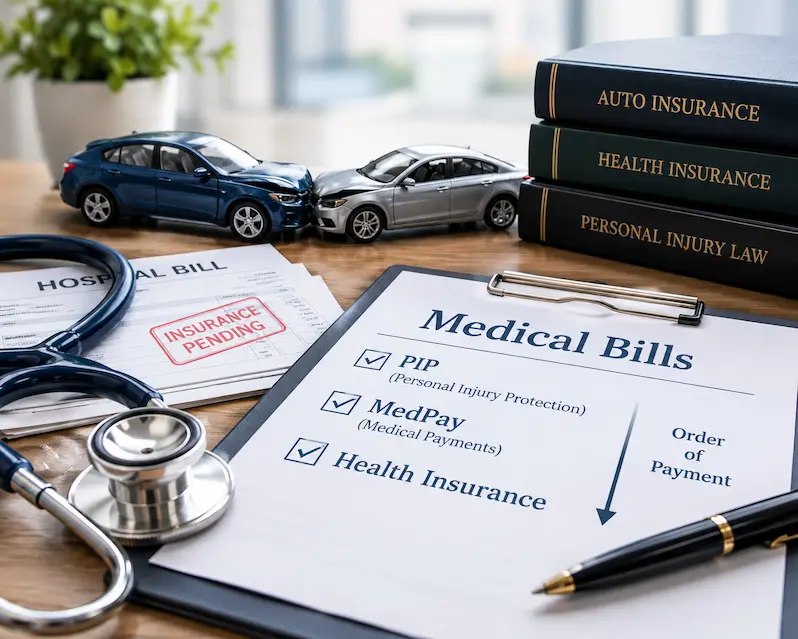
The other driver’s insurer usually pays once, at settlement — not as bills arrive. Until then, your own coverage pays: in no-fault states, your PIP goes first; elsewhere, MedPay (if you have it) and your health insurance usually carry the bills. Whatever pays now often expects to be repaid from your settlement.
Get the care you need first. Billing questions can be sorted out afterward, and nothing here is a reason to delay treatment.
If a hospital won’t bill your health insurance and files a lien instead, your state’s law may limit that — ask in writing. Jump to hospital liens.
Find out who pays first in your situation
See what you owe now vs. later
Just crashed and not sure what to do first? Start with What to Do After a Car Accident.
- Who pays first
- No-fault states
- When PIP runs out
- Hospital liens
- Medicare & Medicaid
- Letters of protection
- Paying it back
- Letter to the hospital
Rules verified . Your state’s law and your policies control.
Find Out Who Pays First
Pick your state and coverage. The tool shows a likely order for that combination. Do not enter names, claim numbers, or health details.
Related guides: Workers’ Compensation | Hospital Charity Care | Partially at Fault
Why the At-Fault Driver's Insurer Doesn't Pay Your Bills Right Away
Liability insurance generally pays once, at settlement or judgment, after fault and the full value of the claim are worked out.
That takes months, sometimes longer. Your bills do not wait. So your own coverage carries them in the meantime.
No-fault or at-fault rules decide which of your own coverages goes first.
PIP, MedPay, and your health plan each have their own terms and limits.
Give every provider your health insurance card and any auto claim number. Keep every bill and explanation of benefits.
If the crash involved a rideshare vehicle, coverage can work differently. See Rideshare Insurance Gap. If you share some of the blame, see Partially at Fault.
No-Fault vs. At-Fault: The State Rule That Sets the Order
In a no-fault state your own PIP pays first whoever caused the crash, while in an at-fault state your own health coverage and any MedPay carry the bills until the at-fault insurer pays at settlement.
Twelve states are commonly listed as no-fault: Florida, Hawaii, Kansas, Kentucky, Massachusetts, Michigan, Minnesota, New Jersey, New York, North Dakota, Pennsylvania, and Utah. Sources count them differently, so check your state insurance department.
Kentucky, New Jersey, and Pennsylvania are choice no-fault states. Drivers there choose how much right to sue they keep. In Kentucky, rejecting no-fault in writing also gives up basic reparation benefits.
Some states require PIP but otherwise use fault rules. Delaware is one example.
Michigan's 2019 reform replaced mandatory unlimited PIP medical coverage with tiered choices, including a coordinated option where your health plan pays auto-related medical bills first.
Florida note: you may see claims online that Florida ended no-fault on July 1, 2026. The repeal bills did not pass in the 2026 session and PIP remained required. Confirm with the state.
| State | System | PIP minimum | Lawsuit threshold note | Source |
|---|---|---|---|---|
| Delaware | At-fault rules with required PIP | $15,000 per person / $30,000 per accident | Fault rules apply to lawsuits | Delaware Dept. of Insurance guide |
| Florida | No-fault | $10,000 | Serious-injury (verbal) threshold | Fla. Stat. 627.736 and 627.737; Florida Statutes |
| Hawaii | No-fault | $10,000 per person | Monetary threshold | HRS 431:10C-103.5 |
| Kansas | No-fault | $4,500 medical, plus smaller other benefits | Monetary threshold | Kansas Automobile Injury Reparations Act (K.S.A. 40-3101 et seq.) |
| Kentucky | Choice no-fault | $10,000 basic reparation benefits | Monetary threshold if you accept no-fault | KRS 304.39-020 |
| Massachusetts | No-fault | $8,000 per person | Monetary threshold | Mass.gov |
| Michigan | No-fault | You choose a medical level: unlimited, $500,000, $250,000, $250,000 with exclusions, $50,000 for some Medicaid enrollees, or an opt-out for some people with Medicare | Serious-impairment (verbal) threshold | Michigan DIFS |
| Minnesota | No-fault | $40,000 ($20,000 medical + $20,000 non-medical) | Monetary and severity threshold | Minnesota Commerce Dept. |
| New Jersey | Choice no-fault | $15,000 medical minimum on a basic policy; standard options up to $250,000 | Limited-right-to-sue option (verbal threshold) | NJ Dept. of Banking and Insurance |
| New York | No-fault | $50,000 per person | Serious-injury threshold; losses above the basic limit may also be claimed | NY Dept. of Financial Services |
| North Dakota | No-fault | $30,000 per person | Monetary threshold | N.D.C.C. ch. 26.1-41 |
| Pennsylvania | Choice no-fault | $5,000 first-party medical benefits | Limited-tort or full-tort choice | 75 Pa.C.S. 1711 |
| Utah | No-fault | $3,000 per person | Monetary threshold | Utah Code 31A-22-307 |
See the states this guide has verified
- Delaware - at-fault rules, PIP required: $15,000 / $30,000.
- Florida - no-fault: $10,000.
- Hawaii - no-fault: $10,000.
- Kansas - no-fault: $4,500 medical, plus smaller benefits.
- Kentucky - choice no-fault: $10,000.
- Massachusetts - no-fault: $8,000.
- Michigan - no-fault: you choose a medical level.
- Minnesota - no-fault: $40,000 ($20,000 medical).
- New Jersey - choice no-fault: $15,000 minimum medical.
- New York - no-fault: $50,000.
- North Dakota - no-fault: $30,000.
- Pennsylvania - choice no-fault: $5,000 medical.
- Utah - no-fault: $3,000.
Checked October 28, 2026. Any other state: check your state insurance department. The finder above gives your state's system.
Find your state in the finder or the list. If it is not listed, ask your state insurance department whether PIP is required.
PIP, MedPay, and Health Insurance: Who Pays First
There is no single order that fits every crash: your state's system comes first, then your policies' terms.
A typical no-fault order, in a state where PIP goes first:
- PIP, up to its limit
- Health insurance, for what PIP does not cover
- Settlement from the at-fault driver's insurer, at the end
A typical order in an at-fault state without required PIP:
- MedPay and/or health insurance, depending on state law and policy wording
- The other one, for what remains
- Settlement from the at-fault driver's insurer, at the end
If you were driving for work, workers' compensation generally pays first. See Workers' Compensation and Employee Car Accident on a Work Errand.
MedPay is optional in many states, pays regardless of fault, and usually has lower limits. Some state laws make it primary. Colorado's C.R.S. 10-4-641(1) is an example: it says medical payments coverage "shall be primary to any health insurance benefit" of a person hurt in a motor vehicle accident, as the state Supreme Court noted in Harvey v. Centura (2021 CO 65). Other policies coordinate with health insurance. Read the "other insurance" wording in yours.
| Situation | Usually pays first | Then | At the end |
|---|---|---|---|
| No-fault state, you have PIP | Your PIP, up to its limit | Health insurance or MedPay for the rest; in Michigan and some other states your election can put health insurance first | The at-fault driver's liability insurer, if you may claim against them |
| At-fault state, MedPay and health insurance | MedPay or health insurance, depending on state law and policy | The other one | Liability insurer at settlement |
| At-fault state, health insurance only | Health insurance, after deductible and coinsurance | You pay deductible and coinsurance | Liability insurer at settlement; the plan may seek repayment |
| Medicare | Liability, no-fault, or workers' comp coverage that pays promptly | Medicare, conditionally, if they do not pay promptly | Settlement repays Medicare's conditional payments |
| Medicaid | Other coverage first (PIP, MedPay, liability, health plan) | Medicaid, for covered services | State may recover from a settlement |
| Work-related crash | Workers' compensation | Other coverage for what comp does not pay; coordination varies | Liability insurer at settlement; the comp carrier may seek repayment |
| Uninsured | Hospital financial assistance, if you qualify | Payment plan or negotiated bill | Liability insurer at settlement; a lien is possible |
Why using PIP or MedPay first can save money: where it pays first, it takes bills off the table before your health plan's deductible and coinsurance apply. That can leave less for you to pay.
Read your auto declarations page for PIP and MedPay limits, and your health plan booklet for how it treats accident claims. If your health plan denies an accident claim, see Health Insurance Appeal.
When PIP or MedPay Runs Out
When PIP or MedPay is used up, the remaining bills usually go to your health insurance, and in some cases to a claim against the at-fault driver.
Your health plan pays covered care after your deductible and coinsurance. Ask your auto insurer for a written record of what it has paid and when your limit was reached. Send that to your health plan and providers.
Some no-fault states let you claim losses above the PIP limit from the at-fault driver, even without a serious injury. New York is one example.
If the other driver had no insurance or too little, your own uninsured or underinsured motorist coverage may help. See Uninsured Motorist Coverage.
Do not stop treatment because a limit is close. Tell providers early, ask them to bill your health plan next, and keep every explanation of benefits.
The Hospital Won't Bill Your Health Insurance: Liens Explained
A hospital lien is a claim on any money you later recover, and some hospitals file one instead of billing your health insurance, but your state's law may limit that.
Why do it? A lien can be based on the hospital's billed charges, which can be higher than the contracted rate your insurer would pay. That is "can," not "always." Some states cap or reduce it.
State law varies widely. Some states require billing your health insurance first. Others let the hospital choose.
| State | Rule | Source |
|---|---|---|
| Indiana | The lien must first be reduced by benefits you are entitled to under a health plan or medical insurance, after the hospital makes reasonable efforts to pursue the claim. The hospital cannot seek charges beyond your obligation under your private benefits, and cannot enforce collection until the claim is resolved. The lien does not reach Medicare beneficiaries or auto med-pay claims. If liens would leave you under 20% of a settlement, they are reduced pro rata. | IC 32-33-4-3 and 3.5 (2013 codification; confirm current text) |
| Colorado | Before a lien is created, the hospital must submit charges to the property and casualty insurer and the "primary medical payer of benefits." In Harvey v. Centura, 2021 CO 65 (Sept. 13, 2021), the Colorado Supreme Court held that when Medicare is the patient's primary health insurer, the hospital must bill Medicare first. | C.R.S. 38-27-101; Harvey v. Centura |
| Alabama | Act 2019-273 (HB 11, passed May 2019) amended Ala. Code 35-11-371. The bill's title says hospitals must seek compensation solely from the patient's health insurance. The text says no hospital may perfect a lien for a patient covered by a health care payor's policy, with exceptions. The exceptions include a contrary contract or law, coverage the hospital did not know about, government payors such as Medicare or Medicaid, and a payor's denial of a properly coded claim. Later bills have proposed more changes; confirm current text. | Ala. HB 11 (2019); Ala. Code 35-11-371 |
| Nevada | A hospital that has a contract with your health insurer and wants to perfect a lien must send a notice of intent by registered or certified mail within 90 days after hospitalization ends, to the liability insurer and to you. It must then proceed with collection efforts within 30 days, or the notice is void. This does not apply to Medicare, Medicaid, or CHIP. | NRS 108.605 |
| North Carolina (court ruling) | In Sykes v. Vixamar (N.C. Ct. App., June 18, 2019, No. COA18-525), the court held hospitals "may make this choice without abandoning their medical liens." A hospital could rely on its statutory lien without billing the patient's health insurer. It still could not bill the patient directly for charges insurance would have covered, and it risks nonpayment if the other driver is not liable or cannot pay. | Sykes v. Vixamar |
1. Give the hospital your insurance information at registration or as soon as you can.
2. Send the letter below and keep a copy.
3. Ask for an itemized bill and confirmation of who has been billed.
4. Do not ignore a lien notice. Deadlines and your right to contest vary by state. In Indiana, for example, a lien can be contested by motion in the circuit court (IC 32-33-4-4).
5. Talk to a personal-injury attorney about any lien or serious injury. Many offer free consultations.
Letter to the Hospital Billing Office
Fill in the brackets, then send it and keep a copy. It is a documented request, not a guarantee.
Medicare and Medicaid Rules
Medicare is a secondary payer to liability, no-fault, and workers' comp coverage, and Medicaid is the payer of last resort.
The Medicare 120-day rule, in plain terms: providers generally must bill the liability insurer, or file an acceptable lien, rather than bill Medicare.
"Promptly" means payment within 120 days. The clock starts on the earlier of two dates: when a claim is filed or a lien is placed, or the date of service (for inpatient care, the discharge date). The definition is in 42 CFR 411.50(b).
If the liability insurer does not pay within that period, the provider may do one of two things. It may bill Medicare and withdraw its claim or lien. Or it may keep the claim or lien and not bill Medicare. It cannot do both. A special rule applies in Oregon.
Medicare may make a conditional payment when a primary payer has not paid promptly. That payment is conditioned on repayment, so Medicare can seek reimbursement from your settlement. "Conditional payment" is a Medicare term. It does not describe health plans or Medicaid.
Hospital liens come from state law, not from Medicare rules. Colorado's Supreme Court said so in Harvey v. Centura, and Indiana's lien law excludes Medicare beneficiaries.
| Program | Position | What providers can do | What you may owe back |
|---|---|---|---|
| Medicare | Secondary to liability, no-fault, and workers' comp | Pursue the liability insurer for 120 days. Then bill Medicare and withdraw the lien, or keep the lien and not bill Medicare, not both. | Conditional payments, repaid from a settlement |
| Medicaid | Payer of last resort | Bill other coverage first; follow your state's Medicaid rules | Your state Medicaid agency may recover from a settlement |
If you have Medicare or Medicaid, tell the provider about the crash and any auto claim right away. Keep letters from Medicare or your state Medicaid agency. They may list what must be repaid.
Letters of Protection: When They Help and What They Cost
A letter of protection is a provider's agreement to wait for payment from a future settlement, and it can mean higher charges and personal responsibility if the case does not pay.
It can help when you have no other way to get treatment. But a provider treating under a letter of protection may charge more than an insurer's rates. If the claim pays less than expected, or nothing, you may still owe the bill. Rules vary by state.
If you have health insurance, ask whether the provider will bill it. A letter of protection is not required to get care.
Before signing, ask in writing: What will the charges be? Am I personally responsible if there is no recovery? Will you accept less? Who else are you billing? A personal-injury attorney can review it. Many offer free consultations.
What You'll Owe Back From a Settlement
Whoever pays your bills now, including your health plan, Medicare, or Medicaid, often has a right to be repaid from your settlement.
Health plans typically have reimbursement (subrogation) rights. Self-funded employer (ERISA) plans often have stronger terms. PIP or MedPay insurers, workers' comp carriers, hospitals with liens, Medicare, and state Medicaid agencies may also claim repayment. Whether and how much depends on your state and the document that governs each payer.
The math on fees, liens, and what you keep belongs in How Much of Your Settlement Will You Keep. This guide only shows who may claim.
Pay Now vs. Pay Back Later
Enter dollar amounts only. If you have no health insurance, enter 100 for coinsurance.
No Insurance? Your Options
If you have no coverage, ask the hospital for financial assistance before you agree to any payment plan.
Nonprofit hospitals must have a written financial-assistance (charity care) policy under Section 501(r) of the Internal Revenue Code. Ask for it and for the application. See Hospital Charity Care.
- Ask for an itemized bill and review it line by line.
- Ask whether Medicaid or a state program can apply to recent bills.
- Ask for a payment plan in writing, with no interest if possible.
- Use PIP or MedPay if you have it, even if you have no health plan.
- Do not skip care. Tell providers you are working on coverage.
Send the letter in the hospital liens section. It asks for the financial-assistance policy and application.
FAQ
Who pays medical bills after a car accident?
Your own coverage carries the bills until a settlement. In no-fault states that is PIP first. Elsewhere it is MedPay (if you have it) and your health insurance. The at-fault driver's insurer usually pays at the end. Use the finder for your state.
Does the at-fault driver's insurance pay my bills right away?
Usually not. Liability insurance generally pays after fault and damages are resolved, often at settlement or judgment.
Should I use my health insurance after a car accident?
Generally yes, if no PIP or MedPay covers the care first. Get treatment, and give providers your health card. In no-fault states, also give them your PIP details. Your plan may ask to be repaid later.
Will my health insurance pay if I was at fault?
Generally yes. Health plans pay covered care under their terms and do not turn on fault, though they may ask how the injury happened. If a claim is denied, see Health Insurance Appeal.
What is PIP, and who has to have it?
PIP is first-party coverage that pays your medical bills and some other losses regardless of fault. It is required in the no-fault states and in some at-fault states, such as Delaware. See Table 1 and your state insurance department.
Which pays first, PIP or health insurance?
In no-fault states PIP generally goes first, up to its limit. Exceptions exist where you elected coordination with health insurance, as Michigan allows.
Is MedPay primary or secondary?
It depends on state law and your policy. Colorado's C.R.S. 10-4-641 makes MedPay primary to health insurance. Other policies coordinate. Check the "other insurance" wording.
What happens when PIP runs out?
Your health insurance usually takes over, after your deductible and coinsurance. Some states let you claim losses above PIP from the at-fault driver. If that driver was uninsured or underinsured, your UM/UIM coverage may help.
Can a hospital refuse to bill my health insurance?
In some states a hospital may choose to rely on a lien instead. Others require billing insurance first. Ask in writing. See Table 3.
Can a hospital put a lien on my settlement?
Many states give hospitals lien rights. Whether it can file one, for how much, and after what steps depends on your state. Notice rules and limits vary.
Which states require hospitals to bill health insurance first?
Verified examples: Colorado and Alabama require it in most cases, and Indiana reduces and limits the lien by your insurance benefits. Nevada requires a notice of intent first. A North Carolina court allowed a lien without billing the insurer. This is not a full list.
How do I fight a hospital lien?
Ask for an itemized bill and who has been billed. Check your state's notice and filing rules. Ask the hospital to apply your insurance. Some states let you contest a lien in court. A personal-injury attorney can help, and many offer free consultations.
Does Medicare pay for car accident injuries?
Only as a secondary payer. It can pay conditionally if a primary payer does not pay promptly, and it must be repaid from a settlement.
What is a Medicare conditional payment?
It is a payment Medicare makes when a liability, no-fault, or workers' comp payer has not paid promptly. It is conditioned on repayment. The term applies to Medicare only.
Does Medicaid cover car accident injuries?
Medicaid can cover services other coverage does not pay, as the payer of last resort. Your state may seek repayment from a settlement.
What is a letter of protection?
A promise to pay a provider from a future settlement. It can mean higher charges and personal responsibility if the case does not pay. See the section above.
Do I have to pay my health insurance back from a settlement?
Often your plan has reimbursement rights under its terms and state law. Self-funded employer plans can be stronger. Ask the plan for its claim amount in writing, and see How Much of Your Settlement Will You Keep.
What if my medical bills are more than the settlement?
Repayment claims may sometimes be negotiated or reduced. Some states cap liens. Indiana, for example, protects at least 20% of a settlement for the patient. Talk to a personal-injury attorney before you accept.
Sources
- 42 CFR Part 411, Subpart D (411.50, 411.54)
- CMS Medicare Secondary Payer manual
- Harvey v. Centura, 2021 CO 65 (Colorado Supreme Court)
- C.R.S. 38-27-101
- Indiana Code 32-33-4 (2013 codification)
- Alabama HB 11 (2019), enrolled
- NRS 108.605
- Sykes v. Vixamar (N.C. Ct. App. 2019)
- State insurance departments and statutes linked in Table 1
- Internal Revenue Code Section 501(r), financial assistance policies for charitable hospitals
Last updated:
This article is general information, not legal, insurance, or medical advice. Payment order and lien rules vary by state and policy. Facts verified on October 28, 2026.

Daniel Hayes is the founder and sole researcher at AdvoraHQ. He covers U.S. personal finance, insurance, and consumer law — working directly from IRS publications, federal and state statutes, court opinions, and SEC filings rather than secondary summaries. His focus is the gap between what readers think they know and what the source documents actually say. Daniel is not a licensed attorney, CPA, or financial advisor; his articles are educational and not personalized advice. Reach him at Daniel.Hayes@advorahq.com.