
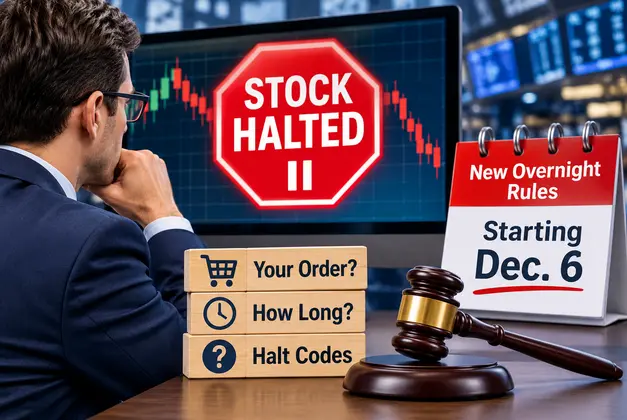
Quick answer
- A halt freezes trading in the stock. Your shares and cash are still in your account.
- Pending orders usually wait and are processed when trading resumes, possibly at a very different price. Whether you can cancel depends on your broker and order type.
- How long it lasts depends on the type: a volatility (LULD) pause is five minutes and can be extended; a news halt lasts until the news is out; an SEC suspension can run up to 10 business days.
- From December 6, 2026, overnight trading gets its own price guardrails.
The one thing to check right now: look at your order type. A market or stop order can fill far from the last price when the stock reopens. Why stop-losses sell below the stop.
See what your halt code means and what happens to your order →
Rules verified November 20, 2026, including changes effective December 6, 2026.
Halt Code & Order Checker
Pick what you see in your app. You get a plain-English read of the code and what usually happens to your order. No ticker needed, and nothing you choose leaves this page.
Your result
What Happens to Your Order When a Stock Is Halted
Your order generally sits and waits, then is processed when trading resumes, at whatever price the stock reopens.
Nothing executes during a regulatory halt. The question is what your order does at the reopen, and that depends mostly on the order type.
Your order at the reopen, by type
| Order type | During the halt | At the reopen | Risk |
|---|---|---|---|
| Market | Waits. It cannot execute while the stock is halted. | Executes at or near the reopening price. | That price can be far from the last trade you saw. |
| Limit | Waits. | Fills only at your limit or better. If the stock reopens past your limit, it may not fill. | You may miss the trade, but you do not pay past your limit. |
| Stop (stop-loss) | Waits. It does not trigger while nothing is trading. | If the reopening price is past your stop, it triggers and becomes a market order. | It can fill well past your stop price. How that happens. |
| Stop-limit | Waits. | If triggered, it becomes a limit order. A big gap can leave it unfilled. | If it does not fill, your position stays open. |
| Options | Options on the stock are generally halted too. | Options trading generally restarts after the stock reopens on its listing exchange. | Premiums can jump at the reopen, and expiration dates do not move. |
| Fractional shares | Handled by your broker; rules vary. | Generally processed when the halt lifts. | At least one broker says a routed fractional order cannot be cancelled during a halt. |
| Day vs. good-til-canceled (GTC) | Both wait. | A day order may expire if the halt runs past its session; a GTC order generally stays open. | Check how your broker treats each one. A GTC order can fill days later at a very different price. |
Market
During the halt: Waits. It cannot execute while the stock is halted.
At the reopen: Executes at or near the reopening price.
Risk: That price can be far from the last trade you saw.
Limit
During the halt: Waits.
At the reopen: Fills only at your limit or better. If the stock reopens past your limit, it may not fill.
Risk: You may miss the trade, but you do not pay past your limit.
Stop (stop-loss)
During the halt: Waits. It does not trigger while nothing is trading.
At the reopen: If the reopening price is past your stop, it triggers and becomes a market order.
Risk: It can fill well past your stop price. How that happens.
Stop-limit
During the halt: Waits.
At the reopen: If triggered, it becomes a limit order. A big gap can leave it unfilled.
Risk: If it does not fill, your position stays open.
Options
During the halt: Options on the stock are generally halted too.
At the reopen: Options trading generally restarts after the stock reopens on its listing exchange.
Risk: Premiums can jump at the reopen, and expiration dates do not move.
Fractional shares
During the halt: Handled by your broker; rules vary.
At the reopen: Generally processed when the halt lifts.
Risk: At least one broker says a routed fractional order cannot be cancelled during a halt.
Day vs. good-til-canceled (GTC)
During the halt: Both wait.
At the reopen: A day order may expire if the halt runs past its session; a GTC order generally stays open.
Risk: Check how your broker treats each one. A GTC order can fill days later at a very different price.
General mechanics; broker policies vary. Verified November 20, 2026.
Why prices jump at the reopen
Halted stocks usually reopen through an auction on the listing exchange. Buy and sell orders build up during the halt, and the auction sets one price that matches as many of them as possible.
If news came out during the halt, that price can be far from the last trade. Robinhood’s help page puts it plainly: a halted stock can begin trading at a very different price when it resumes.
Your chart may look like a flat line during the halt. That is just the last trade repeated, not a real price.
Can you cancel?
Sometimes. It depends on your broker and the order type, so check before you assume.
Robinhood says you can still cancel or replace a pending whole-share order during a halt, but a fractional order that was already routed to a market center can’t be cancelled and will execute when the halt lifts.
Fidelity says that during a halt you can still cancel open orders and exercise options.
Some brokers cancel certain orders themselves when a stock halts. Wealthsimple, for example, lists a trading halt as a reason it may cancel an order.
A cancel request is also only a request. If the halt lifts first, the order can fill.
“While It’s Halted” checklist
- 1. Confirm the halt and its code on the exchange’s official halt page, not social media.
- 2. Look at every open order on that stock: type, limit or stop price, day or GTC.
- 3. Check your broker’s cancel rules for halted stocks, especially fractional orders.
- 4. Ask yourself: would I still want this order to fill if it reopens 20% higher or lower?
- 5. If you hold options, margin, or a short: check expiration, margin requirements, and borrow fees.
- 6. Read the company’s news once it’s released (T1 → T2).
- 7. If it’s an SEC suspension (H10): read the SEC’s suspension order and investor bulletin before doing anything.
The Four Ways Trading Stops
Trading stops for one of four reasons: news or a regulatory question, a volatility pause, a market-wide crash, or an SEC suspension.
Each has a different trigger and a different clock. Knowing which one you are in tells you most of what to expect.
| Type | Who triggers it | Why | How long | How it reopens |
|---|---|---|---|---|
| News or regulatory halt (T1, T2, T3, T12, H4, H9, H11, M1) HOURS | The listing exchange (FINRA for many OTC stocks) | Material news is coming, the exchange has questions, or the company has a compliance or corporate-action issue | Until the news is out or the question is answered: often hours, sometimes days | Posted resumption time, then a reopening auction |
| Limit Up-Limit Down (LULD) pause (LUDP, LUDS) MINUTES | Automatic under the LULD Plan; declared by the primary listing exchange | The price hit its band and stayed there for 15 seconds | Five minutes; can be extended in five-minute steps | Reopening auction, with price collars that widen at each extension |
| Market-wide circuit breaker (MWC1, MWC2, MWC3) MINUTES | Exchanges and FINRA, triggered by the S&P 500 | The S&P 500 fell 7%, 13% or 20% from the prior close during regular hours | Level 1 or 2: 15 minutes (only before 3:25 p.m. ET). Level 3: rest of the day | Listing exchanges reopen their stocks through auctions |
| SEC trading suspension (H10) DAYS OR LONGER | The SEC | Questions about the company’s information, its trading, or missing reports | Up to 10 business days | Exchange stocks resume when it ends; OTC stocks need a broker to file Form 211 first |
News or regulatory halt (T1, T2, T3, T12, H4, H9, H11, M1)
HOURS
Who: The listing exchange (FINRA for many OTC stocks)
Why: Material news is coming, the exchange has questions, or the company has a compliance or corporate-action issue
How long: Until the news is out or the question is answered: often hours, sometimes days
How it reopens: Posted resumption time, then a reopening auction
Limit Up-Limit Down (LULD) pause (LUDP, LUDS)
MINUTES
Who: Automatic under the LULD Plan; declared by the primary listing exchange
Why: The price hit its band and stayed there for 15 seconds
How long: Five minutes; can be extended in five-minute steps
How it reopens: Reopening auction, with price collars that widen at each extension
Market-wide circuit breaker (MWC1, MWC2, MWC3)
MINUTES
Who: Exchanges and FINRA, triggered by the S&P 500
Why: The S&P 500 fell 7%, 13% or 20% from the prior close during regular hours
How long: Level 1 or 2: 15 minutes (only before 3:25 p.m. ET). Level 3: rest of the day
How it reopens: Listing exchanges reopen their stocks through auctions
SEC trading suspension (H10)
DAYS OR LONGER
Who: The SEC
Why: Questions about the company’s information, its trading, or missing reports
How long: Up to 10 business days
How it reopens: Exchange stocks resume when it ends; OTC stocks need a broker to file Form 211 first
Separately, an exchange can stop trading on its own platform for technical reasons. That kind of operational halt doesn’t stop other markets. The regulatory halts above apply across U.S. markets.
How Long Does a Trading Halt Last?
Anywhere from five minutes to weeks, depending on the type, so don’t assume a halt will be short.
Only LULD pauses have a built-in five-minute clock. Everything else runs until a condition is met.
MINUTES
LULD pauses (five minutes, extendable) and Level 1 or 2 circuit breakers (15 minutes).
HOURS
News and regulatory halts (T1, T2, T12, H11, M1), and a Level 3 circuit breaker, which lasts the rest of the day.
DAYS OR LONGER
SEC suspensions (up to 10 business days) and halts tied to listing problems or delisting (H4, H9).
Why an LULD pause can run past five minutes
If the listing exchange can’t reopen the stock at the end of the pause, for example because there are far more sell orders than buy orders, the pause is extended in five-minute steps. Under LULD Plan Amendment 12, the auction’s allowed price range (the collar) widens at each extension until the stock can reopen.
Why some halts last days
News halts end when the news is out. Halts over missing filings, listing compliance or an SEC suspension end only when the underlying problem is fixed or the deadline passes. Some of those stocks never return to their old market. See SEC suspensions and OTC stocks below.
Halt Codes Decoded
The code in your app tells you who stopped trading and why.
Codes come from the Nasdaq Trader halt list, which covers stocks listed on all U.S. exchanges. NYSE’s halt page shows reasons in words, such as “News Pending” or “LULD.” Brokers may show either.
| Code | Meaning | Who | Typical next step |
|---|---|---|---|
| T1 | News pending. Trading is stopped so material company news can reach everyone at the same time. HOURS | Listing exchange (often after the company tells it news is coming) | Watch for the company’s release and a T2 or T3 update. |
| T2 | News released. The news has started going out; the halt continues briefly so investors can read it. HOURS | Listing exchange | A T3 notice with quote and trade resumption times, then a reopening auction. |
| T3 | News and resumption times. The news is fully out, or the reason for the halt no longer applies. Resumption times are posted. MINUTES | Listing exchange | Quotes return first, then trading reopens through an auction. |
| T12 | Additional information requested. The exchange has asked the company for more information before trading continues. HOURS | Listing exchange | Watch for a company statement and an exchange resumption notice. |
| LUDP | Volatility trading pause (LULD). The price hit a Limit Up-Limit Down band and did not move back inside within 15 seconds. MINUTES | Automatic under the LULD Plan; declared by the primary listing exchange | A reopening auction on the listing exchange. |
| LUDS | Volatility pause, straddle condition. An LULD pause called while quotes straddled a price band, a sign of a disorderly market. MINUTES | Primary listing exchange, under the LULD Plan | A reopening auction on the listing exchange. |
| MWC1 | Market-wide circuit breaker, Level 1. The S&P 500 fell 7% from the prior close before 3:25 p.m. ET, so trading stops in all U.S. stocks. MINUTES | Market-wide rule (exchanges and FINRA), triggered by the S&P 500 | Each listing exchange reopens its stocks through auctions. |
| MWC2 | Market-wide circuit breaker, Level 2. The S&P 500 fell 13% from the prior close before 3:25 p.m. ET, so trading stops in all U.S. stocks. MINUTES | Market-wide rule (exchanges and FINRA), triggered by the S&P 500 | Each listing exchange reopens its stocks through auctions. |
| MWC3 | Market-wide circuit breaker, Level 3. The S&P 500 fell 20% from the prior close. Trading stops in all U.S. stocks for the rest of the day. HOURS | Market-wide rule (exchanges and FINRA), triggered by the S&P 500 | Trading resumes the next trading day. |
| MWC0 | Circuit breaker halt carried over. A market-wide circuit breaker halt carried over from the previous day. HOURS | Market-wide rule | Listing exchanges reopen their stocks. |
| MWCQ | Circuit breaker resumption. The market-wide halt is ending and quoting is resuming. MINUTES | Market-wide rule | Reopening auctions on the listing exchanges. |
| H10 | SEC trading suspension. The SEC has suspended trading, for example over questions about the company’s information or about trading in the stock. DAYS OR LONGER | U.S. Securities and Exchange Commission | Read the SEC’s suspension order; exchange stocks resume when it ends, OTC stocks need a Form 211 first. |
| H4 | Non-compliance with listing rules. Halted because the company is not meeting the exchange’s listing requirements. DAYS OR LONGER | Listing exchange | Watch for company filings and exchange notices. |
| H9 | Not current in filings. Halted because the company is behind on its required reports. DAYS OR LONGER | Listing exchange | Watch for the overdue filings and exchange notices. |
| H11 | Regulatory concern. Halted together with another exchange or market for regulatory reasons, such as a halt on a foreign home market. HOURS | Listing exchange or FINRA, with another market | Watch for a resumption notice. |
| M1 | Corporate action. Halted for a corporate action, such as a reverse split, merger or other event the exchange must process. HOURS | Listing exchange | From December 6, 2026, some corporate-action halts run through the overnight session and reopen in the morning. |
| IPO1 | IPO not yet trading. A new listing that has not opened yet. Nothing is wrong; the first trade has not happened. HOURS | Listing exchange | IPOQ (quotes visible), then the opening trade. |
| IPOQ | IPO released for quotation. Quotes for the new listing are visible; trading opens after the quote period. MINUTES | Listing exchange | The IPO opening trade. |
| IPOE | IPO positioning window extension. The IPO’s opening has been pushed back so orders can be balanced. MINUTES | Listing exchange | The IPO opening trade. |
T1 — News pending
Trading is stopped so material company news can reach everyone at the same time.
Tier: HOURS
Who: Listing exchange (often after the company tells it news is coming)
Typical next step: Watch for the company’s release and a T2 or T3 update.
T2 — News released
The news has started going out; the halt continues briefly so investors can read it.
Tier: HOURS
Who: Listing exchange
Typical next step: A T3 notice with quote and trade resumption times, then a reopening auction.
T3 — News and resumption times
The news is fully out, or the reason for the halt no longer applies. Resumption times are posted.
Tier: MINUTES
Who: Listing exchange
Typical next step: Quotes return first, then trading reopens through an auction.
T12 — Additional information requested
The exchange has asked the company for more information before trading continues.
Tier: HOURS
Who: Listing exchange
Typical next step: Watch for a company statement and an exchange resumption notice.
LUDP — Volatility trading pause (LULD)
The price hit a Limit Up-Limit Down band and did not move back inside within 15 seconds.
Tier: MINUTES
Who: Automatic under the LULD Plan; declared by the primary listing exchange
Typical next step: A reopening auction on the listing exchange.
LUDS — Volatility pause, straddle condition
An LULD pause called while quotes straddled a price band, a sign of a disorderly market.
Tier: MINUTES
Who: Primary listing exchange, under the LULD Plan
Typical next step: A reopening auction on the listing exchange.
MWC1 — Market-wide circuit breaker, Level 1
The S&P 500 fell 7% from the prior close before 3:25 p.m. ET, so trading stops in all U.S. stocks.
Tier: MINUTES
Who: Market-wide rule (exchanges and FINRA), triggered by the S&P 500
Typical next step: Each listing exchange reopens its stocks through auctions.
MWC2 — Market-wide circuit breaker, Level 2
The S&P 500 fell 13% from the prior close before 3:25 p.m. ET, so trading stops in all U.S. stocks.
Tier: MINUTES
Who: Market-wide rule (exchanges and FINRA), triggered by the S&P 500
Typical next step: Each listing exchange reopens its stocks through auctions.
MWC3 — Market-wide circuit breaker, Level 3
The S&P 500 fell 20% from the prior close. Trading stops in all U.S. stocks for the rest of the day.
Tier: HOURS
Who: Market-wide rule (exchanges and FINRA), triggered by the S&P 500
Typical next step: Trading resumes the next trading day.
MWC0 — Circuit breaker halt carried over
A market-wide circuit breaker halt carried over from the previous day.
Tier: HOURS
Who: Market-wide rule
Typical next step: Listing exchanges reopen their stocks.
MWCQ — Circuit breaker resumption
The market-wide halt is ending and quoting is resuming.
Tier: MINUTES
Who: Market-wide rule
Typical next step: Reopening auctions on the listing exchanges.
H10 — SEC trading suspension
The SEC has suspended trading, for example over questions about the company’s information or about trading in the stock.
Tier: DAYS OR LONGER
Who: U.S. Securities and Exchange Commission
Typical next step: Read the SEC’s suspension order; exchange stocks resume when it ends, OTC stocks need a Form 211 first.
H4 — Non-compliance with listing rules
Halted because the company is not meeting the exchange’s listing requirements.
Tier: DAYS OR LONGER
Who: Listing exchange
Typical next step: Watch for company filings and exchange notices.
H9 — Not current in filings
Halted because the company is behind on its required reports.
Tier: DAYS OR LONGER
Who: Listing exchange
Typical next step: Watch for the overdue filings and exchange notices.
H11 — Regulatory concern
Halted together with another exchange or market for regulatory reasons, such as a halt on a foreign home market.
Tier: HOURS
Who: Listing exchange or FINRA, with another market
Typical next step: Watch for a resumption notice.
M1 — Corporate action
Halted for a corporate action, such as a reverse split, merger or other event the exchange must process.
Tier: HOURS
Who: Listing exchange
Typical next step: From December 6, 2026, some corporate-action halts run through the overnight session and reopen in the morning.
IPO1 — IPO not yet trading
A new listing that has not opened yet. Nothing is wrong; the first trade has not happened.
Tier: HOURS
Who: Listing exchange
Typical next step: IPOQ (quotes visible), then the opening trade.
IPOQ — IPO released for quotation
Quotes for the new listing are visible; trading opens after the quote period.
Tier: MINUTES
Who: Listing exchange
Typical next step: The IPO opening trade.
IPOE — IPO positioning window extension
The IPO’s opening has been pushed back so orders can be balanced.
Tier: MINUTES
Who: Listing exchange
Typical next step: The IPO opening trade.
Code meanings from Nasdaq Trader, checked against NYSE on November 20, 2026. Durations are typical, not guaranteed.
Where to check official status
Nasdaq Trader current trading halts, with halt time, code and resumption times.
NYSE trading halts for NYSE Group listings.
For an SEC suspension, the SEC’s suspension order and the Investor.gov bulletin on trading after a suspension.
Limit Up–Limit Down, Explained Simply
LULD is a speed limit for a single stock: if the price moves too far, too fast, trading pauses for five minutes.
Each stock gets a price band above and below the average price of the stock over the preceding five minutes. The band moves as the average moves.
If the price reaches a band and doesn’t move back inside within 15 seconds, trading pauses for five minutes. The listing exchange then reopens the stock through an auction. If it can’t, the pause is extended as described above.
Tier 1 vs. Tier 2
Tier 1 covers S&P 500 and Russell 1000 stocks plus certain ETPs. Tier 2 is everything else. For stocks above $3, the standard band is 5% for Tier 1 and 10% for Tier 2. Lower-priced stocks get wider bands.
Wider bands near the close
LULD applies during regular hours, 9:30 a.m. to 4:00 p.m. ET. From 3:35 to 4:00 p.m., the bands double for all Tier 1 stocks and for Tier 2 stocks priced at or below $3.00.
What LULD doesn’t cover
LULD does not apply to OTC stocks, or to rights and warrants. It also doesn’t run in pre-market or after-hours trading. Overnight trading gets its own separate bands from December 6, 2026 (see below).
Market-Wide Circuit Breakers: 7%, 13%, 20%
If the S&P 500 falls 7%, 13% or 20% from the prior day’s close during regular hours, trading stops in every U.S. stock.
| Level | S&P 500 decline | Before 3:25 p.m. ET | At or after 3:25 p.m. ET |
|---|---|---|---|
| 1 | 7% | 15-minute halt | No halt |
| 2 | 13% | 15-minute halt | No halt |
| 3 | 20% | Halt for the rest of the day | Halt for the rest of the day |
The 3:25 p.m. rule
A Level 1 or Level 2 drop before 3:25 p.m. ET halts the market for 15 minutes. The same drop at or after 3:25 p.m. does not halt trading. Only a Level 3 drop stops trading that late.
Level 3: the rest of the day
A 20% drop halts trading for the rest of the day, whenever it happens. FINRA’s amendment to Rule 6121.02 (SR-FINRA-2026-025), effective December 6, 2026, keeps trading from resuming until 4:00 a.m. ET or later on the next trading day, even though some exchanges will by then trade overnight. FINRA says it filed the change in coordination with the exchanges.
New Overnight Rules Starting December 6, 2026
From December 6, 2026, exchanges that trade overnight get temporary price guardrails, but they work differently from daytime LULD.
That Sunday night, several exchanges begin trading from 9:00 p.m. to 4:00 a.m. ET, creating a near 23-hour, five-day trading week with a one-hour break from 8:00 to 9:00 p.m. ET. (For sessions and how to trade in them, see Can You Trade Stocks After Hours?)
| Session | Hours (ET) | Price-band type | Notes |
|---|---|---|---|
| Regular | 9:30 a.m.–4:00 p.m. | LULD bands around a rolling five-minute average | 15 seconds at a band → five-minute pause. Bands double 3:35–4:00 p.m. for Tier 1 and Tier 2 at or below $3.00. |
| Pre-market and after-hours | Before 9:30 a.m. and 4:00–8:00 p.m. (varies by venue) | No LULD bands | Exchanges and brokers use their own order protections. |
| Nightly break | 8:00–9:00 p.m. | None | No trading on 23/5 exchanges. |
| Overnight Protected Hours (from Dec. 6, 2026) | 9:00 p.m.–4:00 a.m., Sunday–Thursday nights | Temporary static bands, 20% beyond two reference prices | Phase one. No automatic pause; the listing exchange may halt, and a halted stock doesn’t reopen before 4:00 a.m. |
Regular
Hours (ET): 9:30 a.m.–4:00 p.m.
Price bands: LULD bands around a rolling five-minute average
Notes: 15 seconds at a band → five-minute pause. Bands double 3:35–4:00 p.m. for Tier 1 and Tier 2 at or below $3.00.
Pre-market and after-hours
Hours (ET): Before 9:30 a.m. and 4:00–8:00 p.m. (varies by venue)
Price bands: No LULD bands
Notes: Exchanges and brokers use their own order protections.
Nightly break
Hours (ET): 8:00–9:00 p.m.
Price bands: None
Notes: No trading on 23/5 exchanges.
Overnight Protected Hours (from Dec. 6, 2026)
Hours (ET): 9:00 p.m.–4:00 a.m., Sunday–Thursday nights
Price bands: Temporary static bands, 20% beyond two reference prices
Notes: Phase one. No automatic pause; the listing exchange may halt, and a halted stock doesn’t reopen before 4:00 a.m.
Sources: LULD Plan; SEC order approving Amendment No. 27 (Aug. 5, 2026); FINRA. Verified November 20, 2026.
How the Overnight Price Bands work
LULD Plan Amendment No. 27, approved by the SEC on August 5, 2026, creates Overnight Price Bands for “Overnight Protected Hours”: 9:00 p.m. ET Sunday through Thursday until 4:00 a.m. ET the next day.
Each stock gets two reference prices: the listing market’s official closing price, and the consolidated last round-lot sale as of 7:45 p.m. ET.
The lower band sits 20% below the lower reference price. The upper band sits 20% above the higher one.
There is a minimum distance: $1.00 for stocks that closed under $1.00, and $3.00 for stocks at $1.00 or more. Leveraged ETPs get bands scaled by their leverage.
The bands are static for the whole night. Trading venues must have policies to keep trades and displayed quotes inside them.
What happens if a stock hits a band overnight
There is no automatic five-minute pause overnight. Instead, the listing exchange may declare a regulatory halt when it’s warranted. During that halt, orders are rejected, and a stock halted overnight does not reopen before 4:00 a.m. ET.
Which exchanges will trade overnight
Not all of them. Nasdaq, NYSE Arca and Cboe EDGX have announced December 6, 2026 launches. MEMX and 24X also have rules in place for 23/5 trading. Cboe says only EDGX will add overnight hours; its BZX, BYX and EDGA exchanges keep their current schedules. The NYSE itself is not extending its own session, though NYSE-listed stocks can trade overnight on other exchanges.
Each exchange has its own rules. Nasdaq, for example, will accept only limit orders in its overnight session. Your broker decides whether and how you can reach these sessions.
Corporate-action halts overnight
Nasdaq and NYSE Arca will halt some stocks before the overnight session for corporate actions such as reverse splits. Those stocks don’t trade overnight and generally reopen the next morning.
SEC Trading Suspensions and OTC Stocks
An SEC suspension (code H10) can last up to 10 business days, and an OTC stock may not return to normal trading afterward.
The SEC suspends trading when it believes investors need protection, for example over questions about the accuracy of a company’s public information, missing reports, or possible manipulation. It can’t warn investors in advance.
When the suspension ends
Exchange-listed stocks resume trading automatically when the suspension ends.
OTC stocks do not. Before quoting can resume, a broker-dealer must review company information under Rule 15c2-11 and file a Form 211 with FINRA. If regulators still have concerns, that filing may not be approved.
Until then, an OTC stock may trade only on a limited, “unsolicited” basis: trades the customer starts, not ones a broker recommends. Investor.gov notes that a previously suspended stock may trade at a much lower price when it resumes.
Halts Around Splits, Mergers, and Delistings
Some halts are routine paperwork around a corporate event, not a sign of trouble.
Exchanges halt stocks to process events like reverse splits, mergers and listing changes. The code is often M1 (corporate action) or a news code.
Reverse split: the stock may be halted overnight and reopen at the new, higher price with fewer shares. How a reverse split changes your shares.
Merger or buyout: a news halt often comes before the announcement. What happens to your stock in a buyout.
Delisting: halts for listing non-compliance (H4) or missing filings (H9) can come before a delisting. What happens when a stock is delisted.
A halt is also not a market closure. On a market holiday, no stocks trade at all; a halt affects one stock or, in a circuit breaker, the whole market for a set time.
If You Hold Options, Use Margin, or Are Short
A halt freezes trading, but the clocks on options, margin and short positions keep running.
Options: when a stock halts, its options generally halt too, so you may not be able to close a position until it reopens. Expiration dates don’t move. If expiration is close, read what happens when an option expires in the money.
Margin: a big reopening gap can change your account’s equity in one move and trigger a call. How margin calls work.
Short positions: borrow fees generally keep accruing while the stock is halted, and you can’t buy to cover until it trades. How much it costs to short a stock.
Is a Halt Good or Bad News?
Neither by itself: a halt signals news or volatility, not direction.
A T1 halt can come before good news or bad news. An LULD pause can happen on a sharp rise as easily as a sharp fall. The code tells you why trading stopped, not where the price goes next.
What a halt does tell you is that the reopening price is uncertain. That’s why your order type matters more than usual.
FAQ
What happens when a stock is halted?
Trading stops in that stock on U.S. markets. Your shares and cash stay in your account, and pending orders usually wait until trading resumes. The stock then reopens, usually through an auction, possibly at a very different price.
Do I lose my money if a stock is halted?
No, a halt by itself doesn’t take anything from your account. The risk is the price when trading resumes, and in rare cases (such as an OTC stock after an SEC suspension) that normal trading doesn’t come back.
Can I sell a halted stock?
Not while it’s halted. You can often place or keep a sell order, but it won’t execute until trading resumes.
Can I cancel my order during a halt?
It depends on your broker and the order type. Some allow cancels during a halt; at least one says routed fractional orders can’t be cancelled. If the halt lifts before your cancel is processed, the order can still fill.
Will my stop-loss trigger during a halt?
Not during the halt, because nothing trades. It can trigger at the reopen, and then fills as a market order, possibly well below your stop.
What happens to my limit order when trading resumes?
It fills only at your limit or better. If the stock reopens past your limit, it may not fill at all.
What happens to my options during a halt?
Options on a halted stock are generally halted too. Pending options orders typically wait for the reopen, and options restart after the stock reopens on its listing exchange. Expiration dates don’t change.
How long does a LULD pause last?
Five minutes, but the listing exchange can extend it in five-minute steps if the stock can’t reopen in an orderly way.
How long does a T1 news halt last?
Until the news is released and the exchange posts resumption times. There is no fixed clock; many end the same day, but that isn’t guaranteed.
Why has my stock been halted for days?
Multi-day halts usually involve an SEC suspension (H10), missing filings (H9), listing problems (H4), or an exchange waiting on information (T12). Those end only when the issue is resolved.
What does halt code T12 mean?
The exchange has asked the company for more information, and trading stays halted until it gets it.
What does H10 mean?
The SEC has suspended trading in the stock, for up to 10 business days.
What are the circuit breaker levels?
S&P 500 declines of 7% (Level 1), 13% (Level 2) and 20% (Level 3) from the prior day’s close. Levels 1 and 2 halt trading for 15 minutes; Level 3 halts it for the rest of the day.
Why didn’t the market halt after 3:25 p.m.?
Because Level 1 and Level 2 circuit breakers don’t halt trading at or after 3:25 p.m. ET. Only a Level 3 drop stops trading that late.
What changes on December 6, 2026?
Several exchanges start overnight sessions (9:00 p.m.–4:00 a.m. ET). Temporary 20% Overnight Price Bands apply during those hours, and after a Level 3 circuit breaker, trading still can’t resume until 4:00 a.m. ET or later the next trading day.
Do LULD rules apply overnight?
Not the daytime LULD bands. From December 6, 2026, overnight hours get separate, static Overnight Price Bands, with no automatic five-minute pause.
Do LULD rules apply to OTC stocks?
No. LULD doesn’t apply to OTC stocks, or to rights and warrants.
Where can I check why a stock is halted?
On the listing exchange’s official halt page: Nasdaq Trader’s trading halts list or NYSE’s trading halts page. For SEC suspensions, check the SEC’s order.
Sources: FINRA, Guardrails for Market Volatility · FINRA, SR-FINRA-2026-025 (Rule 6121.02) · SEC order approving LULD Plan Amendment No. 27, Release No. 34-106042, 91 FR 51515 (Aug. 10, 2026) · LULD Plan · Investor.gov, Stock Market Circuit Breakers · Investor.gov, Trading After an SEC Suspension · Nasdaq Trader, Trading Halt Codes · NYSE, Trading Halts
Last updated:
General information, not investment advice. Order handling varies by broker; your broker’s policies control. Market rules verified on November 20, 2026, including changes effective December 6, 2026, and may change.

Daniel Hayes is the founder and sole researcher at AdvoraHQ. He covers U.S. personal finance, insurance, and consumer law — working directly from IRS publications, federal and state statutes, court opinions, and SEC filings rather than secondary summaries. His focus is the gap between what readers think they know and what the source documents actually say. Daniel is not a licensed attorney, CPA, or financial advisor; his articles are educational and not personalized advice. Reach him at Daniel.Hayes@advorahq.com.
